
 CasePulse
At its core, calculating billable hours is simple: you multiply the time spent on a client’s work by an attorney's hourly rate. Most firms round this to the nearest six or fifteen minute increment. But while the formula is straightforward, this is precisely where law firms bleed revenue. The real challenge isn't the math, it's accurately capturing every billable moment before you even get to the calculation.
The Hidden Costs of Inaccurate Time Tracking
For many attorneys, tracking time feels like a burdensome administrative task. It's the last thing you want to do after a long day. But skipping it, or doing it poorly, costs your firm a fortune. Think about a high volume practice. Every unrecorded phone call, every quick email, every few minutes spent strategizing on a case adds up. Over weeks and months, these small gaps become a massive profitability leak.
This isn't just about a few forgotten entries; it's a systemic problem that prevents firms from reaching their true revenue potential.

The reality is that a huge chunk of a lawyer's day is spent on work that never makes it onto a timesheet, let alone an invoice. This guide is designed to fix that. We'll show you how to turn those lost minutes into captured, billable time, shifting your firm from a reactive, end of the day tracking habit to a proactive profitability strategy.
The Staggering Reality of Unbilled Time
The gap between hours worked and hours actually billed can be genuinely shocking. Across the legal industry, lawyers bill an average of just 2.6 hours out of an 8 hour workday. That's a 33% utilization rate. This statistic highlights a massive inefficiency plaguing modern law firms, especially plaintiff personal injury firms using systems like Needles or Litify that often struggle to maximize revenue despite handling a high volume of cases.
Let’s put that in perspective. At an average billable rate of $349 per hour, a 20 attorney firm could be losing out on $57,000 in billables every single day. This lost revenue isn't from one single mistake but from a combination of common habits:
- Forgetting Small Tasks: Not logging those short emails, quick text messages, or five minute client calls that add up quickly.
- Delayed Time Entry: Waiting until the end of the day or week to reconstruct your time from memory, a notoriously unreliable method.
- Non-Billable Interruptions: Getting sidetracked by constant administrative questions or client status updates that break your focus and go unrecorded.
The old business adage holds true: you can't improve what you don't measure. When billable hours constantly slip through the cracks, it becomes impossible to get an accurate picture of where your team's most valuable asset, their time, is actually going. Learn more about the metrics that matter and why law firms can't improve what they don't measure.
In this guide, we'll walk you through a clear, practical approach to not only calculate your billable hours correctly but, more importantly, to build a system that ensures you capture more of them in the first place.
Defining What Actually Counts as Billable Work
Before you can accurately track a single minute, your entire team needs to be on the same page. The absolute foundation of profitable time tracking is a crystal clear, firm wide understanding of what’s billable and what’s not. Get this wrong, and you’ll see inconsistency, lost revenue, and even client disputes down the line.
The rule of thumb is pretty straightforward: if a task directly moves a client's case forward, it’s billable. This covers the big stuff, like drafting motions or appearing in court, but it also includes the countless small things we do every day. A quick phone call to opposing counsel, digging into legal research for a specific matter, or even reviewing documents the client sent over all counts.
On the flip side, non billable time is simply the cost of keeping the lights on. Think of administrative tasks like internal staff meetings, professional development courses, networking lunches, or the time you spend putting together invoices. These are all vital for running a healthy firm, but you can't ethically bill them to a specific client.
Choosing Your Billing Increment
A huge piece of this puzzle is deciding on the unit you'll use to measure time. Most firms track in small chunks, with the most common being 15 minute blocks (quarter hour) or 6 minute increments (one tenth of an hour).
While billing in 15 minute increments might feel simpler, it can be a minefield. Hitting a client with a 15 minute charge for a task that took you two minutes is a quick way to erode trust and invite questions about your invoices.
This is why the 6 minute increment (0.1 of an hour) has become the gold standard. It strikes the perfect balance, letting you capture the value of those quick, short tasks without making clients feel like they're being nickel and dimed. Plus, it just makes the math so much easier at the end of the day.
The goal here is to create time entries that are both profitable for your firm and completely defensible to your client. Adopting the 6 minute standard is a crucial step in building that transparency and trust.
For instance, a quick 3 minute email reply gets logged as 0.1 hours. A phone call with a client that lasts 14 minutes would be logged as 0.3 hours (since it falls into the third 6 minute block). This level of precision plugs revenue leaks for the firm and avoids any perception of unfairness.
Billable vs. Non-Billable Activities Quick Reference
To get everyone, from junior paralegals to senior partners, speaking the same language, a simple reference guide is invaluable. Consistency is everything when it comes to clean data and a clear picture of your firm’s financial health.
Here’s a quick glance table to help your team make the right call every time.
| Activity Example | Category | Reasoning |
|---|---|---|
| Drafting a client motion | Billable | This work directly contributes to advancing the client's legal matter. |
| Internal weekly team meeting | Non-Billable | This is considered firm overhead and operational management. |
| Researching case law for a specific client | Billable | The research provides direct value and informs strategy for one case. |
| Attending a general legal seminar | Non-Billable | This is professional development, not work on a specific client file. |
| Phone call with a client about case strategy | Billable | Direct communication with the client regarding their case is billable time. |
| Fixing a printer jam or IT issue | Non-Billable | This is an administrative task necessary for firm operations. |
Having a clear chart like this posted or available digitally removes the guesswork and ensures everyone is categorizing their time correctly from the start.
Putting Billable Hour Calculations into Practice
Knowing what should be billed is one thing. Actually capturing that time accurately in the middle of a chaotic workday is another beast entirely. This is where a solid, repeatable framework for calculating billable hours moves from being a good idea to an essential business habit.
The basic math is straightforward: Time Spent (in minutes) ÷ 60 minutes = Billable Hours (in decimal form). The real skill, however, lies in applying your firm’s rounding policies consistently and writing descriptions that clearly justify every minute. Getting this right means your invoices are transparent, defensible, and far less likely to get a client call back.
This flowchart gives you a quick visual of how to approach billable tasks from start to finish.
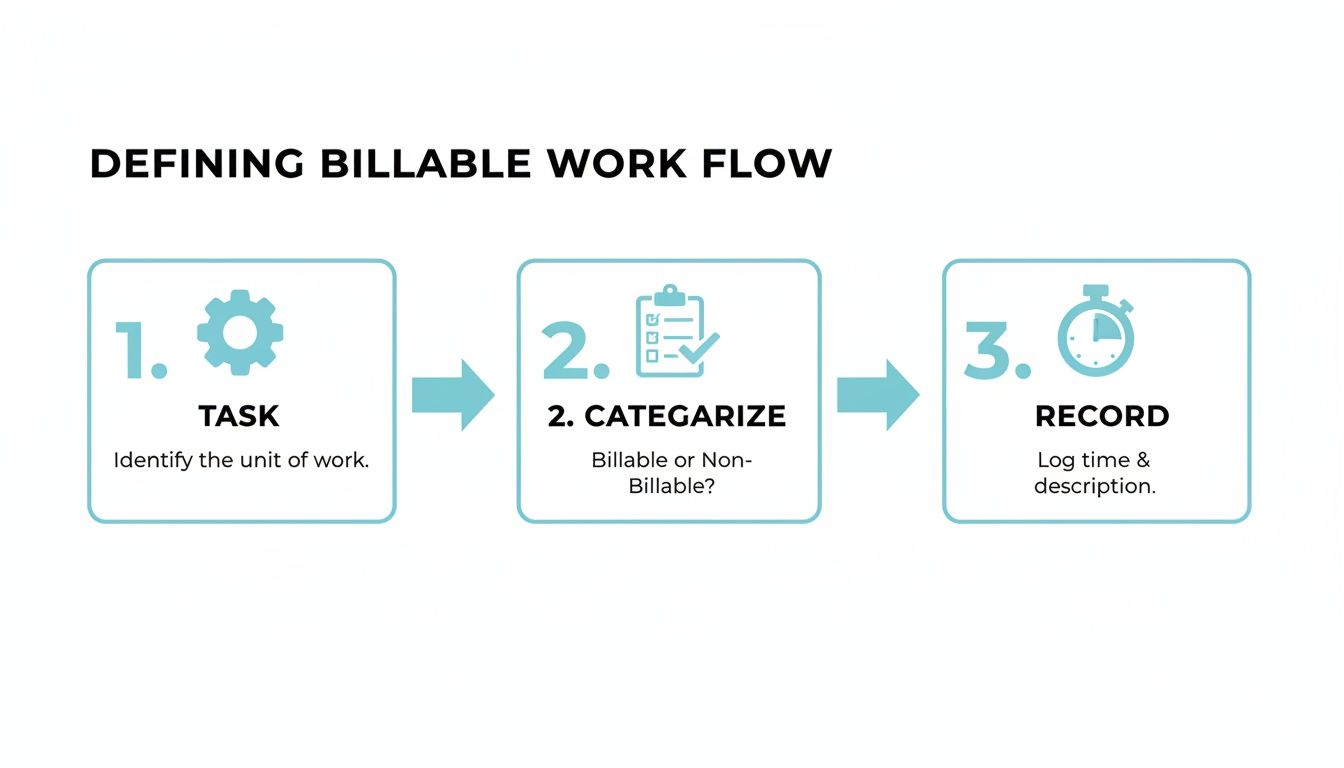
As you can see, every billable entry follows the same path: identify the task, decide if it's billable, and record your time.
A Look at a Paralegal's Day
Let's follow a paralegal, Alex, whose firm bills in 6 minute increments (0.1 hours). Alex’s hourly rate is $150. Before you even start tracking, you have to be certain about what work qualifies as billable. If you need a refresher, it's worth learning how to calculate billable hours accurately.
Here’s a snapshot of Alex’s morning:
- Task 1: Reviewing and summarizing a new batch of medical records for the Johnson case.
- Task 2: A quick phone call with the client in the Smith case to confirm deposition dates.
- Task 3: Drafting a request for production of documents for the Miller case.
Crucially, Alex tracks time as each task happens, not hours later. Contemporaneous time tracking is non negotiable for accuracy. Studies have shown that waiting even a few hours can cause you to forget up to 10% of your billable time.
Applying the Math and Rounding Rules
Now, let's see how the firm's 6 minute increment policy plays out with Alex's time entries. This increment is an industry standard for a reason, it lets you fairly bill for short, valuable tasks without gouging the client.
Here’s how Alex’s time sheet would break down:
-
Medical Records Review (Johnson Case)
- Time Spent: 47 minutes
- Calculation: 47 minutes lands in the eighth 6 minute block (the one covering 43 to 48 minutes).
- Billable Time: 0.8 hours
- Amount Billed: 0.8 hours x $150/hour = $120.00
-
Client Phone Call (Smith Case)
- Time Spent: 4 minutes
- Calculation: This falls squarely into the first 6 minute block.
- Billable Time: 0.1 hours
- Amount Billed: 0.1 hours x $150/hour = $15.00
-
Drafting Discovery (Miller Case)
- Time Spent: 1 hour and 14 minutes (a total of 74 minutes)
- Calculation: That's one full hour (60 minutes) plus 14 minutes. The extra 14 minutes falls into the third 6 minute block (covering 13 to 18 minutes).
- Billable Time: 1.3 hours
- Amount Billed: 1.3 hours x $150/hour = $195.00
In just a couple of hours, Alex has accurately logged 2.2 billable hours, generating $330 in revenue. Each entry is distinct, assigned to the correct client matter, and calculated using a consistent, ethical policy.
This level of detail isn't just about getting paid. It’s about building trust. When clients receive an invoice with clear, descriptive entries that reflect the work they know is happening, disputes become a rarity. They can see the value you're providing every step of the way.
Practical Ways to Capture More Billable Time Every Day
Knowing the math behind billable hours is one thing. Actually capturing all that time in the heat of a busy day? That's a completely different beast, and it's where most firms bleed revenue without even realizing it. The good news is that a few small tweaks to your team's daily habits can make a massive difference to your bottom line.
The single most powerful habit you can build is contemporaneous time tracking. It’s a fancy term for a simple concept: log your work the second you finish it. Don't wait until lunch. Don't save it for the end of the day. When attorneys try to piece their day together from memory, they always shortchange themselves. Waiting just a few hours can cost you 10% of your billable time.
If you wait until the end of the week to fill out your timesheet, you could be losing a staggering 50% of your potential revenue. The "I'll get to it later" approach is easily one of the most expensive habits in the legal profession.
Stop thinking of time tracking as a big project. Instead, see it as a series of quick, simple actions. Just finished a four minute client call? Log it. Fired off a quick email? Log that too. Each one is a small win. You'll be shocked at how all those 0.1 and 0.2 entries pile up over the course of a month.
Make Your Time Entries Tell a Story
Another crucial piece of the puzzle is writing clear, detailed time entries. Lazy descriptions like "phone call" or "research" are red flags for clients. They invite questions, pushback, and write downs. A well crafted time entry doesn't just justify the time; it demonstrates the value you’re delivering.
Think of it this way: every time entry should answer a few key questions for your client:
- What, specifically, did I do?
- What was the subject or goal of that action?
- How did this task push your case forward?
So, instead of a vague "Drafted document; 0.5 hours," you get something much stronger: "Drafted initial Request for Production of Documents to opposing party regarding plaintiff's employment history; 0.5 hours." That level of detail builds trust and significantly cuts down on invoice disputes.
Let Technology Run Interference for You
One of the biggest enemies of billable work is the constant barrage of non billable interruptions. Every time a paralegal has to pause drafting a motion to field a client call about a simple status update, you lose billable momentum. This is where the right technology can be a game changer.
Integrating a client portal like CasePulse with your case management system gives clients a self service option for the routine questions they have. When they can log in 24/7 to see case updates, view shared documents, or send a secure message, the volume of inbound phone calls and emails drops dramatically.
This simple change frees up your team to maintain focus on the deep, substantive work that moves cases toward resolution. Every interruption you eliminate is another opportunity to capture a solid, uninterrupted block of billable time. For more ideas, check out our guide on how lawyers can be more productive and reclaim their day.
Using Technology to Simplify Time Capture
Let's be honest, manual time entry is a drag. It’s also where countless billable hours go to die. Modern law firms are finally getting wise to this and leaning on technology to plug the leaks. The trick is to find tools that slot neatly into your team's daily grind, not ones that add another frustrating layer of complexity.
The biggest game changer I’ve seen is the shift to passive time tracking. These aren't just fancy stopwatches; they are applications that run quietly in the background, logging activity across documents, emails, and even phone calls. They catch all those little tasks, the two minute email, the five minute document review, that are so easy to forget but add up fast.

This isn’t just about convenience; it's about revenue. Passive time tracking tools are a revelation for capturing billable hours. In fact, 50% of law firms that adopt them find an extra one to five billable hours per week. Another 16% manage to secure five to ten more hours. Think about what that adds to the bottom line over a year. You can dig into more of these lawyer statistics in MyCase's 2024 report.
Reducing Interruptions with Smart Integrations
Another huge productivity killer? Constant interruptions. Every time a paralegal has to stop drafting a motion to answer a client’s call about a case status update, the billable clock stops. This is where smart integrations become your best friend.
Imagine automating those routine client updates through a secure portal. Suddenly, the flood of inbound calls and emails slows to a trickle. This lets your team stay deep in focused, billable work. The key is to connect your client portal directly to your firm's legal case management software. Doing this creates a single, reliable source of information for everyone involved.
The real win here is keeping your staff working inside their main case management system, not bouncing between five different apps. When clients can check for routine updates themselves, your team gets that time back for the high value work that actually drives revenue.
Exploring Advanced Automation in Your Tools
It’s not just legal specific software that’s getting smarter. The everyday business tools you already use are packed with new capabilities. If you're still wrestling with spreadsheets for time analysis, it's worth exploring how AI can lighten the load.
For instance, a good guide on using Excel AI can show you how to automate data cleanup and analysis. This can be incredibly useful for digging into your time entry data to spot profitability trends or identify where your team is losing time.
Ultimately, this level of automation ensures that calculating billable hours is not just accurate but also provides the insights you need to run a smarter, more profitable firm.
FAQs About Billing for Your Time
Even with a solid system in place, questions about billing are bound to pop up. Every lawyer has been there. Tackling these common gray areas head on is the key to building confidence and consistency across your firm.
Let's dive into some of the questions I hear most often from legal professionals trying to get their billing right.
What’s the Standard Billing Increment?
Across the legal world, the most common and accepted billing increment is one tenth of an hour, which is six minutes. This has become the industry standard for a good reason. It strikes a fair balance, allowing you to accurately capture the time spent on short tasks, like a quick phone call or reviewing an email, without clients feeling like they're being nickel and dimed.
Some firms do still use quarter hour (15 minute) increments, but I generally advise against it. It's a practice that's falling out of favor because it can easily lead to client disputes. Think about it: it's tough to justify billing a client for 15 minutes when a task really only took two. Sticking to the six minute standard is simply better for transparency and client trust.
How Do You Bill for Work That Helps More Than One Client?
This is a big one, and it's a critical ethical tightrope to walk. Let's say you spend an hour researching a new court ruling that impacts three different cases. You absolutely cannot bill each of those three clients for the full hour. That's called double billing, and it's a serious ethical breach.
Here’s the right way to handle it: Record the total time you spent on the research. Then, you divide that time fairly among each of the client matters it benefits. The key is to be meticulous in your time entry, providing a clear description that explains the work and how the time was allocated across the different files.
The guiding principle is always fairness. Your billing needs to be an honest reflection of the work performed for a specific client. One client should never subsidize the work you're doing for another.
Can We Bill Clients for Administrative Work?
In a word: no. As a general rule, purely administrative tasks are considered the cost of doing business, firm overhead, and should not be passed on to the client.
This includes activities like:
- Time spent preparing and sending out invoices
- Internal firm meetings about operations or training
- Fixing a printer jam or troubleshooting your case management software
Billable time is reserved for the skilled legal work that advances a client's case. The best way to avoid any confusion is to be upfront about this. Clearly define what constitutes billable vs. non billable administrative work in your client engagement letter right from the start.
Stop losing billable time to constant interruptions. CasePulse integrates with your case management system to give clients 24/7 case status updates, reducing non-billable calls and letting your team focus. Learn how CasePulse can help your firm capture more revenue.