
 Brandon Burke
 Would you trust a doctor who never asked if your treatment was working? Yet law firms rarely ask clients how they’re feeling during a case.
Studies show that 84% of law firm clients won’t return after a bad experience (even if the outcome was favorable), and according to the Harvard Business Review, companies that systematically gather and act on client feedback see 10–15% higher retention rates than those that don’t.
The Feedback Gap in Personal Injury Law
Most law firm owners know that client experience matters. But too often, they’re flying blind. Clients rarely speak up when confused, frustrated, or disappointed—and by the time a review is posted, it’s too late to course-correct.
While many industries have solved this with structured feedback loops, personal injury law still lags behind.
That’s where client satisfaction surveys come in, but not just any survey will do.
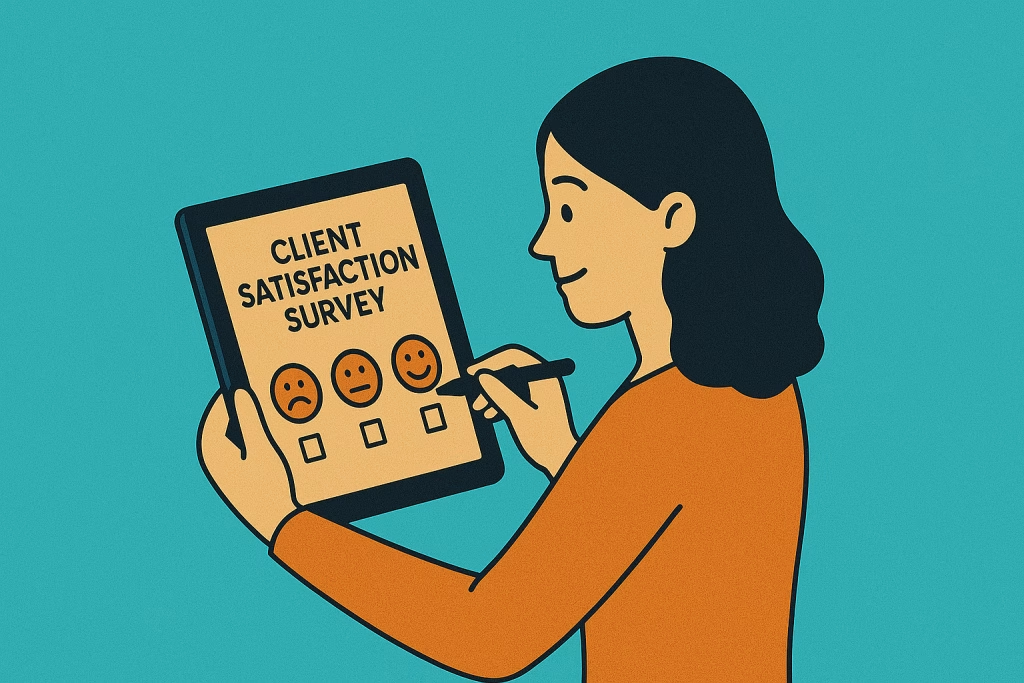
Why Traditional Client Surveys Fall Flat
Popular case management systems like Neos, Litify, Needles, or LawBase focus heavily on case data, not client sentiment, and when firms do attempt feedback collection, the methods are often outdated, irrelevant, or poorly timed.
Here’s why:
- Inconsistent Collection = Incomplete Picture
If you’re depending on your staff to gauge client satisfaction through casual check-ins or after-the-fact conversations, you’re playing a dangerous guessing game. Staff members are busy managing case-level details, and any feedback they capture is filtered through their own lens—unreliable at best, completely skewed at worst.
- Net Promoter Score (NPS): Great for Airlines, sub-optimal for law firms
On a scale of 0 to 10, how likely are you to recommend our firm to a friend or colleague?
Sound familiar? This Net Promoter Score (NPS) question is a favorite among Fortune 500 companies. But let’s be honest, it feels wildly out of place for a law firm client who just underwent a traumatic life event.
Imagine being in the thick of a personal injury case, perhaps still in pain or dealing with financial stress, and receiving a robotic survey asking if you’d recommend your lawyer like they were a sandwich shop. It’s impersonal, tone-deaf, and frankly, a wasted opportunity to gather meaningful feedback.
- Survey fatigue happens, but it’s avoidable
Automated surveys aren’t inherently bad. In fact, automation is necessary to scale client check-ins. But relevance is everything. A generic, cold email asking the wrong question at the wrong time is just digital clutter, and clients will tune out.
Surveys should feel like a natural extension of the client journey, not a corporate form letter. When questions are timely, personal, and case-aware, clients are far more likely to respond, and to respond honestly.
Surveying Done Right: Best Practices for Legal Client Feedback
To truly improve client experience and build long-term loyalty, law firms should treat surveys as a core part of their client communication strategy, not a one-off form. Here are a few best practices to follow:
Normalize the check-in
Let clients know from the outset that check-ins are a standard part of your process. Whenever a firm sets a client’s expectation properly, they feel less intrusive and more like a thoughtful gesture.
Align feedback with the client journey
• Early-Case Survey: Set expectations, identify early frustrations, and make a strong first impression.
• Mid-Case Survey: Think of this as a pressure-release valve. Gauge ongoing satisfaction and catch potential issues before they escalate.
• Late-Case Survey: This is your golden moment. Trust is at its peak, and the insights you gather here not only improve future operations, they directly influence referral potential.
Keep it concise
Surveys should be short, specific, and designed to respect the client’s time. The clearer the question, the more useful the answer.
Objection Handling: “Will Surveys Open a Can of Worms?”
Some firms hesitate:
Won’t this create more complaints mid-case?
In reality, structured feedback reduces escalation. When clients feel heard, they’re more loyal—even if issues arise. Catching a small concern early is far less damaging than reading it in a scathing Google review later.
Technology That Closes the Loop
he best client experience systems aren’t just surveys—they’re feedback engines.
CasePulse integrates directly with your case management platform to trigger well-timed surveys automatically at key stages. Feedback is tracked, stored, and flagged for follow-up so your team can act before it’s too late.
If your firm is serious about delivering outstanding service, increasing referrals, and getting more five-star reviews, it’s time to stop guessing what your clients think. Start asking. The right way.