
 CasePulse
 Cybersecurity is not just an IT line item anymore. It is a critical part of running a modern law firm. It’s about protecting your clients, your reputation, and frankly, your ability to stay in business. Think about it: your firm is sitting on a goldmine of sensitive data, and to cybercriminals, your digital files look like a bank vault that’s just begging to be cracked.
Why Your Firm Is a Prime Target for Cyberattacks

Let's cut to the chase. In a hacker's eyes, your law firm is not just another small business. It's a high value target. The information you handle daily, from attorney client privileged communications to M&A details and sensitive personal data, is worth a fortune on the black market. This reality has completely changed the conversation from if a breach will happen to when.
This is not just fear mongering. The threat is real and it's growing. In 2024, an astonishing 40% of law firms admitted they had suffered a cybersecurity breach. This spike in attacks underscores just how vulnerable the legal sector is. And the fallout is massive. The average cost of a data breach for a law firm climbed to $5.08 million in 2024, a jump of over 10% from the year before. You can dig deeper into these law firm cyberattack trends through recent industry analysis.
The High Stakes of a Data Breach
A successful attack on your firm is far more than a technical headache. It's a full blown business crisis that can paralyze your operations for weeks, if not months. The damage goes way beyond the initial check you have to write for recovery.
Let's break down the true impact:
- Reputational Damage: Trust is the bedrock of your practice. A data breach can instantly demolish that trust, sending current and potential clients running to your competitors.
- Ethical and Legal Consequences: You have a professional and ethical duty to safeguard client information. A failure to do so can trigger malpractice lawsuits, steep regulatory fines, and even disciplinary action from the bar.
- Operational Disruption: Imagine ransomware locking you out of your case files and billing system. Your entire firm grinds to a halt, putting court deadlines and client matters in serious jeopardy.
The bottom line is that strong cybersecurity is now a competitive advantage. Clients are more savvy than ever about these risks. They expect, and deserve, to know that their legal counsel has modern, robust protections in place for their most confidential information.
Moving Beyond Basic IT
It’s a common and dangerous mistake to view cybersecurity as solely the IT department's problem. It’s not. It’s a core component of risk management. You would not practice without malpractice insurance, right? In the same way, you can't afford to operate without a solid security strategy to defend against digital threats.
This guide is designed to cut through the confusing tech speak and give you a practical, actionable roadmap for protecting your firm.
Understanding the Top Cyber Threats You Face
Before you can build a solid defense, you have to know what you’re defending against. Cyber threats are not just technical glitches. They are sophisticated attacks designed to exploit human psychology and gain access to your firm’s most valuable asset: confidential client data.
Think about it this way: a paralegal receives an urgent email that looks like it’s from a senior partner. The message demands an immediate wire transfer for a time sensitive M&A deal. Everything about the email looks right, but it's a clever fake. This is a classic business email compromise (BEC) attack, a tactic that tricks your team into wiring money or sending sensitive files straight to a criminal.
These attacks work because they tap into the high pressure, fast paced environment of a law firm. They create a false sense of urgency and authority, pushing even the most careful employee to make a split second mistake.
Phishing and Social Engineering: The Front Door for Attackers
The most common way criminals get inside is through phishing. These are deceptive emails, texts, or messages designed to fool someone into clicking a malicious link, opening a dangerous attachment, or handing over their login credentials. A phishing attempt could be disguised as a court filing notification, a document sharing request from opposing counsel, or even a simple invoice from a trusted vendor.
A crucial first step to counter these threats is performing a comprehensive cyber security risk assessment. This process shines a light on your firm's specific vulnerabilities, allowing you to focus your efforts where they'll have the biggest impact.
The goal of social engineering is simple: to manipulate your staff into bypassing security protocols. Attackers know that your people are often the easiest path into your network.
Ransomware: The Firm Killer
Ransomware is arguably the most devastating threat a law firm can face. It’s a type of malicious software that encrypts everything, case files, billing records, client communications, making your data completely inaccessible. The attackers then demand a hefty ransom, usually in cryptocurrency, to provide the decryption key.
The consequences are catastrophic. Your firm’s operations grind to a halt. You risk missing critical court deadlines, and the damage to your reputation and client trust can be irreparable. Even if you pay up, there’s no guarantee you’ll get your data back, and you’ve just flagged your firm as a target willing to pay.
Insider Threats: When the Danger is Already Inside
Not all threats come from shadowy hackers in distant countries. An insider threat can originate right within your firm, whether through malicious intent or, more often, simple human error. A disgruntled employee could intentionally leak sensitive client information. But it's far more likely that a well meaning team member accidentally exposes data by using an unsecured public Wi Fi network or misplacing a company laptop.
Human error remains one of the biggest vulnerabilities in any security plan. An untrained employee who clicks on a phishing link can unknowingly hand an attacker the keys to your entire digital kingdom. This is why fostering a security conscious culture is every bit as important as deploying the right technology.
To give you a clearer picture, the table below breaks down these common threats.
Common Cyber Threats Targeting Law Firms
This table summarizes the most prevalent cyber threats, their typical methods, and the primary risks they pose to a law firm's confidential data and operations.
| Threat Type | How It Works | Primary Risk to Your Firm |
|---|---|---|
| Phishing & BEC | Deceptive emails trick staff into revealing credentials or sending funds. | Financial loss, unauthorized system access, and data theft. |
| Ransomware | Malware encrypts all firm data, holding it hostage for a payment. | Complete operational shutdown, massive financial costs, and data loss. |
| Insider Threats | An employee intentionally or accidentally exposes sensitive information. | Breach of client confidentiality, reputational damage, and regulatory fines. |
Understanding these attack vectors is the foundation of a strong cybersecurity posture. By recognizing how criminals operate, you can begin to build the multi layered defense your firm needs to protect its clients, its reputation, and its future.
Meeting Your Ethical and Regulatory Duties
For a law firm today, cybersecurity is not just an IT problem. It's a core professional responsibility. It’s baked right into the ethical and legal promises you make to every single client. The American Bar Association (ABA) puts it plainly: attorneys must make "reasonable efforts" to stop unauthorized access to client information.
This is not just a friendly suggestion. It's a foundational duty of our profession. A failure to protect confidential data is not merely a technical hiccup. It's a serious ethical breach. The fallout can be devastating, ranging from malpractice suits and massive regulatory fines to reputational damage that can haunt a firm for years.
What Does "Reasonable" Mean Today?
That word, "reasonable," is a moving target. What passed for adequate security just five years ago is nowhere near enough today. In our current threat environment, being reasonable means taking a proactive, informed stance to shield client data from both known and emerging dangers.
This requires your firm to stay on top of common security risks and the tools available to fight them. Just having a firewall and some antivirus software does not cut it anymore. True reasonableness demands a defense with multiple layers.
A "set it and forget it" attitude toward cybersecurity is a direct path to an ethical violation. The duty to protect client data requires ongoing vigilance, regular assessments, and a commitment to adapting your defenses as threats evolve.
The Growing Power of Client Expectations
Beyond the formal rules, your clients are paying closer attention to your security practices. They know how valuable their data is, and they expect you to guard it with the same level of care you bring to their legal work. This expectation is fast becoming a deal breaker when clients choose their legal counsel.
Client sentiment is a force to be reckoned with. New data reveals that 36% of clients now expect their law firms to provide proactive updates on security measures. Even more telling, nearly 40% are ready to walk away or warn others about a firm after a breach. You can see the full breakdown of this trend in the 2025 Integris Report on client sentiments. This shift puts any firm that can't demonstrate modern security at a serious competitive disadvantage.
Navigating a Complex Regulatory Landscape
Depending on your practice areas and where your clients live, your obligations might go well beyond the ABA's guidance. For instance, if you handle personal health information, you’re subject to the strict rules of HIPAA. Likewise, regulations like the New York SHIELD Act and the California Consumer Privacy Act (CCPA) place specific data protection duties on any firm that holds personal information of residents from those states.
Getting a handle on these overlapping rules is absolutely critical. A single breach could put you in violation of your ethical duties, state laws, and federal regulations all at once, creating a legal and financial nightmare. This is why you have to measure your security performance. It’s not just an IT task, but a vital part of managing firm wide risk. To start, you need to understand the metrics that matter for improving your firm's security.
Ultimately, strong cybersecurity has moved from being a simple operational expense to a strategic investment. It’s what protects your firm from ruin and builds the client trust you need to not just survive, but thrive.
Building Your Firm's Digital Defenses
Knowing the threats is one thing. Doing something about them is what really counts. Building your firm’s digital defenses is not about spending a fortune, but it does mean putting a practical, layered plan into action. This blueprint will walk you through the foundational, high impact measures you can implement to create a genuinely strong security posture.
Think of it like securing your physical office. You have locks on the doors (technical controls) and policies about who gets a key and when they can use it (administrative controls). You absolutely need both for a complete defense.
The goal here is not to become an unbreachable fortress. It's to make your firm a much harder target than the next one, encouraging attackers to simply move on. Good cybersecurity for law firms is all about creating friction for criminals while keeping things running smoothly for your team and clients.
Foundational Technical Controls
Your first line of defense is always technology. These are the digital tools and settings that actively block threats and protect your systems and data from prying eyes.
If you do nothing else, start with these non negotiable basics:
- Multi Factor Authentication (MFA): This is the single most effective step you can take, period. MFA demands a second piece of proof, like a code sent to your phone, in addition to a password. It's the deadbolt on your digital door, stopping criminals in their tracks even if they’ve stolen your password.
- Data Encryption: Encryption essentially scrambles your data, making it unreadable gibberish to anyone without the right key. You need this in two places: for data at rest (when it's sitting on a server or hard drive) and for data in transit (when you're sending it over the internet).
- Regular Software Updates: Out of date software is riddled with known security holes that hackers actively hunt for. Consistently applying security patches to everything from your operating system to your case management software closes these dangerous backdoors.
Implementing these technical controls immediately raises the bar for any attacker. Your firm goes from being an easy, unlocked target to one that requires serious effort to compromise, and that’s often enough to make them give up.
Essential Administrative Controls
Great technology can't protect you from human error. That's where administrative controls come in. These are the policies, procedures, and rules your firm creates to guide how people interact with sensitive data and technology. They're about creating a framework for smart, security first decisions.
Your administrative strategy should start with a clear security policy that details the acceptable use of firm technology and proper data handling. It also needs to define a vendor risk management process. Before you give any third party vendor access to your systems, you have to vet their security practices to make sure they meet your standards. For smaller or mid sized firms, it can be incredibly effective to outsource this high level strategy by leveraging a virtual CISO for legal partner organizations.
Securing Your Client Communications
One of the most vulnerable points for any law firm is how you talk to your clients. For decades, email has been the go to, but it’s fundamentally insecure. Standard email does not have end to end encryption, which means it’s dangerously easy for criminals to intercept and read privileged attorney client communications.
This is exactly why a secure client portal has become a critical piece of the puzzle. Instead of attaching confidential documents to an email, you use a dedicated, encrypted platform to share them. A portal like CasePulse can integrate directly with your case management system, letting you share files, send messages, and gather information in a secure environment.
This approach gives you two massive wins. First, it drastically boosts security by taking sensitive conversations out of vulnerable email inboxes. Second, it improves the client experience by providing a single, secure place for them to get case updates and interact with your team. To see how these modern tools fit into the bigger picture, it's worth exploring the importance of staying up to date with technology in law firms.
When you combine strong technical tools with smart administrative policies and secure communication channels, you build a resilient defense that truly protects both your firm and your clients.
Creating a Security-Minded Culture in Your Firm

You can have the best firewalls and encryption money can buy, but they only get you so far. At the end of the day, your firm’s true first line of defense is not a piece of software. It's your people. Every single person on your team, from the managing partner to the newest paralegal, is a gatekeeper for sensitive client data.
This is why building a strong security culture is non negotiable. It’s about shifting cybersecurity from an "IT problem" to a shared, daily responsibility. When your team becomes a vigilant "human firewall," they're equipped to spot and stop the very threats that technology might miss.
This shift is critical because attackers are masters of human psychology. They know it's often far easier to trick a busy associate into clicking a malicious link than it is to brute force their way through a hardened network. A staggering number of data breaches start with one simple, avoidable human error.
Moving Beyond the Annual Training Session
Let’s be honest: a mandatory, one hour presentation every year just does not cut it. For security awareness to actually sink in and change behavior, it needs to be continuous, engaging, and directly relevant to your team's day to day work. The goal is not just to check a compliance box. It's to build secure habits.
Effective training has to move past abstract concepts and into practical, real world scenarios. It should empower every employee with the confidence to identify threats they will almost certainly encounter in their inboxes.
A solid training program should constantly reinforce three core areas:
- Spotting Phishing Attempts: Teach staff to recognize the tell tale signs of a phishing email, urgent or threatening language, odd sender addresses, suspicious links, and unexpected attachments.
- Strong Password Habits: It’s not enough to just have a password policy. You need to explain why using a password manager and never reusing passwords across different services is so important for protecting both the firm and their own accounts.
- Safe Data Handling: Establish crystal clear rules for how, when, and where sensitive client information can be shared, stored, and accessed, particularly for anyone working remotely.
Making Security Training Stick
To truly forge a security first culture, training has to be interactive and consistently reinforced. We forget passive lectures almost as soon as we leave the room, but active engagement is what makes secure behaviors become second nature.
One of the most powerful tools for this is running simulated phishing tests. These are controlled, harmless phishing emails sent to your team to see who takes the bait. It’s a completely safe way to find knowledge gaps and provide immediate, teachable moments to those who need them most, without the disastrous consequences of a real attack.
The point of these tests is never to shame or punish employees. It’s about education. There is no better learning experience than realizing you almost fell for a fake phish. It makes the threat feel real and immediate.
Consistent, low effort communication is also key. Short, regular security reminders during team meetings or in an internal newsletter can be far more effective than a single, overwhelming training session. You want security to be a constant, gentle hum in the background of your firm's daily operations.
Ultimately, great cybersecurity is not just about technology. It's achieved when every member of your team understands their personal role in protecting the firm. By fostering this sense of shared responsibility, you transform your biggest potential vulnerability, your people, into your single greatest security asset.
Your Action Plan for Better Cybersecurity
Knowing the threats is one thing. Actually doing something about them is what keeps your firm safe. This is where the rubber meets the road, turning awareness into a concrete, prioritized plan built for busy lawyers and firm managers.
We're going to focus on the most critical actions first. The goal here is to get the biggest security wins on the board right away. This is not just about dodging a bullet. It's about building a more resilient, trustworthy practice that clients actively choose. In today's climate, a strong defense is a powerful business advantage.
Phase 1: The Foundational First Steps
Before you can build a fortress, you have to survey the land and lock the main gates. This first phase is all about understanding what you’re defending and shutting down the most common ways attackers get in.
These are your immediate priorities:
- Conduct a Risk Assessment: You can't protect what you don't know you have. A risk assessment is simply the process of figuring out what sensitive data you hold, where it lives, and who can access it. This single step will guide your entire security strategy.
- Activate Multi Factor Authentication (MFA): Honestly, this is the single most powerful tool you have against stolen passwords. Think of it as a digital deadbolt. Even if a thief has your key (the password), they can't get past the deadbolt (the MFA code). Mandate it for everything, especially email and your case management software.
- Establish a Data Backup and Recovery Plan: If ransomware hits, a reliable and recently tested backup is your only lifeline. Make sure your critical data is backed up regularly, and, this is crucial, keep at least one copy offline or offsite where an attack can't reach it.
These initial steps are the low hanging fruit. They are high impact, low complexity actions that immediately make your firm a much harder and more expensive target for attackers.
Phase 2: Strengthening Your Core Operations
With the basics locked down, it's time to formalize your processes and upgrade the tools you rely on every day, especially for client communication. This is how you shift from being reactive to proactive.
There's a reason law firms are boosting their security spending. By 2025, firms are expected to dedicate 6% to 10% of their IT budgets to cybersecurity, and 37% of firms now list it as their top IT priority. This is not just internal pressure. Clients are driving the change. Over a third of them are willing to pay more for a firm they know is secure. You can find more details in these critical cybersecurity trends facing law firms.
Your next moves should be:
- Implement a Secure Client Portal: Email is a massive, gaping security hole. Moving client communication and document sharing to a secure portal is a game changer. An integrated solution like CasePulse lets your team securely share files and messages without ever leaving the platform they already work in.
- Formalize Your Incident Response Plan: When a breach happens, panic is your enemy. You need a clear playbook that spells out who to call, how to contain the damage, and how you'll communicate with clients and regulators.
- Vet Your Vendors: Your firm’s security is only as strong as your weakest link. It’s time to scrutinize the security practices of every third party vendor with access to your data, from your IT provider to every software as a service tool you use.
Phase 3: Building a Resilient Security Culture
This final phase never really ends. Technology and policies are essential, but a security minded culture is what sustains your defenses for the long haul. This means continuous training and making security everyone's job.
When you adopt integrated tools that improve both security and efficiency, you turn a necessary expense into a strategic advantage. For instance, a platform that includes secure communication, like the one built into our legal case management software, also happens to streamline daily tasks for your staff. It's a true win win: client trust goes up, and your operations get smoother.
Frequently Asked Questions
When it comes to cybersecurity, many law firm partners and administrators have the same pressing questions. Getting straight answers is the first step to building a defense that truly protects your firm and your clients.
Where Should My Law Firm Start With Cybersecurity?
The best way to start is by getting back to basics. Do not jump straight into buying expensive software. Begin with a thorough risk assessment. This process is all about figuring out what sensitive data you're responsible for, where it lives, and which vulnerabilities pose the biggest threat to your firm. This is not just a box ticking exercise. It's the blueprint for your entire security strategy.
Once you know where your risks are, implement the foundational controls that give you the most bang for your buck. Turn on multi factor authentication (MFA) for every single account, from email to case management. Create a data backup plan, and just as importantly, test it to make sure you can actually restore your files when you need to.
Finally, start training your people immediately. Your staff is your most critical line of defense, and empowering them with knowledge is one of the most effective security measures you can take.
This straightforward, three step approach ensures you’re focusing your energy where it counts.
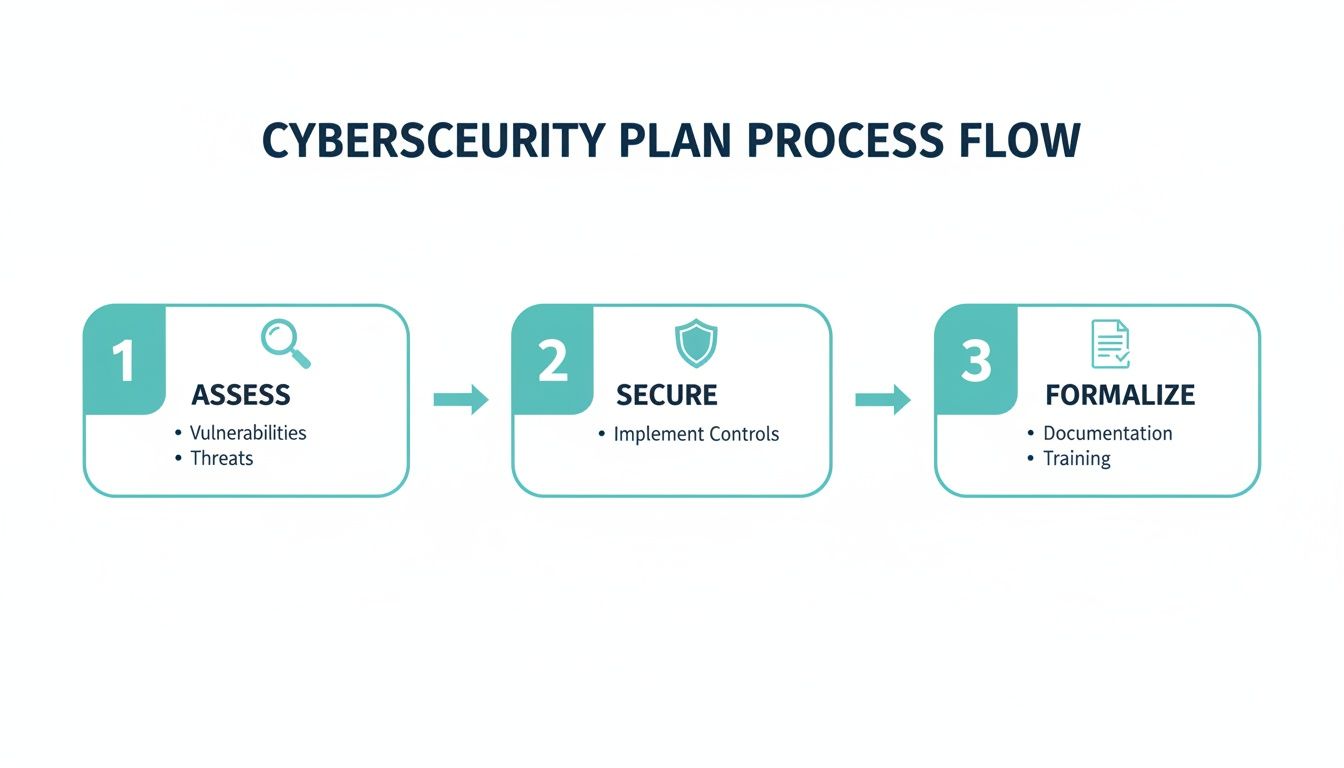
By assessing your specific risks, securing your most vulnerable points, and formalizing your procedures, you build a solid foundation that will support all your future security efforts.
Is It Still Safe to Use Email for Client Communications?
Honestly, no. While email is second nature for most of us, standard email is inherently insecure. It’s like sending a postcard through the mail, anyone who intercepts it can read it. It lacks the end to end encryption needed to protect confidential information.
Every time you attach a sensitive case file or share personal client details over email, you risk a breach of attorney client privilege and your ethical duty of confidentiality. To properly safeguard that information, your firm needs a secure client portal. These dedicated platforms encrypt all communications and documents, ensuring only you and your client can access them.
How Can a Smaller Firm Afford Good Cybersecurity?
Good cybersecurity is not about having the deepest pockets. It's about being smart and strategic. Many of the most powerful security measures are surprisingly low cost.
Protecting your firm is not about buying the most expensive tools. It’s about making smart, strategic investments in the areas that matter most.
Start with these high impact, budget friendly initiatives:
- Mandatory staff training: An aware team is your best defense against phishing.
- Strong password policies: Enforce complexity and length requirements.
- Firm wide MFA: This is one of the single most effective ways to prevent unauthorized access.
For needs that go beyond the basics, look into a managed security service provider (MSSP). They can give you access to expert level oversight for a fraction of the cost of hiring an in house team. You can also get a fantastic return on investment from integrated platforms like CasePulse, which bundle critical security features with tools that make your firm more efficient.
Ready to secure your client communications and streamline your operations? With CasePulse, you can provide a secure, convenient portal for your clients without forcing your team to leave their existing case management system. Learn more at https://www.casepulse.com.