
 CasePulse
 When it comes to improving client satisfaction at your law firm, it really boils down to three simple things: proactive communication, clear expectations, and reliable systems. It’s that straightforward. When clients feel like they're in the loop and genuinely cared for, they transform into your firm's most passionate advocates, driving referrals and those all important positive reviews. This isn't just about providing good service; it's about engineering a predictable and positive experience for every client, every single time.
Why Client Satisfaction Is Your Firm’s Biggest Growth Lever

Here's a hard truth: most law firms think they provide excellent client service. The problem? Their clients often feel differently. This isn't a knock on your legal skills, it’s a direct result of a breakdown in the client experience. The day to day process of being a client can be filled with long silences and a ton of uncertainty, which quickly erodes trust and breeds frustration.
The Perception Gap Between Firms and Clients
There’s a massive disconnect between how firms rate their own service and how clients actually perceive it. The numbers don't lie. A recent Legal Client Experience Report found that while 72% of attorneys described their firms as “caring,” a mere 40% of clients felt the same way. That's a staggering 32 point perception gap.
Even more telling? Only 21% of clients said their legal team ever proactively asked for feedback on their experience. You can dig into the specifics in the complete report on law firm client disconnect. This data makes one thing crystal clear: good intentions are not enough. Without a deliberate system in place, even the most well meaning firms will leave clients feeling ignored and unimportant.
The real source of client dissatisfaction usually isn't the legal work. It’s the feeling of being left in the dark, constantly wondering what’s happening with their case.
Shifting from a Goal to a System
You have to stop thinking of client satisfaction as a vague goal and start treating it as a system you build and refine. It's about creating a consistent, high quality experience that doesn't depend on one person remembering to make a call. The foundation of this system rests on three pillars:
- Reliable Communication: Making sure clients get updates before they have to ask for them.
- Clear Expectations: Setting the stage from day one about how, when, and where information will be shared.
- Smart Technology: Using the right tools to automate routine updates and give clients the transparency they crave.
This is where a modern client portal like CasePulse becomes a game changer. It directly tackles the communication black hole by giving clients 24/7 access to their case status and a secure way to message your team. The best part? It integrates directly with the case management systems you already use, like Neos or Litify, so your staff doesn't have to change their workflow or manage yet another inbox.
Instead of just hoping for satisfaction, you build a process that delivers it. This leads to stronger client relationships and a lot more positive feedback.
Measure What Matters: Finding Your Client Satisfaction Baseline
You can't fix a problem you can't see. Before you start overhauling your communication strategy or pouring money into new tech, you need an honest look at where your firm stands right now. Establishing a client satisfaction baseline is ground zero for making any real improvements. Otherwise, you're just flying blind.
This process gives you a starting point, a tangible benchmark to measure all your future efforts against. It turns the fuzzy idea of "client happiness" into hard data you can actually work with. The goal here is to get real feedback that shows you what you're doing well and, more importantly, pinpoints exactly where the friction is for your clients.
Defining Your Key Performance Indicators
To get a real handle on satisfaction, you need to track the right metrics. Think of these Key Performance Indicators (KPIs) as your guideposts; they'll tell you if the changes you're making are actually moving the needle. For most modern firms, two of the most powerful KPIs are the Net Promoter Score (NPS) and the number of positive online reviews you're getting.
The Net Promoter Score is a gold standard metric for a reason. It measures client loyalty with one simple but incredibly insightful question: "On a scale of 0 to 10, how likely are you to recommend our firm to a friend or colleague?"
- Promoters (9-10): These are your champions. They're the ones who will actively refer new business and sing your praises.
- Passives (7-8): These clients are satisfied, but not thrilled. They got what they needed, but they could easily be swayed by a competitor next time.
- Detractors (0-6): These are your unhappy clients. They're at risk of leaving negative reviews and warning others to stay away.
Calculating your NPS is straightforward: just subtract the percentage of Detractors from the percentage of Promoters. Any positive score is a good start, but anything above 50 is considered excellent. It’s a powerful snapshot of your firm's overall health.
Putting Client Surveys to Work
The best way to get this data is through short, timely surveys. Forget long, complicated questionnaires that no one has time for. Quick, focused surveys sent at key moments in the client's journey will give you the most valuable, actionable feedback. It’s all about asking the right questions at the right time.
I always recommend implementing surveys at two critical touchpoints:
- Right After Intake: A week or two after a client officially signs on, send them a brief survey. This is your chance to see how your onboarding process felt from their perspective. Was communication clear? Did the intake team make them feel confident?
- At Case Conclusion: Once a case is wrapped up, send a final survey to get their thoughts on the entire experience. This is where you dig into their satisfaction with the outcome, the responsiveness of the legal team, and their overall perception of the firm.
The most powerful feedback almost always revolves around communication. Ask direct questions like, "How easy was it to get an update on your case?" or "Did you feel we kept you informed?" The answers will shine a bright light on your biggest opportunities.
Pulling all this information together might sound like a huge project, but it doesn't have to be. Plenty of tools out there are built just for this. To find one that fits your firm, you can explore the best client survey tools for law firms and see how they can put your feedback loop on autopilot.
Once you have this baseline, you’ll have the concrete data you need to set smart goals and build a real strategy for creating an exceptional client experience.
Building a Proactive Communication System
If there’s one universal truth in the legal world, it’s this: communication is the #1 driver of client happiness. The vast majority of client complaints don't come from the quality of the legal work. They come from that simple, painful feeling of being left in the dark.
A proactive communication system stops this problem before it starts, ending the frustrating game of phone tag for simple case updates.
When your team only responds after a client calls or emails, you create a cycle of anxiety for the client and drain your staff's time. A proactive approach flips the script. It's about giving clients information before they even think to ask, which creates a sense of transparency and control that's fundamental to improving their experience. This shift shows you respect their time and understand their need to feel informed.
Empowering Clients with 24/7 Access
The cornerstone of any modern, proactive system is a secure client portal. Think of it as a dedicated, digital window into your firm, available to your clients whenever and wherever they need it. A portal gives clients 24/7 access to crucial information like case status, key documents, and upcoming dates, all on their own terms.
This self service ability is a game changer. Instead of waiting for a return call just to confirm a deposition date, a client can log in from their phone and see it right on their case calendar. This immediate access dramatically reduces client anxiety and frees them from feeling dependent on your office hours for answers.
A proactive communication strategy isn't about sending more emails. It's about creating a single, reliable source of truth that your clients can access whenever they need reassurance.
This approach builds confidence and trust from day one. It shows you're an organized, modern firm that values transparency.
Automating Key Case Milestones
Imagine a personal injury case. Key events happen all the time, from sending a demand letter to scheduling an independent medical exam. Each of these milestones is a perfect opportunity for a proactive update. With an integrated client portal, you can automate notifications for these events.
For example, when your paralegal updates your case management system to show the demand letter has been sent, an automated notification can instantly go out to the client's portal.
Here’s a breakdown of how this works in practice:
- Event Occurs: A paralegal marks a deposition as "Scheduled" in your case management software, like Clio or MyCase.
- Automation Triggers: The system automatically pushes an update to the client's portal.
- Client is Notified: The client gets a notification on their phone or email, letting them know a new event has been added to their case timeline.
This simple workflow eliminates the need for your paralegal to stop what they're doing to draft an email or make a phone call for a routine update. The client feels informed and connected, and your team can stay focused on high value, billable work.
Just look at the difference between the old way and the new way.
Manual Communication vs Automated Portal Communication
| Activity | Traditional Method (Manual) | Portal Method (Automated) |
|---|---|---|
| Document Sharing | Client calls/emails asking for a copy. Staff finds, attaches, and sends it back. | Client logs in and downloads the document from their portal anytime. |
| Case Status Update | Client calls for an update. Paralegal checks the file and calls back. | Client sees real time status changes and a case timeline in their portal. |
| Scheduling | Back and forth emails to confirm a date. Staff manually updates their calendar. | A new event is added to the case file, which auto populates the client's portal calendar. |
| Staff Time | Reactive and time consuming. Pulls staff away from critical tasks. | Proactive and efficient. Frees up staff to focus on substantive legal work. |
The table makes it clear: moving from manual back and forth to an automated portal saves time, reduces errors, and keeps clients in the loop without constant effort.
This visualization shows a simple process for gathering feedback to refine your communication strategy.
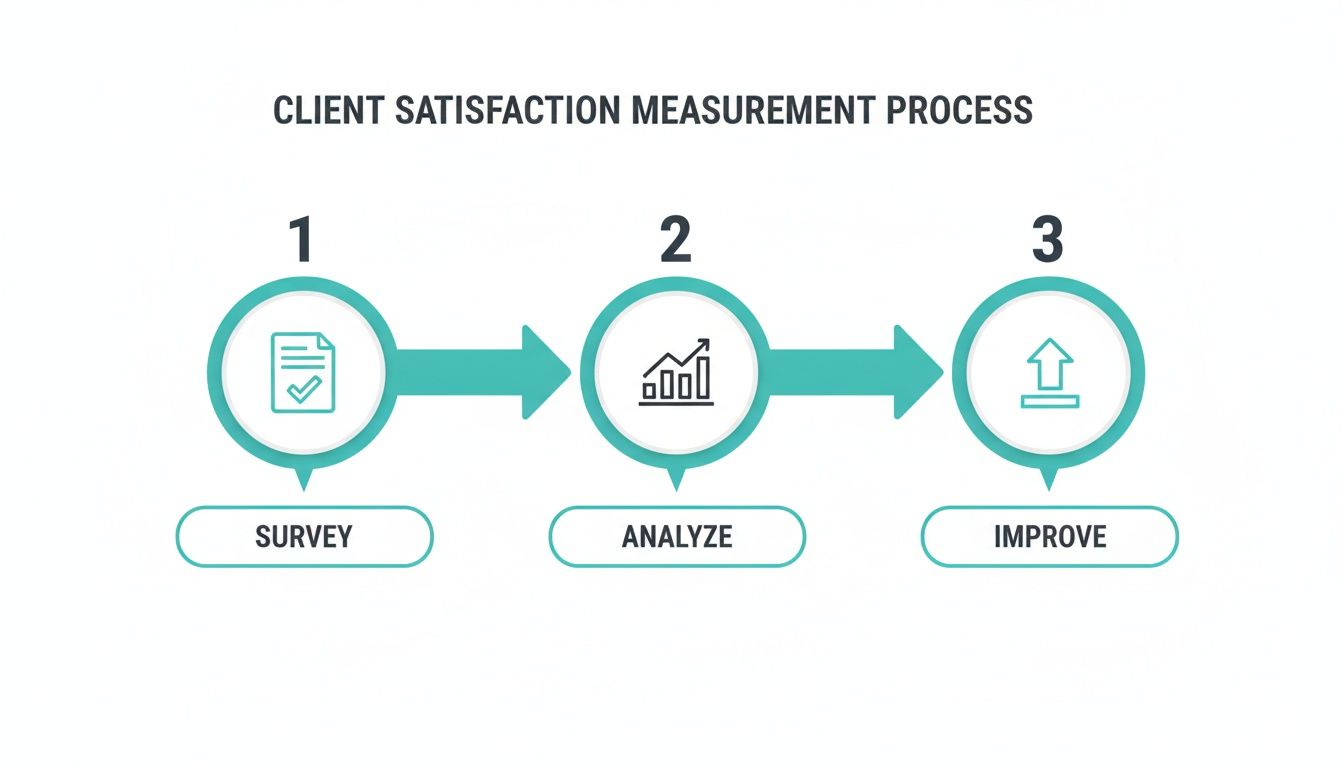
This loop of surveying, analyzing, and improving ensures your communication system continually evolves to meet client needs.
The Real-World Impact of Clear Communication
The link between communication and client happiness isn't just a hunch; it's backed by solid data. A survey of law department clients found that an overwhelming 93% of respondents rated overall services as highly satisfactory when they experienced clear communication and prompt responses.
On top of that, a separate survey reported that 66.67% of lawyers now see “faster and more efficient service” as the top client expectation. You can read more about these findings on client satisfaction and service expectations.
These numbers just confirm what every managing partner knows instinctively. When clients feel heard and informed, their satisfaction skyrockets. A proactive system directly addresses this core need by providing the speed, efficiency, and transparency that modern clients demand. It's one of the most direct and effective ways to boost your firm's reputation and drive positive outcomes.
Modernizing Your Client Intake and Onboarding

You only get one chance to make a first impression. For a law firm, that impression is almost always the intake process. A clunky, slow, or confusing intake experience immediately tells a new client you're disorganized, which can crush their confidence before you’ve even started the real work.
This is a critical moment in your quest for how to improve client satisfaction. Yet, so many firms are still stuck in the past, relying on messy, paper based systems. It’s an approach loaded with problems, lost documents, frustrating data entry errors, and the sheer inconvenience it forces on a client.
Imagine someone who's just been injured. The last thing they need is a mountain of paperwork to print, sign, scan, and somehow get back to you. Every one of these little hurdles creates friction and chips away at their perception of your firm's competence.
Ditching Paper for a Digital First Impression
The fix is straightforward: move your entire intake process online into a secure, digital space. Using a client portal with secure, fillable forms makes gathering information fast, accurate, and unbelievably convenient for your clients. They can provide what you need and sign documents from any device, whenever it works for them.
Think about that personal injury client again. Instead of waiting days for a packet to arrive in the mail, they get a secure link to your portal right away. They can fill out the intake forms on their phone while the details of the accident are still fresh, without having to find a printer or a scanner.
This modern approach delivers some powerful wins right out of the gate:
- Accuracy: Digital forms can have required fields, so you get all the critical information upfront. No more chasing down clients for a missed signature or a key piece of data.
- Security: A secure portal is infinitely safer for sharing sensitive information than unencrypted email attachments.
- Efficiency: The data your client enters can flow directly into your case management software, saving your staff countless hours of mind numbing manual entry.
When you make this first interaction seamless and professional, you're sending a clear message: you’re an organized, modern firm that values their time.
A smooth, digital intake process isn't just about efficiency. It’s your first and best opportunity to demonstrate to a new client that you are competent, organized, and focused on making their life easier.
This single positive experience goes a long way toward building a high satisfaction relationship. It sets the standard for the kind of service they can expect from you from here on out.
Creating a Digital Welcome Experience
Your client portal is more than just a tool for collecting information. It’s the perfect place to deliver a comprehensive digital welcome packet that properly onboards new clients and sets clear expectations for the road ahead. A great onboarding experience is fundamental to keeping clients happy in the long run.
Your digital welcome packet should include a few key things:
- An Introduction to the Legal Team: Put faces to names. Share photos and short bios of the attorneys and paralegals who will be handling their case. This simple step helps build a genuine human connection from day one.
- A Clear Communication Plan: Be upfront about how and when the client will hear from you. Explain that the portal is the go to spot for case status checks and secure messages.
- An Overview of the Case Process: Give them a simplified timeline or flowchart of what to expect. Demystifying the legal journey reduces a ton of anxiety and helps manage their expectations.
This proactive approach to onboarding replaces uncertainty with clarity, a major driver of client satisfaction. To really nail this, consider adopting a proven client onboarding process template to structure your digital welcome. It ensures you cover all your bases and provide a consistent, high quality experience for every single client.
Using Technology to Enhance the Client Journey
Most firms I talk to know that technology is the answer to improving the client experience. But the thought of rolling out yet another system can feel completely overwhelming. When your team is already buried in work, adding one more thing to the to do list seems impossible.
The trick is to find technology that genuinely works with you, not against you. The right tool isn't just another task to manage; it's a solution that gives you back your firm's most precious resource: time.
This isn't just a feeling; it's a documented problem across the legal field. A recent industry report found that while 97% of U.S. midsize firms want to improve client satisfaction, a full 34% admit they're just too bogged down with day to day operations to do anything about it. The 2025 legal outlook lawyer survey digs into this very tension between what firms want to do and what they actually have the bandwidth for.
Integrating Without Interrupting
So, how do you bridge that gap? You find tools that integrate directly into the workflows your team already uses. A modern client portal, for instance, should plug right into the legal case management software you rely on every day.
This approach is a total game changer. It means your staff doesn't have to learn a whole new program or monitor a separate inbox. They keep working inside the system they already know, and any updates they make are automatically pushed to the client portal. No double entry, no new processes to memorize.
When you remove the friction, you remove the resistance to adopting new tech. Instead of disrupting your team, it empowers them to get more done.
The goal is to make great client communication a natural byproduct of your team's existing work, not one more chore on their list. A deeply integrated system is what makes that a reality.
When technology works this seamlessly, it’s no longer a hurdle. It just becomes part of how you operate.
Putting Routine Communication on Autopilot
Think about how much time your paralegals and case managers spend on routine follow ups. Answering the same questions about case status, chasing down documents, and reminding clients to sign forms can consume hours every single day. This is exactly where automation becomes a firm's secret weapon.
A well integrated client portal can take over these repetitive tasks for you. You can set up automatic reminders and notifications that are triggered by events inside your case management system.
Here are a few real world examples:
- Document Requests: When you mark a document as "needed" in your system, the portal can automatically send follow up reminders to the client until it's securely uploaded.
- Form Completion: If a client hasn't finished their intake or medical release forms, the system can send gentle, periodic nudges without anyone on your team having to pick up the phone.
- Case Milestones: As we've covered, hitting a key milestone in your case management software can instantly trigger a clear, jargon free update to the client.
This kind of smart automation ensures every single client gets consistent and timely communication. It completely removes the risk of human error, like a busy paralegal forgetting to make that follow up call.
By putting these routine touchpoints on autopilot, you free up your team to focus on the high value, strategic work that actually moves cases forward. It’s not about replacing people; it’s about equipping them with tools that let them be more effective and less burdened by administrative drag. That shift directly leads to happier clients and a more profitable firm.
Frequently Asked Questions
When you start digging into new ways to improve the client experience, a lot of practical questions pop up. It's one thing to talk strategy, but another to make it work in a busy firm. Let's tackle some of the most common questions we hear from firms looking to make a real change.
How Can We Get Clients to Actually Use a New Portal?
This is the big one. You can have the best tool in the world, but it's useless if clients don't use it. Success here comes down to a simple, consistent communication plan from day one.
It all starts in your onboarding process. Don't introduce the portal as just another option; frame it as the primary way you'll be communicating and sharing documents.
You have to sell them on the benefits for them. Talk about the convenience of having 24/7 access to their case status, a secure place to message you, and one central spot for every important file. Then, you have to build it into your team's muscle memory. Instead of attaching a sensitive document to an email, the new habit is to say, "I've just uploaded the file to your secure portal for your review."
The key is consistent reinforcement. When a client calls for a routine update, your team should politely guide them back to the portal for instant information. This gently trains them to self serve, which empowers them and frees up your team.
Modern platforms like CasePulse are designed to make this easy. They let clients check in from any device without needing to remember a clunky login. When you combine that ease of use with your team's consistent messaging, you'll see adoption skyrocket. The portal becomes an indispensable tool, not another chore.
Will Implementing a Client Portal Create More Work for Our Staff?
I get this question all the time, and it’s a fair one. The last thing your team needs is another task on their plate. But here’s the thing: the right portal integration actually does the opposite. It should take work off their plate.
A system like CasePulse is built to plug directly into the case management software your team already lives in. That's the secret sauce. Your staff keeps working in the system they know.
There is no separate inbox to manage and absolutely no double data entry. An update in your case management system can automatically push a notification to the client. This means the portal starts handling the routine stuff for you.
- Status Updates: The portal mirrors what’s in the case file, automatically.
- Document Sharing: Securely share files without drafting a bunch of individual emails.
- Form Reminders: The system can nudge clients automatically for outstanding intake forms.
By automating these communications, you cut down on the constant stream of "just checking in" calls and emails. This gives your paralegals and attorneys time back to focus on high value legal work instead of playing phone tag. For firms looking to take this even further, it's worth exploring how an AI Front Desk Software for Customer Satisfaction can handle even more of those front line interactions.
What Is the Most Important First Step?
If you do only one thing, do this: establish a system for proactive communication. It's that simple. The number one reason clients get frustrated and leave bad reviews is that they feel like they’re in the dark.
Before you try to overhaul your entire intake process or build complex feedback loops, just solve that core problem first. Make it impossible for a client to ever have to ask, "What's going on with my case?"
Implementing a client portal that gives them 24/7 visibility into their case is the most direct way to do this.
This single change hits the main source of dissatisfaction head on and shows clients you're serious about transparency. It's a quick, high impact win that builds the momentum you need for other improvements down the line.
By eliminating that communication black hole, you start rebuilding trust from the ground up. It’s the highest impact, lowest effort starting point for any firm that wants to fundamentally improve the client experience.
Ready to stop the endless phone tag and give your clients the transparency they deserve? CasePulse provides a secure, easy to use client portal that integrates directly into your existing case management software, so your team's workflow never changes. See how our platform can reduce call volume and dramatically improve client satisfaction by visiting https://www.casepulse.com to learn more.