
 CasePulse
 At its core, lawyer time tracking software is a tool designed to help legal professionals capture and assign the time they spend on client work. It moves firms away from old school manual timesheets and clunky spreadsheets, replacing them with things like automated timers and activity logging. The goal is simple: make sure every billable minute is accounted for, leading to invoicing that is both fair and transparent.
Why Your Firm Is Losing Money Without Accurate Time Tracking
Let's start with a hard truth every managing partner needs to confront: a huge chunk of your firm's workday is probably vanishing into a non billable black hole. Think of untracked time as a leaky faucet, dripping away potential revenue with every unrecorded phone call, email, or document review.
This is not about getting your team to work longer hours. It's about capturing the full value of the work they are already doing. Without a system built for this, it is all too easy for these small but constant tasks to slip through the cracks, leading directly to underbilling and giving you a warped view of your firm's actual profitability.

The Hidden Costs of Inaccurate Timekeeping
Most partners do not realize just how widespread this problem is. The data is sobering: lawyers, on average, bill only about 2.6 hours out of an 8-hour workday. That means just 33% of their time is captured as billable.
This is not just a small leak; it's a massive hole in the boat. More than 65% of a typical attorney's day gets absorbed by administrative tasks and other activities that never make it onto an invoice. This gap between hours worked and hours billed puts a hard ceiling on your firm's earning potential. It also makes it nearly impossible to tell which cases are profitable and which ones are secretly draining your resources.
The real cost is not just the unbilled time itself. It’s the missed opportunity to understand your firm's operational health, make data driven decisions, and optimize resource allocation for maximum profitability.
When you lack precise data, you are essentially flying blind. You might be consistently underestimating the true effort required for certain case types or failing to see which associates are your most efficient performers. You simply can't improve what you don't measure. For more on this, check out our guide on why law firms can't improve what they don't measure.
From Guesswork to Precision
Let's be honest, trying to reconstruct your entire day at 5:00 PM is a recipe for inaccuracy. Manual time tracking is built on guesswork, and when in doubt, people tend to round down, which benefits the client at your firm's expense. Modern lawyer time tracking software gets rid of the guesswork by allowing for real time, contemporaneous recording as the work happens.
This single shift from reactive to proactive time entry has a huge impact across different practice areas:
- For plaintiff personal injury firms, this is not about billing the client but about understanding the true cost of a case. Accurate tracking of attorney hours and expenses is crucial for managing contingent fee matters and knowing which cases are worth the investment.
- For mid to large sized firms, it's about consistency and compliance. A dedicated system ensures everyone is billing in a uniform way, providing the detailed data needed to meet complex client guidelines and internal standards.
Ultimately, getting your time tracking right is fundamental to hitting your revenue goals, including any specific billable hour requirements. In today's legal market, adopting a dedicated software solution is not a luxury. It's a critical investment in the financial health and strategic growth of your practice.
The Real Payoff: What Modern Legal Time Tracking Software Actually Does for Your Firm
Let's be honest, logging hours is nobody's favorite part of the job. But what if we stopped thinking of it as a chore and started seeing it as a core driver of your firm's success? True legal time tracking software is so much more than a digital stopwatch. It’s a tool that directly impacts your firm's financial stability, operational rhythm, and the trust you build with clients.
When you automate the grueling and mistake ridden process of manual time tracking, you are not just saving a few minutes. You are giving your most valuable people, your attorneys and paralegals, their focus back. Instead of getting bogged down in administrative quicksand, they can dedicate their brainpower to winning cases. The result? A happier team and a healthier bottom line.
Sharpen Your Billing Accuracy and Defensibility
The first thing you will notice is a huge leap in billing accuracy. We’ve all been there: trying to piece together a day's work from memory, knowing we're forgetting something. That five minute client call? The ten minutes spent reviewing a crucial document? Those little moments vanish, and with them, real revenue.
Real time tracking catches everything as it happens. This means your invoices are not just estimates; they are precise records of the work you actually did. They become more detailed, more transparent, and a whole lot easier to explain if a client ever raises an eyebrow.
This is not just about capturing more revenue. It’s about building unshakable trust. When clients see exactly where their money is going, it reinforces the value you provide and solidifies your reputation for transparent, ethical billing.
This precision also hands you a rock solid audit trail. If a billing question ever comes up, you have a defensible, minute by minute record for every single matter. It’s a simple way to uphold ethical standards and protect the firm.
Boost Firm-Wide Productivity
Manual timekeeping is a productivity killer, plain and simple. It’s a constant, low level distraction that pulls legal professionals away from the work that matters. By automating the bulk of this task, you are literally handing time back to your team.
Just think about the hours that adds up to across your entire firm every week. That reclaimed time can be poured directly into case strategy, client communication, and other activities that actually move the needle. For more on this, check out our guide on how lawyers can become more productive with better workflows.
And this is not just a win for the lawyers. The productivity boost ripples through your entire support staff:
- Faster Invoicing: With all the data in one place, creating invoices goes from a frantic monthly scramble to a smooth, predictable process.
- Less Admin Overhead: Your administrative team can stop chasing down timesheets and correcting mistakes, freeing them up for higher value work.
- Smarter Resource Planning: When you have accurate data on where time is really going, managing partners can make much better decisions about who works on what.
Create a Clear Audit Trail for Compliance
In the legal field, "good enough" records don't cut it. Meticulous documentation is non negotiable. A modern time tracking platform builds an unshakeable audit trail for every single action on a case, which is invaluable for staying compliant and proving you’re meeting professional standards.
Every entry is automatically timestamped and tied to a specific user and matter, creating a permanent, unalterable history. This kills any ambiguity and provides a clear, chronological story of the work performed. This data is critical for everything from internal reviews and client inquiries to satisfying regulatory audits, ensuring your firm operates with total accountability.
Essential Features In Lawyer Time Tracking Software
Not all time tracking tools are built the same, and let's be honest, a generic stopwatch app just won't cut it for a modern law practice. When you're picking the right software, you have to look past the simple timer. You need a suite of features designed specifically for the messy, complex reality of legal work, from airtight case management integration to bulletproof security.
Think of it this way: a family sedan is great for getting around town, but you would not use it to haul equipment on a construction site. You'd get a heavy duty truck designed for the job. Your firm needs a tool purpose built for legal timekeeping, not a one size fits all gadget. This is your buyer's guide to the non negotiable features that make a real difference.

To help you cut through the noise, we've broken down the must have features. The table below outlines what to look for and, more importantly, why it matters for your firm's daily operations and bottom line.
Table: Essential Features of Lawyer Time Tracking Software
| Feature | Why It's Critical for Law Firms | Impact on Workflow |
|---|---|---|
| Native Timers | Provides instant, one click time capture directly within your workflow. No app switching. | Greatly reduces the friction of starting a timer, ensuring focused tasks like drafting or client calls are always logged. |
| Passive Activity Tracking | Acts as a safety net, automatically logging background activity (emails, docs) for later review. | Catches the "in between" moments that are easily forgotten, turning lost minutes into billable hours at the end of the day. |
| Case Management Integration | Creates a seamless link between time entries and client matters in systems like Neos or Litify. | Eliminates double entry, reduces human error, and ensures all billable activity is instantly tied to the correct case file. |
| Mobile Accessibility | Allows for on the go time and expense logging via a dedicated mobile app. | Empowers attorneys to capture time from the courthouse, client meetings, or anywhere else, preventing lost revenue. |
| Reporting & Analytics | Delivers actionable data on firm productivity, case profitability, and budget adherence. | Transforms raw time data into business intelligence, helping partners make smarter decisions on staffing and pricing. |
| Billing & Export Tools | Simplifies the process of turning logged hours into professional invoices or exporting data for accounting. | Drastically speeds up the billing cycle, improving cash flow and reducing administrative overhead. |
| Bank-Grade Security | Protects sensitive client data with encryption, two factor authentication, and access controls. | Upholds client confidentiality and protects the firm from data breaches, which is non negotiable in the legal field. |
These features are not just nice to haves; they are the foundation of a system that actively contributes to your firm's profitability and efficiency.
Native Timers and Passive Activity Tracking
The core of any legal time tracking tool is how it actually captures time. The best systems give you two ways to do this: one for when you're focused, and one to catch everything else.
- Native Timers: These are the simple start and stop buttons you can click without ever leaving the document you're working on. It’s perfect for the deliberate work you plan to do, like drafting a motion or joining a scheduled client call.
- Passive Activity Tracking: This is your safety net. It runs quietly in the background, logging the time you spend in different documents, emails, and applications. At the end of the day, it shows you a timeline of your work, making it easy to assign all those forgotten bits and pieces to the right case.
This dual approach is powerful. It combines the deliberate focus of manual timers with the comprehensive coverage of automated tracking, creating a system that drastically reduces lost billable hours.
This combination is the key to moving from a rough guess of your day to a precise, billable record.
Seamless Case Management Integration
Your time tracking software can't be an island. To be truly effective, it needs to plug directly into your firm's central nervous system, your case management software. This is what turns a simple time logger into a workflow powerhouse.
When your time tracker integrates deeply with platforms like Needles, Neos, LawBase, or Litify, time entries automatically link to the correct client and matter. No more toggling between screens or manually re-entering data. This creates a single source of truth for every case.
This connection is a huge deal. It wipes out redundant administrative tasks and slashes the risk of human error. Time entries flow right into the case file, ready for billing, making the entire journey from work to invoice faster and far more accurate.
Robust Reporting and Analytics
You can't manage what you don't measure. A modern time tracking platform does more than just count minutes; it gives you the data you need to run your firm like a business. Strong reporting features are crucial for getting a real handle on your financial health and operational blind spots.
Look for a system that can quickly generate reports on things like:
- Profitability by Case or Matter Type: Finally see which practice areas are driving the most revenue.
- Team Productivity: Understand how billable hours are spread across your attorneys and paralegals.
- Budget vs. Actual: Keep an eye on hours and expenses against client budgets to prevent write offs.
These insights give managing partners the hard data needed to allocate resources effectively, set smarter fees, and spot bottlenecks before they become major problems.
Mobile Access and Uncompromising Security
Legal work rarely stays behind a desk. Attorneys are in court, at client sites, and on the road. A quality time tracking solution must have a fully functional mobile app that makes it easy to log time and snap photos of receipts from anywhere.
Finally, and this is non negotiable, security has to be rock solid. Given the confidential nature of client data, the software you choose must use strong encryption for data in transit and at rest. Features like two factor authentication and role based access controls are not just buzzwords; they are essential safeguards for protecting your firm and your clients.
Choosing The Right Software For Your Practice
Let’s be honest: a one size fits all approach to legal tech is a recipe for frustration. The perfect time tracking tool for a small plaintiff personal injury firm looks nothing like what a large, multi practice law firm needs. To find the right fit, you have to start by looking inward at your firm’s unique operational DNA.
Before you even start looking at demos, take stock of your own house. What are your billing models? What tech are you already using every day? Where do you see the firm in five years? A clear eyed self assessment is the only way to find software that solves today's headaches and supports tomorrow's growth.
Tailored Solutions For Plaintiff Personal Injury Firms
For plaintiff personal injury firms, tracking time is not about creating a client invoice. It's about figuring out case profitability. Since you’re working on a contingent fee, the real value of tracking time is internal. It tells you the true cost of taking on a case.
Think about it: accurate time logs are the only way to know if a case is a smart investment of your firm’s limited resources. Without that data, you're flying blind, guessing which cases are making you money and which are silently draining your bottom line.
This kind of insight helps you:
- Analyze Case Profitability: See exactly how many attorney and paralegal hours you’re sinking into a case, from the initial client call all the way to settlement.
- Improve Contingent Fee Management: Make data driven decisions on which new cases to accept by weighing the potential payout against the projected internal hours.
- Optimize Resource Allocation: Get a real feel for your team's workload. This helps you prevent burnout and make sure your cases are staffed for maximum efficiency.
For a PI firm, time tracking is really a business intelligence tool. It gives you the hard numbers you need to protect your firm's financial health while you fight for your clients.
Requirements For Mid To Large Sized Firms
As a law firm grows, so does its complexity. Mid to large sized firms need a time tracking solution that can handle scale, security, and sophisticated integrations without gumming up the works. The focus shifts from just tracking individual hours to ensuring firm wide consistency and control.
For these larger practices, the non negotiables look a little different:
- Scalability: The software has to perform just as well for 500 users as it does for 50, from summer associates to senior partners.
- Advanced User Permissions: Management needs tight, granular control over who can see, edit, and approve time entries to protect billing integrity.
- Enterprise Level Integrations: The system must connect seamlessly with the firm’s existing practice management and accounting software, creating a single source of truth.
This is where investing in the right legal tech really pays off. As firms get bigger, the pressure to operate efficiently skyrockets, especially as clients get more scrutinizing about budgets. In fact, a recent report noted that while firm tech spending is up, what clients are spending on outside counsel has dipped to pandemic era lows. That makes efficiency tools more critical than ever. You can read more about these trends in the 2026 State of the US Legal Market Report.
When selecting new time tracking software, consider the expertise offered by dedicated law firm IT support to ensure seamless integration and ongoing efficiency.
Bringing in outside experts can be a game changer when you're rolling out a new system across a large organization. For a deeper look at this process, check out our guide on choosing the right legal case management software that truly aligns with your firm's goals.
Ultimately, the right time tracking software is not just a utility; it becomes a central pillar of your firm’s operational strategy, driving both efficiency and profitability at scale.
How AI And Automation Are Changing Time Tracking
For most lawyers, the daily ritual of logging every six minute increment is a special kind of misery. It’s tedious, takes you away from actual legal work, and, let's be honest, it’s incredibly easy to forget small but billable tasks. This is not just a morale killer; it's a direct hit to your firm's bottom line.
But now, AI and automation are completely rewriting the rules. They’re turning time tracking from a dreaded chore into something that just happens. In the background. Without you having to think about it.
The Shift From Manual Entry To Automated Suggestions
This is not some far off concept. Modern lawyer time tracking software is already using smart tech to do the heavy lifting. Instead of relying on your memory or a clunky stopwatch, these systems quietly track your digital footprint all day long.
Think of it like having a personal assistant who watches over your shoulder. The software sees you drafting a motion, firing off an email to a specific client, or jumping on a Zoom call that was on your calendar.
At the end of the day, you are not staring at a blank timesheet wondering where the hours went. Instead, you get a pre filled list of suggested entries. Each one has the duration, the activity, and often a smart guess at the right description and case code. Your job is just to give it a quick once over, tweak anything if you need to, and hit approve. The friction is gone.
This all happens in a simple, automated flow: the system captures your activity, suggests time entries, and gets them ready for billing.
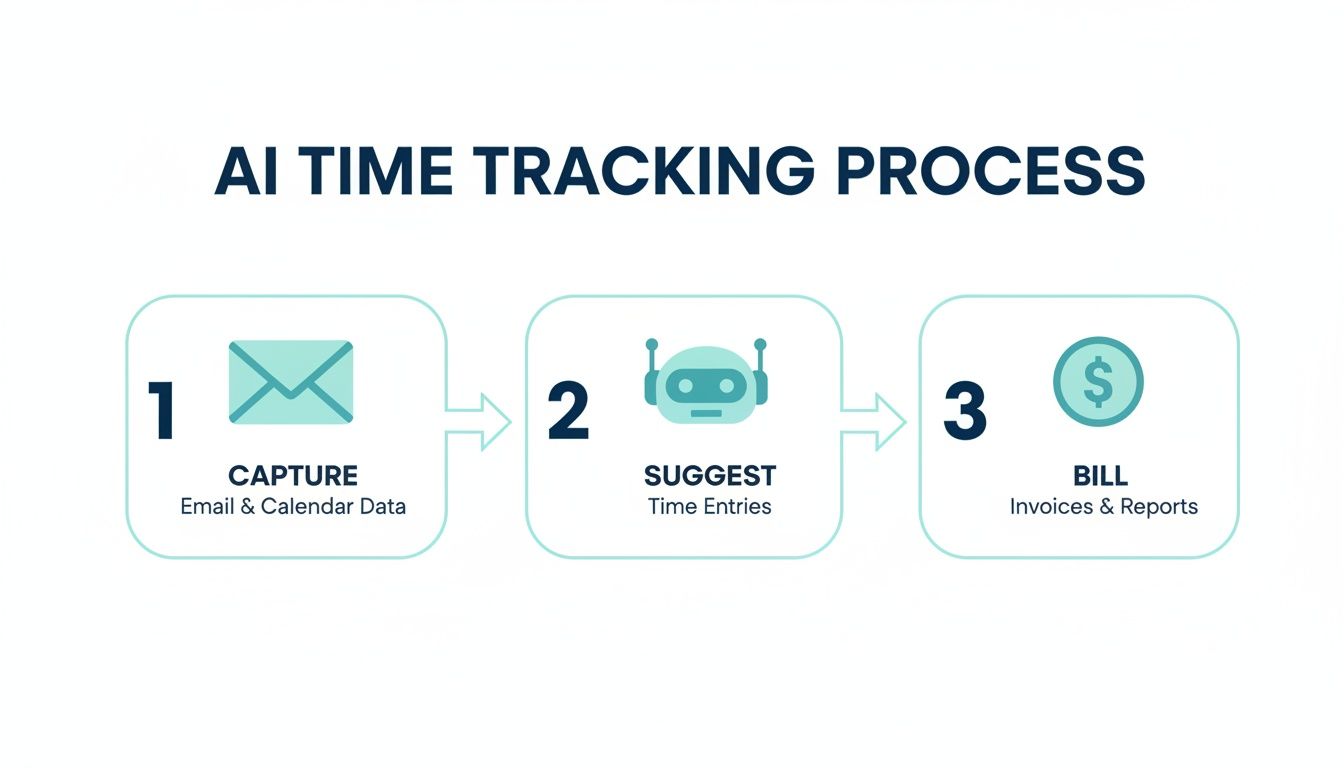
As you can see, AI tools pull in work data from your email, documents, and calendar. Then they build out detailed time entries, which flow directly into your billing process. The big idea here is that automation takes out the guesswork, so your billing records are far more complete and accurate with almost no effort from you.
Capturing More Billable Time, Effortlessly
The most immediate payoff is simple: your firm captures more revenue without anyone having to work longer hours. The software acts as a safety net, catching all those little five minute tasks you’d normally forget to log. It ensures you get paid for all the work you actually do.
And this is not a small change. Recent reports show just how big this shift is. Generative AI is expected to automate a massive 74% of traditionally billable hourly work. That includes documentation, which makes up 66% of a firm's work, along with data collection and analysis.
Firms are catching on fast. The adoption rate for these tools shot up from 19% in 2023 and is projected to hit 79% by 2025 as the software gets better at auto capturing and tagging activities. You can learn more about the impact of AI in legal tech from Lawmatics.
By automating the administrative burden of time tracking, AI frees up legal professionals to focus on high value tasks like case strategy and client counsel. It’s a direct investment in both profitability and productivity.
This move toward intelligent automation is more than just a shiny new feature; it’s a fundamental change in how law firms can operate. It takes a necessary evil, timekeeping, and makes it a seamless part of your day that directly boosts the firm’s financial health. The future of legal time tracking is not just easier, it's a whole lot smarter.
A Practical Guide to Implementing Your New System
Choosing the right lawyer time tracking software is a huge step, but the real work begins with implementation. A great tool collecting digital dust is useless. A successful rollout is what actually turns your investment into real profitability.
This process is about more than just installing an application. It requires a clear plan for everything from moving your existing data to getting your whole team on board. Without a structured approach, even the best software can fail to gain traction.

Creating Your Implementation Blueprint
First things first: you need an actionable plan. This is not just a technical checklist; it’s a roadmap for managing change within your firm and ensuring a smooth transition for everyone involved.
Your plan should map out the key stages to keep the project on track and prevent any nasty surprises. A phased approach is almost always best, letting you manage each step effectively, from the initial setup to full firm wide adoption.
Think about these critical milestones:
- Data Migration: How will you get existing time and case data out of your old systems and into the new one? This needs a clear strategy.
- System Configuration: Customizing the software to match your firm’s specific billing rules, rates, and matter types is non negotiable.
- Integration Setup: The real magic happens when you connect your time tracker with your core case management system, whether that's Needles, its successor Neos, LawBase, or a platform like Litify.
- Team Training: You have to schedule dedicated sessions to teach everyone, from partners to paralegals, how to actually use the new system.
A successful rollout hinges on demonstrating value from day one. When your team sees how the new software makes their jobs easier and contributes to firm success, adoption becomes a shared goal, not a mandate.
Driving Team Adoption and Overcoming Resistance
Let's be honest: no matter how good the software is, change is hard. You will almost certainly run into some resistance, often from people who are perfectly comfortable with their old routines. The key to getting past this is to focus on the "what's in it for me" for every single user.
Instead of just announcing a new top down requirement, show your team how the tool helps them personally. For attorneys and paralegals, highlight how it kills that frantic end of day scramble to reconstruct timesheets. For your admin staff, demonstrate how much faster the entire billing and invoicing cycle becomes.
Ultimately, you're trying to build a culture that values accurate time tracking. Don't frame it as a surveillance tool. Frame it as a collective effort to improve the firm’s financial health. When everyone understands that precise timekeeping leads to better profitability and stability for all, they’re far more likely to get on board.
Common Questions About Lawyer Time Tracking Software
Any time you bring new technology into a law firm, a healthy dose of skepticism is expected. When it comes to time tracking software, we tend to hear the same questions pop up again and again, usually centered on security, getting people to actually use the tool, and whether the investment really pays off. Let's tackle those head on.
Is My Client Data Secure in the Cloud?
This is the big one, and for good reason. The short answer is yes, as long as you partner with a reputable provider that understands the legal industry's strict confidentiality requirements. Keeping client data secure is not just a feature; it's a fundamental obligation.
Top tier legal tech companies use what's often called "bank grade encryption" to protect your data both in transit and at rest on their servers. More importantly, look for practical security tools you can control, like two factor authentication and user permissions that let you decide precisely who sees what. This ensures your ethical duty of confidentiality is always upheld.
How Do I Get My Team to Actually Use It?
Getting attorneys and paralegals to change a long standing habit is always the toughest part. The secret is not a mandate from the top; it's showing them what's in it for them. Nobody enjoys reconstructing their day from memory or battling with a clunky spreadsheet.
Frame the software as a personal assistant that gets rid of that end of the day scramble. When you show your team how passive timers and smart suggestions can give them back an hour of their week, you’re no longer pushing a tool on them. You're offering them a solution to a daily frustration.
A great way to start is with a small pilot group. Find a few of your more tech forward team members, let them get comfortable with the software, and then turn them into internal champions who can share their success with their colleagues.
What's the Real Cost and ROI?
Most time tracking platforms operate on a subscription basis, usually priced per user, per month. It's a predictable operating expense, but the real question is what you get back for it. The return on investment here is often surprisingly fast and significant.
Think about it this way: if the software helps each attorney capture just a handful of billable minutes they previously lost each day, it more than pays for its own subscription cost. The true ROI, though, goes deeper. It comes from eliminating billing errors, speeding up your invoice to payment cycle, and finally having clear data to understand firm profitability.
Ready to modernize your firm's operations and improve client satisfaction? CasePulse offers a secure client portal that integrates directly with the case management systems you already use, like Needles, Neos, LawBase, and Litify. See how our platform can reduce call volume and streamline communication by visiting https://www.casepulse.com to learn more.