
 CasePulse
 Legal operations management is the business backbone of any modern legal team. It takes care of all the non legal, operational heavy lifting, the things that keep the lights on and the engine running, so that lawyers can get back to what they do best: practicing law. It’s about applying solid business principles to legal services to make the whole operation smarter, faster, and more cost effective.
What Is Legal Operations Management
Think of it like a high end restaurant. The chefs are the stars, masters of their craft. But they are not the ones ordering supplies, scheduling the waitstaff, or balancing the books. A great restaurant manager handles all of that behind the scenes so the chefs can focus purely on creating amazing food.
Legal ops serves that exact same function for a law firm or in house legal department. It ensures the entire team operates smoothly and actually contributes to the company’s bigger strategic goals. This role has evolved way beyond just trying to trim budgets. It is now a strategic function that creates tangible business value by optimizing everything from technology and workflows to vendor management and financial planning.
The Shift From Cost Center to Value Driver
For years, in house legal teams were often seen as a necessary expense, a “cost center” whose main job was to put out fires and manage risk. That mindset is completely outdated. Today, the core of legal ops is all about implementing smarter processes and technology to turn the legal department into a proactive business partner. Exploring real world examples of Business Process Automation (BPA) can really shine a light on how this transformation takes shape.
With a solid operational framework, a legal team stops just reacting to problems. It starts using data to predict needs, allocate resources wisely, and demonstrate a clear return on investment. This shift is non negotiable for any legal team that wants to be seen as a valuable player in the business.
The Growing Importance of Legal Ops
The numbers speak for themselves. A recent study found that 87% of general counsel increased their legal operations budgets by an average of 11%. That is a huge vote of confidence in its strategic value. On top of that, 82% of legal departments now have at least one dedicated legal operations professional on their team.
This is not just a fleeting trend. It is a fundamental change in how legal services are delivered. The aim is to build a system that is not only efficient but also scalable and predictable, allowing lawyers to make the biggest possible impact.
The ultimate goal of legal operations is to let lawyers be lawyers. By handling the business side of the legal department, an ops team frees up attorneys to focus on high value legal work, which directly impacts the bottom line and client outcomes.
Adopting a legal ops mindset really comes down to looking at every single task and asking, “Can we do this better, faster, or more cost effectively?” Answering that question is the first step toward real improvement. For those just starting out, our guide on how lawyers can be more productive is packed with practical tips to get you going. This way of thinking is absolutely essential for any modern legal practice aiming for success.
Understanding the 12 Core Competencies
So, what exactly does a legal operations framework look like on the inside? To get a clear picture, we can look to the industry standard set by the Corporate Legal Operations Consortium (CLOC). They have identified 12 core competencies that define a high performing legal department.
It is best not to think of these as a dozen separate job descriptions. Instead, see them as interconnected gears in a machine. They work together, and for things to run smoothly, each one needs attention.
We can group these competencies into three main areas, which gives us a simple but powerful way to visualize the structure of legal ops. It is all built on a solid foundation of smart financial management, efficient processes, and the right technology.
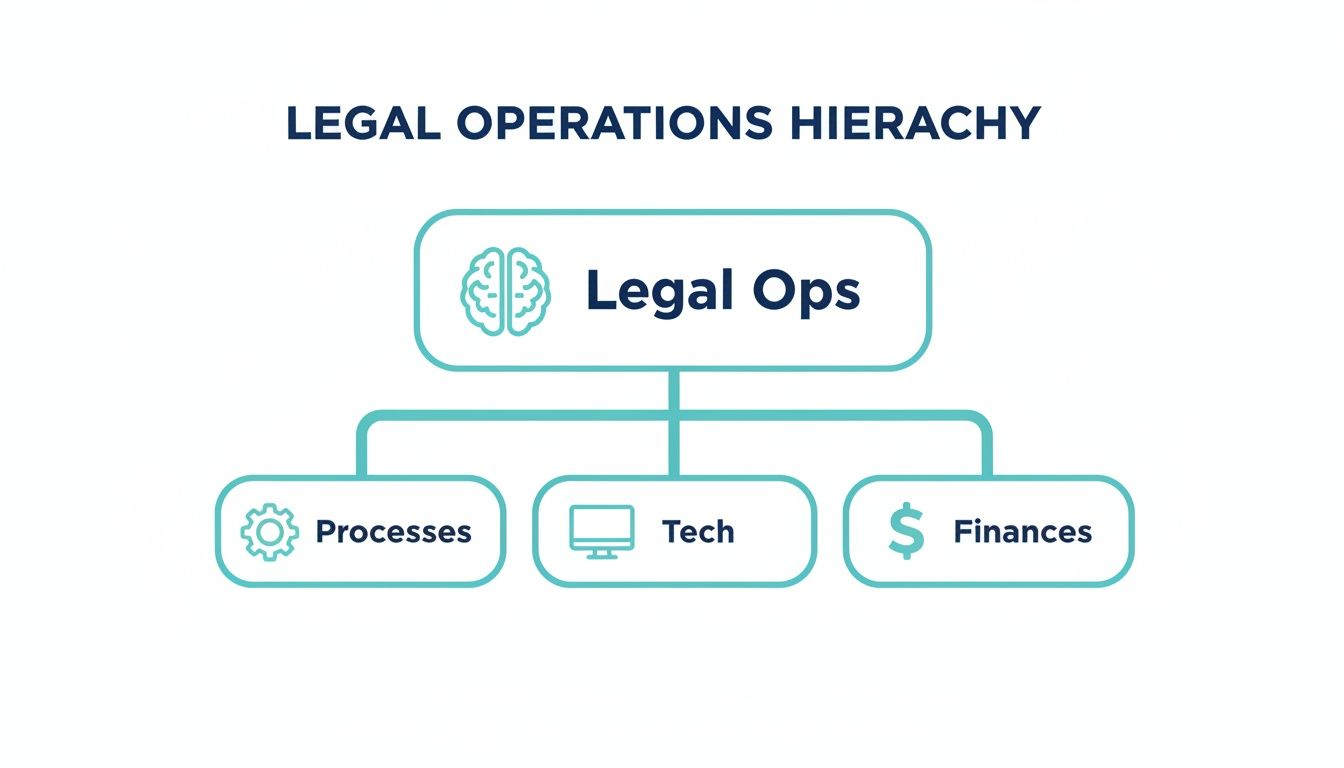
This structure is not just an org chart; it is a reminder that truly effective legal ops requires a balanced focus. Neglect one area, and the other two will eventually feel the strain.
Financial and Vendor Management
Let’s start where many legal ops journeys begin: with the money. This area is all about managing budgets and relationships to squeeze the most value out of every dollar. It is often the first priority because the impact on the bottom line is so immediate and easy to prove.
- Financial Management: This goes way beyond just paying the bills. It is about building budgets, forecasting future spending, and meticulously tracking where every dollar goes. When you get this right, you have the hard data you need to make smarter spending decisions and demonstrate the department’s value to the C suite.
- Vendor Management: This is the art of strategically managing your relationships with outside counsel and other service providers. It involves everything from negotiating better rates and defining clear expectations to tracking performance. The goal is simple: ensure you are getting the absolute best service for your investment.
These two are two sides of the same coin. Great vendor management directly fuels your financial goals by keeping costs in check and ensuring your partners are delivering real, measurable value.
Technology and Process Improvement
If finance is the fuel, this category is the engine room. It is all about building efficient, repeatable systems that eliminate grunt work and free up your legal team to focus on the high stakes, strategic stuff.
- Technology Management: This is about thoughtfully choosing, implementing, and managing the right software for your team. From e billing and contract management systems to secure client portals, the aim is to build a tech stack where every piece of software talks to each other and makes life easier.
- Business Intelligence: Raw data is just noise. Business intelligence is about turning that noise into a clear signal. It means using metrics and analytics to actually understand performance, spot trends before they become problems, and make strategic decisions based on evidence, not just gut feelings.
- Process and Project Management: This is where you apply proven project management disciplines to legal work. Think of it as creating a playbook for common tasks. You map out workflows, find the bottlenecks, and roll out standardized processes to make work more predictable, efficient, and consistent.
You can see how these three work together. A new piece of technology might enable a more efficient process, which in turn generates the very data you need for insightful business intelligence.
Strategic and Organizational Enablement
This final group of competencies is what elevates legal ops from a back office administrative function to a true strategic partner to the business. It is about aligning the legal department with the bigger company wide goals and building a rock solid team.
- Information Governance: This is about creating the rules for how the firm’s data is managed, stored, and protected. It covers everything from document retention policies to cybersecurity protocols, ensuring you stay compliant and safeguard sensitive information.
- Knowledge Management: Your legal team possesses a massive amount of collective wisdom. Knowledge management is the practice of capturing, organizing, and sharing that expertise. A good system makes it dead simple for lawyers to find precedents, templates, and crucial internal advice, saving huge amounts of time and ensuring consistency.
- Strategic Planning: A legal ops pro does not just execute; they help shape the department’s long term vision. They work with leadership to set goals, define priorities, and build a practical roadmap for the future, making sure the legal team is actively supporting the company’s overall strategy.
Other key competencies here include Service Delivery Models (deciding the smartest way to get legal work done, in house, outsourced, or a hybrid), Organizational Design (structuring the team for peak effectiveness), and Training & Development (making sure everyone has the skills to excel).
By mastering these competencies, legal operations management transforms a legal department from a reactive support unit into a proactive, data driven business partner that actively contributes to the organization’s success.
Navigating Common Legal Operations Hurdles
Bringing a legal operations framework into your firm is a game changer, but let’s be honest, it is not always a smooth ride. Just like any major shift in how you do business, the path to peak efficiency has its share of bumps. Knowing what these hurdles are ahead of time is half the battle.
Too many legal teams are stuck in a vicious cycle. The work keeps piling up, outside counsel bills are getting scarier, and asking for new resources feels like shouting into the wind. These are not just minor annoyances; they directly impact your ability to serve clients well and stay profitable.
The Squeeze of Rising Costs and Workloads
The biggest headache for most legal departments today? The economic pressure cooker. You are constantly being asked to do more work with the same budget, or sometimes even less. This is not just a feeling, the numbers tell the story.
The reality is that legal departments are in a serious cost management crunch. Consider that average partner rates in major markets have now shot past $1,000 per hour. This financial strain is compounded by the fact that 81% of law departments have seen their workload increase. Meanwhile, 73% said their tech budgets are stuck in neutral.
To handle it all, 46% of legal departments are pulling more work in house. That creates a tricky puzzle: how do you manage a growing mountain of tasks without any new people or tools? If you are interested in digging deeper, you can discover more insights about legal operations trends from Wolters Kluwer.
This squeeze forces legal ops pros to get creative. You have to find smart ways to get more done without spending more, which is why efficient processes and the right technology are no longer optional.
Securing Budget for New Technology
Here’s another all too common roadblock: convincing leadership to invest in new tech. A legal ops manager might see the crystal clear value of a new case management system or a client portal, but the partners often just see a big price tag. To get their buy in, you need to build a rock solid business case, one that is driven by data, not just promises.
You have to learn to speak their language, the language of metrics and ROI.
- Calculate the Cost of Inefficiency: Start tracking the hours your team wastes on repetitive, manual work, like fielding constant client calls for status updates. Put a real dollar amount on that lost time by multiplying those hours by billing rates. Suddenly, the cost of doing nothing becomes very clear.
- Show a Direct Line to Profitability: Do not just talk about efficiency; talk about money. Explain how a tool like a client portal cuts down on non billable admin time, freeing up paralegals to handle work that actually brings in revenue.
- Start with a Pilot Program: Instead of asking for a massive firm wide rollout, suggest a smaller, controlled pilot test for a new tool. This approach lowers the upfront risk and lets you collect hard data on how well it works. A successful pilot makes the case for a full implementation for you.
The key is to shift the conversation from “this is a cost” to “this is an investment that will pay for itself.” Show leadership how the right technology is not just a nice to have, but an essential tool for scaling the firm and improving client satisfaction.
Getting past these challenges takes a strategic mindset. It is about recognizing the financial pressures, using data to make your case, and proving that operational excellence is not just about saving a few bucks. It is about building a stronger, more competitive legal practice for the long haul.
How to Build Your Legal Technology Stack
Technology is the engine that keeps a modern legal operations department running. But building your firm’s tech stack is not about collecting a bunch of fancy, impressive sounding software. It is about carefully assembling a connected system where every tool talks to the others, making your firm run smoother and keeping your clients happy.
A poorly planned tech stack just creates more problems than it solves. You end up with information trapped in different programs, frustrated staff entering the same data over and over, and a clunky, disjointed experience for clients. The real goal is to build an integrated ecosystem, not just a random collection of apps.

Core Components of a Legal Tech Stack
When you are just starting, forget the shiny objects. Focus on the foundational tools that solve your biggest operational headaches. Most successful tech stacks are built around a few essential categories, and each one plays a critical role in your firm’s day to day.
- Case Management System (CMS): Think of this as the heart of your entire operation. Your CMS is the central hub for all client info, case details, documents, and deadlines. It needs to be the single source of truth for everyone at the firm.
- E-billing and Financial Management: These tools are all about getting paid faster and more easily. They handle everything from time tracking to sending invoices and processing payments, giving you a clear, real time picture of your firm’s financial health.
- Contract Lifecycle Management (CLM): If you handle a lot of contracts, CLM software is a lifesaver. It automates the entire process, from drafting and negotiating to execution and renewal, which cuts down on risk and saves an incredible amount of time.
These core systems are your foundation. Once they are solidly in place, you can start layering in more specialized tools for things like e discovery or legal research. The key is making sure they integrate cleanly with your central platforms. To really grasp the central role of this technology, check out our deep dive into legal case management software.
The Critical Role of Client Communication Technology
One of the smartest additions you can make to your tech stack is a tool that directly improves the client experience. This is where a dedicated client portal can be a total game changer, tackling one of the biggest operational bottlenecks: the constant “just checking in” calls from clients.
A secure client portal like CasePulse is designed to integrate directly with your case management system. That integration is what makes it so powerful. Your team keeps working in their familiar CMS, but clients get a modern, self service way to stay in the loop.
A well integrated client portal turns client communication from a reactive, time consuming chore into a proactive, automated process. It’s a direct line from your technology investment to better firm efficiency and much higher client satisfaction.
By giving clients 24/7 access to check case status, send secure messages, and share documents, you practically eliminate the need for them to call for routine updates. This one change can drastically reduce your inbound call volume. Suddenly, your paralegals and case managers are free to focus on moving cases forward instead of playing telephone all day.
Focusing on Seamless Integration
Here’s the golden rule for building your tech stack: prioritize integration. Before you even think about buying a new piece of software, your first question should always be, “How does this play with the tools we already have?”
A tool might promise amazing features, but if it cannot connect to your CMS, it is just going to create more manual work and headaches. The whole point of legal operations management is to create smooth, efficient workflows, and that is only possible when your technology talks to each other.
Here’s a simple checklist to guide you:
- Identify the Core System: Start with your CMS as the central hub. Everything should revolve around it.
- Map Your Workflows: Get a clear picture of how information flows from client intake all the way to case resolution.
- Prioritize Integration: When evaluating new tools, make their ability to connect with your core system a top priority.
- Solve a Specific Problem: Make sure every new piece of tech is being brought in to solve a real, identified operational challenge.
Building your tech stack is a marathon, not a sprint. It is an ongoing process of refinement. Start with a solid foundation and add new tools strategically, always focusing on how they can work together to make your firm a more efficient, client focused machine.
Using KPIs to Measure Your Success
You cannot improve what you do not measure. In legal operations, that simple phrase is gospel. Gut feelings and hallway conversations will not convince the firm’s partners to invest in new software or sign off on a bigger budget. To prove your value and make smart decisions, you have to speak the language of business, and that language is data.
Think of Key Performance Indicators (KPIs) as your translator. They turn operational improvements into the clear, undeniable results that leadership understands. These are not just numbers for an end of year report; they are the vital signs of your legal department, showing you exactly where you are thriving and where you need a course correction.

Financial Metrics That Matter
Let’s start where managing partners always do: the money. Financial KPIs show how your operational efforts directly impact the firm’s bottom line. Tracking these numbers consistently gives you the power to manage resources with precision.
- Total Legal Spend by Matter Type: This tells you where the firm’s money is really going. Are personal injury cases costing more than you thought? This data helps you budget more accurately and spot opportunities for cost control.
- Outside Counsel Spend: Keeping a close eye on what you pay external firms is non negotiable. This KPI lets you compare performance, negotiate better rates, and make sure you are getting real value from your partners.
- Forecasted vs. Actual Spend: This is your accountability metric. It reveals how well you are planning and managing your budget. A small variance demonstrates financial discipline and builds trust with leadership.
The most successful legal ops pros use data to tell a compelling story. They connect operational tweaks to financial outcomes, showing how efficiency isn’t just a nice to have, it’s a direct contributor to the firm’s profitability.
Operational Metrics for Peak Efficiency
While financial KPIs get the attention, operational metrics reveal the how behind the numbers. These indicators measure the real world efficiency of your team’s daily workflows. They help you pinpoint bottlenecks and uncover opportunities to make work flow more smoothly.
The push for a data first approach has only accelerated. Today, the most common metrics tracked include total spend by law firm, total spend by matter type, and the number of matters opened and closed. By giving executives clear metrics, legal ops professionals earn a strategic voice at the leadership table, turning the legal department into a data driven business unit. Thomson Reuters’ research offers a great deep dive into these data-driven trends.
Key operational KPIs include:
- Case Lifecycle Time: How long does it take to get a matter from open to close? Shortening this cycle means resolving cases faster, which usually leads to happier clients and better cash flow.
- Client Satisfaction Scores (CSAT): Are your clients actually happy? Simple surveys provide invaluable feedback, helping you see your service through their eyes and identify what you are doing right.
- Staff Productivity Metrics: This could be tasks completed per paralegal or documents processed per day. It is not about micromanaging; it is about understanding team capacity and ensuring workloads are balanced and fair.
By tracking a balanced mix of financial and operational KPIs, you get a complete, 360 degree view of your department’s health. For more ideas, you might be interested in our guide on the metrics that matter for law firms. This data is what empowers you to stop guessing and start making strategic decisions that drive real, measurable success.
Your Legal Operations Questions, Answered
Jumping into legal operations can feel a bit overwhelming. Once you start thinking about the business of law, not just the practice of it, a lot of practical questions pop up. It is completely normal to wonder where to start and what to expect.
Let’s tackle some of the most common questions we hear from firms just like yours.
What Is the First Step to Implementing Legal Operations in a Small Firm?
For a small firm, the first step is not hiring a full blown legal ops team. It is about a change in mindset.
Start by finding your single biggest operational headache. Where is the most friction? Is it the endless phone calls from clients asking for updates? Maybe it is the black hole of document management. Pick one major pain point and find a straightforward fix, either a better process or a smart piece of technology.
For example, bringing in a client portal can immediately slash the time your team spends on the phone giving routine status updates. You start small, get one clear win, and build momentum from there.
How Does Legal Ops Improve Client Satisfaction?
Legal operations directly impacts client happiness by making their experience with your firm feel seamless and transparent. It is a game changer.
When your internal processes are running smoothly, communication naturally gets better. Using technology to give clients 24/7 access to their case status or a secure channel to upload documents eliminates the frustration of phone tag and waiting.
This kind of proactive communication, powered by solid operations, makes clients feel seen and valued. That is how you build trust and earn referrals.
The heart of legal operations is efficiency. That efficiency has a direct, positive ripple effect on the client experience. Better systems mean faster responses, fewer mistakes, and more transparency, the very things that build unshakable client loyalty.
Can Legal Operations Management Really Save Our Firm Money?
Absolutely. But it is not just about slashing line items on a budget. The real savings come from boosting efficiency.
Legal ops saves money by automating the repetitive, non billable tasks that eat up your team’s day. This frees up your attorneys and paralegals to focus on the high value, billable work that actually drives revenue. It also helps you get smarter about how you manage outside counsel spend by using data, not just gut feelings.
Think about it: an analysis of your team’s time might show they spend hours each week on manual client updates. A simple tool can automate that for a fraction of the cost, improving both your bottom line and your team’s morale.
Do I Need a Dedicated Legal Ops Manager?
Not necessarily, especially when you are a smaller firm. In many cases, a managing partner or a senior paralegal with an interest in process improvement can wear the legal ops hat.
The crucial part is to officially give someone ownership of these functions. They need the authority to actually make changes. As your firm grows and operations get more complex, hiring a dedicated legal ops professional becomes a strategic investment, one that pays for itself many times over in efficiency gains and the ability to scale.
Ready to take the first step toward better client communication and operational efficiency? CasePulse offers a secure client portal that plugs right into your existing case management system, putting updates on autopilot and freeing up your staff. See how you can cut down on inbound calls and give your clients an experience they’ll rave about.