
 CasePulse
 At its core, mass tort intake is the engine that drives a plaintiff firm's ability to screen, qualify, and ultimately sign up large groups of people harmed by the same product or event. It's the system that brings order to the chaos, transforming thousands of inquiries into a structured, manageable workflow from the first phone call to a signed retainer.
The High Stakes of Modern Mass Tort Intake

Major litigations, like the ones involving talcum powder and Roundup, have completely changed the game. If you don't have the right systems in place, the challenge of handling a sudden influx of thousands of potential clients can be overwhelming. It's a make or break moment for any firm.
We've all seen firms get buried under an avalanche of calls, struggle with critical data entry mistakes, and apply inconsistent screening criteria across the board. This kind of operational mess doesn't just strain your team, it actively loses you valuable cases to more organized competitors. The financial and reputational stakes have never been higher.
The reality of a modern mass tort is that your firm isn't just competing in the courtroom; it's competing from the very first phone call. A slow or disorganized intake process is an open invitation for a potential client to contact the next firm on their list.
This guide gives you a practical framework for building a scalable and compliant mass tort intake process. We'll walk through how a methodical approach can turn that flood of inquiries into a profitable, orderly workflow and set your firm up for success from day one.
Understanding the Sheer Scale of Intake
To really get a sense of the scale, just look at the sprawling talcum powder lawsuits against Johnson & Johnson. These cases are a perfect illustration of the immense pressure firms are under.
As of September 2026, the multidistrict litigation (MDL) alone had a staggering 66,910 pending cases, and that doesn't even count the thousands of others active in various state courts. This explosion shows just how quickly even a well prepared firm can get swamped. You can review more details about active litigations and their staggering scale to understand the challenge.
The Pitfalls of Manual Intake
Let's be blunt: a manual intake process built on spreadsheets, sticky notes, and email inboxes just can't keep up anymore. It’s a recipe for bottlenecks and costly mistakes.
Here is a quick comparison of the old, manual approach to intake versus a modern, automated system.
Comparing Manual vs Automated Intake Systems
| Intake Aspect | Manual Process (The Old Way) | Automated Process (The New Way) |
|---|---|---|
| Initial Contact | Phone calls and emails logged in a spreadsheet. | Web forms automatically create a contact record. |
| Data Entry | Staff manually types information from notes into a file. | Client data is captured once and syncs across systems. |
| Screening | Relies on staff memory and inconsistent checklists. | Standardized, automated questionnaires ensure consistency. |
| Follow-Up | Dependent on calendar reminders and individual effort. | Automated emails and texts for missing information. |
| Reporting | Manually compiling data, often out of date. | Real time dashboards showing conversion rates and KPIs. |
As you can see, the differences are stark. Relying on outdated methods just isn't sustainable when dealing with hundreds or thousands of potential clients.
Here are some of the most common problems we see firms run into when they stick with a manual process:
- Inconsistent Screening: Without a central, standardized system, different intake specialists will inevitably apply different criteria. This means good cases get turned away by mistake, while non viable ones waste everyone's time.
- Data Entry Errors: Manually keying in information from a phone call or web form is a minefield of human error. A single transposed digit in a Social Security number or a misspelled medication can create a nightmare down the road, potentially jeopardizing the entire case.
- Poor Claimant Experience: When your team is overwhelmed, response times grind to a halt. Potential clients are left in limbo, making them feel ignored and giving them every reason to call the next firm on their Google search.
Designing Your Intake Foundation
Before you even think about automation or fancy workflows, you need to get the basics right. A truly effective mass tort intake process starts with a smart, dynamic intake form that pulls the right information from the very first click or call. Without that core structure, the best software in the world won't save you.
Think of it like building a house. You can't start framing walls on a weak or uneven foundation. Your intake form and screening criteria are that concrete slab for your entire mass tort practice.
The whole point is to capture the must have details upfront. This allows your team to quickly and consistently figure out if a potential client actually meets the basic requirements for the case. It’s the first, most important filter that separates promising leads from those who don't qualify, saving your firm an incredible amount of time and money down the road.
Crafting an Intake Form That Actually Works
For fast moving torts, like those involving PFAS chemicals or the mental health impacts of social media, asking the right questions from the get go is everything. These aren't just glorified contact forms; they are strategic tools designed to collect specific, actionable data.
The mass tort world is always in motion. We saw intake volumes hit historic highs in recent years as new fronts like PFAS and social media harm cases exploded, demanding far more from our client management systems. The PFAS litigation alone involves thousands of lawsuits over "forever chemicals," an area that blew up after 3M's massive $10.3 billion settlement in 2023. You can find more information about these infamous mass tort litigation cases on Bolster Legal.
Because of this complexity, your intake form has to be laser focused on the specific tort. For a strong mass tort intake form, I always make sure we cover these areas:
- Injury and Diagnosis: What specific injury did they suffer? What was the exact diagnosis, and when did they receive it? This is your first and most important qualifying gate.
- Exposure and Use: When were they exposed to the product or substance, and for how long? For a product liability case, you need dates of use for a specific drug or medical device.
- Product ID: Can the person name the specific brand or manufacturer? This detail is often the linchpin that connects their claim to the right defendant.
- Statute of Limitations Data: Getting key dates, like the date of injury or diagnosis, is absolutely critical for flagging any potential statute of limitations issues right away.
A well designed intake form is your first line of defense. It gives your team the power to make fast, informed decisions and stops non viable cases from eating up resources that should be spent on your qualified claimants.
Establishing Your Screening Criteria
Once you’ve built the form, you need to define clear, non negotiable screening criteria for your team. This ensures that every intake specialist, paralegal, and attorney is looking at potential clients through the same objective lens.
You absolutely cannot scale your operation without this consistency. When the rules are fuzzy or left up to individual interpretation, you're guaranteed to either turn away good cases or, just as bad, waste time chasing leads that are going nowhere.
Your screening criteria should be a direct reflection of your intake form. For every question asked, there should be a corresponding "pass" or "fail" logic.
Example Screening Logic for a Hernia Mesh Case
Here's how this looks in the real world. Let's say you're screening for a hernia mesh case:
- Question: "Did you have hernia mesh implant surgery between 2010 and 2020?"
- Criteria: Must be "Yes." A "No" is an immediate disqualification. No exceptions.
- Question: "Did you suffer complications like chronic pain, infection, or mesh migration?"
- Criteria: Must say yes to at least one of the listed complications.
- Question: "Have you had revision surgery to remove or repair the mesh?"
- Criteria: A "Yes" here flags them as a high priority lead. "No" answers aren't a dealbreaker, but they may need more follow up.
This kind of black and white logic removes the guesswork. It allows even junior team members to handle the initial triage with confidence, escalating only the truly qualified leads to senior paralegals or attorneys for a deeper dive. Our guide on client intake software for law firms digs into how technology can automatically enforce these rules for you.
By investing the time upfront to build a detailed form and define your screening rules, you lay the bedrock for a successful mass tort intake system. It’s this foundational work that makes everything else, like a secure client portal, so powerful, turning simple software into a growth engine for your firm.
Connecting Intake with Your Case Management System
You’ve designed a smart intake form and established solid screening criteria. That’s a huge first step. But if you stop there, you're leaving the most significant efficiency gains on the table. The real magic happens when your intake process plugs directly into your firm's case management system (CMS).
This single connection is what separates a decent intake setup from a truly scalable one. It bridges the gap between getting a lead and actually working the case, eliminating the painful, redundant work that bogs down so many mass tort practices. When your intake portal and your CMS are in sync, you create one fluid motion from start to finish. No more toggling between an email inbox, a clunky spreadsheet, and your case files. No more manual data entry. Period.
Bridging the Gap Between Intake and Your Case Files
Let’s be honest: the old school approach to intake is broken, especially for high volume torts. A potential claimant fills out your web form, and their information gets dumped into a digital black hole, usually a shared inbox or a sprawling spreadsheet. From there, a paralegal or assistant has to manually copy every single detail into your primary CMS to open a new matter.
This isn't just slow; it's a recipe for disaster. One typo during the transfer, a wrong digit in a phone number or a misspelled name, can create headaches that ripple through the entire lifecycle of a case.
An integrated system closes this gap for good. It builds a direct pipeline from your intake forms into your CMS, whether you’re running on platforms like Needles, Neos, LawBase, or Litify. This is how you make your mass tort intake operation genuinely efficient.
This simple flow is the bedrock of a well oiled intake machine.
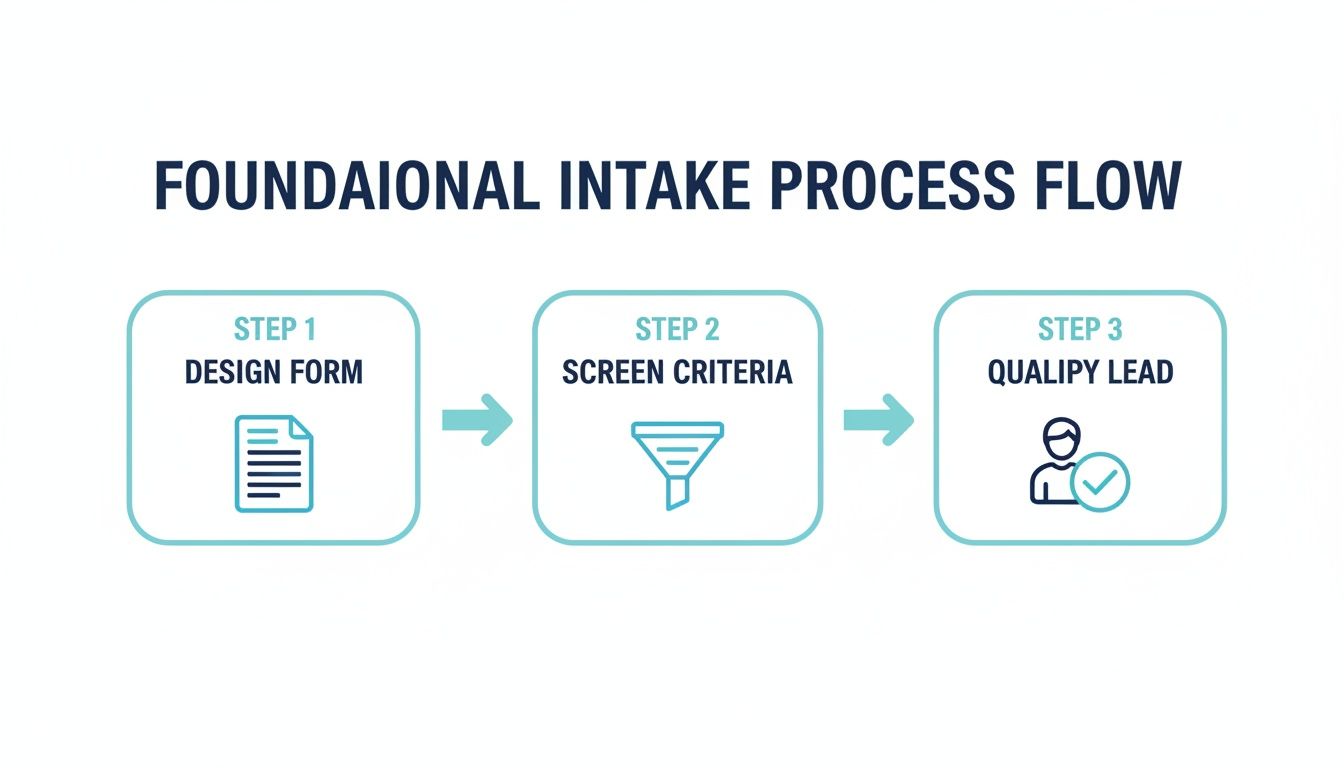
Getting these three pieces right, design, screening, and qualification, simplifies everything that comes after.
A Day in the Life: With and Without Integration
Let’s get practical. Picture a paralegal, Sarah, who’s managing the flood of inquiries for a new hernia mesh MDL.
The Old Way (No Integration):
Sarah’s morning starts with an inbox overflowing with form submissions. She opens an email, scans the details, and then opens the firm's CMS. She then begins the soul crushing task of copying and pasting the claimant's name, address, phone number, surgery date, and injury details. She double checks her work, praying she didn’t make a mistake. This takes her about 10 to 15 minutes per claimant. With 50 new leads in the queue, her entire day is gone.
The New Way (With Integration):
With an integrated client portal, Sarah’s day looks completely different. When a potential claimant fills out the intake form and meets the screening rules, their information is automatically pushed into the firm's CMS. A new case file is instantly created and populated with every piece of data and every uploaded document.
Sarah simply gets a notification that a new, qualified lead is ready for review, inside the system she already works in all day. She never has to copy a single field. Her time is freed up for what really matters: calling the most promising claimants to build rapport and move their cases forward.
Integration turns your intake staff from data entry clerks into strategic client relationship managers. It frees them to focus on high value tasks that actually win cases.
The Power of a Single Source of Truth
This seamless handoff does more than save time. It establishes a "single source of truth" for every single person who contacts your firm.
When a claimant's entire history lives in one place from the very first click, your team gains immediate clarity and avoids the usual chaos. Here’s what that looks like in practice:
- No More Data Silos: Every piece of information, from the initial web form to medical records uploaded months later, is neatly organized in the client's case file.
- Complete Client History: Anyone at the firm can see a complete, chronological history of interactions without having to hunt through stray emails or shared drive folders.
- Better Team Collaboration: Attorneys, paralegals, and intake specialists are all working from the exact same up to date information. No more crossed wires.
For a firm handling the sheer volume of a mass tort, this isn't a "nice to have." It's a necessity. If you're new to the concept, you can learn more about what a case management system is and why it’s the central nervous system of a modern law firm. By connecting your intake directly to it, you ensure your mass tort intake process is a fully integrated part of your firm's operational core, not just a separate task.
Automating Client Communication and Document Gathering

Once your core systems are integrated, you can finally tackle the biggest time waster in any intake department: the endless back and forth with potential clients.
Your intake team’s most valuable asset is their time. But that time quickly disappears when they’re stuck manually chasing down claimants for missing information or incomplete forms. Automation is how you give that time back to them.
It takes the repetitive, soul crushing tasks off your specialists' plates. More importantly, it ensures every single person who contacts your firm gets a prompt, consistent response. This constant contact builds trust and keeps them from calling a competitor down the street. People feel seen and valued, even when your team is completely swamped.
Think of it as your firm’s tireless assistant, one that works 24/7. This assistant handles all the nagging follow ups, freeing up your staff to do what they do best: talk to highly qualified leads and move good cases forward.
Building Automated Follow-Up Workflows
I’ve seen it a thousand times. The most common bottleneck in mass tort intake is the half finished form. A potential claimant starts filling it out, their kid cries or the dog barks, and they never come back to it. Without a system to gently nudge them along, that lead is gone forever.
This is where automated workflows are absolutely essential. You can build simple but incredibly powerful sequences to reengage these people without anyone on your team lifting a finger.
Let's walk through a real world scenario:
- The Drop-Off: A person starts your hernia mesh intake form but abandons it right before entering their surgery date.
- The Nudge: After a day, the system automatically sends a friendly email. Something like, "We noticed you started your form but didn't get to finish. Just a reminder, providing your surgery date is a critical step for us to review your potential claim."
- The Second Chance: If another 48 hours go by without a response, a text message can go out. A simple, "Still interested in the hernia mesh matter? Complete your form here to see if you qualify," can work wonders.
This multi channel approach meets people where they are. It dramatically increases the odds of getting the complete information you need to qualify the case. For a deeper dive into setting these up, our guide on https://casepulse.com/what-is-workflow-automation/ has more practical ideas.
Automating Document Collection Through a Secure Portal
Gathering medical records, proof of use, and other key documents is another huge time sink. Chasing these down via email is not only clunky but also a massive security and liability risk. This is where a secure client portal changes the game.
Instead of your team sending one off email requests, the portal can automatically trigger document requests the moment a claimant is qualified.
A secure client portal isn't just a nice to have feature; it’s a fundamental shift in how you manage client relationships. It creates a single, encrypted hub for all communication and document sharing, giving both your firm and your clients total peace of mind.
This method doesn't just secure sensitive information; it also creates a perfect, auditable trail of every document you receive for that client's file.
When you're dealing with protected health information, security is non negotiable. For any audio or video files claimants send as evidence, you should look into tools like HIPAA-compliant transcription software to ensure every piece of data is handled securely.
Keeping Claimants Engaged and Informed
Automation isn't just for chasing down paperwork. It’s also your best tool for managing expectations and keeping qualified claimants in the loop throughout the long, winding road of a mass tort.
You can set up automated messages to deliver case updates, send reminders about important deadlines, or even just to check in.
This proactive communication stops your phone lines from being flooded with "what's happening with my case?" calls. It shows clients you're on top of things and that you respect their role in the process.
Ultimately, a smart automation strategy ensures no potential client falls through the cracks, improving not only your conversion rates but the entire claimant experience from start to finish.
How to Structure Your Team for High-Volume Triage
All the powerful software in the world won't sign cases for you. The tech is just one piece of the puzzle; you still need a smart, organized team of real people to manage the firehose of leads that comes with any major mass tort campaign.
Without a solid staffing model, even the best case management system will buckle under the pressure. The real goal is to build a human workflow that guides your team on how to triage that flood of inquiries, turning your marketing dollars into signed retainers. You need a system where everyone knows their role and leads move seamlessly from one stage to the next without falling through the cracks.
Creating a Multi-Tiered Triage System
From my experience, the most effective way to handle a massive influx of leads is with a multi tiered triage system. Think of it as a funnel that filters inquiries, making sure your most experienced, and expensive, team members only touch the most promising claims. This keeps your senior paralegals and attorneys from getting bogged down in initial screening calls that anyone on the front line can handle.
Here’s a practical way to structure this:
- Level 1: The Front Line. These are your intake specialists. They perform the initial pass on every single web form and phone call. Their sole job is to quickly screen for the absolute non negotiable criteria you've established. Is the injury right? Is the timeline correct? If not, the lead is disqualified right away.
- Level 2: The Qualifiers. Once a lead passes that first basic check, it gets routed to this team. These are often junior paralegals who make the first real outbound calls. They build rapport, verify the claimant's story, and gather any missing information to paint a clearer picture of the potential case.
- Level 3: The Final Reviewers. Only the best qualified leads should ever reach this stage. This group is made up of your senior paralegals or attorneys who conduct the final, deep dive review before a retainer packet ever goes out the door. They assess the legal merits and make the final call on whether to sign the case.
This layered approach ensures your firm's resources are used efficiently. It makes the entire mass tort intake process far more productive and, ultimately, more profitable.
Managing the Workflow with a Central Hub
A tiered team is only as good as its coordination. Everyone needs to be working from the same playbook, which is why a central platform for all claimant data isn't just a nice to have; it's essential. This gives intake managers a bird's eye view to assign leads, track progress, and spot bottlenecks before they derail the whole operation.
Look at the Roundup weedkiller litigation. Even after Bayer settled a huge chunk of claims, it still faced over 54,000 pending cases as of late 2026. That constant churn, fueled by ongoing trials, creates an absolute deluge of inquiries. A firm handling those cases needs airtight client onboarding to track unique injuries and exposure histories, a perfect example of why organized intake is non negotiable.
A central command center gives you the visibility to manage that kind of volume. Managers can see instantly which team members are swamped and reassign leads with a click. They can also monitor key metrics, like the time it takes for a lead to move from Level 1 to Level 2, helping them pinpoint exactly where the process is slowing down.
A central platform doesn't just store data; it empowers your managers to actively direct traffic. It provides the command center needed to orchestrate a high volume triage operation without the chaos.
This setup builds accountability and clarity for the entire team. Everyone knows what they're responsible for and can see how their work directly contributes to the firm’s bottom line. And don't forget, modern AI tools can do more than just automate emails. You can get great insights on improving agent productivity with AI-powered support. This technology helps your team offload repetitive work and focus on the high value human interactions that actually sign cases.
Measuring and Optimizing Your Intake Funnel
You’ve built your intake machine, but the work isn't over. In fact, it’s just beginning. A top tier mass tort intake process is never a "set it and forget it" operation. It's a living system that needs constant attention, and the only way to improve it is to measure it.
This is where having all your data in one place really pays off. When you stop chasing numbers across disconnected spreadsheets and email inboxes, you get a clear, live look at your entire funnel. Suddenly, you can stop guessing and start making decisions based on solid evidence.
What Should You Actually Be Tracking?
In a high volume practice, it's easy to get lost in a sea of data. Don't. You only need to obsess over a few key performance indicators (KPIs) to get a real handle on your intake health.
These are the numbers that matter most:
- Conversion Rate (Inquiry to Signed Client): This is your north star. What percentage of people who contact you actually end up signing a retainer? A low number here is a major red flag that something is broken in your marketing or your intake workflow.
- Time to Qualify: How long does it sit in someone's queue before a new inquiry is officially marked as "qualified"? If this takes hours or days, you're losing viable claimants who are also calling your competitors. Delays almost always point to a bottleneck in your screening or triage steps.
- Cost Per Acquisition (CPA): This is the bottom line business metric. How much did you spend on ads to get that one signed case? Knowing your CPA is the only way to judge whether a marketing campaign is actually profitable.
Consistently watching these numbers is the difference between running your intake on gut feelings versus hard facts. It tells you exactly where leads are falling through the cracks and where your marketing dollars are doing the most good.
Turning Data Into Smarter Decisions
Once you have this data, you can start making real improvements. You're no longer just reacting; you're being proactive.
For example, you might notice your CPA is creeping up. A quick look at your campaign data reveals that one TV spot is bringing in tons of calls, but almost none of them qualify. The fix is obvious: pull the ad and shift that budget to the channel that's delivering better quality leads.
Or maybe your "Time to Qualify" metric is lagging. Digging in, you see that one specific paralegal in your triage team has a massive backlog. It might not be a performance issue, they could be swamped with a particularly complex set of inquiries. This data lets you step in and rebalance the workload before it brings your whole system to a crawl.
This commitment to measurement creates a powerful feedback loop. You spot a problem, fix it, and watch the numbers improve. That's how you turn a good mass tort intake process into a truly great, and profitable, one.
Common Questions About Scaling Mass Tort Intake
Even with the best strategy, moving to a modern mass tort intake process brings up some very real, practical questions. Let's walk through some of the most common concerns we hear from firms looking to make this shift.
How Quickly Can We Really Get a New Intake System Running?
This is one of the first things everyone asks, and for good reason. The answer really depends on the path you take. If you choose a platform designed for rapid deployment, you could be inviting new clients and gathering their information in about a week.
The secret is native integration. When an intake portal is built to plug directly into your existing case management software, you sidestep the nightmare of a massive data migration project. Your team doesn't have to learn a completely separate program from scratch; they can just get to work.
A quick setup isn't just a convenience, it means you can launch your next mass tort campaign knowing the intake pipeline is ready for the floodgates to open. It eliminates that technical lag that so often kills momentum.
Does This Mean My Staff Has to Juggle Yet Another Program?
No, and this is a non negotiable for most firms. Let's be honest, the last thing your paralegals and case managers need is another login to remember or a separate inbox to monitor.
A properly designed client intake portal should feel like an extension of your primary case management system, whether you're running on Needles, Neos, LawBase, or Litify.
This allows your team to operate entirely within the software they use all day, every day. All claimant messages, signed retainers, and completed intake forms automatically appear right where they belong, in the client's case file. There’s no need to constantly switch screens or check another platform.
How Do We Keep Data Secure With Thousands of Intake Forms?
Security is, without a doubt, the biggest concern, and it should be. Trying to collect sensitive information from thousands of potential clients via standard email is a massive liability waiting to happen. It's just not built for that kind of scale or security.
A modern intake process solves this by using a secure, encrypted client portal for every single communication and document exchange.
This model is infinitely safer than trading email attachments back and forth. It ensures all the personal health information and identifying data you collect is locked down from the moment a claimant hits "submit." It provides peace of mind for both your firm and your clients, confirming their most sensitive information is protected.
At CasePulse, we built a secure, all in one client portal that integrates directly with the case management systems your team already relies on. You can modernize your client communications and build a scalable intake process without giving your team another program to manage. Learn more about CasePulse.