
 CasePulse
 Your intake team leaves at 5:30. Your website doesn’t.
That gap matters more than many firms admit. A prospective client gets hurt, talks to family, searches for a lawyer at night, lands on your site, and hesitates. If all they see is a phone number and a contact form, many won’t wait. They’ll leave, compare firms, or move on entirely.
For plaintiff firms, that’s not a small marketing issue. It’s lost case inventory. It’s paid traffic that never turns into a conversation. It’s a staff problem too, because every missed lead raises the pressure on the next business day.
Ngage live chat exists to solve that first-contact problem. It puts trained live operators on your website so a visitor can interact with a person instead of a static form. For firms that need better lead capture, that can be useful. For firms that already generate volume and now struggle with handoffs, internal workflow, and client updates after intake, the story gets more complicated.
Is Your Firm's Website Losing Potential Clients
A common scene plays out the same way.
A visitor lands on your site from a search ad or referral listing. They skim the home page, click your practice area page, and pause on the contact section. It’s after hours. They’re unsure whether they have a case. They don’t want to call yet. They leave.
That’s the kind of leak most firms feel but don’t always measure cleanly.

When a firm site acts like a brochure
A brochure site explains who you are. It doesn’t actively engage anyone.
That’s fine for some businesses. It’s weak for plaintiff work, where urgency, reassurance, and responsiveness often decide who gets the intake call. If a visitor is anxious, injured, or helping a family member, they usually want an answer path that feels immediate.
Ngage live chat addresses that by replacing passive waiting with active engagement. On its website, Ngage says it is deployed on more than 8,500 websites and that its live chat operators can potentially double website leads compared to standard contact forms alone, while reducing bounce rates and improving conversion efficiency (Ngage Live Chat).
That claim fits what many managing partners already suspect. A human response captures attention better than a cold form.
Why this matters more in PI
Personal injury leads rarely arrive in a neat, scheduled pattern. They come when people are off work, at home, in waiting rooms, or dealing with stress. That’s why firms looking at attorney lead generation usually end up facing the same question. Is the website creating conversations, or just collecting occasional submissions?
Practical rule: If your site asks an injured visitor to wait until tomorrow, you’ve already made retention harder before intake even begins.
The strongest case for ngage live chat starts right there. It gives your firm a way to greet, screen, and route visitors before they disappear. That’s valuable. It can also expose a second problem that many larger firms know well. Capturing a lead is one thing. Moving that lead into a clean intake and communication workflow is another.## Understanding the Ngage Live Chat Service
Ngage isn’t just a chat widget. It’s better understood as a managed live chat service.
That distinction matters because many lawyers hear “website chat” and think of an automated bot firing canned responses. Ngage’s model is different. The service is built around live operators who engage website visitors on behalf of the firm.
Think of it as a digital front desk
The simplest analogy is a digital front desk for your website.
A visitor arrives, has a question, hesitates, and gets greeted by a real person who can keep the interaction moving. The operator’s job is not to litigate the case or give legal advice. The job is to start a conversation, gather relevant intake information, and keep a potentially qualified prospect from vanishing.
That human layer is the point.
Firms that want more context on how live chat fits into broader online intake strategy can also review this overview of Digital Marketing Live Chat, which frames why firms use chat to create immediate engagement instead of relying only on forms.
Why law firms still choose human chat
In legal intake, tone matters. A confused injury lead doesn’t always respond well to robotic logic trees.
A live operator can slow down, ask follow-up questions, and create the feeling that someone is present. That’s often enough to keep a prospect engaged long enough for your intake team to get a real opportunity.
Ngage says it was founded in 2008 and has handled more than 6 million chats, reflecting a long operating history in this category (about Ngage Live Chat). For a managing partner, that history signals maturity in the narrow task the service is built for, which is converting website visitors into qualified inquiries.
What Ngage is, and what it is not
At this point, firms should stay clear-eyed.
Ngage is well suited for the front end of the funnel. It helps turn anonymous traffic into identified leads. It is not the same thing as a full client communication platform, and it should not be evaluated as one.
A useful perspective:
- At the website stage: Ngage works like reception coverage for online visitors.
- At the intake stage: It can support faster handoff to your team.
- After retention: Its role becomes much narrower, because signed clients need structured updates, document exchange, and ongoing workflow tied to the case file.
A lot of firms buy chat expecting a communication solution. What they actually buy is a lead-capture solution.
That doesn’t make ngage live chat a bad tool. It means the buying decision should match the operational problem you’re trying to solve. If your website loses prospects after hours, the service makes sense to evaluate. If your bigger pain is what happens after a lead is captured, you need to look beyond chat itself.## How Ngage Captures and Qualifies Leads
The practical value of ngage live chat comes from process, not from the widget alone.
When firms get results from live chat, it’s usually because the workflow is simple. A visitor gets engaged quickly, key information is collected, and the lead reaches the intake team while interest is still high.
What the visitor experiences
From the prospect’s side, the experience is straightforward.
They visit the site, see an invitation to chat, and start typing instead of filling out a static form. The operator responds in real time, keeps the exchange moving, and asks enough questions to determine whether the person should be routed forward.
That matters because many website visitors won’t commit to a phone call on first touch. Chat lowers the friction. It feels less formal, less risky, and easier to start.
What the firm gets from that interaction
From the firm’s side, the value is in turning an anonymous visitor into an actionable intake item.
Ngage describes several ways its operators can do that:
Initial greeting and engagement
The operator starts the conversation before the visitor leaves, allowing many firms to recover interest that would otherwise die on the page.Basic case detail collection
The operator gathers information that helps the intake team decide what to do next. That can include contact details and the broad outline of the matter.Immediate routing options
Ngage offers live transfers, instant callbacks, and text-to-chat, which gives firms more than one path for moving a lead into live contact without delay.Transcript delivery
The firm receives the conversation record, which gives intake staff context before the next call or follow-up.
For teams trying to improve intake discipline, it’s useful to think about how sales organizations effectively qualify sales leads. The legal context is different, but the underlying principle is the same. Quick response and clean qualification improve follow-up quality.
Where the workflow helps most
Ngage is at its best when your firm has these conditions:
- You have meaningful website traffic but too many visitors leave without contacting you.
- Your staff misses after-hours opportunities because nobody is available to answer.
- Your intake team can act quickly once a lead arrives.
- You need a lighter first touch than a full consultation request form.
If your process after the chat is disorganized, live chat won’t fix that by itself.
The chat operator can win the first minute. Your staff still has to win the next hour.
A short operational checklist
Firms usually get more from this kind of service when they define a narrow handoff standard.
| Intake point | What good looks like |
|---|---|
| New chat alert | Routed to a specific intake owner |
| Transcript review | Staff sees enough context to make the next contact sensible |
| Callback handling | Someone is accountable for speed and outcome |
| Qualification notes | Information is added to the firm’s intake process, not left in email |
That last line is where many firms stumble.
A chat transcript sitting in an inbox is better than a lost lead, but it still leaves work for staff. If your team already uses dedicated client intake software for law firms, the key question isn’t whether Ngage can capture leads. It can. The question is whether that lead lands cleanly inside the systems your staff already lives in.
What works and what does not
What works:
- Real-time engagement for hesitant website visitors
- Better first contact than a passive contact form
- Multiple handoff options, including live transfer and callback
- A practical way to cover nights and weekends
What does not work as well:
- Treating the transcript itself as a finished intake record
- Assuming every chat lead arrives ready for immediate sign-up
- Expecting front-end chat to solve downstream communication issues
That distinction is where law firms should evaluate ngage live chat with discipline. As a lead-capture engine, it’s doing a specific job. The trouble starts when firms expect that same tool to carry the rest of the client journey.## Assessing Ngage for PI and Large Law Firms
For plaintiff firms, the appeal is easy to understand. Injury prospects don’t always want to call first. Many need reassurance, fast screening, and a low-pressure way to start talking.
That makes live operator chat a practical fit for the top of the funnel.

Where Ngage fits well
For a PI firm with active marketing, ngage live chat can help in a few specific situations.
- After-hours lead capture: A visitor who won’t wait for business hours still has a way to engage.
- Spanish-language availability: That can help firms serve a broader client base without making the website experience feel narrow.
- Faster path to human contact: Live transfer and callback options can reduce the delay between interest and intake action.
- Less dependence on forms: Some prospects abandon forms but will answer questions in chat.
For larger firms, there’s another benefit. A managed chat service can remove some pressure from front desk staff and intake coordinators by filtering the very first contact online.
The real friction starts after the chat
Many reviews of live chat stop too early.
If your firm runs on Needles, Neos, LawBase, or Litify, the important question isn’t just whether Ngage captures leads. It’s whether the captured information moves into your working system without extra labor.
That’s the weak point.
A critical challenge with Ngage is the integration gap with specialized case management systems like Needles or Litify. This often requires manual forwarding of chat transcripts, which can increase manual data entry tasks by 20 to 30% per lead and disrupt intake workflows (Clio App Directory listing for Ngage Live Chat).
For managing partners, that’s not a technical footnote. It’s an operating cost.
Why manual transcript handling creates downstream problems
When a transcript lands by email and your staff has to re-enter details, several things happen:
| Workflow issue | What it means in practice |
|---|---|
| Duplicate entry | Staff types the same information into the case or intake system |
| Delayed follow-up | A lead waits while someone interprets and routes the transcript |
| Inconsistent records | Important facts may be summarized differently by different staff members |
| Intake disruption | Teams leave their normal workflow to process one more outside input |
A small firm may tolerate that. A mid-sized or large PI firm with volume usually feels it fast.
If your intake team has to copy from chat into the real system of record, the chat tool solved one problem and created another.
A balanced view for plaintiff firms
Ngage deserves credit for the thing it is built to do. It can improve first contact. It can help firms engage visitors before they leave. It can create more opportunities for intake.
But plaintiff firms should evaluate it through a wider operational lens.
Good fit
If your main problem is website abandonment and your intake process can absorb transcript-based handoffs, Ngage may be a solid addition.
Risky fit
If your main problem is staff overload, fragmented communication, and too many systems already sitting outside Needles, Neos, LawBase, or Litify, the tool may add one more handoff rather than remove one.
Poor fit
If leadership expects a live chat product to handle the full communication lifecycle, expectations will likely outrun the product.
The key point is simple. For PI firms, front-end responsiveness matters. So does backend continuity. Ngage addresses the first. It does not fully resolve the second for firms built around specialized case management platforms.## Common Mistakes When Implementing Live Chat
Some firms install live chat and assume the problem is solved. It isn’t.
The widget can increase conversations, but implementation failures show up quickly. Usually the issue isn’t the chat itself. It’s the operating model around it.
Treating every chat like a generic script
Injury leads don’t sound like retail shoppers. They often arrive stressed, unsure, or suspicious.
If your setup uses bland, one-size-fits-all prompts, the interaction can feel artificial even with a live operator involved. Firms need scripts that match actual practice areas, intake priorities, and tone. A motor vehicle collision inquiry should not feel identical to a premises claim or a mass tort screening conversation.
Failing to define internal ownership
A chat transcript with no owner is just another message waiting to be ignored.
I’ve seen firms spend energy choosing the vendor and almost none deciding who follows up, how quickly, and where the lead is documented. That’s when staff start asking basic questions in Slack or email that should already have standard answers.
A stronger rollout usually includes:
- Named responsibility: One person or team owns new chat leads during each shift.
- Clear escalation path: High-priority chats move differently from low-fit inquiries.
- Documented follow-up rules: Staff know what to do when the prospect doesn’t answer.
- System entry standard: Case details go into the firm’s intake workflow, not just into inbox folders.
The common mistake isn’t adding chat. It’s adding chat without changing the intake playbook.
Expecting chat to cover the full relationship
This is the most expensive misunderstanding.
Live chat is strong at the moment of first contact. It is not the same thing as ongoing client communication. Once a prospect signs, the firm’s needs change. Clients want updates, documents, status visibility, and a way to communicate without repeatedly calling the office.
That’s where firms often discover a gap they didn’t plan for. The lead was captured well, but the post-intake experience still depends on manual calls, scattered emails, and status requests.
Forgetting that intake speed still matters
A live operator can hold attention for a short window. After that, your team has to take over.
If a firm responds slowly, asks the client to repeat everything, or loses the transcript in an admin queue, the value of the chat fades fast. Good implementation means the handoff feels continuous to the client, even if several people are involved internally.
A simple test
Ask your intake manager these two questions:
- Where does a new chat lead go first?
- What happens in the first few steps after it arrives?
If the answer is fuzzy, your issue isn’t whether to install live chat. Your issue is that the intake path still depends on memory and manual effort.## Ngage vs CasePulse A Tool Comparison
The cleanest way to compare these tools is by role.
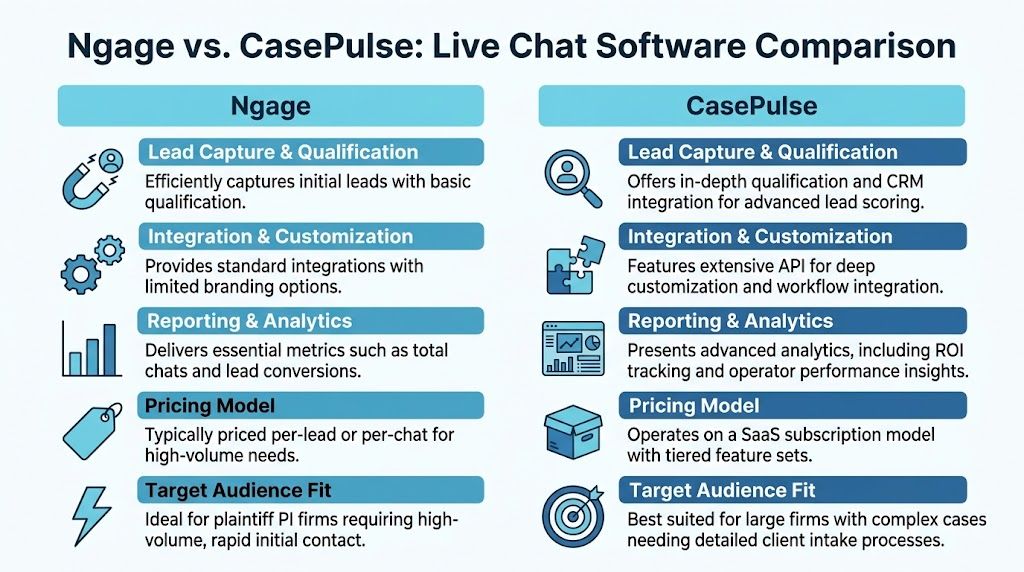
Ngage live chat is the website greeter. It helps a visitor start the conversation.
CasePulse is the personal case concierge. It is built for the ongoing relationship after that first step.
Those are different jobs. Firms get into trouble when they evaluate them as if they are substitutes for the same problem.
They solve different moments in the client journey
Ngage focuses on top-of-funnel engagement. It helps identify and route prospects from the website.
CasePulse is built around ongoing client communication tied to the firm’s working systems. If you need background on that product category, this overview of what CasePulse is gives the broad picture.
That difference matters because many PI firms don’t have a “chat problem.” They have a workflow continuity problem. Their website may need better capture, but their larger burden comes later, when clients call for updates, documents need to move, and staff have to communicate without leaving Needles, Neos, LawBase, or Litify.
Ngage Live Chat vs. CasePulse Client Portal
| Criterion | Ngage Live Chat | CasePulse Client Portal |
|---|---|---|
| Primary purpose | Lead capture and early qualification from website visitors | Ongoing client communication and self-service after intake |
| Typical user | Prospect or anonymous website visitor | Signed client and firm staff |
| Best use case | Engaging visitors before they leave the site | Managing updates, messages, files, and forms across the case lifecycle |
| Workflow handoff | Creates an intake task for staff to review and route | Designed to support work inside existing case management workflows |
| Integration depth | Stronger for initial engagement than for specialized PI system continuity | Purpose-built for direct integration into Needles, Neos, LawBase, and Litify |
| Communication style | Real-time website conversation at the point of inquiry | Structured, ongoing portal communication tied to case activity |
| Operational effect | Helps capture leads that might otherwise bounce | Helps reduce repetitive status calls and manual communication tasks |
| Strategic role | Front-door greeter | Long-term relationship layer |
Where firms misjudge the comparison
The mistake is not choosing one over the other in the abstract. The mistake is buying one while expecting the outcome of the other.
If your marketing team says the site leaks leads, Ngage is the more relevant tool to examine. If your legal ops team says staff are overwhelmed by update calls and disconnected systems, a client portal is the more relevant answer.
Buy a website greeter when you need more conversations. Buy a client portal when you need cleaner service delivery after retention.
A practical selection lens
Use this quick lens with your leadership team:
- Choose ngage live chat first if your biggest pain is anonymous visitors leaving without contacting the firm.
- Choose a portal-first strategy if your biggest pain is managing signed clients inside specialized case systems.
- Use both categories thoughtfully if your firm needs stronger first contact and better post-intake communication, with each tool assigned to its actual role.
This is less about features and more about sequence. Front-end conversion and post-intake communication are related, but they are not the same operational challenge.## Choosing the Right Client Engagement Strategy
The right answer depends on where your firm is leaking time and opportunity.
If your website gets traffic but too many visitors disappear without making contact, ngage live chat is a sensible tool to evaluate. Its value is straightforward. It helps your firm engage prospects at the moment they are deciding whether to reach out.
If your staff is buried in status calls, follow-up messages, document requests, and repetitive client communication after retention, live chat won’t solve that on its own. It may improve the top of the funnel while leaving your largest workload untouched.
Ask the better question
Don’t start with, “Do we need live chat?”
Start with these questions:
- Are we losing leads before intake begins?
- Are we creating manual work when those leads arrive?
- Are our biggest communication problems before sign-up or after sign-up?
Those answers usually point to the right investment faster than any feature list.
For many PI firms, the honest answer is that both stages matter. They need strong lead capture at the website level and a cleaner way to manage communication after intake inside the systems they already use. That’s why managing partners should evaluate ngage live chat as a focused lead-generation tool, not as a complete communication stack.
Used that way, it has a clear place. Used as a stand-in for integrated client engagement, it leaves too much unfinished.
If your firm has already improved lead capture and now needs a better way to handle client updates, messages, files, and forms inside Needles, Neos, LawBase, or Litify, take a look at CasePulse. It’s built for the part of the client journey that starts after intake, where most communication workload lives.