
 CasePulse
 At its core, a personal injury case is a formal process for seeking compensation when someone else's carelessness or intentional act has left you injured. It’s a civil matter, not a criminal one, which means the goal isn't to punish the other party but to secure the financial support you need to recover.
What a Personal injury Case Really Means
Think of it as a way to restore balance. We all operate under an unwritten social contract called a duty of care, which is just a commonsense expectation that we won't act in ways that needlessly endanger others. When someone violates that duty, by texting while driving, neglecting a hazardous spill on their property, or selling a faulty product, a personal injury case is how we hold them accountable.
The focus is squarely on making the injured person "whole" again, at least financially. This means providing compensation to cover the harm they’ve endured. And these situations are far more common than most people realize.
Every year, an estimated 39.5 million Americans need medical attention for injuries, and the sheer volume is staggering. Motor vehicle accidents alone make up a massive 52% of all personal injury cases.
The Three Pillars of a Valid Claim
Just because you were hurt doesn't automatically mean you have a case. Every valid claim rests on three essential pillars. An experienced legal professional is crucial for evaluating these elements. To get a better sense of how they do this, you might want to learn more about what a personal injury lawyer does and how they analyze a potential claim.
A strong case must demonstrate:
- Fault (Liability): First, we have to show that someone else was legally responsible. This could be a distracted driver, a property owner who ignored a safety hazard, or a company that made a defective product. The key is proving they breached their duty of care.
- Harm (Damages): Next, you must have suffered actual harm because of their actions. This isn't just about physical injuries. It includes everything from medical bills and lost income to emotional distress and pain and suffering.
- Proof (Evidence): Finally, you need a clear, provable link connecting the other party’s fault to your harm. This is where evidence becomes critical. Things like police reports, medical records, witness testimony, and photos are used to build that bridge.
Without these three pillars standing strong, building a successful personal injury case is nearly impossible. Understanding this foundation from the start helps demystify the legal journey ahead, turning a confusing process into a manageable one.
The Five Stages of a Personal Injury Case
When you're dealing with an injury, the legal process can feel overwhelming. But it helps to think of it not as a maze, but as a journey with five clear stages. While no two cases are exactly alike, understanding this roadmap can give you a sense of control and clarity.
It all starts the moment you decide to reach out for legal help. That first call or meeting is what kicks off the entire process.
Stage 1: Intake and Consultation
This is where your story begins. During an initial consultation, you'll sit down with a legal team and walk them through what happened. It’s your chance to share the details of the incident, the injuries you're facing, and the real world impact it's had on your life.
The firm’s job is to listen and assess whether your case has the three essential ingredients for success: fault, harm, and proof. Think of it as a two way street. You’re also getting a feel for the firm and asking your own questions. For complex cases involving many people, firms might rely on expert mass tort intake services to help manage the initial wave of inquiries.
If it feels like a good fit for everyone and the firm believes you have a strong case, you'll sign an agreement. With that, your case is officially open, and you move into the next, more hands on phase.
Stage 2: Investigation and Evidence Gathering
Once you've hired your attorney, the real detective work starts. This stage is all about collecting the hard evidence needed to build a powerful and persuasive claim. Your legal team will be digging deep to gather all the critical pieces of the puzzle.
You can expect them to be busy tracking down:
- Official Reports: Police reports, accident reports, or any official write up that documents what happened.
- Medical Records: A complete file of your medical journey, from the emergency room visit to your latest physical therapy session. This proves the extent of your injuries.
- Witness Statements: Finding and interviewing anyone who saw the accident to get their unbiased, firsthand accounts.
- Expert Opinions: Sometimes, we need to bring in specialists like accident reconstructionists or medical experts to lend their professional weight to your claim.
This part of the process takes patience, as pulling everything together can be time consuming. But a thorough investigation is the bedrock of a strong negotiation down the line.
Stage 3: Demand and Negotiations
With a mountain of evidence compiled, your attorney is ready to make the first move. This typically begins by sending a formal demand letter to the at fault party's insurance company. This isn't just a simple note; it's a detailed package that lays out the facts, proves liability, and spells out the full scope of your damages.
The letter makes a clear case for why their client is responsible and states exactly what you're seeking in compensation. This includes tangible costs like medical bills and lost income, as well as non economic damages for things like pain and suffering.
After the insurer gets the demand, their adjuster reviews it and almost always comes back with a lowball offer. That’s normal. It kicks off a round of back and forth negotiations, where your attorney fights to get them to a number that’s actually fair. The reality is that over 95% of personal injury cases are settled right here, without ever setting foot in a courtroom.
A settlement is a practical solution. You agree to a specific sum of money, and in return, you release the other party from any future liability. It gives you a guaranteed outcome without the risk and long wait of a trial.
Stage 4: Litigation and Discovery
What happens if the insurance company just won't budge? If negotiations hit a wall and a fair offer isn't on the table, it’s time to file a lawsuit. This officially kicks off the litigation phase, moving your case from the informal negotiating table into the formal court system.
Don’t panic. Filing a lawsuit doesn't automatically mean you’re going to trial. In fact, it’s often the move that finally gets the insurance company to take your claim seriously. Once the suit is filed, both sides enter a phase called discovery. During discovery, each party has the legal right to request evidence from the other. For tips on what to do right after an accident, take a look at our guide on what every client should know in the first 24 hours of their personal injury case.
This flowchart breaks down the three core components that are essential for any valid personal injury claim, which are the focus throughout every stage of the case.
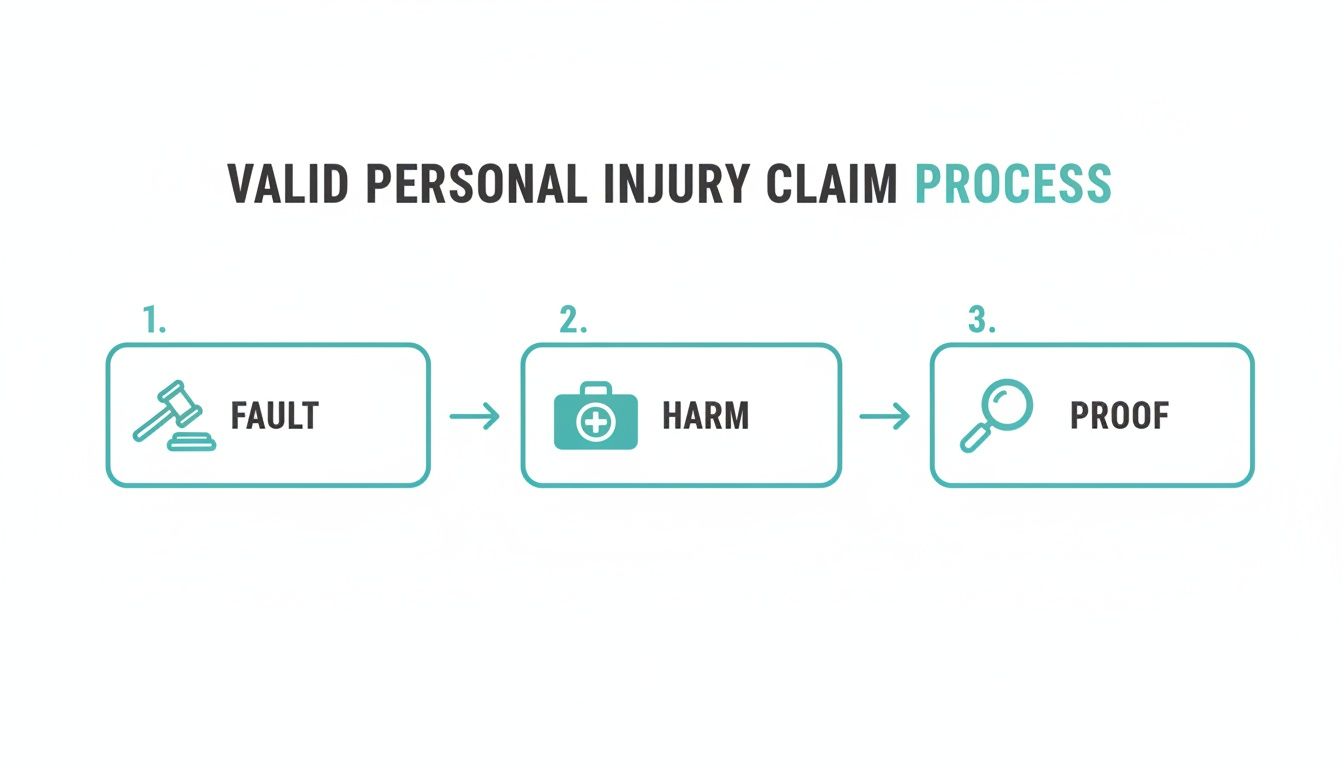
As you can see, a successful case is built on proving someone was at fault, showing you suffered harm, and backing it all up with solid proof.
Stage 5: Resolution: Settlement or Trial
This is the final chapter, where your case is officially resolved. This can happen in one of two ways: through a negotiated settlement or a trial verdict. Even after a lawsuit is filed, your attorney will likely keep the lines of communication open for a potential settlement.
Many cases settle during litigation, sometimes just days or hours before the trial is scheduled to start. A settlement is still the most common outcome because it provides certainty for both sides, eliminating the wildcard of a jury decision.
If no agreement can be reached, your case will proceed to trial. Here, both sides present their evidence and arguments to a judge and jury. After all the testimony, the jury will deliberate and deliver a verdict on who is at fault and how much compensation should be awarded. A trial has the potential for a bigger payout, but it also comes with the significant risk of walking away with nothing.
Understanding Key Legal Concepts in Plain English
Legal jargon can be intimidating, almost like learning a new language. But the core ideas behind a personal injury case are actually pretty straightforward. Getting a handle on them helps you understand the "why" behind your legal team's strategy and requests.
At the end of the day, every personal injury case boils down to three simple questions: Who is to blame? What did this cost you? And how long do you have to take action? The legal world has specific terms for these questions: liability, damages, and the statute of limitations.
Who Is Legally at Fault? The Concept of Liability
First, let's talk about liability. This is just a legal term for responsibility. For any personal injury claim to succeed, you and your attorney have to prove that someone else is legally responsible for your injuries. Most of the time, this comes down to proving negligence. That the other party failed to act with a reasonable amount of care.
Think about a driver texting and running a red light. They were negligent. Any reasonable person knows to stop for a red light and pay attention to the road. By failing to do so, they violated their duty to keep other people safe, and that makes them liable for the crash.
Liability isn't just about a wrong action; it can also be about a failure to act. A classic example is a grocery store owner who knows there's a spill in an aisle but doesn't clean it up. If a customer slips, falls, and gets hurt, the owner can be held liable for their inaction.
Proving liability is the first major hurdle in any case. It gets particularly complex when medical negligence is involved, as you need to show that a healthcare provider’s actions fell below the accepted standard of care. This is often where a medical malpractice expert witness becomes indispensable, as their testimony can clarify complex medical details and pinpoint exactly how that standard was breached.
What Are Your Losses? The Two Types of Damages
Once you've established who is at fault, the conversation turns to damages. This term simply refers to the money you are owed to compensate you for everything you've lost because of the injury. It’s not just a number pulled out of thin air; damages are carefully calculated to cover specific, recognized losses.
Damages are generally split into two buckets:
- Economic Damages: These are the straightforward financial losses with a clear paper trail. Think of them as anything you can show a receipt or a bill for. Medical expenses, lost income from missing work, and the estimated cost of future medical treatments.
- Non-Economic Damages: These are the very real, but intangible, human costs of an injury. There's no price tag for things like physical pain, emotional trauma, or the inability to enjoy hobbies and activities you once loved. This category attempts to compensate for that suffering.
For example, a $1,000,000 settlement in a serious spinal injury case might break down into $400,000 for past and future medical care (economic) and $600,000 for the permanent pain and life changes the person must endure (non economic).
Why Time Is a Factor: The Statute of Limitations
Finally, every personal injury case operates on a strict timeline set by the law, known as the statute of limitations. Think of it as a countdown clock. It’s the absolute deadline for filing a lawsuit after you’ve been injured.
If you miss this deadline, even by a day, you lose your right to seek compensation forever. It doesn’t matter how strong your case is.
These deadlines are different depending on where you live and the type of injury you sustained. One state might give you two years from the date of a car accident to file, while another might give you three. This is precisely why it's so critical to contact an attorney as soon as possible after you get hurt.
The personal injury law sector is a massive field, which tells you just how common these situations are. In the U.S. alone, the industry generated $61.7 billion in revenue in 2026. With over 164,559 attorneys competing for cases, firms that run efficiently are simply better equipped to help clients navigate these complex rules. You can explore more about these figures in the latest personal injury law statistics and what they signal for the future.
The Role of Evidence in Building Your Case

When we build a personal injury case, evidence is the raw material we use to prove your story. Without it, even the most legitimate claim has no foundation. Think of your lawyer as the architect, but the evidence, every photo, report, and receipt, is the brick and mortar needed to construct a convincing argument.
Each document plays a distinct role. Some pieces prove the other party was at fault, while others paint a clear picture of what you've lost. Knowing what to collect helps you become an essential partner in your own legal journey.
Proving Fault and Connecting It to Your Injury
First things first, we have to prove the other party is responsible. Evidence is what draws a straight, undeniable line from their negligence to your injury. This means gathering objective facts that lock down the who, what, and where of the incident.
To build that part of the case, your legal team will zero in on a few key items.
- Photos and Videos: Nothing tells a story like a visual. A picture of a wet floor with no "caution" sign or a dashcam video of a car running a red light can be incredibly persuasive. They capture the scene in a way words never can.
- Official Reports: A police report after a collision or a formal incident report from a store manager provides a third party account of events. These are often viewed as impartial and carry a lot of weight with insurance companies.
- Witness Information: Getting the names and phone numbers of people who saw what happened is critical. An independent bystander who can back up your version of events adds a powerful layer of credibility to your claim.
This initial evidence gathering is absolutely crucial. Without it, you're often stuck in a "he said, she said" scenario, which is a tough spot to be in.
Evidence has to do more than just show what happened. It must directly link the incident to your suffering. For example, a medical expert might testify that the specific force from a rear end collision is what caused your herniated disc, connecting the at fault driver's mistake to the surgery you had to endure.
Documenting the Full Extent of Your Losses
Once we’ve established fault, the evidence shifts to its second major role: calculating the true value of your damages. This is about so much more than just the first round of hospital bills. It’s about capturing every single loss, financial, physical, and personal, to ensure you’re made whole.
This is where meticulous record keeping becomes your best friend. Every document helps tell the financial story of your recovery and justifies the settlement figure we demand.
Keep a file for these key financial documents:
- Medical Bills and Records: This is the bedrock of your damages claim. Collect every single bill, from the hospital, specialists, physical therapists, and pharmacy. Your medical records are just as important, as they detail your diagnosis, treatment plan, and prognosis.
- Pay Stubs and Employment Records: If you were unable to work, your pay stubs are the clearest proof of your lost income. A simple letter from your employer confirming your time off and hourly wage can also be a huge help.
- Receipts for Out-of-Pocket Expenses: Did you have to pay for parking at your doctor’s office? Buy a cane or a brace? Hire someone to mow the lawn because you couldn't? Save every single receipt. These small costs add up.
By gathering these documents, you give your attorney the ammunition needed to build a detailed spreadsheet of your economic damages. It transforms abstract losses into hard numbers, strengthening your position at the negotiating table.
Improving Client Communication and Managing Expectations

When you start a personal injury case, there’s often a flurry of activity right at the beginning. But one of the hardest parts for any client is what comes next: the waiting. It’s completely normal for a case to have quiet periods that stretch for weeks, or even months, especially during the investigation or while your lawyer is in tough negotiations with an insurance adjuster.
This "radio silence" can be incredibly stressful. You’re left wondering if your case has stalled or, worse, been forgotten. While these lulls are a standard part of the legal process, that knowledge doesn't make the anxiety go away. Smart law firms understand this and are finally adopting better ways to keep their clients informed without drowning in phone calls.
A Modern Fix for an Age-Old Problem
The old way of doing things, relying on endless phone calls and emails, just doesn’t cut it anymore. When you have a question, you call your paralegal. If they're on another line or deep in casework, you get their voicemail. Then you wait, hoping for a callback. This cycle of phone tag is frustrating for you and constantly interrupts the very work your legal team needs to focus on to win your case.
Thankfully, there's a much smarter way to handle this now: a secure client portal. Think of it as a private digital dashboard for your case, accessible anytime, from any device. Instead of calling to ask if a medical record was received, you can just log in and see for yourself.
This simple shift gives you a clear window into your case’s progress, transforming a process that often feels like a black box into something open and transparent. It directly tackles that need for information and reassurance.
A client portal acts as a central command center for your case. It’s where you can check for updates, look at important documents, and send secure messages to your legal team. It’s all about providing peace of mind with 24/7 access to information.
This kind of direct access is a game changer. You’re no longer tethered to your lawyer’s schedule just to get a simple update. You can find most answers on your own, the moment a question pops into your head. If you want to dive deeper, you can read more about the client communication best practices that are reshaping how modern firms operate.
How a Client Portal Transforms the Experience
A good client portal does much more than just show you status updates; it fundamentally improves the relationship between you and your law firm. It’s all about building trust through transparency and making everything more efficient.
Features like automated reminders and easy document uploads make a real world difference. For example, if your lawyer needs a signed medical release, the system can automatically send you a notification. You can then fill it out and sign it digitally right then and there, cutting out days of postal delays.
This table highlights just how different the experience becomes.
Traditional vs. Modern Client Communication
The shift from playing phone tag to having on demand access is stark. A client portal eliminates bottlenecks and empowers you with information.
| Activity | Traditional Method (Phone & Email) | Modern Method (Client Portal) |
|---|---|---|
| Case Status Check | Call or email the firm and wait for a response. | Log in 24/7 to see real-time case updates. |
| Document Sharing | Mail, fax, or drop off physical copies. | Securely upload files from your phone or computer. |
| Asking a Question | Leave a voicemail and hope for a quick callback. | Send a secure message and get a notification on reply. |
| Completing Forms | Receive forms by mail, sign them, and mail back. | Fill out and sign digital forms instantly online. |
Ultimately, this modern approach creates a win win. You feel more in control and less stressed because you have on demand access to your case. At the same time, your legal team gets back precious hours to focus on the strategic work that pushes your personal injury case toward the best possible outcome.
Frequently Asked Questions About a Personal Injury Case
Even after you get the big picture, you're bound to have more specific questions about what your personal injury case will actually look like. That's perfectly normal. Let's walk through some of the most common concerns we hear from people just starting this journey.
How Much Does It Cost to Hire a Personal Injury Lawyer?
One of the first questions people ask is, "Can I even afford a lawyer?" The good news is, you absolutely can. Most personal injury attorneys work on a contingency fee basis.
This structure was designed to give everyone a fair shot at justice, no matter what their bank account looks like. You won't pay a dime out of your own pocket to get started. Instead, your lawyer’s fee is a percentage of the final settlement or court award.
Put simply: if we don’t win you money, you don’t owe us a fee. This “no win, no fee” promise means there’s no financial risk on your end. We’ll go over the exact percentage in a straightforward written agreement before any work begins, so everything is crystal clear from day one.
How Long Will My Personal Injury Case Take?
This is the million dollar question, and honestly, there's no single, easy answer. The timeline of a personal injury case depends entirely on the specifics. Think of it like a medical recovery. The duration depends on the severity of the injury.
A straightforward claim with clear fault and minor injuries might settle in just a few months. But for something more complex, we could be looking at one to two years, or even longer if we have to take the fight to a courtroom. Factors like the length of your medical treatment, how willing the insurance company is to negotiate fairly, and the local court’s backlog all play a major role. For instance, a case involving two spinal fusion surgeries could take years to resolve simply because we need to see the full picture of your future medical needs.
What Is My Personal Injury Case Worth?
It’s natural to wonder what your case is worth, but it’s not like a lottery ticket with a set price. The value is a direct reflection of the "damages", or losses, you've suffered. Each person's situation is unique. A simple finger fracture might lead to a $100,000 award, while a severe ankle injury needing multiple surgeries could be valued at $750,000 or more by a jury.
Damages are generally broken down into two buckets:
- Economic Damages: These are the tangible, on paper costs. Think medical bills, lost paychecks from being unable to work, and any other direct expenses you've had to cover because of the accident.
- Non-Economic Damages: This is compensation for the human cost of the injury, the things you can't put a receipt on. It includes your physical pain, emotional trauma, and the loss of your ability to enjoy life's activities.
A good lawyer will dig into every detail, from the severity of your injuries to the strength of the evidence, to build a case for what you are rightfully owed.
Should I Talk to the Other Party's Insurance Adjuster?
Our advice here is simple and firm: do not speak with the other party’s insurance adjuster before you have a lawyer. The adjuster’s job isn't to help you; it's to protect their company's bottom line by paying out as little as possible.
Insurance adjusters are trained negotiators. They might push for a recorded statement, hoping you'll say something, anything, that could be twisted to hurt your claim. Or, they might dangle a quick, lowball settlement offer before you even know how serious your injuries are.
Let your attorney be your shield. They should handle every single phone call and email with the at fault party's insurer. This protects your rights and frees you up to focus on the one thing that truly matters: getting better.
At CasePulse, we know that keeping clients informed is the key to a better experience. Our secure client portal empowers you to check case status 24/7, share documents easily, and communicate with your legal team without ever having to play phone tag. Learn more about how CasePulse can help your firm build trust and efficiency.