
 CasePulse
 SEO for law firms is not just about tweaking your website. It is about strategically positioning your firm so you are the first name a potential client finds when they desperately need legal help. Think of it as transforming your website from a static online brochure into your most powerful client generation tool.
Why SEO Is a Non-Negotiable for Law Firms
Let's be blunt: if potential clients cannot find you online, you might as well be invisible. In today's legal market, search engine optimization is not just another marketing expense; it is the engine that drives modern law firm growth. When someone needs a personal injury or family lawyer, their first move is not the Yellow Pages. It is Google.
This reality means having a website is just the starting point. You need a deliberate strategy to show up for the exact phrases people type in when they are looking for an attorney. This is especially true in competitive legal markets where the fight for online visibility is fierce.
The Modern Client Journey Starts Online
The old days of relying purely on word of mouth referrals and print ads are long gone. The modern client's journey begins with a search query. They are looking for answers, reassurance, and an expert they can trust to navigate a stressful situation. A strong SEO presence puts you right there at that critical first touchpoint.
It is estimated that a staggering 94% of law firms see search engines as their number one channel for building brand awareness. This is not just a trend; it is the new standard. In major cities, organic search is the primary driver of leads and cases. Without a solid SEO game plan, even the most brilliant attorneys will be outranked by competitors who have invested in their online presence.
This flowchart maps out what a successful, sustainable SEO effort really looks like.
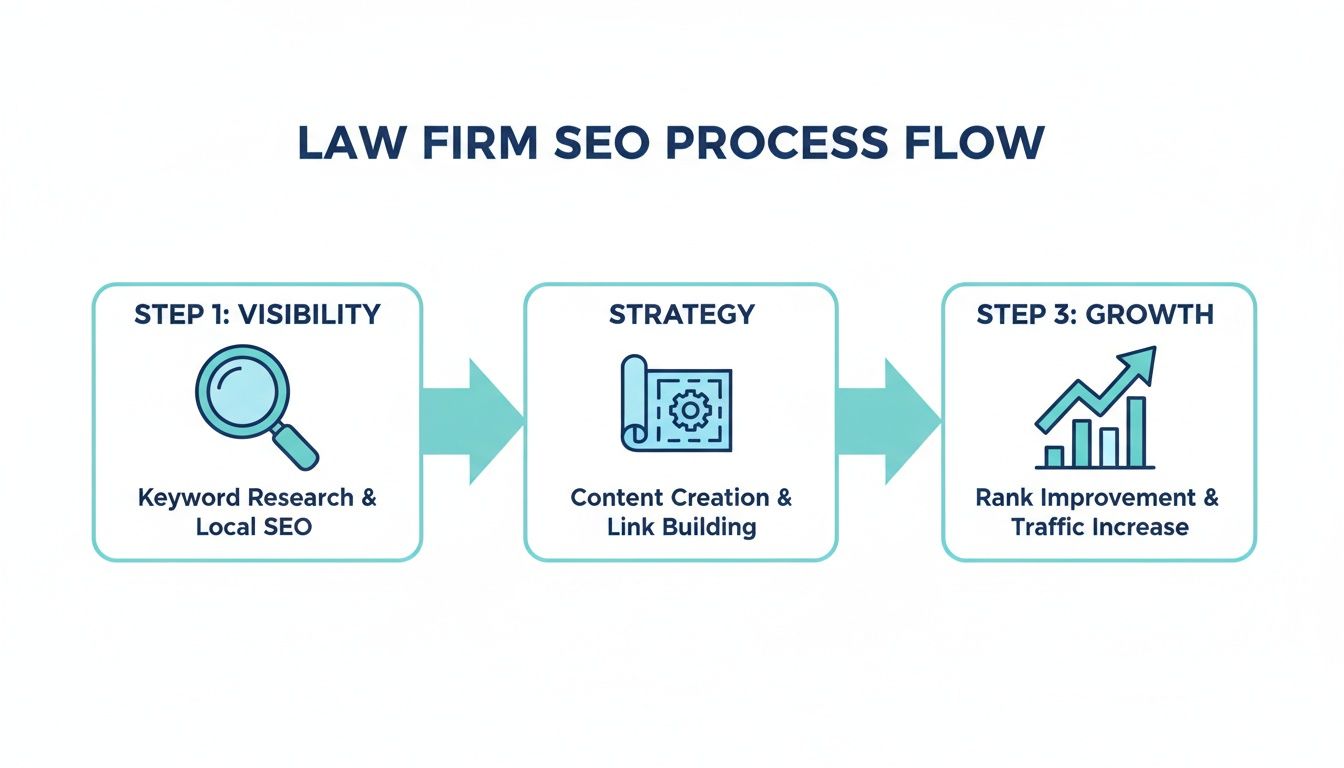
As you can see, it all begins with establishing visibility. That initial traction then feeds into a smarter strategy, which ultimately fuels long term growth.
Building Your Digital Authority
A winning SEO strategy is built on several core pillars. We will dive deep into each one in this guide, but they all work in concert to build your firm's authority and earn trust from both search engines and potential clients.
- Dominating Local Search: This is about showing up for clients in your immediate service area, the people most likely to hire you.
- Targeted Keyword Research: You need to get inside your ideal client's head and understand the precise terms they use when searching for legal help.
- High-Value Content: Creating compelling practice area pages and blog posts that directly answer client questions is how you demonstrate expertise.
- Technical Excellence: A fast, secure, and mobile friendly website is no longer a "nice to have." It is a foundational requirement.
Remember, converting this hard earned online traffic into actual cases also depends on your firm's internal processes. Integrating your marketing with modern firm technology is essential for a smooth client intake experience. If you are still on the fence about the investment, asking Is SEO Worth It? is the first step toward understanding its long term ROI.
Finding the Keywords That Actually Drive Cases
Your SEO strategy lives and dies by the keywords you target. This is not about guessing what potential clients are searching for; it is about digging deep to understand the exact language they use when they are in trouble and need a lawyer.
A huge mistake I see firms make is chasing vanity keywords like "personal injury lawyer." It feels like a win, but it is a black hole for your marketing budget. You end up competing with everyone, attracting a ton of low quality traffic, and wondering why the phone is not ringing. The real gold is in the phrases that signal a specific, urgent legal need.
To find these high value keywords, you have to put yourself in your ideal client's shoes. When a legal crisis hits, what are they typing into Google? They are not searching for a job title; they are searching for an answer to a very real, very specific problem. This is where you have to get obsessed with user intent.
It’s All About Intent
User intent is simply the "why" behind a search query. Once you grasp this, you can focus on phrases that connect you with people who are ready to hire someone.
Think about the massive difference between someone searching for "what do personal injury lawyers do" versus "car accident lawyer near me for rear end collision." The first search is purely informational. It is probably a student or someone just curious. The second is from a person who almost certainly needs legal help, and they need it now.
That single distinction is the foundation of an efficient SEO plan. By zeroing in on high intent keywords, you automatically filter out the tire kickers and attract qualified prospects who are actively looking for your services. These highly specific phrases are what we call long tail keywords.
While they might have lower search volumes individually, long tail keywords are far less competitive and convert at a much, much higher rate. They are the bedrock of a keyword strategy that brings in actual cases, not just a spike in website traffic.
For instance, a family law firm might instinctively want to rank for "divorce lawyer." But a smarter strategy would be to target long tail keywords that reflect actual, complex situations people face.
- "Contested divorce lawyer for business owners"
- "How to file for military divorce in Texas"
- "Child custody attorney for unmarried parents"
Each of these points to a distinct type of client with a clearly defined need. They are infinitely more valuable than a generic search.
Building Your Keyword "Master List"
So, how do you find these gems? The process starts with a simple brainstorm and then gets supercharged with the right tools.
First, sit down and list every single one of your practice areas and the specific services you handle within them. Think about the most common questions clients ask you during initial consultations. Those questions are often the seeds of your most powerful keywords.
Once you have that foundational list, it is time to plug it into a keyword research tool like Ahrefs or Semrush. These platforms give you the hard data you need to make smart decisions.
- Search Volume: Tells you how many people, on average, search for a term each month. Do not be seduced by huge numbers; they almost always mean brutal competition.
- Keyword Difficulty: This score (usually out of 100) gives you a realistic idea of how tough it will be to rank on the first page of Google. Look for the low hanging fruit to get some quick wins.
- Related Keywords: This is where you will strike gold. The tool will spit out hundreds of related phrases, uncovering all sorts of long tail opportunities you would never have thought of on your own.
Let's walk through a real world scenario. Imagine your firm handles workers' compensation cases. A broad term like "workers comp lawyer" is a dogfight. But with a good tool, you can uncover much smarter alternatives.
| Keyword Phrase | Search Intent | Strategic Value |
|---|---|---|
| "workers comp lawyer" | Broad, informational | Extremely competitive, low conversion rate |
| "construction site injury lawyer Dallas" | Local, commercial | Targets a specific niche and city. High-value. |
| "what to do after a workplace fall" | Informational, problem-aware | Perfect for a blog post to attract potential clients early on. |
| "denied workers comp claim appeal attorney" | Transactional, urgent | Grabs a client at a critical, high-stakes moment. |
By mapping out your keywords like this, a clear content plan starts to emerge. You can build a robust practice area page for "construction site accidents" and write a deeply informative article on "how to appeal a denied claim." This is what modern SEO for law firms is all about. It is turning your website into a precision tool that attracts the right clients for your most profitable services.
Winning the Local Search Battle in Your City

For most law firms, your next client is not across the country; they are right down the street. That is why winning at local search is so crucial. It is how you make sure they find you first when they need help. This is not just about having a website. It is a focused strategy to become the most visible and trusted firm in your specific city or neighborhood.
The prize here is a spot in the Google Map Pack, that coveted block of three businesses at the top of local search results. Think about it: when someone urgently searches for a "personal injury lawyer near me," that Map Pack is often the first and only place they look. A strong local presence is one of the most direct paths to new clients you can build.
Your Google Business Profile Is Your Digital Front Door
Your Google Business Profile (GBP) is, for all intents and purposes, your firm's digital storefront. It is the first impression a potential client will have, and leaving it incomplete is like having a messy, unwelcoming office lobby. It needs to be meticulously optimized to signal to both Google and searchers that you are a serious, active, and authoritative local practice.
Start by getting the fundamentals perfect. Your firm's name, address, and phone number (NAP) must be 100% consistent with your website and every other online directory. Even tiny variations like "St." versus "Street" can create confusion for search engines and water down your authority.
Once that is locked in, it is time to dial in the details that many firms unfortunately overlook.
Your Google Business Profile is a living profile, not a set it and forget it task. The table below outlines the core components you need to manage actively for maximum impact.
| Element | Optimization Tip | Why It Matters |
|---|---|---|
| Categories | Choose the most specific primary category (e.g., "Family Law Attorney") and add all other relevant practice areas as secondary categories. | This tells Google precisely what services you offer, helping you show up for a wider range of relevant searches. |
| Business Description | Write a compelling summary that highlights your firm's unique approach, your main practice areas, and your connection to the local community. | This is your chance to make a personal connection and stand out from competitors before they even click to your website. |
| Photos & Videos | Regularly upload high-quality photos of your attorneys, office (inside and out), and team. Videos add an extra layer of trust. | Photos humanize your firm, build credibility, and show potential clients that there are real people ready to help them. |
| Google Posts | Use this feature weekly to share firm news, recent case results (with client permission), or links to new blog content. | Active posting signals to Google that your firm is active and engaged, which can positively influence your ranking. |
| Q&A Section | Proactively add and answer common questions your clients ask. Monitor this section for new questions from the public. | This lets you control the narrative and provide immediate, helpful answers to common concerns, positioning you as an expert. |
Treating your GBP with this level of detail is a game changer. It directly influences your visibility in the Map Pack and gives clients the critical information they need to pick up the phone.
Key Takeaway: A complete and active Google Business Profile is the single most important factor in local SEO for law firms. It is your handshake with the community before you ever meet.
Build Powerful Location-Specific Pages
While your GBP is your digital storefront, your website is your home base. To truly dominate local search, you need to build dedicated pages on your site for each practice area in every specific location you serve. Generic content just will not cut it anymore.
A page simply titled "Car Accidents" is far too broad. A page titled "Chicago Car Accident Attorney," on the other hand, is laser focused and infinitely more powerful. These location specific pages, sometimes called "local landing pages," are engineered to rank for searches that include a geographic modifier.
Each page should feel like it was written specifically for someone in that town. Mention local landmarks, discuss specific state or city laws, and sprinkle in testimonials from clients in that exact area. This targeted content proves to Google that you are the expert for that legal issue in that community. For a more detailed walkthrough, this ultimate local SEO checklist is a fantastic resource.
Manage Your Reputation with Client Reviews
In the world of local SEO, client reviews are gold. They serve as a powerful signal of trust to both potential clients and Google's algorithm, and a steady stream of positive reviews can absolutely boost your rankings in the Map Pack.
More importantly, nearly all potential clients read reviews before deciding which attorney to call. You cannot afford to be passive here.
You need a proactive process for encouraging satisfied clients to leave feedback. Do not just cross your fingers and hope they remember. Even a simple, automated email or text message after a case concludes can make a world of difference.
Remember to respond to every single review, both positive and negative. It shows you value client feedback and are an engaged member of your community.
Creating Content That Converts Prospects into Clients

Getting high value keywords and a perfect local profile to drive traffic is only half the battle. Once potential clients land on your website, it is your content that has to do the heavy lifting, convincing them to stay, trust you, and ultimately, pick up the phone.
Think of your content as your firm’s digital handshake. It is your first and best chance to show off your expertise and start building a relationship before you ever speak to a prospect.
Effective content in SEO for law firms is not about pumping out generic blog posts. It is about strategically building a library of resources that speaks directly to the fears, questions, and urgent needs of your ideal clients. When someone finds a page on your site that perfectly describes their situation, you immediately transform from just another lawyer into a trusted guide.
Building Authoritative Practice Area Pages
Your practice area pages are the absolute pillars of your website. These cannot be just simple service descriptions. They need to be comprehensive, educational hubs that answer every conceivable question a potential client has about that specific legal issue. The goal is simple: make your page the single most helpful resource they can find.
Put yourself in the client's shoes. Someone searching for a "motorcycle accident attorney" is probably grappling with serious injuries, confusing insurance calls, and a mountain of medical bills. A truly powerful practice area page needs to meet them right there, addressing all of those anxieties head on.
To build a page that actually converts, you have to cover the topic from every angle.
- Common Causes and Liability: Break down the typical reasons these accidents happen and who is usually found to be at fault.
- Types of Injuries: Show you understand the medical side by discussing injuries common to these cases.
- The Legal Process: Walk them through what happens after they hire you, from the initial investigation to settlement negotiations.
- Statute of Limitations: Clearly state the filing deadlines in your state. This creates a genuine sense of urgency.
- Frequently Asked Questions: Have a dedicated FAQ section that directly answers the questions you found during your keyword research.
When you structure pages this way, you are not just selling your services. You are preemptively answering their questions, calming their fears, and positioning your firm as the undeniable authority. This is great for clients, and it is exactly what search engines reward.
Turning Complex Law into Client-Focused Advice
Here is the biggest mistake I see law firms make: they write content for other lawyers. Your real audience is scared, overwhelmed, and looking for clarity, not a legal brief filled with jargon. The real skill is translating complex legal concepts into practical, easy to digest advice.
For instance, instead of a dry, academic explanation of "negligence," frame it from the client's perspective with a heading like "Proving the Other Driver Was at Fault." Use real world scenarios to make your points. This simple shift in framing makes the information infinitely more accessible and reassuring.
Expert Insight: Google holds legal websites to a much higher standard called "Your Money or Your Life" (YMYL). This means your content is heavily scrutinized for Expertise, Authoritativeness, and Trustworthiness (E-A-T). Creating helpful, accurate, and client focused content is the single best way to build this trust with both people and search engines.
To build that crucial E-A-T, make sure every piece of content signals your firm’s credibility.
- Attorney Bios: From your practice area pages, link out to detailed attorney bios. Show the real people behind the expertise.
- Case Results: Provide concrete proof of your success by showcasing relevant case results (always respecting client confidentiality, of course).
- Client Testimonials: Weave in quotes and stories from satisfied clients. This adds social proof and humanizes your firm.
These elements all work together to build a powerful, unspoken case for why a prospect should trust you with their problem.
Creating Helpful Articles and FAQs
Beyond your core practice area pages, a blog or a "Resources" section is your chance to capture potential clients much earlier in their journey. This is where you target those informational, long tail keywords, the "what if" and "how to" questions people ask before they are ready to hire someone.
Take a family law firm. While the main practice page might target "divorce lawyer," a helpful blog post could be titled, "How Is Property Divided in a Texas Divorce?" This article will attract people who are just starting their research, establishing your firm as a helpful resource from day one.
Here are a few content formats that work exceptionally well:
- Step-by-Step Guides: Walk readers through a specific legal process, like "A Step-by-Step Guide to the Probate Process in Florida."
- "What to Do After…" Articles: These posts give immediate, actionable advice for people in a crisis, such as "What to Do Immediately After a Slip and Fall Accident."
- Answering Common Questions: Turn the top questions you hear in consultations into their own detailed articles or FAQ pages.
This is not just about attracting traffic for traffic's sake. This type of content builds a deep foundation of trust and positions your firm as the go to expert. That way, when a searcher is finally ready to hire an attorney, your firm is already at the top of their list.
Getting Technical SEO Right for Your Law Firm's Website
Your website might have the most compelling copy in the world, but if it is slow, broken, or insecure, potential clients and search engines will simply pass you by. Technical SEO is the bedrock your entire digital marketing strategy rests on. It is all the behind the scenes work that ensures Google can easily find, understand, and ultimately, rank your content.
Think of it like this: your content and keyword strategy are the arguments you will make in court. Your technical SEO is the courthouse itself. If the building is a maze, has broken doors, and feels unsafe, no one is going to stick around to hear your brilliant case. A technically solid website keeps people on the page, sending a clear message to Google that you are a credible authority.
Make a Strong First Impression with Site Speed
Let's face it, clients often search for a lawyer during a moment of stress. A website that takes forever to load just adds to that frustration, and they will hit the "back" button before they ever find your phone number. Site speed is not just a nice to have; it is a huge part of the client experience and a major ranking factor for Google.
Pages that load in a snap create a better user experience, and Google rewards that. Even a one second delay in mobile load times can slash conversion rates by up to 20%. For a law firm, that could be the difference between landing a major case and losing it to a competitor whose site was just a little bit faster.
The Mobile-First Mandate
These days, the vast majority of legal searches start on a smartphone. Recognizing this shift, Google now primarily uses the mobile version of a website for indexing and ranking, a practice known as mobile first indexing.
What does that mean for you? It means your website has to be flawless on a phone. The text needs to be readable without pinching and zooming, the navigation must be simple, and your phone numbers should be "click to call." If your site is a clunky mess on mobile, you are not just creating a bad experience; you are actively tanking your search rankings.
A seamless mobile experience is non-negotiable. It signals to Google that your firm is accessible and user-friendly, while ensuring that clients in distress can reach you without any added friction.
Securing Your Site and Building Client Trust
Another absolute must have for technical SEO is a secure website, indicated by HTTPS encryption. That little padlock icon in the browser bar protects any information exchanged between a visitor and your site. This is critical for building trust, especially when potential clients are sharing sensitive details through your contact forms.
Search engines like Google actively flag sites that are not secure and give a boost to those that are. That padlock is a simple, visual cue of the professionalism and trustworthiness that clients demand from a law firm.
Clean Site Structure and Schema Markup
Finally, a clean website structure is like a well organized file cabinet. It helps both users and search engines find what they need. You should organize your pages in a logical hierarchy, with main practice areas branching out into more specific services or sub topics. Using internal links between these pages helps spread authority throughout your site.
On top of that, schema markup is a special type of code you can add to your site to give search engines more context about your content. For law firms, this is incredibly powerful. You can use it to explicitly define things like:
- Your specific practice areas (e.g., "Family Law," "Personal Injury")
- Attorney credentials and bar admissions
- Office locations and hours
- Client reviews and ratings
This helps Google generate richer, more informative results for your firm in search, making you stand out right from the results page.
Building Authority Through Links and Reviews
In the legal world, trust is the currency of your reputation. Search engines have their own way of measuring that trust, and two of the most powerful signals are backlinks and client reviews.
Think of a backlink as a digital referral from another website, a vote of confidence that tells Google your firm is a credible source. A client review, on the other hand, is a direct testimonial that speaks volumes to potential clients. Nailing both is a cornerstone of any serious SEO strategy for a law firm.
Earning High-Quality Backlinks
Let's be clear: not all backlinks are created equal. A link from your state's bar association website is worth exponentially more than a link from some random, unrelated blog. The entire game is about earning high quality links that signal you are an authority in your field.
This process, called link building, is all about strategy and ethical outreach. Forget about buying links or using spammy tactics that can get you penalized. The real work lies in building genuine relationships and creating content so valuable that other people want to reference it.
So, where do you start?
A great first step is to tap into your existing professional network. Think about local business groups, alumni associations, or legal organizations you are a part of. These groups often have member directories or resource pages where a link to your firm's site is a natural fit.
Another powerful tactic is to become a go to source for local news. Journalists are always on the lookout for legal experts to weigh in on developing stories. By positioning yourself as an accessible expert, you can land some incredibly authoritative backlinks from trusted news websites.
Here are a few other practical ideas to get the ball rolling:
- Legal Directories: Make sure your firm has a complete and optimized profile on major directories like Avvo, FindLaw, and Justia.
- Guest Articles: If you are a real estate attorney, offer to write an article on "5 Common Closing Pitfalls" for a local realtor's blog. Provide real value to their audience, and you will get a great link in return.
- Local Sponsorships: Sponsoring a local 5K run or a community arts festival often comes with a logo and a link on their website. It is good for the community and good for your SEO.
Link building is not a sprint; it is a marathon. Focus on creating genuinely helpful content and fostering real world connections. Over time, these efforts compound into a powerful backlink profile that search engines will reward.
The Power of Client Reviews
While backlinks build your authority with search engines, client reviews build trust directly with the people you want to hire you.
Nothing signals "hire this firm" for local searches quite like a steady stream of 5-star reviews on your Google Business Profile. This tells both Google and potential clients that you get results and provide excellent service.
You cannot just sit back and hope for reviews to trickle in. You need a simple, repeatable process for asking happy clients to share their experience. This does not need to be awkward or complicated. A well timed email or text message right after a successful case resolution is often all it takes. For a more structured approach, you can find great advice on using client survey tools for law firms to automate and improve this process.
Responding to every review, the good and the bad, is just as crucial. It shows you are actively listening and that you care about client feedback. This level of engagement builds a rock solid online reputation that not only attracts new clients but also reinforces your firm’s credibility.
Answering Your Law Firm's Top SEO Questions
When I sit down with managing partners and legal marketers, the same questions always come up. It is only natural to want clear answers before you invest time and money into something like SEO. Let's tackle some of the most common ones head on.
How Long Until We Actually See Results?
This is the big one, and the honest answer is this: it is a marathon, not a sprint. You are not going to rank #1 overnight. You should plan on seeing the first real signs of progress, think noticeable traffic boosts and a trickle of new leads, within about three to six months.
Why so long? The first few months are all about laying the groundwork. We are fixing technical issues, building out content, and showing Google you are a serious player. Factors like how old your website is, how fierce the competition is in your practice area, and how consistently you work on it all affect the timeline.
But here is the upside: once that foundation is solid, the results start to build on themselves. Paid ads disappear the second you stop paying. A well executed SEO strategy, on the other hand, becomes an asset that brings in organic traffic for years.
My Take: I always tell clients to think of SEO like building a reputation in the legal community. It does not happen with a single ad or event. It is built through consistent, high quality work over time. Once you have that reputation, it works for you constantly.
What Does a Realistic SEO Budget Look Like?
There is no one size fits all answer here. A law firm's SEO budget really depends on your market and your ambitions. If you are a personal injury firm trying to rank in a major city like Chicago, you could be looking at several thousand dollars a month just to keep up. But for a family law practice in a smaller town, a budget of a few hundred to a couple of thousand might be perfectly effective.
Your investment generally breaks down into a few key areas:
- In depth keyword research and strategic planning
- Creating genuinely helpful articles and practice area pages
- Ongoing technical SEO to keep your site healthy
- Managing your local presence (Google Business Profile is huge)
- Building high quality, authoritative links back to your site
It is about matching the investment to the opportunity. The potential return on a single high value case often justifies a significant marketing spend.
What's the Real Difference Between SEO and Paid Search Ads?
Both get you on the search results page, but they work in completely different ways. Think of it as earned media versus paid media.
SEO is about earning your spot. You build organic, unpaid visibility by creating the best content and proving your authority to search engines. It is a long term play that builds trust and credibility.
Paid Search Ads (PPC) are about buying your spot. You bid on keywords to place an ad at the very top of the page. The traffic is immediate, which is fantastic for a specific, short term campaign, but it stops the moment you turn off your budget.
Ultimately, a smart strategy often uses both. PPC can get the phone ringing right away while your long term SEO strategy gains momentum. Over time, a strong SEO presence almost always delivers a better return on investment because you are not paying for every single click.
At CasePulse, we understand that a modern law firm's success is built on a seamless client journey, from their first Google search to their final case update. Integrating a secure client portal like ours directly into your website does not just streamline your operations; it also builds the kind of trust and professionalism that search engines and potential clients love.
See how you can modernize your client communications and support your firm's growth.