
 CasePulse
 Your billing team already knows the pattern. A client says the check is in the mail. Another pays by card, then questions the fee on a large invoice. A settlement disbursement or retainer replenishment sits in limbo while staff chase signatures, confirm receipt, and manually match payments to matters. None of that is unusual in a law firm. It is just expensive, distracting, and harder to justify now that clients expect digital payment options.
For firms that want to accept ACH payments, the issue isn't whether ACH works. It does. The harder question is how to use it without creating trust accounting problems, intake friction, or a messy reconciliation process that paralegals and accounting staff end up cleaning up later.
Law firms have a narrower margin for error than a typical business. You are dealing with IOLTA trust accounts, earned fee deposits, settlement timing, client consent, and systems that already need to stay aligned. If ACH is bolted on as a generic payment method, it can create more operational risk than benefit. If it is set up deliberately, it can reduce paper checks, lower payment cost on larger invoices, and give clients a cleaner way to pay through the same portal they already use for messages, forms, and case updates.
Why Your Firm Should Accept ACH Payments Now
A client approves a replenishment request at 4:45 p.m. through your portal, but the funds still do not post cleanly because staff are waiting on a paper check or chasing a card authorization for a large amount. That delay is not just annoying. In a law firm, it can affect intake timing, trust balance monitoring, and how quickly accounting can reconcile activity to the right matter.
ACH gives firms a practical middle ground between paper checks and card payments. It reduces collection friction on larger invoices and recurring retainers, and it usually lowers processing cost compared with cards. For firms using a client portal tied to systems like Needles or Litify, ACH also fits the way legal billing should work. The client authorizes payment in one secure place, the matter record stays current, and staff spend less time rekeying payment details or answering status calls.
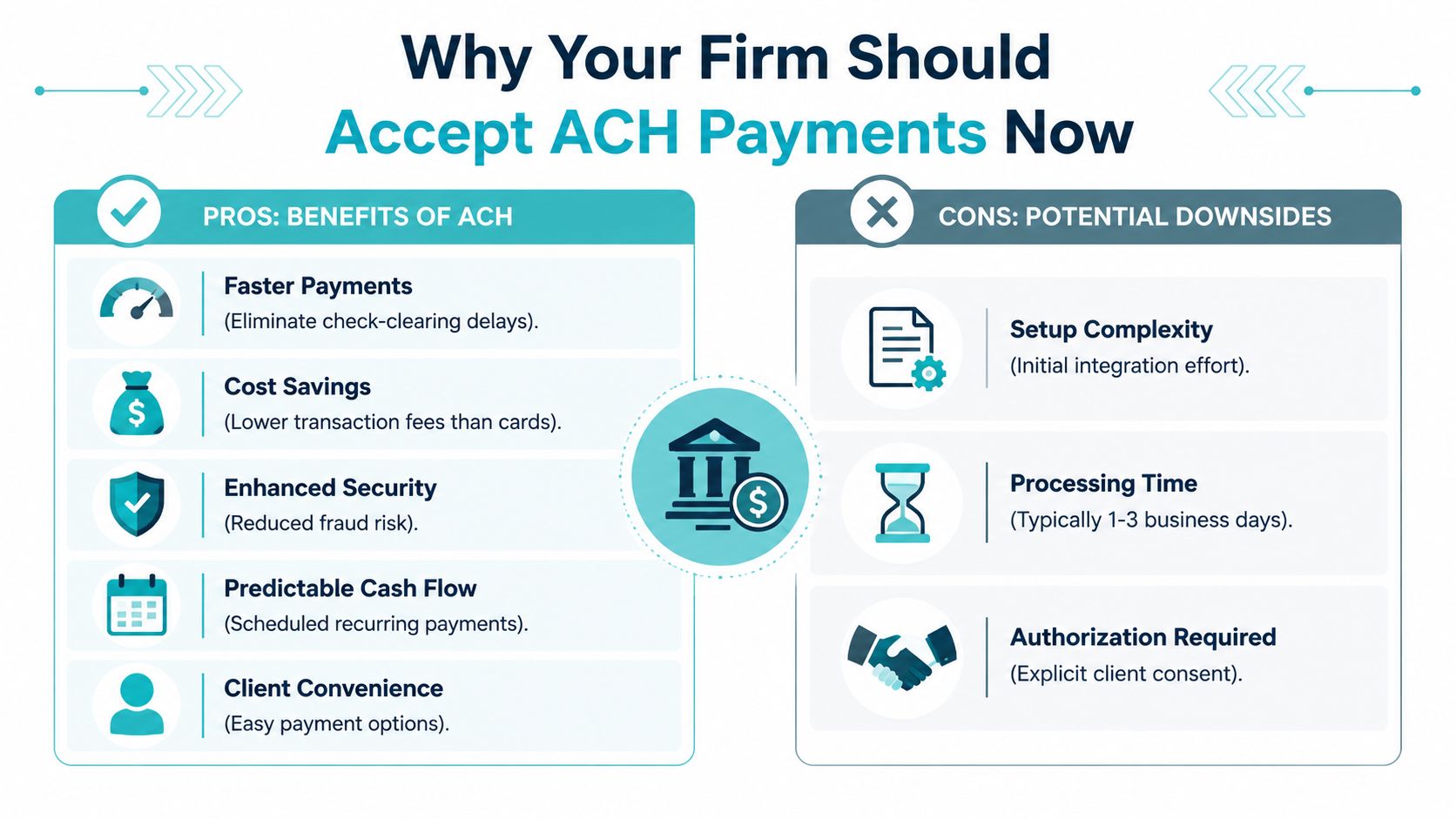
Where ACH helps law firms most
Law firms usually see the fastest return in routine billing operations, not exotic edge cases.
- Retainer replenishment: ACH works well for repeat authorizations, especially when clients fund trust balances through a portal and the payment record needs to sync back to the matter without extra staff handling.
- Larger invoices: Bank payments are often a better fit than cards when invoice size makes percentage-based card fees painful. For many firms, this becomes noticeable in business litigation, contingency cost recovery, and corporate matters with recurring monthly billing.
- Client convenience: Many clients prefer paying a substantial legal bill from a bank account instead of putting it on a card, particularly business clients paying from an operating account.
The operational benefit is larger than the transaction itself. A well-set-up ACH flow can reduce follow-up emails, cut down on payment exceptions, and make month-end reconciliation easier. That is especially true if the payment request, authorization, receipt, and matter update all run through the same portal and billing system. Firms evaluating legal billing software for law firms should treat ACH support as part of that workflow decision, not as a separate add-on.
The trade-off law firms need to accept
ACH is efficient, but it is not the right answer for every payment.
Settlement-sensitive deadlines, urgent filing costs, or any situation where you need immediate confirmed funds may still call for another payment method. ACH returns can also create trust accounting headaches if your process is sloppy, which is why firms need clear authorization language, the right account mapping, and a processor that can support trust and operating workflows separately.
Practical rule: Use ACH for predictable collections and planned client payments. Use faster payment methods where timing is the primary concern.
For managing partners, a key reason to accept ACH now is straightforward. It gives clients an easier way to pay, lowers billing friction for staff, and supports a more controlled collections process when it is built around firm-specific requirements such as IOLTA handling, portal-based authorization, and matter-level reconciliation. Firms in other regulated service environments often make similar payment decisions when comparing digital payment solutions for agencies, but law firms have tighter compliance constraints and less room for reconciliation errors.
Choosing the Right ACH Payment Processor for Your Firm
Law firms often make mistakes when choosing a processor. They compare fees, confirm that the vendor can accept bank account details, and skip the questions that matter later during reconciliation, trust review, and client disputes.

A managing partner usually sees the problem after go-live. Staff are exporting payment reports by hand. Accounting is trying to determine whether a debit belongs to earned fees or client funds. A client says they approved one payment amount, but the firm cannot pull the authorization record quickly. At that point, a low processing rate does not look like a good deal.
What a law firm should evaluate first
A legal practice needs a processor that fits legal operations, not general retail payments.
| Decision area | What to confirm |
|---|---|
| Trust accounting fit | Can the processor support workflows that keep client trust funds separate from earned fees? |
| Matter level reconciliation | Will payments map cleanly back to the right client and matter? |
| Client experience | Can clients authorize and pay without being pushed into a confusing third party experience? |
| Reporting | Can accounting staff quickly see pending, returned, and completed payments? |
| Support | Does the vendor understand legal billing realities, not just generic e commerce? |
If a processor makes it hard to separate trust receipts from operating account collections, reject it. The vendor does not need to replace your accounting system, but it must support clean routing, clear records, and reviewable audit trails that help your firm stay aligned with IOLTA obligations.
Integration matters more than firms expect
In law firms, ACH succeeds or fails in the workflow. If the payment processor sits outside your billing system, your staff will rekey data, chase down missing matter references, and spend month-end fixing preventable errors.
That integration issue is even sharper for firms using Needles, Litify, or similar case management platforms. Payment data should post back to the right client and matter with enough detail for billing and accounting to act on it. If your firm is reviewing legal billing software with ACH support and workflow integration, treat the processor choice as part of that same system decision.
The client portal should be the center of the experience. It gives clients one place to review invoices, authorize debits, and confirm payment activity without relying on email threads or staff callbacks. It also gives the firm a cleaner record of consent and a more consistent collection process.
A related lesson shows up outside legal as well. Organizations comparing digital payment solutions for agencies often focus on operational fit, reporting clarity, and branded payment experiences. Law firms need those basics too, with tighter controls around trust handling and matter-level reconciliation.
The wrong processor rarely causes trouble at checkout. It creates work during reconciliation, return handling, and compliance review.
Questions worth asking on the demo
Do not settle for a product tour. Ask the vendor to show the exact workflow your staff will use.
- Trust handling: How do you help firms route funds correctly when one payment belongs in trust and another belongs in operating?
- Authorization records: Where are authorization records stored, and how quickly can staff retrieve them?
- Return management: How are failed or returned ACH payments surfaced to accounting staff?
- Portal experience: Can clients pay through a branded experience that aligns with the rest of the firm's communication flow?
- Matter syncing: What exactly syncs back to the case or billing system, and what still requires manual entry?
One more point matters in practice. Ask who on the vendor side understands legal accounting and who will help your team during implementation. A processor can look inexpensive on paper and still cost the firm more in staff time if accounting has to monitor exceptions manually.
Understanding NACHA Rules and Client Authorization
Most ACH problems in law firms start before the first payment is ever submitted. They start with weak authorization language, inconsistent onboarding, or poor recordkeeping. If your firm wants to accept ACH payments safely, authorization cannot be an afterthought.
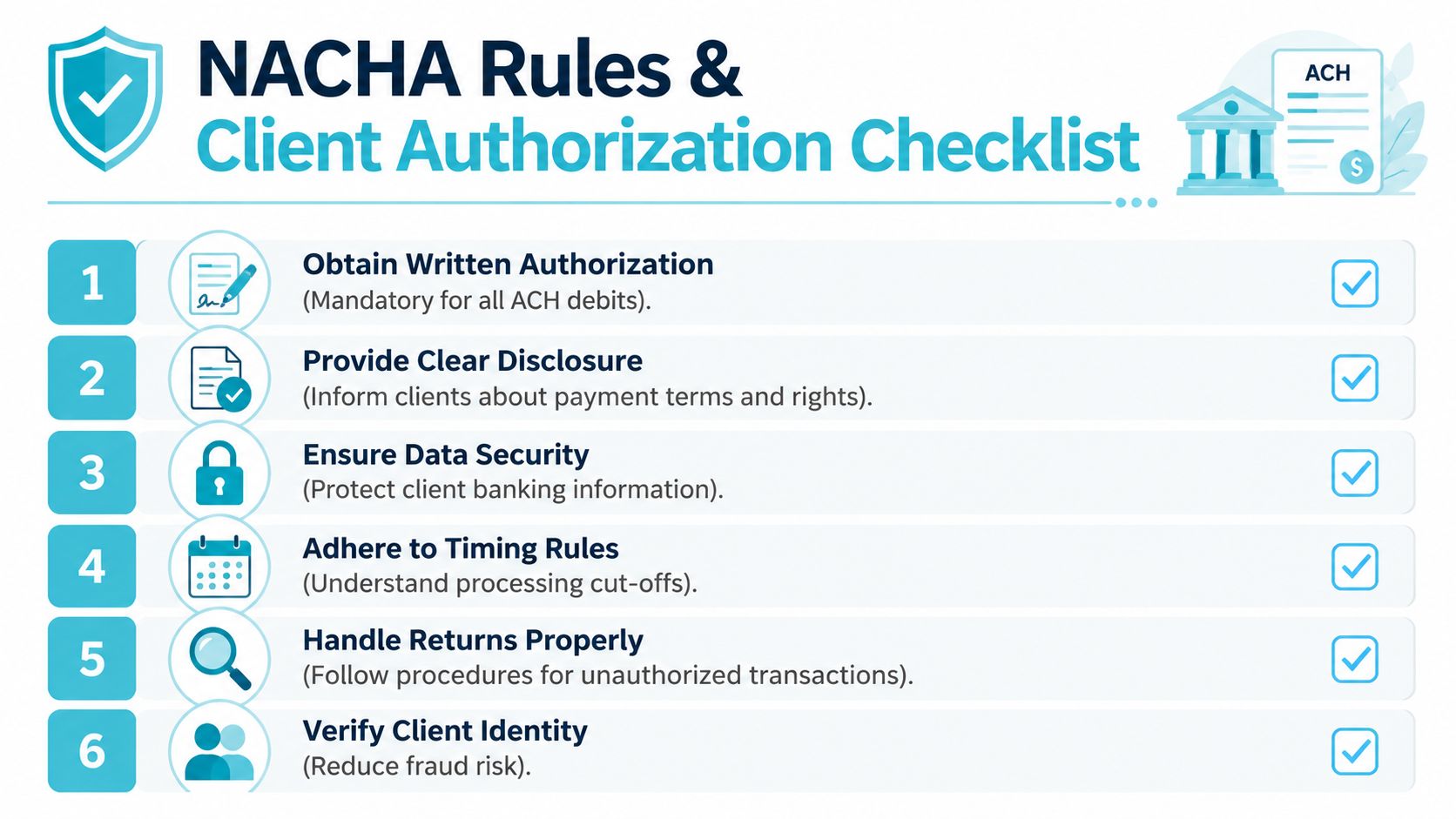
The authorization issue is bigger than many firms expect. The complexity of authorization is a frequently overlooked risk. Firms need a process that captures consent for recurring debits, manages revocation requests, and retains documentation to resolve disputes, as discussed in the U.S. Chamber's guidance on accepting ACH payments and authorization practices. For firms also tightening controls around trust handling, this broader view of trust accounting software is relevant because payment authorization and trust compliance often intersect in practice.
What valid authorization needs to cover
For recurring debits, vague consent is not enough. The record should clearly show who authorized the debit, what account information was provided, what payment the client agreed to, and how revocation works.
At a minimum, your workflow should capture:
- Client identity: The client's full name and a way to connect the authorization to the matter.
- Bank details: Routing number and account number entered through a secure process.
- Debit permission: Clear consent for the firm to debit the designated account.
- Payment terms: Whether the debit is one time or recurring.
- Revocation instructions: A practical way for the client to withdraw authorization.
A sample authorization framework
This is the kind of language firms should adapt with counsel and compliance review, not copy blindly:
I authorize the law firm to initiate ACH debits from the bank account I designate for payment of authorized legal fees, costs, or agreed retainer replenishments. I understand whether this authorization applies to a one time payment or recurring payments, and I understand how to revoke that authorization according to the firm's stated procedure.
That language is not enough by itself, but it points the firm in the right direction. The key is clarity. If a client later disputes the debit, your firm should be able to produce a clean record that shows exactly what was authorized.
Where firms get into trouble
Law firms usually create risk in one of three ways:
- They separate the authorization from the payment experience. The client signs one document, then enters bank information somewhere else, and no one can later prove the records belong together.
- They ignore revocation handling. Staff don't know who receives a cancellation request or how quickly the change must be reflected in the payment system.
- They store records poorly. A screenshot in one inbox and a PDF in another is not an audit trail.
Clear electronic authorization isn't red tape. It's what turns ACH from a convenience feature into a defensible collection process.
A client portal can help here because it gives the firm one place to collect forms, capture consent, and tie payment records back to the client matter. But the portal only helps if the firm decides in advance who owns the workflow, where records live, and how updates are handled when a client changes bank accounts or revokes recurring consent.
Implementing ACH into Your Firm's Daily Workflow
A partner approves a settlement invoice, the client wants to pay that afternoon, and staff are still emailing PDF forms, chasing bank details, and asking accounting which account should receive the funds. That is the point where ACH either helps the firm or creates more administrative risk.

For law firms, daily ACH operations should run through the matter workflow, not alongside it. The cleanest setup uses the client portal as the hub for authorization, account entry, invoice review, and payment status. That matters because firms need one record tying the client's consent, the payment attempt, and the matter ledger together. It also makes reconciliation easier when the payment data has to sync back into Needles, Litify, or the firm's accounting system.
Build the process around payment type and account destination
ACH workflow breaks down when the firm treats every bank transfer the same way. A trust deposit, an earned fee payment, and a recurring replenishment should not follow one generic path.
Set the rules before launch:
Assign each payment type to the correct destination account
Intake retainers and trust replenishments require extra care because the receiving account matters for IOLTA compliance. Earned fees belong on a different path. Staff should never have to guess.Route clients through the portal, not ad hoc emails
The portal should present the invoice or request, capture authorization, and collect bank details in one controlled session. That reduces confusion and gives the firm a cleaner audit trail.Push status updates back into the systems staff already use
Intake, billing, and accounting teams need to see whether a payment is submitted, pending, settled, or returned without checking separate dashboards all day. If your firm works in Needles or Litify, confirm that matter notes, billing status, or task triggers can reflect that payment status in a usable way.Separate initiation from reconciliation
Someone can submit an ACH in seconds. Reconciling it correctly takes process. Accounting should know where settlement reports appear, how they map to client ledgers, and how exceptions are reviewed before anyone marks a balance paid.
Firms that want tighter collections discipline should also review practical guidance on how law firms can collect accounts receivable more effectively.
Give staff a workflow for exceptions
Training should focus on the issues that create write offs, client complaints, and trust accounting problems.
Staff need clear answers to questions like these:
- What happens if a client enters the wrong routing or account number
- Who reviews ACH activity each business day
- How is a returned payment documented in the matter file
- Who decides whether client follow up comes from billing staff or the responsible attorney
- What steps apply when a recurring debit is canceled or a bank account changes
- How does the firm reverse or correct an entry without creating a trust accounting mess
Those decisions should not live in someone's inbox or memory. Put them in the billing procedure manual and in the case management workflow where staff will see them.
Examples from other trust-based organizations can still be useful. Articles about secure payment processing for churches often focus on clear portal-based payment collection and reducing friction for people authorizing remote payments. Law firms have stricter recordkeeping and trust accounting duties, but the operational lesson is the same. Clients are more likely to complete payment when the process is clear, contained, and easy to verify later.
Write the workflow into your client documents and internal controls
If ACH is part of the firm's standard collection process, the paperwork and the internal controls need to match. Engagement letters, payment policies, and portal prompts should use the same language about what the client is authorizing and how the firm handles different payment categories.
At minimum, document:
- Which charges may be paid by ACH
- Whether the authorization is one-time or recurring
- How the client revokes recurring authorization
- How the firm handles trust deposits versus payments for earned fees
- Where the authorization record and payment confirmation are stored
- Who reconciles the transaction to the matter and general ledger
A good ACH workflow is not flashy. It gives the client one clear payment path, gives staff fewer chances to make account-allocation mistakes, and gives accounting a record they can reconcile without pulling data from three systems.
Managing Security and Common ACH Pitfalls
The common assumption is that once a firm turns on ACH, collections become easier by default. That is only partly true. ACH can lower payment cost, but it can also introduce delayed confirmation and return risk that firms don't manage well unless they build procedures around it.
A major underserved issue in ACH operations is return risk. ACH payments can take 2 to 5 business days to fully settle, and firms need processes for monitoring return codes tied to issues like insufficient funds, as explained in this overview of ACH benefits and operational risks. For a law firm, that delay matters because a payment that looks complete on day one may still become a collection problem later in the week.
The pitfalls firms feel most
Here is where firms usually get burned:
| Pitfall | What it causes inside the firm |
|---|---|
| Insufficient funds | Staff think payment is underway, then have to restart follow up |
| Bad account data | Failed transactions, client frustration, extra outreach |
| Stop payments or revoked consent | Disputes that require documentation and careful communication |
| Loose monitoring | Accounting learns about returns too late to act cleanly |
If your firm treats ACH initiation as the finish line, these issues will create confusion. The better approach is to treat submission as the start of a monitored settlement period.
Security needs process, not just software
Protecting client banking data is not just a vendor responsibility. Internal handling matters just as much.
Use basic discipline:
- Limit access: Only staff with a clear operational reason should be able to view payment details or authorization records.
- Keep records centralized: Don't let banking details or consent forms drift into personal inboxes or local drives.
- Use verification controls: Providers often recommend instant bank account verification or micro deposits before submission because failed ACH payments often stem from bad routing details or insufficient funds, as noted earlier in the article.
- Document follow up rules: Decide when staff contact the client, what they say, and who approves deviations.
A returned ACH payment is not just a failed transaction. It is a workflow test.
Cash flow discipline matters more with ACH
Card payments tend to create faster certainty. ACH often creates lower cost with more waiting. That is a good trade in many legal billing contexts, but only if the firm plans for it.
A few practical safeguards help:
- Avoid promising immediate clearance to internal teams
- Hold off on sensitive downstream actions until payment status is sufficiently confirmed
- Review return activity on a set cadence
- Escalate repeat failures instead of retrying casually
If your team is formalizing these controls, it can help to look at structured operational references such as payment management documentation, then adapt the discipline to legal billing and trust accounting realities.
What does not work is treating ACH as a cheaper card substitute. It is a different collection rail. Firms that respect the difference usually do well with it.
Your Firm's Top Questions About ACH Payments
Should initial retainers go to trust and earned fees go to operating
Yes, if your jurisdiction requires that separation, your ACH workflow needs to enforce it from the start.
For law firms, this is not just an accounting preference. It is an IOLTA control. Unearned funds and retainers generally need to post to trust, while earned fees belong in operating after billing and transfer procedures are complete. The right processor and client portal should let staff direct funds to the correct account at the time of payment, instead of relying on manual cleanup later. That matters even more when ACH activity syncs into systems like Needles or Litify, where bad account mapping can create reconciliation problems across the matter.
How long should we expect ACH payments to take
Set client and internal expectations conservatively. ACH does not behave like a card payment, and "authorized" is not the same as "final."
Nacha explains that ACH processing depends on timing, the type of entry, and the institutions involved, and returns can still occur after the initial settlement step. Their ACH Processing Timelines resource is a better operational reference than treating ACH as instant payment confirmation. For a law firm, the practical rule is simple. Do not treat a newly submitted ACH payment as cleared money for trust accounting, disbursements, or other sensitive downstream actions until your workflow says it is sufficiently confirmed.
What if a client disputes or revokes an ACH authorization
Your defense is the authorization record. The firm should be able to produce the client's consent, the payment terms presented to the client, and the method the client was given to revoke future debits.
A secure client portal helps here because the authorization, timestamp, account details, and matter context stay in one system instead of being scattered across email chains, PDFs, and staff notes. If a client revokes consent, staff need a documented stop process immediately, especially for recurring debits tied to payment plans.
Is ACH always better than card payments for law firms
No. ACH usually makes more sense for larger invoices, evergreen retainers, and recurring payment plans where processing cost matters and the firm can tolerate slower confirmation.
Cards remain useful for situations where immediate payment confirmation is more important than cost, or where the client strongly prefers to pay that way. Many firms do best with both options available through the same portal, then apply policy rules by payment type, matter stage, and destination account.
What is the biggest implementation mistake firms make
Firms get into trouble when they add ACH as a checkout feature without building the surrounding controls.
In practice, the failure points are predictable. Staff collect authorization outside the approved system. Trust and operating deposits are mapped inconsistently. Return activity is reviewed late, or not at all. The stronger approach is to make ACH part of the same operating workflow the firm already uses for billing, client communications, and matter management. That usually means the client portal becomes the collection hub, and the payment data flows back into the case management system the team already works in.
If your firm wants a cleaner way to handle client communication, forms, and payment related workflows without pushing staff into another disconnected system, CasePulse is worth a look. It gives law firms a secure client portal that works with platforms like Needles, Neos, LawBase, and Litify, so clients can interact with the firm in one place while staff stay inside their existing workflow.