
 CasePulse
 Attorney rates keep climbing, but higher prices alone do not create a stronger billing model. The firms that perform best treat the attorney hourly rate as both a pricing decision and a service design decision.
Managing partners rarely have a pure math problem here. They usually have a systems problem. Rate sheets, intake scripts, matter staffing, invoice narratives, and client updates often developed separately over time. Clients feel that disconnect quickly. They see a quoted rate, then an invoice with multiple timekeepers, uneven descriptions, and no easy way to confirm progress or next steps.
That gap affects profit and client confidence at the same time.
Clients now expect more than a number. They want to know who will handle the work, what tasks will be delegated, how often invoices will arrive, and what they can review between bills. Firms that answer those questions early tend to collect faster and spend less partner time resolving preventable billing friction. Firms that stay vague usually create write-downs, delayed payments, and avoidable skepticism about value.
The operational side matters just as much as the rate itself. A firm can justify a premium more effectively when clients can review updates, documents, and billing detail in one place, and when those tools are usable for everyone, including through attention to digital accessibility for law firms. Billing transparency is no longer just a courtesy. It is part of the client experience, and firms that build it into their process turn it into a competitive advantage.
The Modern Challenge of Setting Attorney Rates
A wide gap in attorney rates is now standard across the market. For managing partners, that means pricing can no longer be treated as a simple local benchmark exercise. Rates now reflect how the firm is staffed, how matters are managed, how clearly work is explained, and how easy it is for clients to stay informed.
Many firms still rely on a cost-plus method. They total compensation, occupancy, technology, and target margin, then set a number that seems defensible. That approach may produce a workable rate sheet, but it often misses the client side of the equation. Clients do not buy your overhead. They judge the experience of working with the firm, including response times, handoffs between timekeepers, billing clarity, and whether the matter feels under control.
Why the old pricing habit breaks down
Rate setting now sits at the intersection of finance, operations, and client service. A rate increase announced without context tends to create pushback. A premium rate paired with vague invoices creates even more. On the other hand, a lower rate without disciplined staffing and scope management can erode profit on matters that looked healthy at intake.
I see the same pattern in firms that struggle with collections. The issue is rarely the number alone. The issue is that the rate, staffing plan, invoice format, and client communication process were designed separately.
Clients want to understand what they are paying for before the first dispute appears. They expect clear staffing, predictable updates, and an easy way to review documents, status, and charges online. Firms that provide that visibility put themselves in a stronger position to defend their rates and shorten the time to payment. Practical improvements outside billing matter too. For example, firms reviewing their client experience often overlook digital accessibility for law firms, even though accessible intake and communication workflows affect how clearly clients can engage with the firm from the start.
Practical rule: A rate sheet should change only as fast as the firm can explain and support it operationally.
What firms need now
Managing partners need a billing model that does three things at once:
- Protects margin by aligning rates with staffing, overhead, and matter complexity
- Builds trust by making invoices easier to understand before the first bill goes out
- Supports modernization by fitting the way clients want to communicate and monitor their matters
The firms pulling ahead treat billing transparency as part of business development and service delivery, not just accounting. A client portal, clear matter updates, and consistent invoice narratives do more than reduce billing questions. They help justify the rate, improve collection speed, and give the firm a competitive advantage in a market where clients compare not only price, but also clarity.
Deconstructing the Attorney Hourly Rate
Most clients hear one number and assume it covers everything. That's rarely how legal billing works in practice. The attorney hourly rate is better understood as the lead price in a broader staffing system.
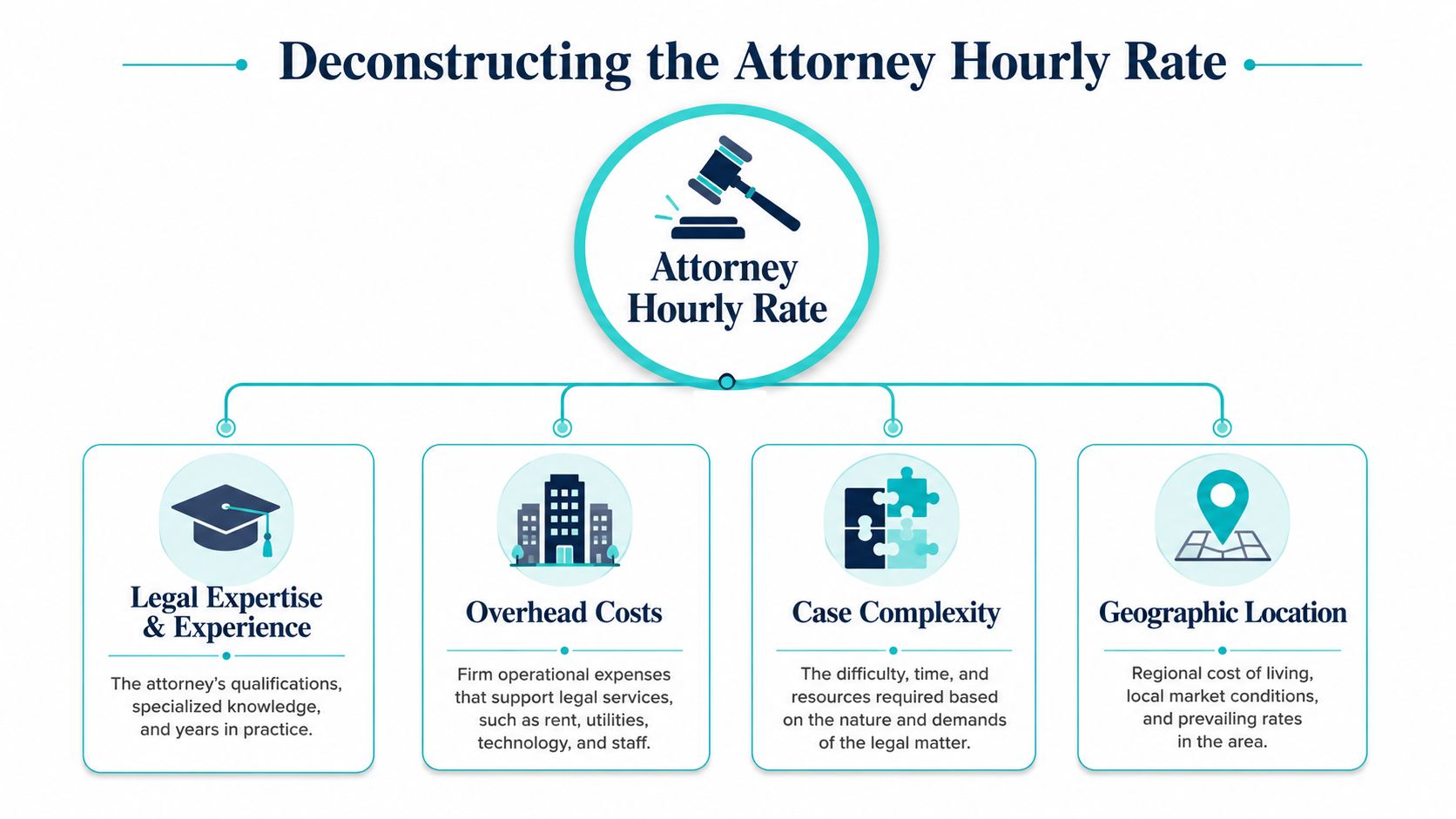
Consider it as a trial team rather than a solo advocate. The partner's rate is one part of the total cost structure, but the final bill also reflects the associate handling, paralegal support, administrative coordination, and the way time is recorded and described. If a firm doesn't explain that early, the client often believes the quoted rate is an all-in figure.
What the billable hour actually means
In most firms, time is recorded in tenths of an hour. That means six-minute increments. A short call, a document review, a strategy email, and a case update can each become separate time entries if they meet the firm's billing standard.
That doesn't make the system wrong. It means the system needs explanation.
Clients usually accept time-based billing when they understand three things:
- Who performed the task
- Why that person was the right level of timekeeper
- How the task moved the matter forward
Without that context, even a reasonable invoice can feel padded.
Why one quoted rate creates confusion
One of the biggest misunderstandings in legal billing is the assumption that all personnel are billed at the lead attorney's rate. In reality, Accurate Legal Billing notes that partner rates average $400 to $1,000+, while non-lawyer staff such as paralegals are billed at about $193 per hour in 2024, and many clients still assume there is one flat rate for everyone.
That misunderstanding causes friction in two directions. Clients feel surprised when they see multiple timekeepers. Firms feel frustrated because they staffed the matter efficiently and still end up defending the invoice.
A clear billing conversation at intake prevents more fee disputes than a polished collections email ever will.
How to explain it better
Use a tiered explanation, not a single-number quote. A simple version sounds like this:
- Lead attorney time covers strategy, legal judgment, negotiations, and high-stakes decisions
- Associate time covers research, drafting, and day-to-day legal execution under supervision
- Paralegal time covers process-heavy work that shouldn't be billed at attorney rates
- Administrative handling may be included or treated separately, depending on firm policy
If your time capture is messy, your explanation will be messy too. Firms that want cleaner invoices should tighten timekeeping before they rewrite engagement language. This guide to improving law firm timekeeping efficiency is a useful operational reference because rate communication only works when the records behind it are disciplined.
Key Factors That Determine Your Billing Rate
A durable pricing model starts with realism. Your billing rate should reflect what the market will bear, what your delivery model costs, and what kind of legal judgment the client is buying. When firms skip one of those variables, they either underprice good work or overprice routine work.
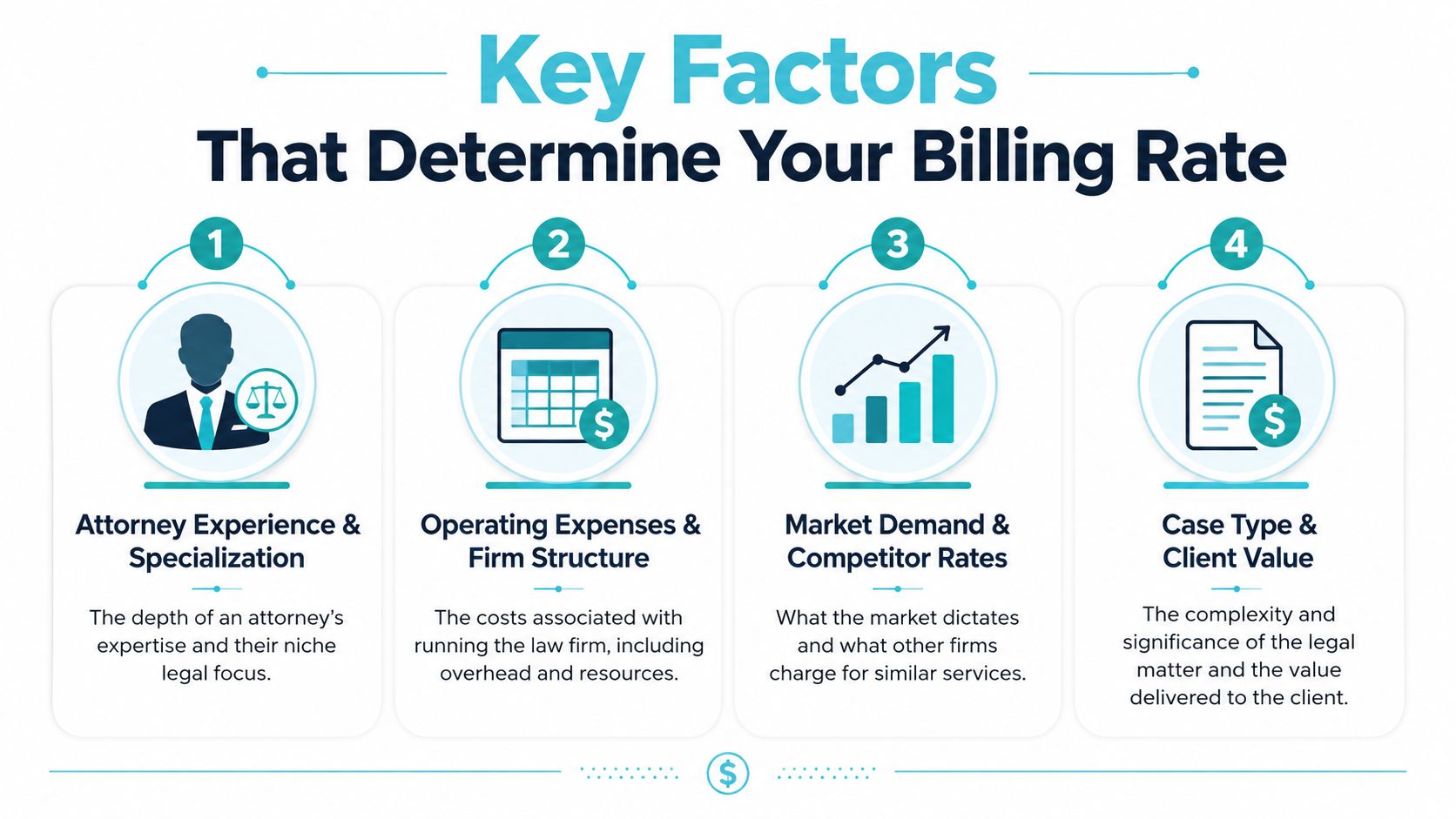
Experience changes what clients are paying for
Experience doesn't just affect reputation. It changes the nature of the service. Senior lawyers often spot risk faster, narrow strategy sooner, and avoid rework that less experienced teams may not see coming.
That difference shows up directly in rate data. According to LawPay's state and experience analysis, attorneys with 20 to 30 years of experience charge between $511 and $606 per hour on average, while attorneys with less than four years of experience average $182 to $212 per hour.
This is why “competitive pricing” can become a trap. If a highly experienced partner prices like a junior-heavy competitor, the partner may win matters that are profitable only on paper. The matter looks healthy at intake and leaks margin in delivery.
Geography still matters, but it's not the whole story
Location remains a major rate signal because it shapes client budgets, labor costs, and local expectations. National data still shows wide variation between states and markets. That said, geography should be treated as a boundary condition, not the sole answer.
If you're in a premium market, clients expect stronger infrastructure and smoother service. If you're in a lower-rate market, clients still expect clarity and responsiveness. The rate ceiling changes. The need for operational discipline doesn't.
Firm structure affects more than overhead
Large firms don't only charge more because they spend more. They often support premium pricing through deeper specialization, broader staffing options, and more institutional process. Smaller firms can compete effectively, but they need to be sharper about where partner time is used and where it isn't.
Bookkeeping becomes strategic rather than clerical. If you don't understand your cost per timekeeper, matter type profitability, and realization patterns, rate setting turns into guesswork. Managing partners who want cleaner pricing decisions should connect rate reviews with matter economics and law firm bookkeeping discipline.
Four practical levers to review before changing rates
- Seniority mix: If partners are doing work that associates or paralegals could handle, your rate may be fair but your staffing model isn't.
- Matter profile: Commodity work resists premium billing. High-stakes advisory work can support it.
- Operational burden: Complex approval chains, slow collections, and rework all affect the rate you realize.
- Market position: A firm known for speed, clarity, and narrow expertise can usually defend pricing better than a generalist firm with vague intake and uneven billing narratives.
Firms don't lose pricing power only because the market pushes back. They lose it because the invoice doesn't match the story sold at intake.
National and Regional Rate Benchmarks for 2026
Benchmarking your attorney hourly rate is less about copying the market and more about locating your firm within it. If your rates are materially above peers, you need a stronger justification. If they're materially below peers, you need to know whether that's strategy or drift.
The cleanest national benchmark available is this: Clio reports that as of 2025, the average hourly rate for a lawyer in the United States is $349, with small firms at $262 per hour and large firms above $439 per hour. Those figures are useful because they frame the conversation by firm size rather than relying only on anecdotes from your local market.
2026 Attorney Hourly Rate Averages by Firm Size
| Firm Size | Average Hourly Rate |
|---|---|
| Small firms | $262/hour |
| All firms average | $349/hour |
| Large firms | Exceeds $439/hour |
Those numbers should be used as directional benchmarks for 2026 planning, since the underlying source states them as 2025 figures. They are most useful when paired with internal data on realization, write-downs, and staffing mix.
Regional comparisons that sharpen the picture
Regional variation remains substantial. ConsumerShield's 2025 overview of lawyer costs places the national average at about $349 per hour, with a range from $196 in West Virginia to $490 in Washington, D.C. That gap shows why firms shouldn't borrow rate logic from a different market without adjusting for local demand and client expectations.
For firms serving matters that begin with an advance deposit, benchmark rates should sit alongside your retainer policy. A rate that looks reasonable on paper can still create intake friction if the initial payment structure is mismatched to the client base. This breakdown of the typical retainer fee for an attorney is useful for that part of the conversation.
How to use benchmarks correctly
- Compare like with like: Measure your rates against firms with similar staffing depth and matter profile.
- Look beyond posted rates: Focus on collected revenue, not just standard rates.
- Review outliers carefully: A low-performing practice group may have a pricing problem, a realization problem, or both.
Benchmark data helps. It doesn't replace judgment.
Comparing Hourly Billing with Modern Alternatives
Hourly billing still has a legitimate place in legal practice. It works best when scope is uncertain, strategy evolves in real time, and the client understands why flexibility matters. The trouble starts when firms use hourly billing as the default for matters that could be packaged more clearly.
For many practice areas, the better question isn't “Should we abandon hourly billing?” It's “Which parts of our work benefit from it?”
Where hourly still earns its keep
Hourly billing remains useful for litigation, complex investigations, and advisory work where the path changes as facts develop. It protects the firm from underestimating work and gives clients a detailed record of activity.
But hourly billing also places the burden of uncertainty on the client. The client doesn't just buy legal work. The client buys exposure to changing scope.
That's why alternative fee arrangements keep gaining traction in specific workflows. According to Attorney at Work's analysis of hourly and flat-fee performance, flat fee matters close 2.6 times faster and are paid nearly twice as quickly as hourly matters. That doesn't make flat fees universally better. It does mean firms should stop assuming hourly is the most efficient option for every matter type.
Billing Model Comparison Firm vs. Client Perspective
| Billing Model | Pros for Firm | Cons for Firm | Pros for Client | Cons for Client |
|---|---|---|---|---|
| Hourly billing | Protects against uncertain scope, supports detailed invoicing, fits evolving matters | Slower payment cycles, heavier billing administration, more invoice scrutiny | Visibility into work performed, flexible when facts change | Less predictability, harder to budget, risk of invoice fatigue |
| Flat fee | Faster matter closure, quicker payment, easier packaging of repeat services | Scope creep risk, bad pricing assumptions can erase margin | Predictable price, simpler buying decision, fewer billing surprises | May feel expensive upfront, limited flexibility if matter changes |
| Contingency fee | Strong upside in the right case, attractive to clients who need access | Revenue risk, selective intake required, long cash cycle | Lower upfront cost, alignment around outcome | Less control over total fee at resolution, not available for every matter |
| Hybrid model | Balances predictability and flexibility, can match staffing and matter phases | Harder to design and explain, requires disciplined scoping | Better budget control with room for complexity | More complex engagement terms, may require closer upfront review |
What tends to work in practice
A practical hybrid often performs best. Use hourly billing for strategic phases that are hard to predict. Use flat or capped components for repeatable tasks, intake stages, or procedural milestones. That structure is easier for clients to absorb and easier for the firm to defend.
Some firms also use client testimonials and implementation stories to test whether their service model feels clear from the client side. Collections improve when the service experience supports the pricing model. If you want outside examples of how firms present modernization and client communication, it's worth reviewing AI law client stories for patterns in how legal service providers explain efficiency and value.
For firms reevaluating when hourly billing still makes sense, this overview of billable hours meaning in law firms is a useful operational reference point.
Communicating Rates and Improving Billing Transparency
The firms that handle billing best usually don't have the cheapest rates. They have the clearest explanations. Clients can tolerate expensive legal work more readily than confusing legal bills.
That matters because pricing power is tied to perceived value. The best recent example is the one already noted at the start: Christopher Clark raised his rate to $3,000 per hour without client objection, as reported by The Wall Street Journal. Most firms won't operate at that level, but the lesson scales down. When clients understand the value, the process, and the staffing model, resistance falls.
Here's what modern billing visibility can look like in practice:

What to say before work begins
A strong engagement conversation should answer the questions clients are often reluctant to ask directly. Don't wait for the first invoice to explain who does what.
Use language like this:
- On staffing: “Your matter will be handled by a team. Strategic decisions stay with the attorney responsible for the matter, while supporting work may be assigned to other timekeepers at different rates.”
- On estimates: “This estimate is based on the current scope. If facts change, we'll flag that early rather than surprise you later.”
- On invoicing: “Each invoice will identify the task, the timekeeper, and the time spent so you can see how the work progressed.”
That kind of language lowers anxiety because it gives clients a model they can follow.
Why visibility beats reassurance
Telling a client “we'll keep you updated” is weak. Giving the client a reliable place to check status, exchange messages, upload files, and complete forms is stronger. Transparency works best when it's built into the process, not delivered as a promise during intake.
Clients don't want more billing language. They want fewer surprises.
For plaintiff firms and high-volume practices, client portals are particularly important. When clients can review case status and communications on their own schedule, staff spend less time answering routine calls and more time on case-moving work. Billing becomes easier to defend because the client has ongoing visibility into activity instead of receiving a bill divorced from the broader case experience.
A short transparency checklist for managing partners
- Spell out timekeeper tiers in the engagement letter
- Set expectations on update cadence before the matter opens
- Use plain-English invoice narratives instead of internal shorthand
- Flag scope changes early rather than burying them in the next invoice
- Give clients self-service access to status, messages, and routine follow-up items when your workflow supports it
A firm doesn't need to lower rates to improve client satisfaction. It usually needs to communicate the rates like a business that expects to be understood.
Frequently Asked Questions About Attorney Rates
How often should a firm review its rates
At minimum, review rates on a regular annual cycle and again when staffing, practice mix, or local competition changes materially. Don't make rate review a once-a-year spreadsheet exercise. Tie it to realization, matter profitability, and collections experience.
Should you publish rates on your website
Sometimes. For highly standardized services, published pricing can reduce intake friction and qualify leads faster. For complex matters, published rates can create false certainty because staffing and scope vary. Many firms do better by publishing their billing philosophy instead of a rigid rate card.
What should you do when a client disputes a bill
Start with the narrative, not the balance. Walk through the invoice line by line, identify whether the objection is about scope, staffing, timing, or communication, and correct the underlying issue. If the bill is right but the explanation was poor, improve the explanation. If the scope drifted without warning, the firm owns part of that problem.
Is a higher attorney hourly rate always better for profitability
No. A higher standard rate with heavy write-downs is weaker than a lower rate that clients understand and pay promptly. Rate strength comes from a combination of positioning, staffing discipline, and billing transparency.
When should a firm move away from pure hourly billing
Move when the work is repeatable enough to scope responsibly, when clients consistently push for predictability, or when hourly invoicing creates more friction than value. Keep hourly billing for matters where uncertainty is real and legal judgment unfolds over time.
CasePulse helps law firms turn billing transparency into a better client experience. Its secure client portal lets clients check case status, message the team, share files, and complete forms from any device while staff stay inside existing systems like Needles, Neos, LawBase, and Litify. If your firm wants fewer inbound status calls, smoother communication, and a more modern way to support trust around legal work, take a look at CasePulse.