
 CasePulse
 Billable hours are the time a lawyer spends on client specific work that can be invoiced, while non billable time covers overhead like admin, training, and internal meetings that cannot. In practice, the average lawyer bills only 1,693 hours annually, even though many firms set targets between 1,800 and 2,200 hours, and only about 37% of total worked time is billable.
That gap is why the billable hours meaning matters so much more than a dictionary definition. If you run a law firm, or you're a new associate trying to understand what the pressure is really about, the issue isn't just whether time can be billed. It's whether the firm can turn effort into collected revenue without exhausting the people doing the work.
A lot of lawyers talk about billables as if the only question is whether someone hit target. That misses the operating problem. A firm can have lawyers working hard all week and still leave money on the table because time isn't captured, entries are vague, invoices get cut, or clients push back on charges they don't understand.
The Billable Hour a Double Edged Sword for Law Firms
The average lawyer bills only 1,693 hours annually, and only about 37% of an employee's total worked hours are billable to clients, according to LeanLaw's analysis of billable hours in a year. This figure should reshape perceptions of billables. The pressure isn't just about productivity. It's about how much of a lawyer's workday turns into revenue.
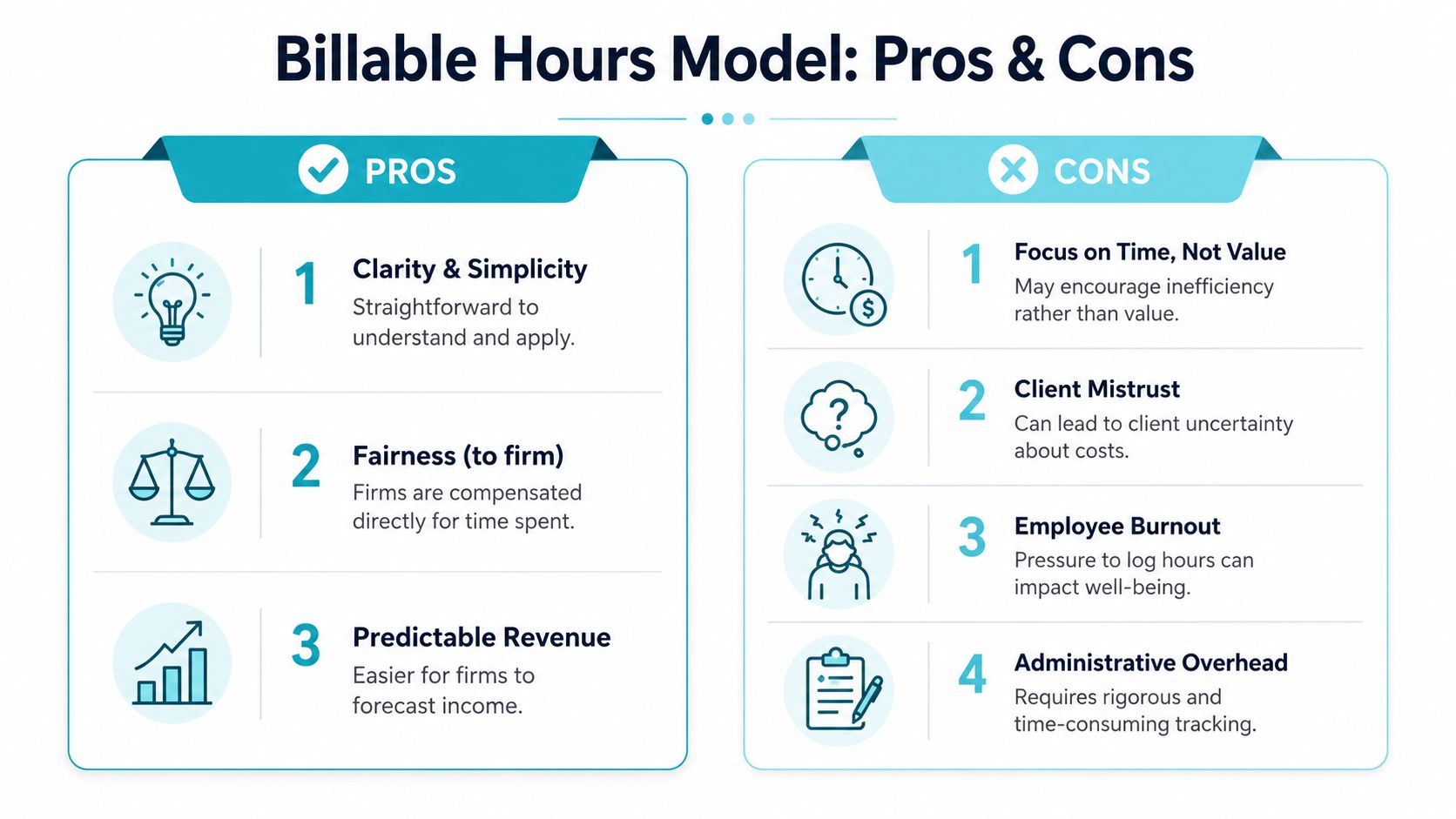
For many firms, the billable hour remains the core business model because it's straightforward. Time gets worked, recorded, invoiced, and collected. But the same model also creates strain. Associates feel constant pressure to log time. Partners spend hours reviewing narratives. Clients scrutinize invoices line by line when they don't see the connection between the work and the value delivered.
Why the model survives
The billable hour survives because it does a few things well.
- It creates a common unit of work. Partners, associates, and staff can all measure effort against the same standard.
- It supports forecasting. Firms can project revenue based on timekeeper rates and expected workloads.
- It disciplines matter management. When time must be recorded, lawyers become more aware of where effort goes.
Still, a billable target by itself doesn't tell you whether a matter is healthy, whether a client relationship is profitable, or whether your team is drowning in overhead.
Billable hours are the engine. They aren't the whole financial picture.
Law firms that manage this well usually look beyond time entries alone. They tighten workflows, reduce administrative friction, and make it easier for lawyers to stay in billable work. Operational improvements outside the billing department matter here too. Firms exploring infrastructure changes often look at resources on the benefits of managed IT for legal services because reducing system friction can protect attorney time that would otherwise disappear into avoidable overhead.
What Are Billable Hours in a Legal Context
In a law firm, billable hours are the time spent on work that directly advances a client's matter and can be charged under the engagement. Productive defines billable hours as time spent on activities that directly progress a client's project status, such as consulting, legal work, or strategy sessions, and says they exclude internal meetings or admin tasks in its guide to billable hours.
The easiest way to understand billable hours meaning is to think of a law firm's inventory. A manufacturer can count finished goods. A law firm can't. What it has instead is lawyer time that can be tied to a client matter. If the work advances the matter and the engagement allows it, that time is inventory. If it keeps the firm running internally, it's overhead.
The bright line that matters
Lawyers get into trouble when they blur that line. A client call about case strategy is usually billable. An internal meeting about office procedures isn't. Research for a motion is typically billable. Training a new associate on the firm's internal system usually isn't.
This distinction matters for three reasons:
- Pricing accuracy. If a firm doesn't separate client work from overhead, it underestimates what matters really cost.
- Ethics and trust. Clients expect to pay for work on their case, not for the firm's internal inefficiency.
- Management decisions. Firm leaders need to know whether low profitability comes from staffing, write downs, or too much non billable drag.
Billable vs Non Billable Activities for Law Firms
| Activity | Billable | Non-Billable |
|---|---|---|
| Researching case law for a client's motion | Yes | No |
| Drafting a demand letter for a live matter | Yes | No |
| Phone call with a client about settlement strategy | Yes | No |
| Reviewing medical records for a client's claim | Yes | No |
| Preparing for a client deposition | Yes | No |
| Internal staff meeting about office policy | No | Yes |
| General CLE seminar attendance | No | Yes |
| Recruiting interview for a new hire | No | Yes |
| Updating internal procedures | No | Yes |
| Marketing lunch not tied to a specific client matter | No | Yes |
Practical rule: If you can't explain how the task directly moved a specific client's matter forward, it's usually not billable.
Firms that want tighter financial reporting often pair billing discipline with stronger accounting processes. If you want a finance side view of how professional services firms structure revenue and reporting, the Steingard Financial professional services guide is a useful reference.
The Mechanics of Tracking and Calculation
Lawyers don't bill in vague chunks of "part of the morning." They bill in standard increments. In legal practice, billable hours are typically recorded in six minute intervals, which is 0.1 hour, as explained in Wikipedia's overview of billable hours.
That six minute unit matters because legal work is full of small tasks. A quick client email, a short call with opposing counsel, a brief review of a filing, a discussion with a paralegal about a deadline. If those fragments aren't captured, the firm loses revenue one small omission at a time.
How the math works in practice
The formula itself is simple. Billable revenue equals billable hours multiplied by the hourly rate. NetSuite lays out that core concept in its overview of billable hours.
A basic example looks like this:
- You spend 18 minutes reviewing a client's records.
- You spend 12 minutes drafting an email with legal analysis.
- You spend 6 minutes on a follow up call.
Under six minute billing, that's logged as:
- Record review: 0.3
- Client email: 0.2
- Follow up call: 0.1
Total time: 0.6 hours
The exact invoice amount depends on the applicable hourly rate for that timekeeper. The principle is straightforward. Small increments become invoice line items, and line items become revenue.
What good time entries look like
A strong time entry does two things. It identifies the task, and it connects the task to the client's matter.
Good entries usually have these traits:
- Specific task description: "Reviewed treating physician records regarding causation issues."
- Matter connection: "Prepared objections to defendant's interrogatories."
- No internal shorthand: Clients shouldn't have to decode office abbreviations.
- No lumping unrelated work together: One long block entry invites cuts.
Poor entries create avoidable disputes. "Work on file" tells a client nothing. So does "attention to matter." Those phrases guarantee more scrutiny from the billing partner and often from the client.
Vague entries don't just look sloppy. They get reduced.
For firms trying to reduce missed time and tighten daily capture, attorney time tracking software can help standardize entries and make contemporaneous logging easier than end of day reconstruction.
Common tracking mistakes
- Reconstructing from memory: By evening, many short tasks are already gone.
- Rounding by habit: Consistent inflation creates ethics risk. Consistent underreporting leaves money behind.
- Block billing: Combining many tasks into one line makes review harder and client objections more likely.
- Treating admin as billable by default: If the engagement doesn't support it, it shouldn't be on the invoice.
The Financial Reality Billed vs Realized Hours
The hardest lesson for younger lawyers is this. Billed hours are not the same as realized revenue. A firm can record time accurately, send the invoice, and still fail to collect the full amount.
LeanLaw reports that the average realization rate for law firms is 84% of billed hours, which means nearly 16% of billable time is never paid. The same source also notes that attorneys work 2.7 actual hours for every 1 billable hour because of the non billable burden, in its discussion of billable hours per month for law firms.
That is where many firms overestimate profitability. They see strong billable totals and assume the economics are healthy. But revenue leaks in multiple places between the time entry and the bank deposit.

Where revenue leaks out
Three common points of loss show up again and again.
- Write downs before the invoice goes out: A partner reviews time and cuts entries that look excessive, duplicative, or poorly described.
- Discounts during billing: The firm reduces charges to preserve the relationship or meet a client expectation.
- Collection issues after billing: The client does not pay the full invoice.
None of those losses show up if you only monitor hours worked.
Why realization changes firm behavior
A lawyer who records more time isn't always helping the firm if that time won't survive review or collection. That's why smart firms don't manage billables in isolation. They look at the path from task to payment.
A useful internal review includes questions like these:
| Question | Why it matters |
|---|---|
| Are time entries clear enough to defend? | Weak descriptions lead to cuts |
| Are certain matters repeatedly discounted? | Pricing may be wrong from the start |
| Are some clients slower or less likely to pay? | Collection risk affects matter strategy |
| Is admin burden pushing lawyers out of client work? | Too much overhead reduces usable capacity |
The number that matters most isn't what went on the prebill. It's what reached the operating account.
If your firm is trying to tighten that revenue cycle, selecting the right billing workflow matters as much as recording the time itself. This guide on choosing the best legal billing software for your firm is a practical place to start.
Pros Cons and Common Criticisms
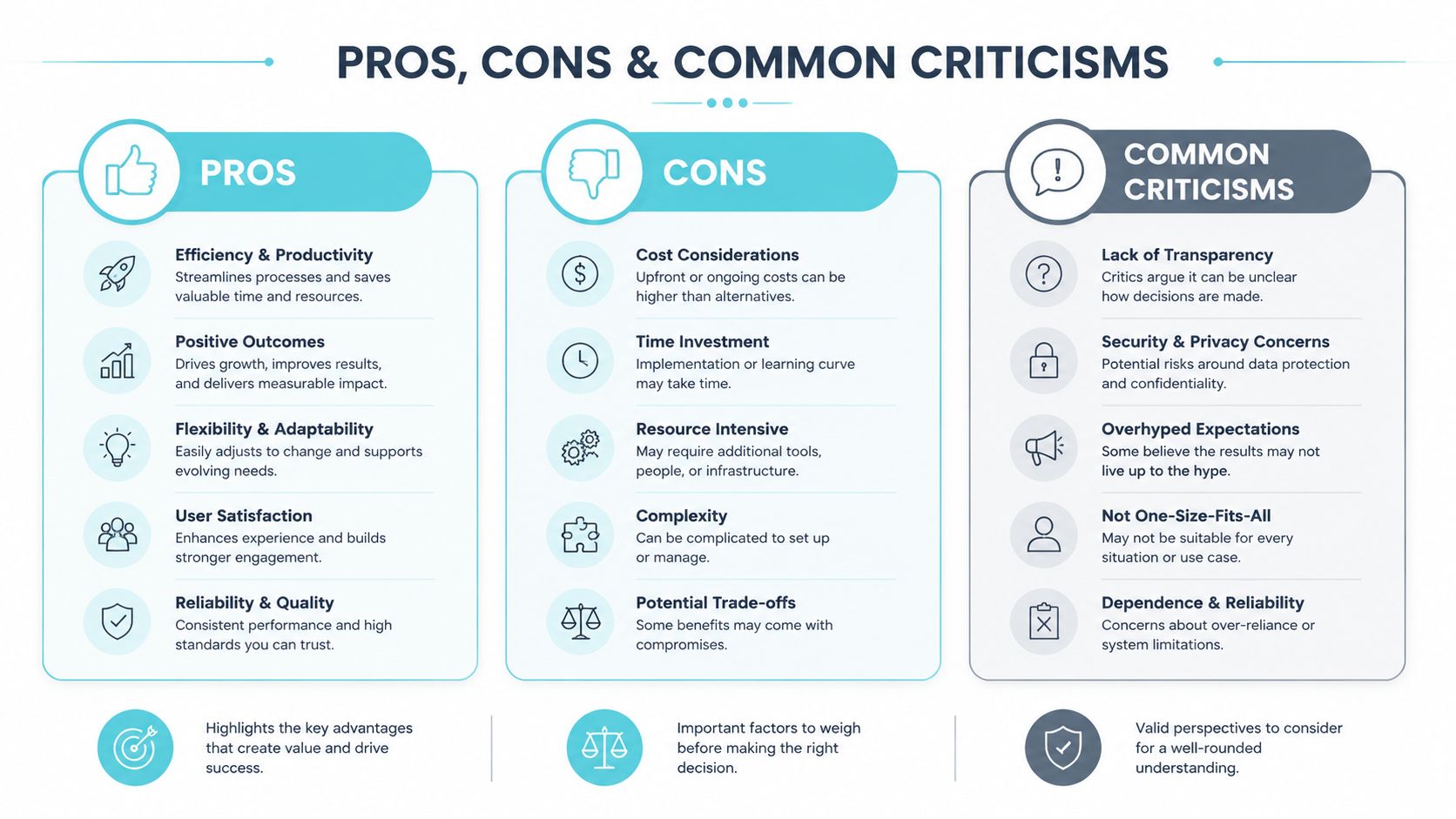
The billable hour has survived for good reasons. It is familiar, understandable, and easy to defend when the work is unpredictable. Litigation often doesn't move in clean, prepackaged units. New facts appear. Opposing counsel changes tactics. Courts alter schedules. Billing by time gives firms a way to price that uncertainty without pretending every matter is routine.
That said, the criticisms aren't academic. They come from daily experience inside firms and from client frustration outside them.
Where the model works
Some strengths are hard to ignore.
- Simple pricing logic: Time worked gets charged at the agreed rate.
- Useful internal metric: Firms can compare workload across lawyers and matters.
- Adaptable to complex cases: When scope shifts constantly, hourly billing can be more honest than a forced flat fee.
Where the model breaks down
The weaknesses are just as real.
First, it can reward time spent rather than value delivered. A faster, more skilled lawyer may generate a lower bill than a slower one, even if the result is better.
Second, it can create client mistrust. Clients don't always object because the amount is high. Often they object because the invoice reads like a mystery. If they can't see what they got, they question why they owe it.
Third, it contributes to burnout. Lawyers feel pressure not just to work, but to record enough work in the right categories. That changes behavior. Some people over document everything. Others stay late to protect target hours after a day filled with non billable obligations.
Clients buy outcomes, judgment, and progress. They tolerate time based billing when the invoice shows those things clearly.
The criticism isn't that hourly billing is always wrong. It's that firms often use it lazily, then act surprised when lawyers feel squeezed and clients feel suspicious.
Alternatives to the Billable Hour
Hourly billing is still common, but it isn't the only option. In fact, modern firms are shifting toward hybrid pricing models that blend hourly baselines with value add ons, while pure fixed fees can create problems with underpricing complex cases or discouraging necessary work, according to this industry discussion of hybrid pricing models.
That shift makes sense. Different matters call for different fee structures. A plaintiff PI firm, for example, doesn't approach pricing the same way as a firm handling routine advisory work or repeat contract review.

Common alternatives firms actually use
Flat fees work best when scope is predictable. Think standard filings, uncomplicated estate work, or repeatable business matters. Clients like certainty. Firms like administrative simplicity. The risk is obvious. If the matter expands, the fee may no longer fit the work.
Contingency fees are common in plaintiff work. The client doesn't pay by the hour. The firm is paid from the recovery if the case succeeds. This aligns incentives in many injury cases, but it also means the firm carries risk and cash flow pressure.
Retainers can create stability when a client needs ongoing access to legal services. Some retainers function as deposits against future hourly work. Others support continuing advisory relationships with a defined service model.
Hybrid arrangements mix methods. A firm might bill part of the work hourly, price a defined phase at a flat amount, or tie a premium to outcome or complexity. In practice, these models often reduce friction because they preserve flexibility without pretending every matter can be priced perfectly up front.
Choosing the right fit
The right fee model depends on scope clarity, risk tolerance, cash flow needs, and how much the client values predictability versus flexibility.
For lawyers reassessing what kind of practice and pricing model suits them long term, resources about find your ideal legal career can also be useful. Career fit and billing model fit are often more connected than lawyers admit.
Improving Timekeeping and Client Communication
Most billing problems start long before the invoice goes out. They start when lawyers wait too long to enter time, write descriptions only another lawyer could understand, or fail to explain the billing approach at the beginning of the representation.
The fix isn't glamorous. It's discipline.
Better timekeeping habits
A sound timekeeping process usually includes a few non negotiables:
- Enter time contemporaneously: The longer you wait, the more likely you are to miss short but legitimate tasks.
- Describe work in plain language: Clients should be able to understand what happened and why it mattered.
- Separate unrelated tasks: Distinct tasks deserve distinct entries.
- Review patterns, not just totals: If one lawyer consistently loses time in prebill review, the issue may be entry quality rather than effort.
For legal operations teams, standardization matters just as much as individual discipline. When lawyers classify work inconsistently, reporting becomes unreliable and billing review becomes subjective.
Better client communication practices
The cleanest invoice in the world won't fix a relationship that started with vague billing expectations. Clients need to know what counts as billable time, how the firm records it, and what kinds of work may generate charges during the life of the matter.
That conversation should happen early and be reinforced throughout the engagement.
A few habits make a measurable difference in everyday practice:
- Explain the billing method at intake. Don't assume the engagement letter alone does the job.
- Flag scope changes promptly. Clients react better to surprises before the work is done than after.
- Use status updates to connect work to progress. When clients see movement, invoices feel less abstract.
- Make it easy for clients to ask questions. Silence often turns into resistance when the bill arrives.
Clear billing language is client service, not clerical work.
For firms that want to reduce confusion and keep clients informed between major milestones, strong communication systems matter. These client communication best practices are especially relevant for firms trying to cut avoidable status calls and billing misunderstandings.
The firms that perform best over time usually aren't the ones that push the hardest for bigger raw hour totals. They're the ones that capture time accurately, describe it clearly, price matters intelligently, and keep clients informed enough that invoices don't come as a shock.
CasePulse helps law firms modernize client communication without forcing staff to leave their existing case management workflow. If your firm wants fewer status calls, more consistent client updates, secure messaging, forms, and file sharing in one branded portal, CasePulse is worth a look.