
 CasePulse
 An auto accident demand letter template is not just a fill in the blank form. It is the essential framework for telling your client's story, establishing clear liability, and formally requesting a specific settlement from the insurance company. Getting this document right from the start is your best shot at framing the narrative on your own terms.
The Blueprint For A Successful Personal Injury Claim

Think of your demand letter as the opening argument in your personal injury case. This is far more than a simple request for money. It is a strategic document that presents a compelling, evidence backed case for why the insurance company owes your client. You get to control the narrative, lay out the facts, and set the tone for the entire negotiation process.
A truly effective letter weaves a story that directly connects the other driver's negligence to your client's injuries and resulting financial losses. When you back that story up with solid evidence, you can dramatically speed up the settlement timeline and fend off the lowball offers adjusters love to throw at unprepared claimants.
What Goes Into A Winning Demand Letter
From my experience, adjusters are quick to exploit any missing information. To build a demand letter they take seriously, you need to include several key elements. Each piece serves a specific purpose, building a comprehensive picture of the claim.
The table below breaks down the must have components of a demand letter that gets results.
| Component | Purpose | Example |
|---|---|---|
| Liability Narrative | Clearly explains how the accident occurred and proves the other party was at fault, citing specific traffic laws or actions. | "The at-fault driver violated Vehicle Code §21802(a) by failing to yield the right-of-way…" |
| Detailed Injuries | Documents all physical and psychological injuries, the treatment received, and the ongoing prognosis. | "Ms. Smith sustained a herniated disc at L4-L5, requiring a course of physical therapy and epidural steroid injections." |
| Economic Damages | Provides a complete, itemized list of all financial losses, including medical bills, prescriptions, and lost income. | "Total medical expenses to date: $12,547.89. Lost wages from 2/1/26 to 3/15/26: $4,800." |
| Non-Economic Damages | Justifies the amount requested for pain, suffering, emotional distress, and loss of enjoyment of life. | "The chronic pain from the injury has prevented Ms. Smith from engaging in her passion for marathon running." |
Putting these pieces together cohesively is what separates a demand that gets paid from one that gets ignored.
For plaintiff firms, mastering this document is a game changer. We've seen that claims supported by a thorough demand letter settle 30-45 days faster on average. It’s a direct path to better, quicker results.
The goal is to present a case so clear and well-documented that the adjuster has no choice but to take your demand seriously. It leaves no room for them to question the facts or the severity of the claim.
Why Organization Is Your Secret Weapon
Let's be blunt: insurance adjusters are overworked and buried in claims. A sloppy, disorganized, or purely emotional letter is an easy excuse for them to put your file at the bottom of the pile.
On the other hand, a professionally structured letter that logically presents the facts makes their job easier. It is a clear signal that you are a serious professional who knows what you are doing and are fully prepared to litigate if they do not make a fair offer. This alone can change the entire dynamic.
Knowing how to handle curveballs, like an at fault driver who is uninsured, also shows the adjuster you are ready for anything. If you need a refresher on those specific situations, this accident rights claim guide is a fantastic resource. That kind of specialized knowledge gives you a real edge in negotiations.
Building A Compelling Narrative With The Template
Think of your demand letter template as less of a form to fill out and more of a blueprint for a powerful story. Your job is to take the adjuster beyond a dry list of facts and make them experience the accident from your client's point of view. A well told story, grounded in evidence, is what separates a lowball offer from a fair settlement.
The narrative always begins by cementing liability. It’s not enough to just say the other driver was at fault. You have to prove it, leaving no room for doubt. This is where your evidence, especially the police report, forms the unshakable foundation of your client's story.
Setting The Scene And Proving Fault
Your first goal is to paint a vivid, factual picture of the collision. The template gives you the structure, but you provide the detail. Ditch vague statements and use active, precise language to describe exactly what the at fault driver did wrong.
For instance, never settle for "The other driver hit my client." That leaves far too much open to interpretation. Instead, get specific.
Scenario: Rear-End Collision
"On January 15, 2026, around 2:30 PM, my client, Sarah Jenkins, was properly stopped at a red light at the intersection of Elm Street and Maple Avenue. The defendant, driving a 2022 Ford F-150, failed to stop and violently crashed into the rear of Ms. Jenkins’ vehicle. The official police report (Exhibit A) clearly notes the defendant was cited for following too closely, a direct violation of Vehicle Code §21703."
This approach accomplishes several things at once. It locks in the time and place, confirms your client was obeying the law, and uses the defendant’s own citation to prove negligence. It’s not just an allegation; it’s a fact backed indictment.
Adapting The Narrative To The Accident Type
Of course, not every case is a simple rear ender. The beauty of a good template is its flexibility. You have to mold the narrative to fit the unique facts of your case to maintain credibility.
Here’s how you might frame a couple of other common scenarios:
- For a Left-Turn Accident: "The defendant executed an unprotected left turn, driving directly into the path of my client’s vehicle, which held the undisputed right-of-way. The defendant's failure to yield was the sole cause of this collision, a fact corroborated by the witness statement from John Doe (Exhibit B)."
- For a Sideswipe or Lane Change Incident: "While my client maintained their lane of travel, the defendant initiated a dangerous and unsignaled lane change, sideswiping the passenger side of my client's car. This negligent maneuver is captured on dashcam footage, which is included as Exhibit C."
Notice the pattern? In every example, you're telling a story of negligence. You connect the defendant’s specific action to the crash and immediately point to the evidence that proves it. This methodical approach makes it incredibly difficult for an adjuster to argue about who was at fault.
Connecting Negligence Directly To Injuries
With liability firmly established, you pivot to the next chapter of your story: connecting the defendant's negligence to your client's injuries. This link is absolutely critical. The adjuster must clearly see that the harm your client endured was caused by this specific crash, not some old injury or unrelated event.
Describe the physics of the impact and how that force directly affected your client. You could explain, for example, how the violent, side to side snapping motion in a T bone accident caused a torn rotator cuff. If you're new to drafting demands, it helps to understand the fundamentals. For a deeper dive, check out our complete guide on writing a demand letter for personal injury.
The logic has to be airtight: The defendant's negligence caused the crash. The crash caused the injury. The injury caused the damages. This chain of causation is the engine that drives your entire demand.
By focusing on this evidence based storytelling, your auto accident demand letter template becomes a powerful tool of persuasion. You’re not just filing a claim; you’re presenting a case that’s already been won. This narrative driven approach immediately puts you in a stronger negotiating position and makes it much harder for the insurer to justify a lowball offer.
Documenting Damages To Maximize Settlement Value
Once you’ve clearly established how the other driver was at fault, it’s time to talk money. This is where you put a precise dollar amount on your client's losses, and a powerful demand letter hinges on the proof you provide for every cent.
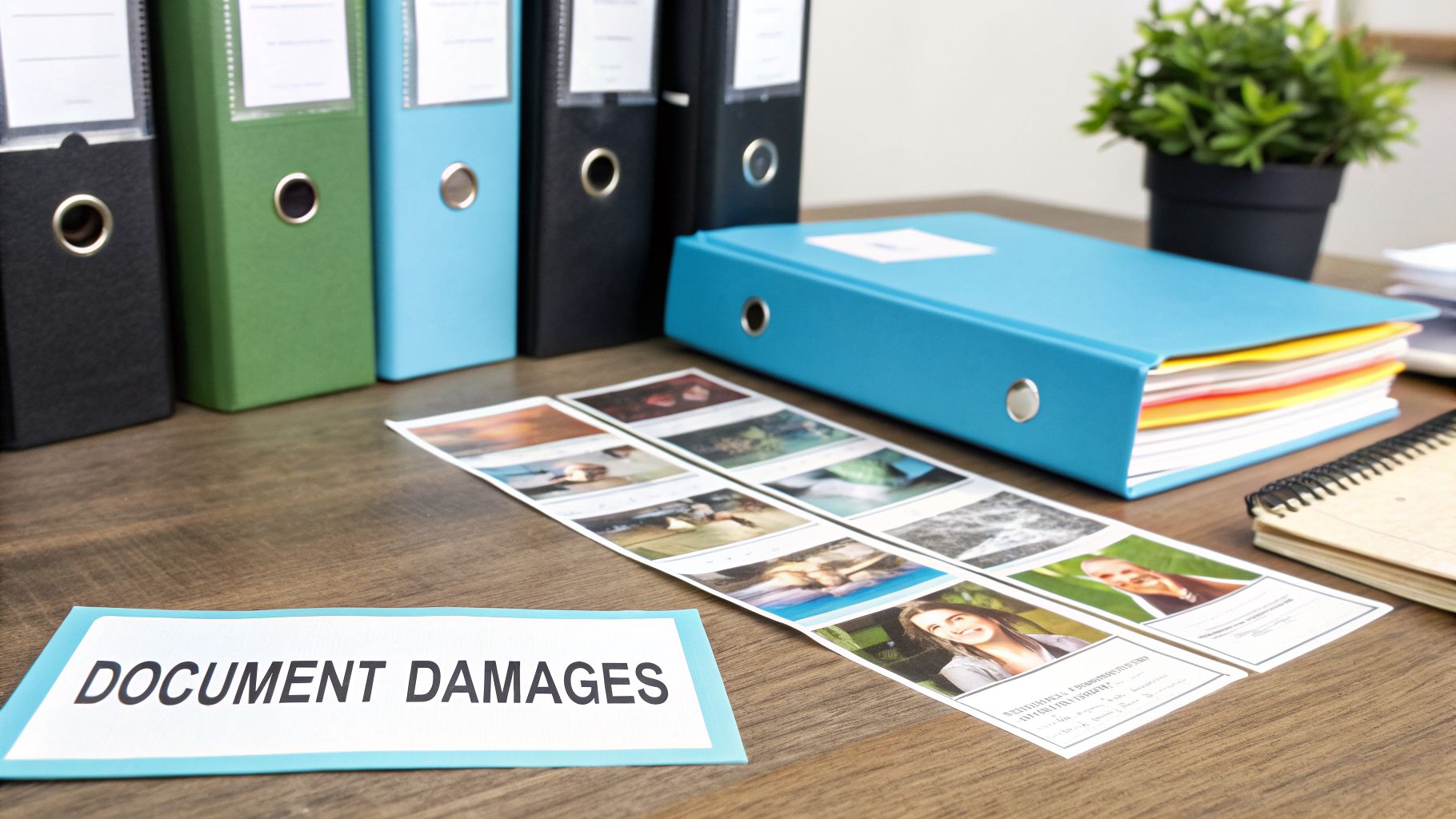
Your negotiating power comes directly from the quality of your evidence. Insurance adjusters are trained to find weak spots, and a single missing bill gives them all the reason they need to lowball their offer. The goal is to hand them a damages package so airtight there’s simply nothing left to question.
Differentiating Economic And Non-Economic Damages
First, you'll need to sort your client's losses into two buckets: economic and non-economic damages.
Think of economic damages as anything with a receipt. These are the straightforward, calculable costs that resulted directly from the accident. They have a clear paper trail.
Non-economic damages, on the other hand, are the intangible, human costs. Pain, suffering, anxiety, and the loss of enjoyment of life. They are harder to put a number on, but they are an absolutely critical part of getting a fair settlement.
A rookie mistake is to focus only on the medical bills and forget about the real-world impact on your client’s life. An adjuster will never volunteer to pay for pain and suffering; you have to demand it and back it up.
The modern demand letter has evolved significantly from the simple notices used back in the 1970s. Today, with insurance payouts for U.S. auto claims hitting record highs, adjusters are under intense pressure to minimize what they pay out. This is exactly why your documentation has to be flawless. The strength of the initial demand is often what drives a case to settle before it ever sees a courtroom.
The Essential Document Checklist
Building out the damages section of your letter means being methodical. You'll summarize these losses in the letter itself and then attach the actual documents as organized, numbered exhibits for the adjuster to review.
Here’s a core checklist of what you’ll need to gather:
- Complete Medical Records: This means everything. Get the reports from the initial emergency room visit, all follow ups with a primary care doctor, any notes from specialists, and physical therapy progress reports.
- Itemized Medical Bills: Do not just give them a total. Provide every single itemized bill from every provider, hospitals, surgeons, chiropractors, labs, and ambulance services.
- Pharmacy Receipts: Collect receipts for all prescriptions and any medical equipment your client needed, like crutches or a knee brace.
- Lost Wage Verification: You'll need an official letter from your client's employer on their letterhead. It must state your client's job title, rate of pay, typical work schedule, and the specific dates they were unable to work because of their injuries.
- Vehicle Repair Estimates: Always get at least two separate estimates for the vehicle repairs. If the car was totaled, include the official valuation report from the insurance company.
For vehicle damage claims, it can be a game changer to uncover a vehicle's accident history by VIN. Proving the car had a clean record before this accident gives you massive leverage when arguing for its pre-accident value or depreciation.
Calculating The Full Value of Your Claim
After you've gathered all the proof for your economic damages, add it all up. This total is often called the "specials," and it forms the baseline for your settlement demand. For example, if your client has $15,000 in medical bills, $5,000 in lost wages, and $500 in out of pocket costs, your total economic damages are $20,500.
Calculating non-economic damages is more of an art than a science. A common starting point is the "multiplier method." Here, you take the total economic damages and multiply them by a number, usually between 1.5 and 5. The right multiplier depends on factors like the severity of the injury, how long the recovery will take, and the long term impact on your client.
Using our example of $20,500 in specials, a moderate injury with a few months of physical therapy might justify a 3x multiplier. That would add $61,500 for pain and suffering, bringing your total initial demand to $82,000. Be sure to explain in your letter exactly how you arrived at your final number.
Simply gathering these documents is not enough; how you present them matters. For more on keeping your case files in order, our guide on document management best practices has some great tips for law firms. When you present a demand that’s well documented and logically calculated, you make it easy for the adjuster to say "yes."
The Art of the Deal: Negotiation and Timing
Drafting a powerful demand letter is a great start, but it's only half the job. The real difference between a fast, lowball payout and a genuinely fair settlement comes down to two things: knowing exactly when to send your demand and how you play your hand when the insurance company responds.
I’ve seen it happen time and time again. A firm sends a demand package too early. It’s one of the most common and expensive mistakes you can make. It screams inexperience to the adjuster and immediately puts your claim on the back foot. An early demand almost always means you haven’t accounted for the full extent of your client's injuries and losses, which can leave a lot of money on the table.
Why You Must Wait for Maximum Medical Improvement
So, when is the right time? The non negotiable rule is to wait until your client reaches Maximum Medical Improvement (MMI). MMI is that critical point where a doctor can confidently say the client’s condition has stabilized. No significant future improvement is expected, which gives you a complete, concrete picture of their medical journey.
Waiting for MMI is everything. Here’s why:
- It locks in your special damages. Once treatment is finished, you have a final, undeniable number for all medical bills, therapy sessions, and prescriptions. There’s no room for speculation.
- It brings future medical care into focus. At MMI, doctors can provide a clear prognosis. This might include the need for future surgeries, ongoing physical therapy, or a long term pain management plan, all of which need to be in your demand.
- It substantiates the pain and suffering claim. The full story of their recovery, how long it took, the pain they endured, is now known. This creates a rock solid foundation for calculating those non-economic damages.
Sending your demand after MMI turns it from a speculative ask into a factual, evidence-based claim. The adjuster has far less room to argue with hard numbers and a complete medical narrative.
If you submit that letter before your client hits MMI, you’re just inviting the adjuster to pick your claim apart. They will question the severity of the injuries or argue that future treatments are not really necessary. In this game, patience is your best weapon.
Handling the Inevitable Lowball Offer
Once you’ve sent your perfectly timed and documented demand, the ball is in the adjuster's court. Get ready, because their first settlement offer will almost always be low. Sometimes, it is so low it feels insulting. Do not get angry or discouraged. This is a standard opening move. They’re testing your resolve and hoping you’ll take a quick, cheap exit.
Instead of getting frustrated, look at their response as a gift. The adjuster’s letter will explain why their offer is so low. Maybe they are disputing liability, questioning a specific treatment, or trying to blame a pre existing condition.
This is gold. Their response is a roadmap to their defense strategy, showing you exactly where they think your case is weak. Now you can craft a counteroffer that systematically tears their arguments apart.
Crafting a Smart and Effective Counteroffer
Your counteroffer should not be a wild slash from your original demand. A common tactic is to meet them somewhere in the middle, but that is not a hard and fast rule. The goal is to show you are willing to negotiate while reinforcing the fact that your initial demand was serious and well supported.
A strong counteroffer has a few key components.
First, you want to politely but firmly reiterate your strongest facts. Start by reminding them of the core liability. If the police report put their driver 100% at fault, say it again.
Next, you need to tackle their arguments head on. Did the adjuster question a specific MRI? Respond with a clear note from the doctor explaining why it was medically necessary. Did they point out a gap in your client's treatment? Provide a simple, logical explanation for it.
If any new information has surfaced, maybe you finally tracked down a key witness, this is the perfect time to introduce it. New evidence can dramatically shift the negotiating power in your favor.
Finally, make a justified reduction in your demand. Lowering your number by a reasonable amount shows good faith, but a small reduction sends a clear signal. Your first number was not a guess, and you will not be lowballed.
This negotiation dance might go on for a few rounds. The key is to stay professional, be patient, and always, always anchor your position to the evidence. This is how you transform a great demand letter template into a tool that secures the compensation your client truly deserves, often without ever needing to step foot in a courtroom.
Automating The Demand Letter Workflow With Tech
In any personal injury firm, the demand letter is a critical milestone. But let's be honest, getting it out the door can be a real grind. The whole process often turns into a bottleneck, bogged down by the administrative slog of chasing clients for documents, giving constant status updates, and trying to keep all the evidence straight.
This back and forth is a huge time sink for your paralegals and a major source of frustration for your clients. Your team is stuck sending endless follow up emails, while clients are left wondering what’s going on with their case. This is exactly where modern client portals are changing the game, completely overhauling how firms manage the demand letter workflow.
Centralizing Communication and Document Collection
Think about all the time lost playing phone tag just to get a simple update from a client. Now, picture them receiving a fillable form right on their phone, where they can detail their injuries and explain, in their own words, how the accident has upended their life. That’s the kind of efficiency a dedicated client portal brings.
Tools like CasePulse, which work hand in glove with case management software like Neos and Litify, can automate so many of these tedious steps. When a client fills out a form detailing the impact of their injuries, that information, the very heart of your pain and suffering argument, flows directly into your case management system. No manual data entry, no risk of typos.
A secure client portal doesn't just make your firm more efficient; it empowers clients to become active participants in building their own case. This collaboration leads to faster turnaround times and, just as importantly, more accurate information for a stronger demand.
Your team can stay within their familiar case management software, while your clients get a simple, intuitive way to provide the critical details you need.
A Secure Hub for Critical Evidence
A portal is much more than just a place for forms. It’s a secure, central hub for every piece of evidence you need to build a rock solid demand. Forget insecure email attachments or asking clients to drop off a stack of papers.
Let's walk through a typical scenario. Your client snaps photos of their crumpled car at the scene. A week later, the first medical bills start arriving. Then they get a copy of the police report. Instead of this evidence trickling in randomly, they can use a portal like CasePulse to upload everything instantly using their phone's camera.
Each photo and document is automatically organized within their case file, ready for your team to access in real time. This direct pipeline for evidence cuts out the endless back and forth and lets you build your case faster.
This streamlined process is key to getting your timing right.
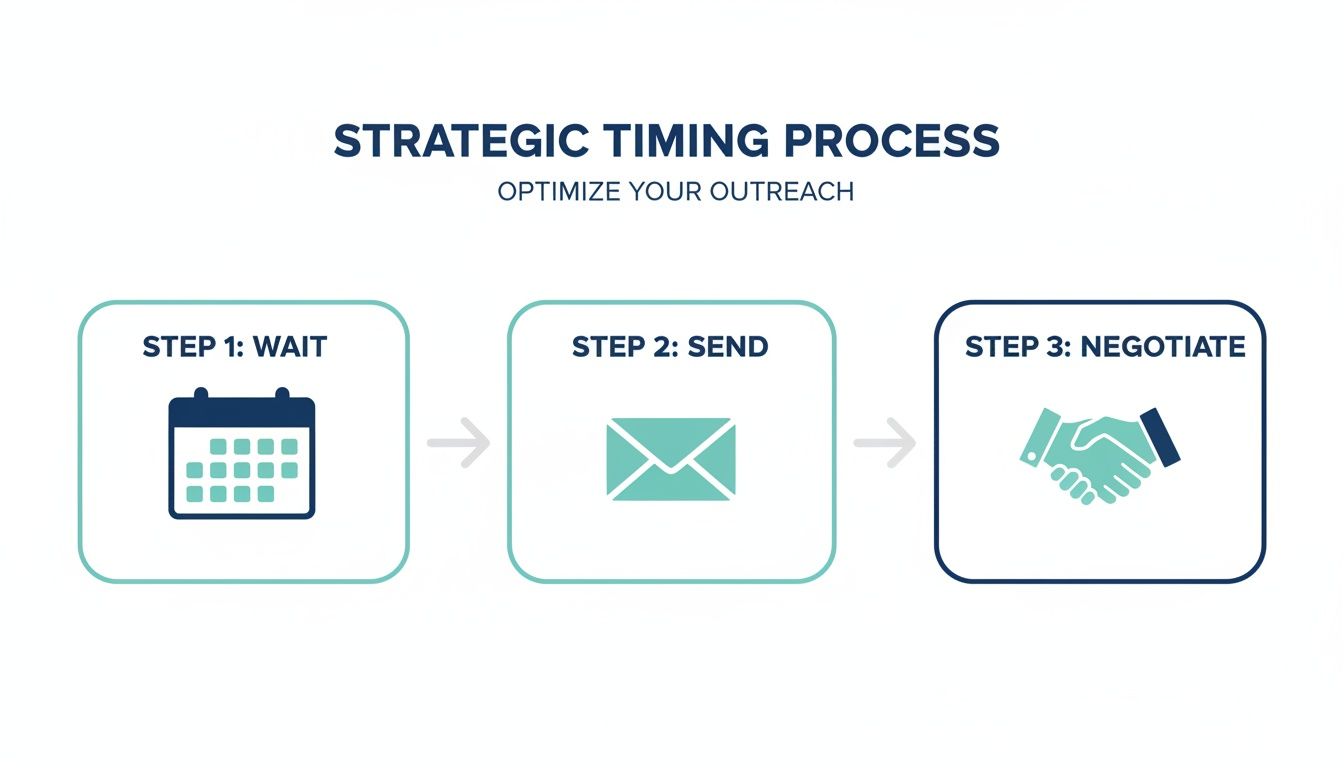
As you can see, the efficiency you create during the "wait" phase, when you are gathering all that crucial documentation, directly strengthens your position when it's time to "send" the demand and "negotiate" a settlement.
Improving The Client Experience
This kind of automation is not just about saving your firm time; it fundamentally improves the client experience. We all know one of the biggest complaints clients have is feeling left in the dark. A client portal tackles this head on by giving them 24/7 access to their case status.
No more calling your office for a simple update. They can log in anytime, from any device, and see exactly where things stand. That transparency builds incredible trust and provides much needed peace of mind during a stressful time.
If you want to dig deeper, you can learn more about what workflow automation means for law firms and the impact it can have. By automating routine updates and document collection, you free up your team to focus on the high value work, like crafting a compelling narrative for the auto accident demand letter that gets results.
Common Questions About Demand Letters
Even for attorneys who have written hundreds of them, drafting the perfect auto accident demand letter template can raise a few questions. From nailing the right length to handling specific details, getting these points right from the start can make a huge difference in how an adjuster views your claim.
Here are some of the most common sticking points we see and our thoughts on how to handle them to strengthen your negotiating position.
How Long Should an Auto Accident Demand Letter Be?
There’s no magic page count. The real focus should always be on thoroughness, not brevity. A powerful demand letter is usually several pages long, and that’s before you even get to the exhibits.
For a straightforward soft tissue case, a 3-5 page letter might do the trick. But for a complex claim involving a severe injury, multiple surgeries, and extensive lost time from work, you could easily be looking at 10 pages or more.
Do not get hung up on a specific page number. The goal is to build an undeniable case for your client's settlement. Have you fully explained liability? Detailed the injuries and treatment journey? Accounted for every penny of financial loss? The strength of your argument is what moves the needle, not the word count.
Should I Include a Specific Settlement Amount?
Absolutely. You must include a specific, total settlement figure. This is the "demand" in your demand letter, and it acts as the anchor for the entire negotiation.
If you do not put a firm number on the table, you are essentially inviting the adjuster to start the bidding at rock bottom. Your job is to set the expectation high with a figure you can solidly defend.
Of course, that number has to be realistic and meticulously justified. You need to show your math and connect it directly to the evidence. Break it down for them:
- Economic Damages: Tally up all the medical bills, pharmacy receipts, and lost wages into a clear total.
- Non-Economic Damages: This is where you explain your calculation for your client's pain, suffering, and the overall disruption to their life.
An adjuster will immediately dismiss a number that seems pulled out of thin air. But a well calculated demand, backed by evidence, forces them to engage with your claim seriously.
What Are the Biggest Mistakes to Avoid?
A few common missteps can completely sabotage an otherwise solid demand letter. Simply being aware of these pitfalls is half the battle.
Based on our experience, these are the mistakes that cause the most damage:
- Sending it too early. If you send the demand before your client reaches Maximum Medical Improvement (MMI), you are negotiating with incomplete information. You cannot know the full value of a claim until you know the full extent of the damages.
- Forgetting the proof. Every single claim, from a physical therapy bill to a day of lost work, must be backed up by a corresponding exhibit. No proof, no payment.
- Using an aggressive or emotional tone. A hostile letter makes you look unprofessional and gives the adjuster a reason to be difficult. Stick to the objective facts.
- Exaggerating the facts or injuries. Adjusters are trained to spot inconsistencies. Once your credibility is shot, it is nearly impossible to get it back.
- Poor organization. A confusing, poorly structured letter is frustrating for an adjuster to read. It signals a lack of preparation and makes it easier for them to miss, or ignore, key details.
A professional, well organized, and meticulously supported letter is always your most powerful tool for getting your client a fair result.
Ready to transform your client communication and automate your firm's workflows? CasePulse provides a secure client portal that integrates with your existing case management system, allowing you to streamline document collection, automate updates, and deliver a modern client experience. Learn how you can start inviting clients in about a week by visiting https://www.casepulse.com.