
 CasePulse
 A personal injury demand letter is where the rubber meets the road. It’s the formal, written opening shot that kicks off settlement talks with the at-fault party’s insurance carrier. This document does the heavy lifting: it lays out the facts of the incident, details your client's injuries and damages, and makes a concrete demand for compensation.
Think of it as the critical first move that can define the entire case.
Why a Strong Demand Letter Is Your Most Critical Opening Move
Don't mistake the demand letter for a simple piece of correspondence. It's your opening gambit in a high stakes negotiation. A well crafted letter does more than just state the facts. It establishes the entire tone for the settlement process and signals to the insurance adjuster that you are organized, professional, and serious about getting a fair number for your client.
This initial communication is your best tool for compelling a meaningful response and sidestepping the lowball offers that adjusters love to throw at unprepared claims.
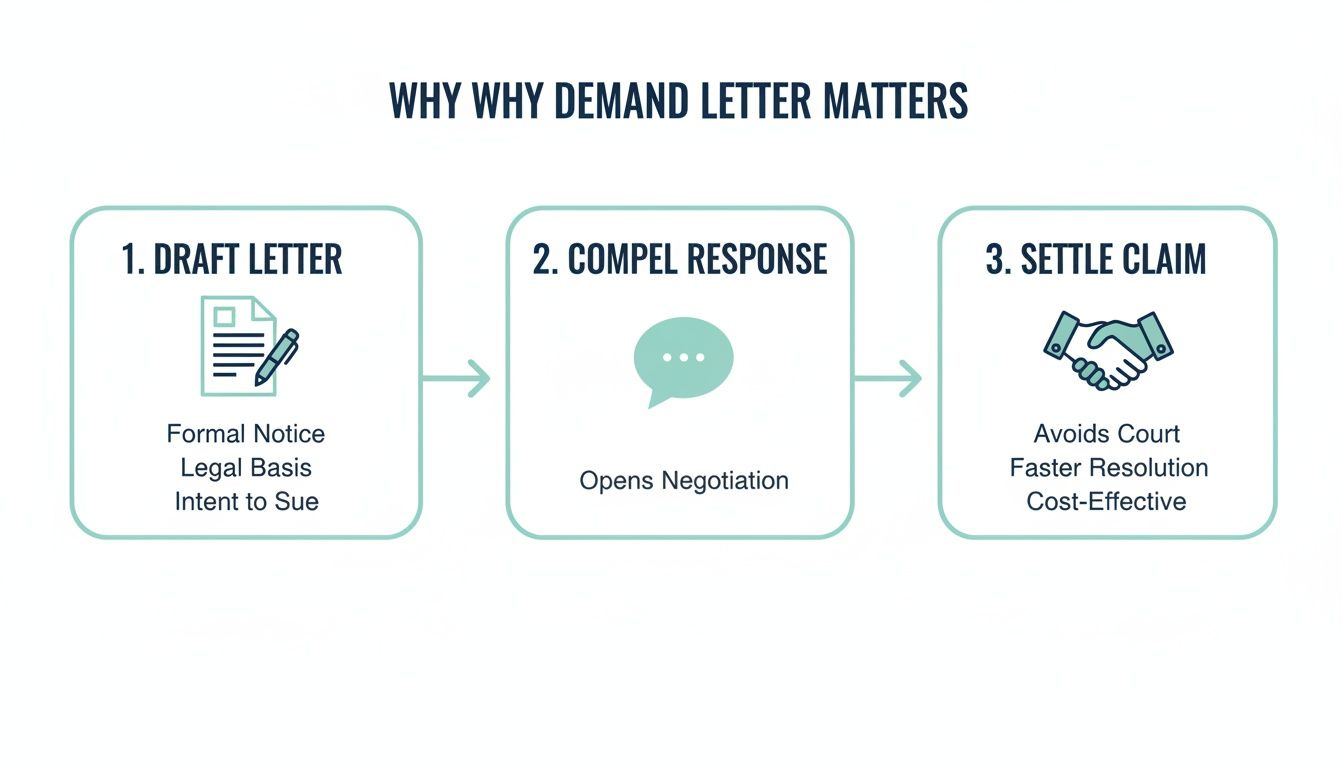
The flowchart above shows it perfectly. A meticulously prepared letter is the engine that drives the entire settlement process forward. It forces a reaction and paves the way for a successful resolution without ever stepping foot in a courtroom.
Establishing Credibility and Forcing a Response
The moment an insurance adjuster opens your demand, they're sizing you up. A letter that’s vague, poorly documented, or full of emotional pleas gets tossed to the bottom of the pile. But one that presents a clear liability argument, tells a compelling client story, and is backed by irrefutable evidence? That’s different. That letter anchors the negotiation on your terms from day one.
A logical, evidence backed narrative accomplishes two crucial goals:
- It establishes your firm's credibility. It shows the adjuster you've done your homework, you know what the case is worth, and you aren't just fishing for a quick, cheap settlement.
- It forces the insurer to evaluate their risk. A strong demand package makes them seriously consider the financial exposure they face by ignoring your claim or daring you to take it to trial.
A powerful opening letter lays the groundwork for a successful settlement before a lawsuit is ever filed. It’s your chance to control the narrative and prove you’re ready to fight for a fair outcome.
The Power of Pre-Litigation Negotiation
Here’s a number every PI attorney should know: a staggering 95 to 96% of cases settle before they ever reach a courtroom. Only about 4 to 5% of personal injury claims actually go to trial. This statistic alone underscores just how critical the pre litigation phase is.
This is why mastering the demand letter isn't just a useful skill. It’s a core competency for any plaintiff's firm aiming for consistent, favorable results. It’s the key to unlocking that 95%.
Technology is also playing a bigger role. Modern tools like AI for drafting legal notices can help ensure you hit all the necessary points, which is a huge help for firms juggling a high volume of cases.
Setting the Stage: Weaving a Powerful Narrative of the Incident
Your demand letter is your opening move, and it needs to be far more than a dry recitation of facts. Think of it as telling a story. Insurance adjusters read hundreds of these things, and a generic, paint by numbers letter will get you a generic, lowball offer. Every single time.
To get their attention and command a serious offer, you have to build a compelling, fact based narrative. This story needs to clearly and convincingly explain what happened, why their insured is unquestionably at fault, and exactly how this incident has upended your client's life.
This is where you transform your client from a claim number into a real person. A person who has suffered a real loss because of someone else’s carelessness. A well told story makes the adjuster start thinking about the risks of trial, where a jury would hear this same persuasive account.

Laying the Foundation: The Opening Statement
Get straight to the point. The opening of your letter isn't the place for suspense or fluff. The adjuster needs to know exactly what claim they're dealing with from the first sentence.
Your introduction must clearly lay out the basics:
- The Parties: Name your client and the at fault party (their insured).
- The Incident: State the exact date and location.
- The Purpose: Explicitly state that this letter is a formal demand for settlement.
Don't forget the claim number. If one has been assigned, put it right at the top. It’s a small detail that helps the adjuster pull the file immediately and shows them your firm is organized and ready to go.
Building an Airtight Case for Liability
Right after the intro, you need to dive into a detailed, chronological account of what happened. Your goal here is simple: leave zero doubt about who was at fault. This section is a factual reconstruction of events, not an emotional plea.
Think about how you'd present the case to a jury. You would walk them through the events logically, backing up every point with proof. So, instead of a vague statement like "their driver was reckless," be specific: "Your insured, Mr. Smith, was traveling at 55 mph in a posted 35 mph zone when he ignored a solid red light at the intersection of Main and Elm, violently striking our client's vehicle."
To make your liability argument undeniable, you have to weave your evidence directly into the narrative.
- Police Report: Reference it by number and quote the key findings, especially any citations issued to the other driver.
- Witness Statements: Summarize what independent witnesses saw, focusing on observations that corroborate your client's account.
- Traffic Laws: Pinpoint the specific vehicle and traffic laws the at fault party violated, like failure to yield or following too closely.
The strongest liability arguments are built on a bedrock of objective evidence. When you frame the narrative around official reports and third party observations, you make it incredibly difficult for the insurer to argue about their client's responsibility.
Connecting the Dots: From Negligence to Injury
Once you’ve locked down liability, you must draw a clear, direct line from the at fault party's actions to your client’s injuries. This is where many demand letters fall short. The adjuster must understand that the injuries weren't just a coincidence. They were a direct result of the collision.
Start by listing the immediate diagnoses from the ER or urgent care visit right after the incident. From there, walk the adjuster through the entire course of medical treatment your client has endured.
For example, you can paint a picture of a client's journey from an initial diagnosis of cervical strain to months of grueling physical therapy, a series of painful epidural injections, and eventual consultations with a neurosurgeon. Every step in their treatment path reinforces the severity and longevity of their suffering.
It’s absolutely crucial to use precise medical terminology pulled directly from the records. This adds a layer of credibility and shows you’ve done your homework. Steer clear of exaggerating symptoms. Adjusters are trained to sniff out embellishments, which can poison the entire claim.
By methodically detailing this medical journey and grounding every statement in documented evidence, you forge an unbreakable link between the incident and the damages. This structured approach moves the adjuster from simply acknowledging fault to truly understanding the full value of the claim.
How to Accurately Calculate and Present Damages
Once you’ve laid out a solid case for liability, the entire dynamic of your demand letter shifts to the numbers. The strength of your entire demand really hinges on how clearly and thoroughly you calculate and present your client's damages.
If you submit a vague or poorly supported figure, you're essentially inviting the adjuster to send you a lowball offer. On the other hand, a meticulously itemized and justified demand forces them to respond to your specific points and defend every dollar they try to shave off. This is more than just adding up receipts. It's about building an unassailable financial case that puts you in a commanding position right from the start.
The key is to break the damages down into two distinct, well organized categories: special damages and general damages.

Itemizing Your Special (Economic) Damages
Special damages, often called economic damages, are the tangible, out of pocket financial losses your client has actually incurred. These are the easy ones because they come with a paper trail. Your job is to hunt down every single piece of documentation and present it in a clean, itemized list that’s impossible to dispute.
Think of this section as a forensic audit of your client's losses. Every single line item needs to be backed up by an invoice, a receipt, or an official statement.
Here’s a good checklist to work from:
- Past and Future Medical Expenses: This goes far beyond the final hospital bill. You need to include every single cost, from the initial ambulance ride and ER visit to surgery, physical therapy, prescriptions, and specialist follow ups. If future care is on the table, you absolutely need a life care plan or a detailed physician's report to substantiate those projected costs.
- Lost Wages and Diminished Earning Capacity: Document every dollar of income lost while your client was recovering. This means gathering pay stubs, W 2s, and getting a letter from their employer verifying their pay rate and the exact time they missed. If the injury is career altering, you'll need a report from a vocational expert to project future lost income.
- Property Damage: In an auto accident, this is usually the cost to repair or replace their vehicle. But don't forget other personal property that might have been damaged in the incident, like a laptop, cell phone, or even eyeglasses.
- Other Out of Pocket Costs: Keep an eye out for the smaller expenses that can really add up. We’re talking about mileage to and from doctor's appointments, parking fees at the hospital, or the cost of hiring help for household chores your client couldn't handle during recovery.
Quantifying General (Non-Economic) Damages
This is where the art of advocacy really shines. General damages, or non economic damages, are meant to compensate your client for the intangible suffering that doesn't come with a price tag. This covers their physical pain, emotional distress, mental anguish, and the loss of enjoyment of life.
While you can’t produce an invoice for suffering, you still have to present a logical and justifiable figure. One of the most common ways to approach this is the multiplier method.
The process is straightforward: you total up all the special damages and multiply that figure by a number, typically between 1.5 and 5. The specific multiplier you choose is crucial and depends entirely on the severity of the case.
A minor, low impact car accident with a full and quick recovery might only warrant a 1.5x multiplier. In stark contrast, a catastrophic injury case that results in permanent disability, significant disfigurement, and chronic pain could easily justify a multiplier of 5x or even higher.
The justification for your chosen multiplier is what makes or breaks this part of the demand. You have to connect it directly to the human story. Did they miss their child's graduation because they were laid up in the hospital? Can they no longer play golf, garden, or engage in a hobby they once loved? These specific, human details are what give real weight to your demand for general damages. It’s also wise to understand what liability insurance covers for the at fault party, as this can frame your negotiation strategy from the outset.
Bringing It All Together for a Final Demand
After carefully calculating both special and general damages, you need to present a final, lump sum settlement demand. This should be a clear, unambiguous number, the total compensation you are seeking to fully and finally resolve the claim.
This detailed financial breakdown isn't just an accounting exercise. It's the foundation of your entire negotiation. An effective demand letter gives you a powerful statistical edge. Consider this: between 90 to 95% of cases handled by experienced attorneys settle before trial, a rate that completely dwarfs the outcomes for unrepresented claimants who often get stuck with meager offers.
Since roughly 95% of lawsuits are resolved before they ever see a courtroom, a well crafted demand letter is the single most critical tool for securing fair payment for medical bills, lost income, and your client’s pain and suffering.
Assembling the Supporting Evidence Package
A demand letter without a strong evidence package is just an unsubstantiated story. It’s the supporting documentation that transforms your narrative from a claim into a fact based argument the insurance adjuster can't ignore. Your goal is to assemble a comprehensive, professionally organized package that proves every single assertion you've made about liability and damages.
This level of preparation does more than just validate your demand. It sends a clear message. It tells the adjuster you've done your homework, you're prepared for what comes next, and you won't be pushed around by a lowball offer. A meticulously assembled evidence package is proof you’re ready to back up every word.
Building Your Foundation of Proof
First things first: you need to prove exactly what happened and why their insured is at fault. These documents are the bedrock of your liability argument, making it incredibly difficult for the insurer to shift blame or dispute the basic facts of the incident. Without this foundation, the rest of your demand is built on sand.
Your liability evidence should always include:
- The Official Police or Incident Report: This is often the most important document you'll have. Be sure to highlight the officer’s narrative, any citations issued to the at fault party, and diagrams of the scene.
- Witness Statements: A signed statement from an independent third party who backs up your client's version of events is incredibly powerful.
- Scene Photos and Videos: Clear images of vehicle damage, road conditions, traffic signals, and the overall accident scene can visually dismantle any attempt to dispute fault.
When you present the adjuster with an undeniable, evidence based account of the incident, you effectively shut down arguments about liability before they can even begin. This forces them to focus on the one thing you want to negotiate: the value of the damages.
Documenting Every Dollar of Economic Damages
Next, you have to provide a clear and undeniable paper trail for every economic loss your client has suffered. This section needs to be organized with absolute precision. Group similar documents together and present them in a logical order that makes it easy for the adjuster to follow along and verify your math.
The core of this documentation includes:
- All Medical Bills: This means everything. The ambulance ride, the emergency room, invoices from surgeons, specialists, physical therapists, and pharmacies, all of it.
- Proof of Lost Wages: This requires more than just a number. You need recent pay stubs and, ideally, a formal letter from your client's employer confirming their rate of pay, typical hours, and the specific dates they were unable to work because of their injuries.
This detailed financial accounting leaves no room for the adjuster to question your special damages calculation. It presents your numbers as concrete, verifiable facts. And for a deeper dive into the technical side of managing these files, you can learn more about the importance of secure file sharing with clients to keep this sensitive information protected.
Substantiating the Human Cost of the Injury
Finally, you need evidence that supports your demand for general damages. While you can't put a price tag on pain and suffering, you can use documentation to paint a vivid picture of how the injury has profoundly affected your client's life. This is where you connect the cold, hard medical facts to the human story.
This part of the package should include:
- Complete Medical Records: These are different from the bills. Records include doctors' notes, diagnostic imaging reports (like X rays or MRIs), and treatment summaries that detail the nature and severity of the injuries.
- Photos of Injuries: Visual proof of bruising, scarring, or other visible injuries can have a much bigger impact than words alone.
- Personal Statements: A journal or a formal statement from your client describing their daily pain levels, challenges with routine activities, and the emotional toll of the injury adds a powerful, personal dimension to the claim.
By assembling a thorough and organized evidence package, you aren't just writing a demand letter. You're building an irrefutable case for a fair settlement. This level of diligence demonstrates your readiness and forces the insurance company to take your demand seriously right from the start.
Common Mistakes That Can Weaken Your Demand
You can craft a nearly perfect demand letter, only to see it completely undermined by a few simple, avoidable mistakes. These slip ups are more than just minor errors. They're red flags to an insurance adjuster, signaling inexperience or a lack of preparation. This immediately puts you on the back foot and practically invites a lowball offer.
Knowing what not to do is just as critical as knowing what to include. Remember, a strong demand is a strategic move. While only about 4 to 5% of personal injury cases ever see a courtroom, those that do often result in a plaintiff's victory. This tells you that firms are pushing their strongest cases to trial, usually after a demand letter failed to get a fair settlement. You can explore more personal injury claim statistics to see just how crucial this opening move is.
Using Emotional or Threatening Language
One of the fastest ways to get your demand dismissed is to let emotion creep in. The adjuster isn't your enemy. They're a business professional evaluating a claim based on liability and financial risk. A letter laced with angry accusations, threats, or dramatic, over the top language just comes across as unprofessional. It shuts down productive negotiation before it even starts.
Your tone should be firm and factual, never personal.
For example, don't write, "Your reckless client deserves to pay for ruining my client's life." It’s an emotional plea. Instead, a powerful, professional statement would be, "As a direct result of your insured's negligence, our client has suffered significant and lasting damages." One is an outburst; the other is an assertion of fact that demands a serious response.
Presenting an Unsupported Demand Figure
Never just pull a number out of thin air. Sending a demand for a large, round number, say $250,000, without a detailed breakdown is a classic rookie mistake. It tells the adjuster you’re just fishing, and they’ll treat it that way. An unsupported demand is an open invitation for an equally unsupported (and insultingly low) counteroffer.
Every single dollar you ask for must be tied to a specific, quantifiable loss. It has to be connected to a medical bill, a pay stub, or a well reasoned calculation for pain and suffering.
A demand letter's power comes from its evidence. Without a clear, logical connection between the facts of the case and the financial demand, your letter becomes an opinion piece, not a serious legal document.
Make sure your letter includes a meticulous summary of both special and general damages. Reference the attached documents that prove each expense. This transparency forces the adjuster to engage with your valuation on its merits, item by item.
Sending the Letter Prematurely
Timing is absolutely crucial. Sending a demand letter before your client has reached Maximum Medical Improvement (MMI) is perhaps the most dangerous mistake you can make. MMI is the point where a doctor can confidently say the client's condition has stabilized, and they can project future medical needs and permanent impairments with reasonable certainty.
If you jump the gun, you're essentially guessing what your client's total damages will be. You won't have the final medical bills, a clear picture of future treatment costs, or the full scope of their lost earning capacity. Once they sign that release, it's over. You can't go back for more money if a "healed" injury suddenly requires major surgery down the road.
Imagine a client settles a back injury claim early. Six months later, an MRI reveals a herniated disc requiring spinal fusion surgery. Because the demand was premature, the massive cost of that procedure and the subsequent lost income are no longer recoverable. Always, always wait until you know the full story.
Answering Your Questions About Demand Letters
When you're drafting a personal injury demand letter, a handful of questions pop up time and time again. Getting these right from the start can be the difference between a smooth negotiation and a protracted fight.
Let's walk through some of the most common questions we see from firms, along with some practical, experience based answers.
When Is the Best Time to Send a Demand Letter?
Timing is everything. The short answer is you send the demand after your client has reached Maximum Medical Improvement (MMI). This is a critical milestone where their doctor confirms their condition is stable and no further improvement is expected.
If you jump the gun and send it before MMI, you’re flying blind. You won't have the final medical bills, a clear prognosis for future care, or a full understanding of any permanent impairment. This is a classic mistake that almost always leads to undervaluing a claim. Once you settle, there's no going back.
Waiting for MMI is non negotiable. It’s the only way to arm yourself with a complete and accurate picture of the damages, ensuring your demand reflects the true value of the case.
How Much Detail About the Accident Should I Include?
You're walking a fine line here. You need enough detail to nail down liability, but not so much that you give the adjuster things to pick apart.
Think of it as building an airtight, factual narrative. A straightforward, chronological account works best. The goal is to present the other party’s negligence as an undeniable conclusion.
Here’s how to do that effectively:
- Cite the Proof: Always reference the police report number. If there was a clear traffic violation, mention the specific statute.
- Facts Over Feelings: Stick to what happened. Avoid emotional language, speculation, or aggressive accusations. Let the facts speak for themselves.
- Be Objective: Present the incident as a clear sequence of events that logically proves their insured was at fault.
This approach frames liability as a settled matter, making it much harder for the adjuster to argue.
A great demand letter makes liability a non issue. When you ground your argument in objective evidence, the negotiation starts with how much they owe, not if they owe.
Is It Okay to Use a Demand Letter Template?
Templates can be a good starting point for structure, but that's where their usefulness ends. Never, ever just fill in the blanks and send it off.
Seasoned adjusters can spot a generic, cookie cutter demand letter instantly. It signals that you might not have put much work into the file, which often translates to a lowball first offer.
Every case has a unique story, the specific facts, the client's individual injuries, and the real world impact on their life. You have to weave those details into every section, from the incident description to the pain and suffering argument. A personalized letter shows you’re serious and have built a strong case. For more on the power of personalized communication, see our guide on how to manage client expectations.
At CasePulse, we know that powerful communication drives results. Our secure client portal works with your existing case management software to handle routine updates automatically. This frees you up to focus on high impact work, like drafting demand letters that get adjusters’ attention. See how CasePulse can make your firm more efficient and keep clients happier by visiting https://www.casepulse.com.