
 CasePulse
 A managing partner hires an SEO agency, gets a glossy report three months later, and still cannot answer the only question that affects firm economics. Did the campaign produce qualified consultations that turned into signed cases?
That standard should drive this entire review. The best SEO company for lawyers does more than push a few practice area pages up the search results. A good agency brings in the right matters, supports a faster intake process, and helps your firm convert demand without wasting staff time on bad-fit leads. If you need a baseline on what strong SEO for law firms should connect to, start there.
We judged these agencies on legal focus, reputation in the market, and how well their model connects top-of-funnel search traffic to bottom-line results. That matters because the field is crowded, and crowded markets produce a lot of polished sales decks and very little accountability. As noted in this First Page Sage legal SEO market analysis, law firms have no shortage of agencies competing for this work.
A significant blind spot in legal SEO buying is treating rankings as the finish line. Rankings matter. Intake quality matters more. If your phone team misses calls, your site attracts the wrong case types, or your local presence breaks down at the map-pack level, traffic alone will not help your firm grow.
1. Rankings.io
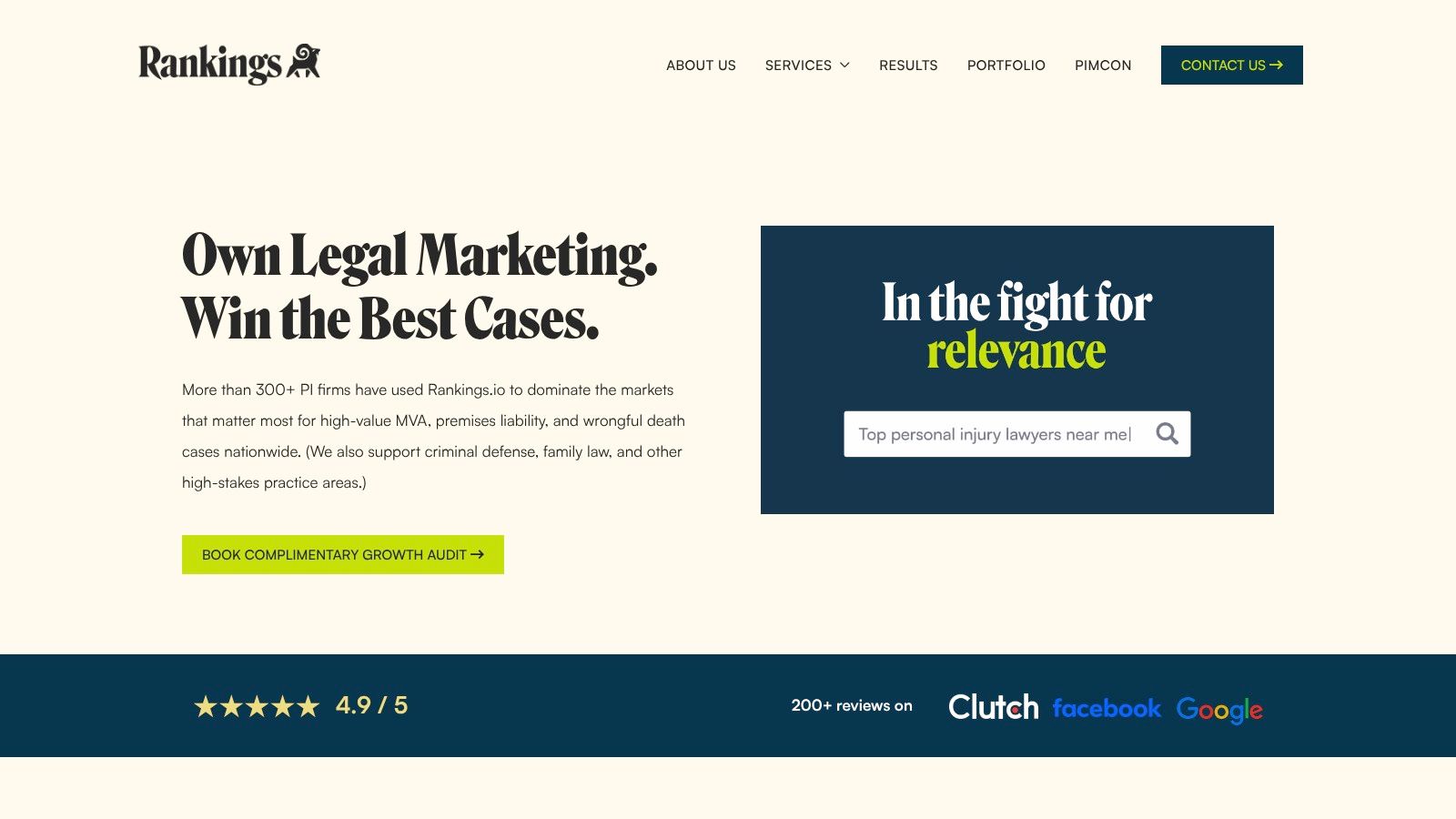
If your firm is serious about personal injury growth, Rankings.io belongs near the top of your shortlist. This is a legal-only agency founded in 2013, based in Marion, Illinois, and built around serving law firms nationwide across practice areas including personal injury and criminal defense (legal SEO company roundup featuring Rankings.io).
That legal-only focus matters. You're not hiring a general agency that happens to take lawyers. You're hiring a shop that built its reputation around law firms.
Why firms call them first
Rankings.io isn't just selling SEO. Their service mix includes PPC advertising, Local Service Ads management, law firm web design, and social media marketing, which is useful if you need one partner coordinating more than organic search. For firms trying to dominate local search, that matters more than a national visibility story.
Their market reputation is also hard to ignore. As of 2026, they appear consistently in the top three across at least five major industry ranking publications, including Josh Brown's rankings, SeoProfy's analysis, and Clutch's legal SEO ratings, according to the same roundup above.
Practical rule: If a PI firm wants one agency accountable for search visibility across organic, local, and adjacent paid channels, Rankings.io is one of the clearest fits.
A few strengths stand out:
- Legal specialization: They work inside the legal vertical, not around it.
- Broader channel support: SEO, PPC, LSAs, web design, and social are all in scope.
- Local search focus: The demand they're fielding points straight at local visibility and map pack performance.
If you're comparing vendors, pair your agency search with a clear intake strategy. This law firm SEO guide is a useful companion because it frames SEO around actual client acquisition, not just rankings.
Where they fit best
This is a premium choice. That usually means they make the most sense for PI firms and established practices with real growth budgets and a willingness to commit to a competitive market strategy.
If you're a small firm looking for the cheapest monthly retainer, keep moving. If you want a recognized legal specialist with a strong reputation in the category, Rankings.io is one of the safest bets.
You can review the agency directly at Rankings.io.
2. Juris Digital

A common firm scenario goes like this. Traffic improves, rankings look better, and intake still complains that the phone calls are weak, the forms are messy, and too many leads never turn into consultations.
Juris Digital makes sense for firms trying to fix that gap between visibility and signed cases. Their appeal is not flashy. It is operational. If you need one agency to handle the website, local SEO, content, and technical cleanup without turning your marketing into a vendor management exercise, they are a serious option.
That matters more than another page-one promise.
What makes Juris Digital a strong fit
Juris Digital is a practical choice for firms with multiple practice areas, an outdated site, or a weak local presence that is hurting intake quality. They are built for coordinated execution. That usually produces better business results than hiring one shop for design, another for SEO, and a freelancer for content.
Split ownership causes predictable problems. The site gets rebuilt without conversion strategy. SEO pages get published without intake input. Local listings drift. Reviews sit untouched. If your agency cannot connect traffic growth to call handling, form quality, and consultation volume, you are buying reports, not growth.
That is also why reputation management belongs in the conversation. Local SEO performance and intake trust are tied together, especially for firms competing in maps. A firm comparing agencies should also review a practical plan for getting more Google reviews for a law firm, because stronger review systems improve both click-through and first-impression trust.
My recommendation
Juris Digital fits firms that want a legal marketing partner with range and discipline. I would look at them for a growing firm that needs better coordination across the site, content, local search, and lead flow.
I would not hire any agency in this category without asking hard questions about how they measure success after the click. Ask how they track qualified leads, consultation rates, and signed cases by practice area. Ask who owns intake feedback. Ask how quickly they fix conversion problems when traffic rises but consultations do not.
That is the true test.
If Juris Digital can show a clear process from search visibility to intake performance, they deserve a spot on your shortlist. If they cannot, keep looking.
Visit Juris Digital.
3. LawRank

Your firm starts ranking better. Traffic goes up. Consultations do not. That is the failure point most agencies avoid discussing.
LawRank deserves attention because they appear built for firms that want SEO, website design, and conversion support under one roof. That combination matters more than another promise about page-one rankings. A law firm does not need more vanity metrics. It needs qualified calls, cleaner intake, and more signed cases from the traffic it already pays to attract.
LawRank is usually a stronger fit for firms with serious competition and enough budget to expect custom work. They are not the bargain option, and that is fine. Cheap legal SEO usually produces thin content, weak local pages, and reporting that hides the gap between traffic and revenue.
What I would evaluate first
I would look closely at how LawRank handles the middle of the funnel. Rankings get attention, but the key question is whether their site builds and SEO pages help a prospective client trust the firm, call the office, and complete intake without confusion.
That means reviewing page structure, calls to action, mobile experience, practice area intent, and local credibility signals. It also means checking whether the agency has a real plan for reviews, because map visibility and consultation rates are tied to reputation. A firm comparing agencies should review their approach to getting more Google reviews for a law firm, not treat reviews as a side task for staff to figure out later.
LawRank stands out most for firms that want tighter coordination between design and search performance. That can improve results if the agency treats the website like a business asset instead of a brochure.
Best fit and caution
LawRank makes sense for PI and criminal defense firms that want a legal-only agency and expect hands-on website support alongside SEO. I would also consider them for firms in major metros where weak design and slow intake follow-up waste expensive traffic fast.
- Best for: Established firms in competitive markets, especially those that want stronger websites and better conversion paths, not just more rankings
- Watch for: Retainer scope, who handles CRO decisions, how intake feedback gets incorporated, and whether reporting reaches signed-case quality instead of stopping at leads
My recommendation is simple. Put LawRank on the shortlist if they can show how SEO work connects to consultation volume and client quality. If the conversation stays centered on rankings, impressions, and generalized traffic growth, keep your guard up.
You can review them at LawRank.
4. Consultwebs

A managing partner with three offices does not need another agency promising traffic charts. They need a team that can support a real intake operation, keep reporting organized, and help turn search demand into signed cases across multiple markets. That is the lane where Consultwebs makes sense.
Consultwebs is a strong option for firms that want an established legal marketing agency with process, infrastructure, and experience across practice areas. If your firm has several stakeholders, several locations, or a mix of SEO and broader digital needs, that matters. Loose execution creates internal friction fast.
Their value is less about flashy positioning and more about operational fit. Firms that outgrow small SEO vendors usually hit the same wall. Rankings improve, but intake is inconsistent, reporting is thin, and no one ties campaign decisions back to case quality. Consultwebs is better suited to firms that want a more formal partner and are prepared to manage marketing like a business function, not a side project.
Where Consultwebs fits best
Consultwebs is a practical choice for firms that need coordination across offices, practice groups, and internal decision makers. In that setup, process is not bureaucracy. It protects budget, clarifies ownership, and keeps marketing from turning into weekly opinion battles.
I would look at them for mid-sized and larger firms that care about questions like these:
- How are leads routed and tracked by office or practice area?
- Which campaigns produce consults that show up?
- Where does intake break down after the form fill or call?
- Who on the agency side can handle strategy beyond basic SEO tasks?
Those are the right questions. Vanity rankings are not.
The honest tradeoff
Consultwebs will likely feel heavier than a boutique agency. The sales process is usually more structured, and pricing clarity may take a conversation instead of a quick scan of the website. Some firms will find that annoying. I would rather deal with that than hire a cheaper vendor that sends reports no partner can use.
The main risk is paying for breadth without getting enough accountability on outcomes. If you speak with Consultwebs, press on how they connect SEO work to signed cases, intake efficiency, and lead handling by market. If that part of the conversation stays vague, keep looking.
Review their services at Consultwebs.
5. Mockingbird Marketing

Your firm is getting calls, but half of them are junk, intake is inconsistent, and nobody can tell you which SEO work is producing consults that turn into signed cases. That is the situation where Mockingbird Marketing makes sense.
Mockingbird is a better fit for firms that want a close working relationship, fast feedback, and serious attention on local search performance and conversion paths. If you are tired of bloated agency process and junior account management, this is one of the more credible boutique options in the legal market.
What stands out is not raw size. It is focus.
A smaller agency only earns its keep if it stays close to the work and ties traffic growth to better intake results. That means stronger local visibility, cleaner landing page paths, better call handling awareness, and fewer weak leads clogging the front desk. For a law firm, those outcomes matter a lot more than a monthly ranking report.
Mockingbird is worth a look if your firm needs help with:
- local market visibility in Google Maps and organic search
- conversion issues on key practice and city pages
- closer senior involvement instead of layered account teams
- better alignment between SEO traffic, lead quality, and intake follow-up
That last point is the one I would press on in every sales call. Ask how they measure qualified leads, how they review call quality, and how they spot breakdowns after the click. If the conversation stays centered on traffic charts, keep your guard up.
The tradeoff is straightforward. Boutique attention does not create infinite capacity. If your firm is in an aggressive personal injury market and expects fast domination across many offices, you may outgrow a smaller shop or need more support than a boutique model can provide. Senior attention is valuable, but it does not replace budget, execution, and patience.
For firms that want a tighter agency relationship and care about signed cases more than vanity rankings, Mockingbird belongs on the shortlist.
Take a look at Mockingbird Marketing.
6. PaperStreet

A partner usually notices the problem late. Traffic is flat, practice pages are thin, biographies read like they were written ten years ago, and intake keeps getting calls from people who are curious but not ready to hire. That is the kind of situation where PaperStreet deserves a serious look.
PaperStreet is a strong fit for firms that need to fix the foundation. They have long focused on legal websites, legal content, and brand presentation. If your site is underbuilt, inconsistent, or full of weak pages that never had a real chance to rank or convert, that matters.
Their value is not just publishing more words. It is building a site that gives prospective clients a clearer path from search to contact. Better practice area coverage, better city pages, and cleaner page structure can improve both visibility and intake quality. That is the standard I would use to judge them. Not whether they got you a few more impressions. Whether the site helps produce better consultations.
PaperStreet makes the most sense for firms dealing with issues like stale content, uneven page quality, and a dated design that hurts trust before intake ever gets the call. A polished legal site with useful content does two jobs at once. It helps search performance, and it gives potential clients more confidence that your firm is established and credible.
One point is easy to miss. Content only pays off when it matches how legal consumers search and how your firm signs cases. A hundred blog posts will not solve a weak intake process or a site structure that sends users in circles. Ask PaperStreet how they decide which pages to build first, how they connect content plans to practice area revenue, and how they evaluate whether traffic is turning into consultations instead of low-quality inquiries.
I would be cautious if your entire growth plan depends on outranking entrenched personal injury competitors through aggressive authority building alone. PaperStreet is better positioned for firms that need strong execution on content and web fundamentals than firms looking for a pure heavyweight in the most combative PI markets.
For a firm that needs a better site, better content, and a clearer route from search visit to signed case, PaperStreet belongs on the shortlist.
Visit PaperStreet.
7. Scorpion

Your firm is spending across SEO, PPC, LSAs, reviews, and a website rebuild. Intake is blaming lead quality. The agency is pointing to dashboard growth. That is the situation where Scorpion usually enters the room.
Scorpion is built for firms that want one company controlling a large share of marketing execution. That appeals to larger firms for a reason. One vendor can reduce finger-pointing, centralize reporting, and keep paid and organic campaigns from working at cross purposes.
The tradeoff is simple. The more you buy under one roof, the more disciplined you need to be about accountability. A polished dashboard is not the same as better case acquisition. If Scorpion is on your shortlist, judge them on whether they can connect search visibility to call handling, consult quality, and signed cases.
Scorpion fits best when your firm has enough volume and operational maturity to benefit from centralization. Multi-office firms, larger personal injury practices, and firms tired of managing several specialist vendors are the obvious candidates. If your internal team wants one point of contact and one reporting system, that can be a real advantage.
Before you sign, press on the parts that tend to get vague in enterprise sales conversations:
- Who owns the assets? Get a clear answer on the website, content, call tracking data, and analytics setup.
- Who does the work? Ask who manages strategy after the sale and how often senior people review performance.
- How do they judge success? Require reporting on qualified calls, booked consultations, show-up rates, and signed cases where possible.
- How do channels support intake? Make them explain how SEO, PPC, LSAs, and reviews improve the full path from first click to retained client.
- What happens if lead quality drops? You want a process for diagnosing whether the problem is traffic, page intent, intake handling, or follow-up speed.
That last point matters more than firms realize. An agency can send more traffic and still miss the business goal if the wrong cases come in, intake response is slow, or practice area pages attract research-heavy visitors instead of people ready to hire counsel.
Scorpion is worth considering if you want scale, consolidation, and tighter coordination across channels. If you want a highly customized relationship with direct access to a small senior team, look elsewhere.
See Scorpion.
Top 7 SEO Companies for Lawyers, Comparison
| Agency | Implementation complexity | Resource requirements | Expected outcomes | Ideal use cases | Key advantages |
|---|---|---|---|---|---|
| Rankings.io | High, market-by-market, aggressive execution | Premium budgets; heavy content & link investment | Intake growth (signed cases & organic calls); KPI-driven gains | Personal injury firms aiming for market dominance | PI specialization, full-funnel SEO, documented case studies |
| Juris Digital | Moderate, packaged LaunchPad for fast delivery | Moderate–high; AI-assisted production + editorial review | Fast time-to-value; live optimized sites producing cases | Multi-practice firms needing quick go-live and playbooks | Rapid LaunchPad programs, AI workflows with human oversight |
| LawRank | Moderate, integrated SEO, web, PPC with AI tuning | Custom retainers; requires scope vetting | Conversion-ready sites; improved local and answer-result visibility | PI and criminal defense firms focused on conversion & AI search | Legal-focused web+SEO, AI-era search optimization |
| Consultwebs | Moderate–High, enterprise processes and compliance focus | Established team; consult-based pricing | Steady ROI with structured reporting; compliance-aware campaigns | Multi-practice firms seeking experienced, process-driven partner | 25+ years in legal, ethics/compliance emphasis, strong reporting |
| Mockingbird Marketing | Low–Moderate, boutique, hands-on engagement | Small senior-led team; capacity limits | Measurable local lead generation and CRO improvements | Firms wanting senior attention and Local/Maps focus | Transparent, data-driven work with senior guidance |
| PaperStreet | Moderate, content-heavy with technical SEO | Clear content pricing; sizeable content operations | Steady growth via consistent content and technical SEO | Firms needing scalable, legally appropriate content and branding | Longevity in legal niche, published content pricing, web design |
| Scorpion | High, full-stack, platform-driven execution | Enterprise retainers; proprietary tech and dashboards | Scalable multi-location growth across paid & organic channels | Large or multi-location firms seeking integrated multi-channel programs | Full-stack services, proprietary platform, strong scalability |
Making Your Choice and Maximizing Your ROI
Your SEO campaign starts working. Calls go up. Form fills increase. Then your intake team takes two days to respond, prospective clients get no clear status updates, and good cases slip away.
That is the key decision point.
Choosing the best seo company for lawyers is not about who promises the biggest traffic graph. It is about which agency can help your firm produce more signed cases without breaking intake, client communication, or staff capacity. Rankings matter only if they turn into retained matters and profitable work.
That is why agency selection should be tied to operating reality. Ask every vendor how they measure qualified leads, signed cases, intake speed, and lead-to-client conversion. If they keep returning to impressions, clicks, and keyword positions, they are talking about activity, not results. You are hiring for revenue.
The same standard applies to your internal systems. If SEO succeeds while your intake process stays slow or inconsistent, the campaign creates more waste. Firms that win from search usually connect marketing to intake review, call handling, follow-up discipline, and client communication. Firms that ignore that connection usually blame the agency when the actual problem sits inside the office.
For plaintiff firms, that often means checking whether your client service process can handle volume inside the systems you already use. CasePulse is relevant here in a practical way. It gives law firms a secure client portal with case status updates, messaging, file sharing, forms, and integration with systems such as Needles, Neos, LawBase, and Litify, so staff can manage communication without adding another disconnected tool.
You should also be skeptical of pricing models that reward motion instead of outcomes. This results-based search marketing strategy lays out a smarter way to judge SEO investment.
Pick the agency that fits your firm's size, case economics, and market competitiveness. Then pressure-test your intake team, response times, follow-up process, and client communication before traffic scales. That is how SEO turns into signed cases instead of expensive noise.
If your firm is investing in SEO and wants the client experience to keep up, CasePulse is worth a look. It gives law firms a secure client portal with case status updates, messaging, file sharing, forms, and direct integration with systems like Needles, Neos, LawBase, and Litify, so your staff can handle more clients without creating more communication drag.