
 CasePulse
 Think of a legal CRM as your firm's command center for every relationship. It starts from the very first phone call and continues long after a case is closed. It is the system that meticulously organizes and tracks every interaction before someone officially becomes a client. For modern personal injury firms swimming in a high volume of inquiries, this kind of technology is not just helpful, it is a game changer.
What Is a Legal CRM?

Many law firms, especially plaintiff side personal injury practices, are constantly buried under a mountain of inquiries from potential clients. Every call, email, and website form submission is a person in need and a potential case for your firm. The real challenge, though, is managing that initial flood of contact without letting anything slip through the cracks.
This is exactly where a legal CRM steps in. A Customer Relationship Management (CRM) system is a technology built to manage a company’s relationships and interactions with potential customers. To really get it, it helps to understand what is customer relationship management explained in straightforward terms.
A legal CRM is a specialized version of this tool, fine tuned to handle the unique journey from a potential lead to a signed client. It's all about mastering the art of client intake and relationship management.
The Purpose of a CRM in a Law Firm
Picture your front desk or intake team juggling sticky notes, a chaotic email inbox, and a patchwork of spreadsheets just to keep track of new leads. It is a recipe for disaster. Important details get lost, follow ups are missed, and potential clients who are often facing a crisis can feel completely ignored. This disorganization costs your firm both time and real opportunities.
A dedicated CRM for legal firms acts as a single, organized hub for this entire process. It ensures no lead is forgotten and every potential client receives timely, professional communication from the moment they reach out.
The primary goal is simple: Convert more qualified inquiries into signed cases by creating a structured, repeatable, and efficient intake process. It's about winning clients before the legal work even begins.
This focus is driving massive growth in the legal tech space. The global Legal CRM software market was valued at $1,200 million by 2025 and is projected to grow at a compound annual rate of 15% through 2033. This impressive trajectory shows just how many firms are turning to cloud based CRM solutions to manage complex client relationships.
Why Your Firm Needs This Technology
It's important to understand that a CRM serves a different purpose than your case management software. While your case management system is the digital command center for an active case, a CRM excels at managing the relationship before that case even exists.
For a high volume firm, the core benefits are undeniable:
- Organized Lead Tracking: It captures every single inquiry from every channel, like phone, web form, and referral, and funnels them into one central, manageable location.
- Automated Follow-Ups: The system can automatically send emails or text messages to nurture leads, ensuring you maintain consistent and timely communication without manual effort.
- Improved Client Experience: Potential clients get a fast, professional response, which builds immediate trust and sets a positive tone right from the start.
- Data-Driven Decisions: With clear dashboards and reports, you can see exactly which marketing efforts are bringing in the best leads, helping you make smarter business choices.
Ultimately, a legal CRM sets the stage for a more organized, efficient, and client focused practice. It provides the rock solid foundation you need to grow your firm strategically.
CRM vs. Case Management vs. Client Portals Explained
Trying to make sense of legal technology can feel like learning a whole new language. You will hear terms like CRM, case management, and client portal thrown around, often interchangeably. But they are not the same thing at all. They are three distinct tools, each with a very specific job.
Getting this right is the key to building a law firm that runs smoothly for your team and your clients.
Think of these systems as specialists on an all star team, each handling a different part of your client's journey. They are not competing for the same role; they are collaborators working toward the same goal, which is turning an inquiry into a happy, well served client.
Let's break down exactly what each of these specialists does.
The CRM: Your Firm's First Impression Machine
A Customer Relationship Management (CRM) system is all about the beginning of the story. It is your firm's intake specialist, marketing guru, and business development coordinator, all rolled into one. Its sole focus is managing every interaction with a potential client, from the moment they first call or fill out a web form until they officially sign on the dotted line.
Imagine it as the super organized host at a popular restaurant. They greet everyone who comes in, manage the waitlist, take down contact info, and make sure the handoff to the server is seamless. Without that host, potential diners get frustrated and walk out.
In a law firm, a CRM handles the same critical first steps:
- Lead Capture: It automatically pulls in inquiries from your website, phone calls, and social media so no potential case ever slips through the cracks.
- Intake Workflow: It walks your intake team through a consistent process for qualifying leads and gathering the essential initial details.
- Follow-Up Automation: For leads who are not quite ready to sign, it can send automated emails and texts to keep your firm top of mind.
The CRM’s job ends once that person becomes a client. Its entire purpose is to convert an inquiry into a signed case, professionally and efficiently.
Case Management Software: The Engine Room of Your Firm
Once a client signs the retainer agreement, the case gets handed off to your Case Management Software (CMS). This is the digital command center for the actual legal matter. If the CRM is your intake specialist, the CMS is your lead paralegal and operations manager.
Systems like Clio, Filevine, or MyCase are built to wrangle the incredible complexity of an active case. This is the central nervous system for your legal work, where your team tracks deadlines, manages documents, and logs every note and task.
A case management system is the internal engine of your law firm. It’s where your legal team lives and breathes day to day, managing tasks, tracking deadlines, and storing all case related documents and notes.
A CMS is not built for marketing or nurturing leads. It's designed to manage the nitty gritty details of litigation and case progression. For a deeper dive, check out our guide to legal case management software.
A Client Portal: The Bridge to Your Client
Finally, we have the Client Portal. This tool serves as the dedicated, secure communication channel between your firm and your client. A portal like CasePulse plugs directly into your case management system, creating a transparent window for clients to see what is happening with their case.
If your CMS is the firm's internal command center, the client portal is the secure bridge connecting that command center directly to your client. It lets them get answers without having to call your office for every little question. This kind of proactive communication is no longer a nice to have.
The market for Legal Practice Management Software is booming. It was worth $3.4 billion globally in 2025 and is projected to hit $10 billion by 2034, according to detailed industry research. This growth shows just how much pressure firms are under to meet modern client expectations. Tools that improve communication are not just a luxury anymore; they're essential.
A client portal solves this problem by giving clients 24/7 access to:
- Real time case status updates
- Secure messaging with your legal team
- Document sharing and e signatures
- Easy to fill online forms
By giving clients this direct line of sight, a portal drastically cuts down on inbound calls. This frees up your paralegals and case managers to focus on high value work that actually moves cases forward. It is the perfect complement to your CRM and CMS, handling the one critical job they were not designed for: direct, on demand client communication.
Comparing Your Firm's Core Legal Tech
To make it even clearer, here is a simple breakdown of how these three essential pieces of legal technology fit together.
| Technology | Primary Function | Who Uses It Most | Core Benefit |
|---|---|---|---|
| Legal CRM | Manages potential clients (leads) from first contact to signed retainer. | Intake specialists, marketing team, managing partners. | Converts more inquiries into paying clients and tracks marketing ROI. |
| Case Management | Manages all internal aspects of an active case after the client has signed. | Attorneys, paralegals, case managers, legal assistants. | Organizes case files, automates workflows, and keeps the legal team on track. |
| Client Portal | Provides a secure, self-service channel for clients to communicate and stay updated. | Clients, and by extension, the entire legal team. | Reduces client phone calls, improves client satisfaction, and saves staff time. |
Each tool has a distinct, vital role. When you understand how they differ and how they can work together, you're on your way to building a more efficient and client focused law firm.
What a Modern Legal CRM Should Actually Do
When you're looking at different CRMs for your law firm, it's easy to get lost in a sea of features. But the best system is not the one with the longest checklist; it's the one with the right features that solve your firm’s real world problems. It is all about connecting each tool to a practical, daily benefit for your team and your clients.
For a high volume personal injury firm, the right CRM is the difference between chaotic growth and smart, manageable expansion. It takes the repetitive, time sucking tasks off your team's plate and automates them, freeing up your skilled paralegals to focus on what they do best: moving cases forward.

Streamlined Intake Management
Your intake process is your first handshake with a potential client. If it is messy and disorganized, you're not just losing leads, you're making a bad first impression. A modern legal CRM tames this chaos by giving you one central dashboard for every new inquiry, no matter if it came from a phone call, a web form, or a referral.
This means your intake team sees exactly who called, what they need, and what the next step is, all in one place. It gets rid of the scattered sticky notes and overflowing inboxes, replacing them with a clear, actionable pipeline. No one falls through the cracks.
Automated Follow-Ups and Lead Nurturing
Let's be realistic: not every person who contacts your firm is ready to sign on the spot. Many are still weighing their options or need more information. This is precisely where automated follow ups become your most valuable player, turning hesitant inquiries into signed clients.
A good CRM can send out a pre set series of personalized emails or text messages over days or weeks. These messages can share useful articles, answer common questions, or just gently remind the person that your firm is there for them. This consistent, professional contact keeps you top of mind without anyone on your team having to lift a finger.
The goal of automation is simple: make every potential client feel seen and valued, even when your office is swamped. This proactive communication builds trust right from the start.
Powerful Reporting and Dashboards
How do you actually know if your marketing dollars are working? A solid legal CRM gives you clear, easy to read dashboards with real time insights into your firm's performance.
With just a few clicks, you can track the metrics that truly matter:
- Lead Sources: Pinpoint where your best clients are coming from. Is it Google, social media, or that attorney you send referrals to?
- Conversion Rates: See what percentage of leads from each channel become actual cases, which helps you calculate a real marketing ROI.
- Intake Team Performance: Keep an eye on response times and follow up rates to make sure your team is running like a well oiled machine.
This is not just data for data's sake. It's information you can use to make smarter decisions, putting your marketing budget where it will deliver the best results and drive real growth. You can get even more granular feedback by learning about how client survey tools for law firms can track satisfaction and performance.
Seamless Case Management Integration
This one is non negotiable. Your CRM must integrate smoothly with your case management software. A CRM that stands alone is just another data silo, creating double entry nightmares and endless frustration for your staff. When a lead officially becomes a client, all of their information should flow directly and automatically from the CRM into your case management system.
This two way street is critical. The Legal Client Relationship Management (CRM) Software market is growing at a steady 9.9% CAGR, right alongside a boom in legal tech and marketing tools. For firms wanting to cut down on call volume, tools that connect with systems like Neos or Litify can automate entire workflows. We're talking about trimming manual tasks by 40% and seeing a major boost in client NPS scores, as shown in these legal software market insights. This kind of integration breaks down data barriers and creates one unified, seamless client journey.
How to Choose the Right Legal Software for Your Firm
Picking the right technology for your law firm is not just about ticking boxes on a feature list. It's a major strategic decision that will directly affect your team's day to day efficiency and, just as importantly, your clients' experience. To make a smart choice, managing partners really need a clear framework for evaluating their options.
Think of it as a four point inspection. Focusing on these criteria will help you cut through the marketing noise and see how a new system will actually function within your firm's unique environment.
Evaluate Seamless Integration
First things first: how well does this new software play with your existing tech? Your case management system is the operational heart of your firm. Any new tool you bring in, whether it's a CRM for intake or a client portal for communication, absolutely must connect to it without creating friction.
When systems do not talk to each other, you get data silos. This forces your team into the frustrating, error prone drudgery of double data entry. Imagine a new lead signs on. That information has to flow instantly from your CRM into your case management system. Having a single source of truth is not just a nice to have; it's non negotiable for a smooth workflow.
The best legal software does not force you to rip out and replace your core processes. It enhances the tools you already know and trust, making your entire tech stack stronger and more cohesive.
It is like adding a new player to a winning team. They have to communicate and work with everyone else on the field to succeed. A flashy, standalone system will only slow you down.
Prioritize Robust Security
Your firm is a vault for some of the most sensitive information a person can share. Protecting that data is not just an IT problem, it is a fundamental ethical duty. When you're looking at any legal software, security has to be at the top of your list.
Look for platforms built from the ground up with attorney client privilege in mind. That means features like data encryption, secure servers, and strict access controls. Standard tools like email and text messaging are notoriously easy to compromise, making them a huge risk for sharing confidential case details.
A purpose built client portal, for instance, provides a much safer harbor for communication than generic platforms. It creates a protected, private space where you can share documents and messages with clients, giving them peace of mind that their privacy is your top priority.
Focus on User Adoption
Let's be honest: the most powerful software in the world is worthless if your team will not use it. User adoption is the ultimate acid test for any new technology. If the learning curve is too steep or the workflow feels clunky, your staff will quickly fall back on their old habits, and your entire investment will go down the drain.
To avoid this all too common pitfall, look for software with a clean, intuitive interface and a straightforward implementation process. Ask vendors what their onboarding and support really look like. Do they have a dedicated, US based team ready to help you get started and answer questions along the way? A solution like CasePulse, for example, is designed to be up and running in about a week, which keeps disruption to a minimum.
The trick is to find a tool that makes your team's job easier, not harder. The moment your paralegals realize a new system cuts down on their manual tasks and repetitive phone calls, they'll become its biggest champions.
Calculate the Real ROI
Finally, you have to build a solid business case for this investment, and that means looking well beyond the sticker price. The true return on investment (ROI) for legal software is measured in recovered time, expanded capacity, and happier clients.
Frame the benefits in terms that directly impact your bottom line:
- Reduced Call Volume: How much staff time would you get back if routine client update calls dropped by 50% or more?
- Increased Staff Capacity: With administrative busywork automated, how many more cases could each paralegal handle without getting overwhelmed?
- Improved Client Satisfaction: Happier clients leave better online reviews and send more referrals, the most powerful growth engine a firm can have.
While the needs of a law firm are unique, you can often find valuable insights by looking at how other professional services evaluate their tools, such as guides for the best CRM for real estate agents. This kind of cross industry perspective can reinforce the core principles of a smart software investment. By focusing on these four criteria of integration, security, adoption, and ROI, you can confidently select a solution that delivers real, measurable value to your firm.
Powering Your Workflow with a Client Portal
Seeing how these distinct systems like a CRM, case management, and client portal work in harmony is where the lightbulb really goes on. The best way to grasp their combined power is to follow a client’s journey from start to finish, watching how a portal like CasePulse enhances the core work done in your other software. It is a story of how smart tech can automate communication and seriously upgrade the client experience.
Let's walk through the lifecycle of a case, from a brand new lead to a happy, well informed client.
From Initial Inquiry to Active Case
It all starts when a potential client, let's call her Sarah, gets into a car wreck and fills out the contact form on your firm’s website. That form submission does not just go into an email abyss; it's instantly captured by your legal CRM.
Your intake team gets an immediate alert. They can pull up Sarah's details on a clean dashboard, ready to make a great first impression. The CRM guides them through a structured intake script, ensuring no critical information gets missed. After a quick, productive call, Sarah is ready to sign on. With one click, all her contact info and case details are pushed from the CRM straight into your case management system. No manual data entry, no typos, no wasted time. Just like that, Sarah is an official client.
Managing the Legal Work Internally
Now, the case management system becomes the command center for all the internal legal heavy lifting. Sarah’s assigned paralegal, David, lives in this system. It is where he calendars deadlines, drafts documents, logs every call with insurance adjusters, and tracks incoming medical records. This is the firm's engine room, where the complex gears of legal work turn.
Throughout this stage, David and the attorney are working almost exclusively within their case management software. It is their single source of truth. But there is a looming challenge: how do they keep Sarah in the loop without drowning in a constant barrage of “just checking in” phone calls?
This is where picking the right tools becomes crucial. Any new software you consider has to play nice with your existing workflow, which is why evaluating integration, security, adoption, and ROI is non negotiable.
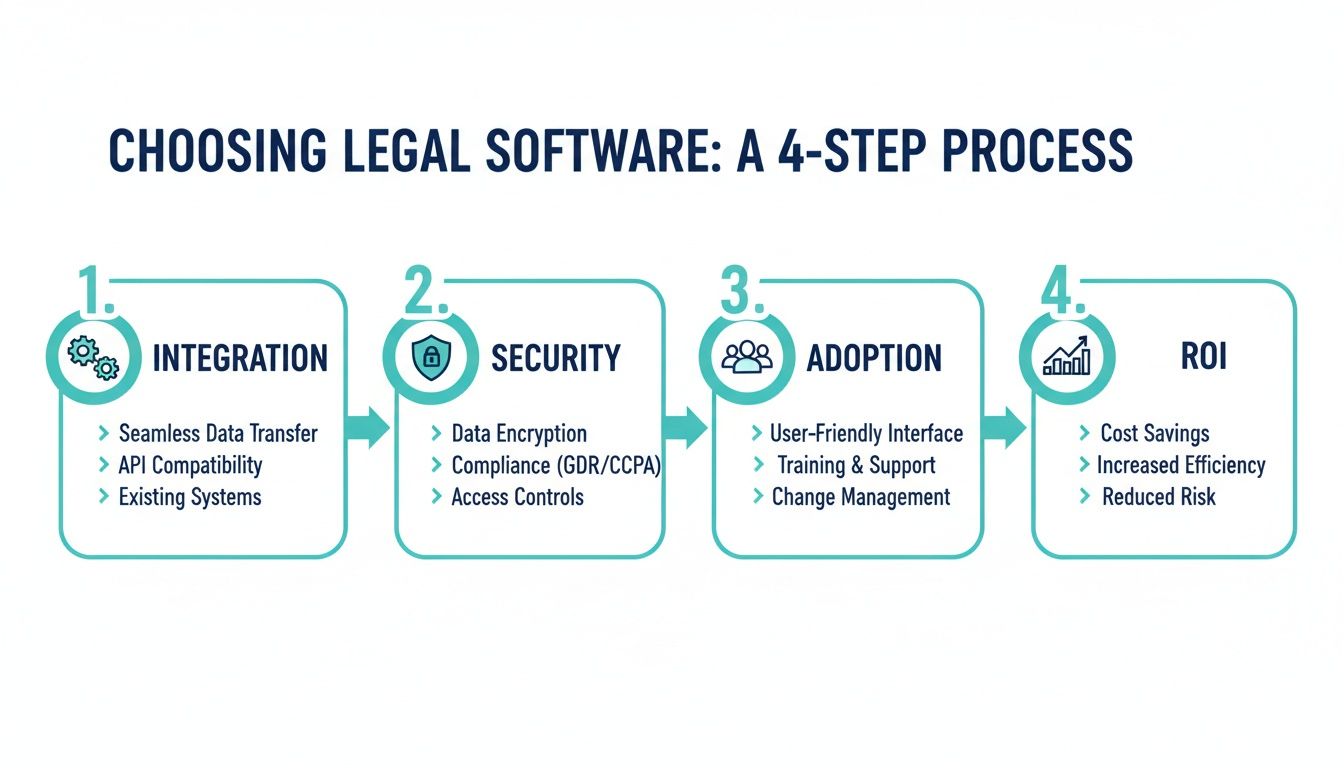
A successful tech stack is built on tools that seamlessly support the client’s journey from beginning to end.
Bridging the Gap with a Client Portal
This is precisely where a client portal earns its keep. A portal like CasePulse plugs directly into your case management system, creating a secure, transparent window for your client to peek through whenever they want. The same day her case is opened, Sarah gets an automated welcome email inviting her to set up her secure portal account.
Instead of calling the office to ask, "What's going on with my case?", Sarah can now log in anytime, day or night, and see real time status updates. She can send secure messages, upload photos of her injuries, and complete necessary intake forms online.
When David ticks off a key milestone in the case management system, say, "Demand Package Sent," that update can automatically and instantly appear in Sarah's portal. She gets a notification, logs in, and sees tangible progress. This proactive communication cuts down on her anxiety and eliminates her need to call for routine updates.
This connected ecosystem lets each system do what it does best:
- The CRM turns a lead into a client with incredible efficiency.
- The Case Management System orchestrates all the internal legal strategy and work.
- The Client Portal automates communication and keeps the client happy and informed.
The result? A massive drop in inbound phone calls, freeing up David and the rest of your staff to focus on substantive legal work that actually moves cases forward. For a deeper dive into what separates a good portal from a great one, check out our guide on the best client portal software. This integrated approach does not just make your firm more efficient; it delivers the modern, responsive experience that today’s clients demand.
Implementing New Tech Without Disrupting Your Firm
Bringing new technology into a law firm can feel like performing open heart surgery on your daily operations. The good news? A successful rollout is less about the software and more about your people and your plan. With a smart strategy, you can introduce a new legal CRM or client portal without throwing your team or your clients into a state of chaos.
The secret is to manage the change proactively. A smooth transition does not start on launch day; it starts with getting your entire team invested in the idea from the very beginning. This means more than just a quick memo. It's about sitting down with each person and showing them exactly how this new tool will solve their biggest headaches.
Earning Team Buy-In From Day One
Think about your paralegals. Show them how automation can finally put an end to the mind numbing task of chasing down clients for routine information. For your intake specialists, demonstrate how a structured workflow means fewer leads slipping through the cracks. When your staff sees the software as a direct answer to their daily frustrations, they will champion the change themselves.
Let's be honest, people naturally resist change. That resistance usually comes from a fear of the unknown. The best way to dismantle that fear is with clear communication that focuses on personal benefits. Frame it not as "another program to learn," but as a tool that frees them up to do the high value, strategic work they were actually hired for.
The success of any new technology is not measured by its list of features. It's measured by how eagerly your team uses it. Make them part of the process, and they'll drive its success.
Setting Clear Goals and Measuring Success
To make sure you're getting a real return on your investment, you need to set clear, measurable goals right out of the gate. A vague goal like "improve efficiency" is impossible to prove. You need to define specific outcomes you can actually track.
For instance, a fantastic starting goal is to cut inbound client update calls by 30% within the first three months. That is a concrete number you can measure. Dive into the system's own reporting and analytics to see how you're doing. This data first approach transforms your goals from wishful thinking into a real roadmap for success.
Here are a few other measurable goals worth considering:
- Reduce time spent on client intake by 25%.
- Increase positive online reviews by 15% in six months.
- Achieve a 90% adoption rate among all client facing staff within 60 days.
The Importance of Reliable Support
Even the most perfect plan will hit a few bumps. Questions will come up. Glitches will happen. This is the moment when your technology partner’s support team becomes the most important part of the equation. Choosing a vendor with a responsive, hands on support team is not just a nice to have; it's a dealbreaker.
A solution like CasePulse is built around a smooth launch, offering expert, US based support to get your firm comfortable and confident. This kind of partnership is what turns a rocky start into a smooth, firm wide adoption, ensuring your team has the backup they need from day one.
Your Top Questions About Legal CRMs Answered
It is completely normal to have a lot of questions when you’re looking at bringing new technology into your firm. When you're a partner at a busy practice, you need straight answers about how a CRM for legal, or any software, for that matter, will actually affect your team, your bottom line, and your clients.
Let's cut through the jargon and get right to the most common concerns we hear from law firms every day.
Can a Legal CRM Replace My Case Management Software?
No, and you would not want it to. They are two different tools built for two very different, but equally crucial, jobs.
Think of it this way: your CRM is the firm’s front desk and intake team. Its entire job is to attract potential clients and guide them through the process of becoming actual clients. Your case management software is the back office where all the real legal work on an active case happens.
The goal is not to pick one over the other. The smart move is to make them work together. A good integration means that once a lead signs on, all their information flows automatically from the CRM into your case management system. It is a seamless handoff that makes everyone's life easier.
How Long Does Implementation Usually Take?
The timeline for getting new software running can vary, but we are not in the era of year long, painful rollouts anymore. Modern, cloud based tools are designed to get you up and running fast.
For example, a dedicated client portal like CasePulse can be fully connected to your existing case management system and ready for your team in about a week. The secret is finding a partner who provides hands on support to ensure the launch is smooth for everyone at the firm, not just the IT department.
Is My Firm's Client Data Secure?
Security is not a feature; it's the absolute foundation. Any software provider worth their salt in the legal space will treat your firm's sensitive data with bank grade security protocols. We are talking about things like data encryption and secure, US based servers as a bare minimum.
A purpose built legal client portal is designed from the ground up with attorney client privilege in mind. It provides a far more secure channel for communication and sharing documents than just using standard email or text messages. Always ask for specifics on a provider's security measures before you commit.
What Is the Real Return on Investment?
The ROI here comes from two main places: massive efficiency gains and much happier clients. Firms that get this right see a huge drop in the time their staff spends on repetitive administrative tasks, especially answering endless phone calls for simple case updates.
That newfound time allows your paralegals and case managers to focus on substantive work that actually moves cases toward settlement. On top of that, clients who feel informed and in the loop are more likely to leave positive online reviews and refer their friends and family, creating a clear, powerful cycle of growth for your firm.
Ready to see how a dedicated client portal can transform your firm's communication and free up your staff? CasePulse integrates seamlessly with your case management system to automate updates, reduce phone calls, and deliver the modern experience your clients expect. Learn more at https://www.casepulse.com.