
 CasePulse
 When you’re going through a divorce in California, you have to create a complete inventory of your financial life, everything you own and everything you owe. The state’s official tool for this is Form FL-142, the Schedule of Assets and Debts.
Think of it as drawing a detailed map of your shared financial world. For a property division to be fair, both you and your spouse need to be looking at the same, accurate map. This form is how the court ensures that happens.
What is Form FL-142 and Why Does It Matter?
Untangling years of shared finances is often the most difficult part of a divorce. Form FL-142 is the legal instrument designed to bring order and transparency to that process. It forces a clear, honest accounting of every asset and debt, creating the bedrock for all financial negotiations and court orders that will follow.
Make no mistake, this form isn't optional. It’s a mandatory part of your financial disclosures. When you sign it, you are swearing under penalty of perjury that the information is true and complete. Hiding an asset or failing to disclose a debt can have serious repercussions, from major financial penalties to having your entire divorce judgment thrown out later.
What Counts as an Asset or a Debt?
When the form asks for your assets and debts, it means everything. It’s easy to think of the big things, like a house or a 401(k), but the law requires a much more granular accounting of your life.
Assets are anything you own that has value. This includes the obvious, like real estate, cars, and bank accounts. But it also covers stocks, bonds, retirement plans, pensions, life insurance policies with cash value, and even business interests, valuable art, or intellectual property.
Debts are any financial obligations you have. This isn't just the mortgage. It includes car loans, credit card balances, student loans, personal loans from family, and even outstanding tax bills.
The Blueprint for a Fair Division
A fair settlement can only be built on a foundation of complete information. If one person’s financial disclosures are incomplete or misleading, the entire agreement is compromised. It’s like trying to negotiate the sale of a house when one person thinks it has three bedrooms and the other knows it actually has five.
The FL-142 ensures both sides start with the same set of facts. It puts all the cards on the table, right from the beginning.
The entire point of this mandatory disclosure is to eliminate surprises. By requiring a full and honest accounting upfront, the courts aim to minimize conflict and protect both spouses from the fallout of hidden assets or secret debts that could unfairly tilt the scales.
This table breaks down the main sections of Form FL-142, explaining what you need to disclose in each category and its importance in the divorce settlement.
Form FL 142 At a Glance
| Section Category | What to Disclose | Why It Matters |
|---|---|---|
| Real Estate | Any property you own, including the family home, rental properties, or vacation homes. Include the address, fair market value, and any mortgage balance. | This is often the largest marital asset. Accurate valuation is crucial for an equitable split, whether you sell the property or one spouse buys out the other. |
| Furniture, Furnishings, and Appliances | A general list and estimated value of household items. You don't need to list every single fork, but major items should be noted. | While often lower in monetary value, these items can carry significant emotional weight. A fair estimate helps prevent disputes over personal belongings. |
| Jewelry, Antiques, Art | Specific, high-value items should be listed individually with their estimated value. Appraisals may be necessary for unique or expensive pieces. | These are often considered separate property if they were gifts or inheritances, but if purchased during the marriage, their value must be included in the marital estate. |
| Vehicles, Boats, and Trailers | All vehicles, including cars, motorcycles, boats, and RVs. You'll need the year, make, model, and current loan balance, if any. | The fair market value minus any outstanding loan determines the equity, which is the community property value that needs to be divided. |
| Bank and Investment Accounts | Checking, savings, money market accounts, stocks, bonds, and mutual funds. List the financial institution and the balance as of the date of separation. | Provides a clear snapshot of liquid assets. This is critical for determining cash flow, support payments, and the division of financial holdings. |
| Retirement and Pensions | All 401(k)s, 403(b)s, IRAs, and pension plans. You'll need to list the plan administrator and the value of the portion earned during the marriage. | Retirement funds are a major asset. Proper disclosure and division are essential for ensuring both spouses' long-term financial security. |
| Debts | Mortgages, car loans, student loans, credit card balances, and any other money you owe. List the creditor and the total amount due. | Debts acquired during the marriage are typically shared. Disclosing all debts ensures they are fairly assigned and one spouse isn't unfairly burdened. |
Completing this table is the first step toward a transparent and fair resolution. Each section provides a piece of the puzzle that, when assembled, reveals the complete financial picture of your marriage.
With over 50,000 divorce cases filed in California each year, Form FL-142 is a cornerstone of the process for nearly every couple with property. Its standardized format is a key reason why many potential disputes are resolved early, as it forces a level of transparency that reduces the need for costly court battles. To get a better sense of its role, you can explore the findings on form FL-142 effectiveness. This is why getting this form right isn’t just about following the rules, it’s a critical step in moving toward a fair and final resolution.
A Step-by-Step Guide to Each Section
Looking at Form FL-142 for the first time can be intimidating. It feels like the government is asking you to inventory every single penny you have and owe. The key is to not get overwhelmed. Instead, think of it as taking a detailed financial snapshot. You just need to tackle it one piece at a time.
At its core, the form splits your financial world into two simple categories: assets and debts.
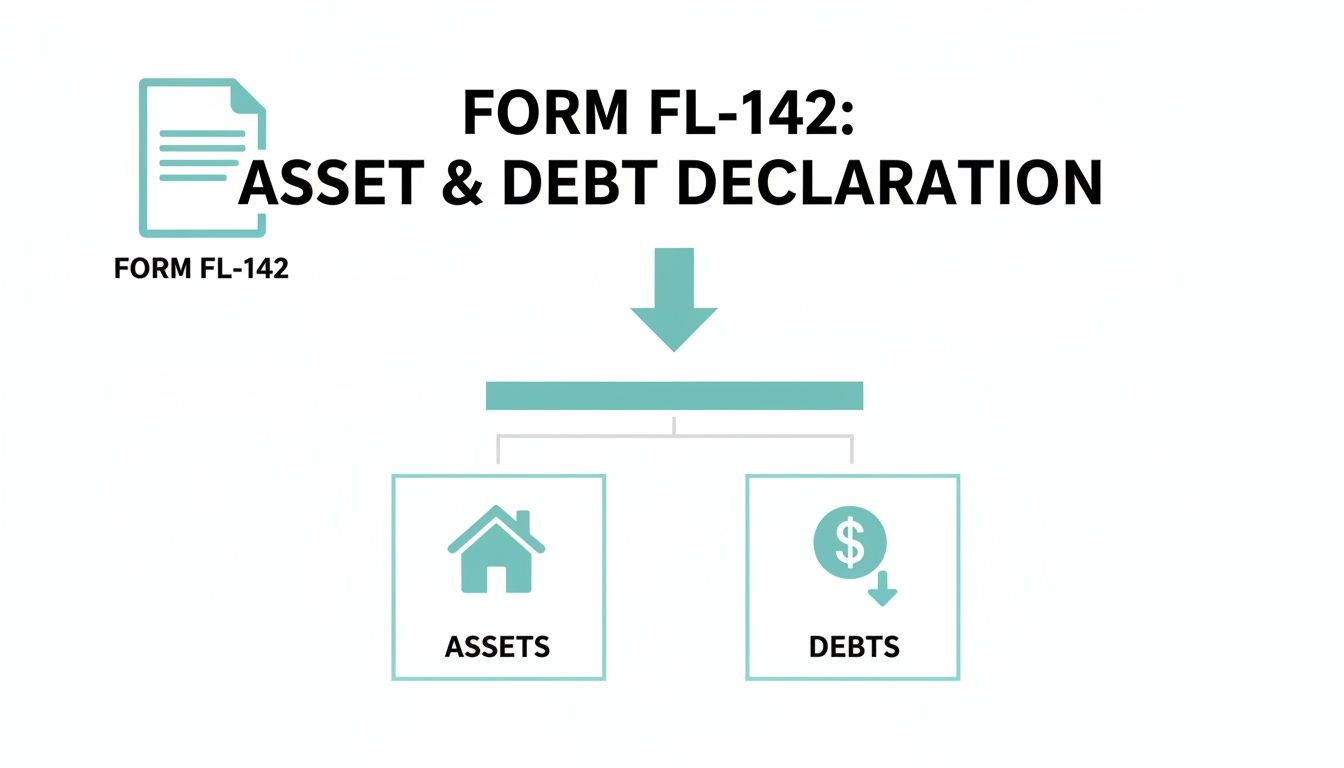
As you can see, the form is really just a balance sheet. It’s designed to give the court a complete and honest picture of your financial situation by listing what you own against what you owe.
Listing Your Assets
The first part of the form is all about your assets, everything you and your spouse own that has value. For every single item, you’ll need to list what it is, when you got it, what it’s worth today, and whether you believe it’s community or separate property.
One of the most common hangups is figuring out an asset's current fair market value. This isn't what you paid for it. It's the price a willing buyer would realistically pay for that item right now.
For example, when you list your car, you wouldn't use the sticker price from five years ago. You’d look up its current value on a site like Kelley Blue Book. For real estate, you'll likely need a recent appraisal to get an accurate number.
Crucial Tip: Be meticulous here. It’s easy to remember the house and the cars, but the small things, like collectibles, expensive tools, or even a valuable piece of furniture, add up quickly. Forgetting to list an asset, even by accident, can look like you're trying to hide it and cause serious legal headaches down the road.
Identifying Your Debts
Just as important as what you own is what you owe. The court needs to divide the debts you both took on during the marriage, and this is where you list them. For each debt, you must name the creditor, state the total amount owed, and note when the debt was first incurred.
This section covers all your financial liabilities, including:
- Mortgages and home equity lines of credit (HELOCs).
- Vehicle loans for any cars, boats, or RVs.
- Credit card balances. You have to list each card individually, even if they're from the same bank.
- Student loans, both federal and private.
- Personal loans and other obligations, which could be anything from a loan from a family member to outstanding medical bills.
It's absolutely vital to pull the most recent statements for every debt. You need the balance to be accurate as of the date of separation. Using an old, outdated number will throw off the entire financial calculation and lead to unnecessary delays.
Distinguishing Community vs. Separate Property
This is where things can get tricky. A huge part of filling out Form FL-142 correctly is knowing how to classify each asset and debt as either community or separate property. In California, the rules are fairly clear, but the consequences of getting it wrong are enormous.
Here’s the basic breakdown:
- Community Property: This is the default category for almost anything earned, bought, or acquired during the marriage. It belongs to both of you, 50/50.
- Separate Property: This generally includes anything you owned before the marriage, anything you received as a personal gift or inheritance during the marriage, and anything you earned or acquired after the date of separation.
Think of it this way: that savings account you opened and funded years before you met your spouse is your separate property. But the car you bought two years into your marriage using money from your paycheck? That's community property, even if the title is only in your name. Nailing this distinction is fundamental to achieving a fair and final settlement.
Common Mistakes to Avoid on Your Form FL-142
A simple mistake on Form FL-142 can have serious consequences, bogging down your divorce and potentially costing you a significant amount of money. Think of this form less as a bureaucratic hurdle and more as the financial foundation of your post-divorce life. Getting it right is crucial, and the best way to do that is to understand where most people go wrong.

The financial inventory this form requires can feel overwhelming. It's no surprise that an estimated 25% of initial FL-142 filings contain errors. For those navigating more complex financial situations, say, tangled medical debts from a personal injury case, the stakes get even higher. In fact, over 70% of such cases report debt inventories climbing past $100,000, making absolute precision on this form non-negotiable. If you need a refresher on the basics, you can explore the details on form FL-142 and its requirements.
Undervaluing or Forgetting Assets
One of the most frequent and damaging mistakes is underestimating the value of assets or, even worse, forgetting to list them altogether. It’s natural to focus on the big-ticket items like the house and the cars, but the court expects a full accounting of everything.
What about stock options you haven't exercised, intellectual property like a patent, or that collection of rare books? Leaving these off the list, even by accident, can be interpreted as an attempt to hide assets, a move that comes with severe legal penalties.
- The Problem: You take a wild guess at the value of your antique dining set or completely forget about that small investment account you opened a decade ago.
- The Solution: Don't guess. Get professional appraisals for anything of significant value, like art, jewelry, or collectibles. To jog your memory, meticulously review your financial records like bank statements, tax returns, and loan applications from the last several years.
Misclassifying Property
Another common trap is incorrectly labeling property as "separate" when it should be classified as "community." This one error can radically shift the final division of your estate. The rule of thumb in California is that most assets and debts acquired during the marriage are presumed to be community property.
A huge misconception we see all the time is the belief that if an asset is only in one spouse's name, it automatically belongs to them as separate property. That's rarely the case. The critical factor is when and how the asset was acquired, not whose name is on the title.
Using Outdated Information
Your finances are a moving target. Using old information on your FL-142 creates an inaccurate snapshot, which is exactly what the court doesn't want. The form requires a clear picture of your finances as they existed on the date of separation.
Submitting a bank statement from six months ago or an old credit card bill is a surefire way to cause delays and trigger questions from the other side.
- The Problem: You list your 401(k) balance from last year's end of year statement, but the market has shifted its value by thousands of dollars since then.
- The Solution: You have to gather the most current statements for every single account and debt. For bank accounts, credit cards, and investments, use the statement that straddles your official date of separation. Staying organized is half the battle, and you can learn more by reviewing these document management best practices.
Understanding Filing Deadlines and Service Rules
Filling out Form FL-142 correctly is only half the battle. How you file and deliver it is just as critical, and California courts are sticklers for the rules. Getting the timing or the delivery process wrong can stall your entire divorce case. These procedures aren't just suggestions, they are mandatory requirements designed to make sure the process is fair and keeps moving.
The first exchange of financial documents happens very early on. Within 60 days of the initial divorce petition being filed, both spouses must serve their preliminary declaration of disclosure. Your Form FL-142 is a key part of this package, ensuring everyone has a clear financial picture from the start.
The Service Process
"Serving" the form isn't as simple as handing it to your spouse. In legal terms, service is a formal process that proves the other party officially received the documents. While the specifics can differ slightly by county, the core methods are the same across the state.
Here are the common ways to serve your FL-142:
- Personal Service: You can have someone who is over 18 and not involved in your case personally hand deliver the documents to your spouse or their lawyer.
- Service by Mail: You can also have the documents mailed. The person doing the mailing must then sign a declaration confirming when and where they sent everything.
Once the forms are served, you have one more crucial step: filing a Proof of Service with the court. Think of this as the official receipt you show the judge. It’s a separate form that confirms you followed the rules and your spouse has your financial information. Without it, the court has no way of knowing you’ve complied.
What if My Finances Change?
A divorce can drag on for months, sometimes even years. A lot can change in that time. If you land a new job, get an unexpected inheritance, or even take on a large new debt, your disclosure duties don't end.
You have a continuing obligation to report any "material" changes to the information on your FL-142. A material change is basically any new information that could realistically impact how assets or debts are divided. Keeping this updated is your best defense against future challenges to the final judgment.
This might mean you have to fill out, serve, and file an amended Form FL-142. Juggling these evolving deadlines can be a real headache. For complicated cases, many law firms use legal calendar software to track everything and make sure no deadlines are missed. Failing to disclose a significant financial change can have severe consequences, sometimes even allowing a closed case to be reopened down the road.
How Law Firms Can Streamline the FL-142 Process
Let’s be honest, the back and forth over Form FL-142 can be a nightmare. It often devolves into a tedious cycle of printing, mailing, and chasing down clients with endless phone calls and emails. This isn't just frustrating; it's a bottleneck that can stall an entire case and wear down both your team and your clients.
But what if you could sidestep that entire paper chasing mess? Many firms are now turning to secure client portals to transform how they handle the Form FL-142. This approach moves the entire process into a single, organized digital space.

Think about it: instead of a paper packet, your client receives a link to a digital, fillable version of the FL-142. They can work on it from their phone during their lunch break or on their laptop after the kids are asleep. You’re meeting them where they are.
Empowering Clients and Boosting Efficiency
A modern client portal does much more than just put a form online. It’s a dedicated toolkit designed to make the disclosure process smoother and far less intimidating for your client.
Here’s what that looks like in practice:
- Secure Document Sharing: Clients can upload sensitive documents like bank statements, property deeds, and loan agreements directly to the portal. No more worrying about the security risks of email attachments.
- Direct Messaging: Have a question about Item 7? Instead of a phone call, clients can send a quick, secure message right from the form, keeping all communications neatly tied to the case file.
- Automated Reminders: You can set up automatic nudges as deadlines get closer. This frees up your paralegals from having to play the role of collections agent for paperwork.
This shift gives clients a real sense of control. Instead of being buried under a mountain of confusing papers, they get a clear, step by step process they can manage on their own schedule, knowing your firm is just a message away.
Reducing Manual Work and Improving Accuracy
The advantages for the law firm are just as compelling. Manually transcribing a client's handwritten form into your case management system is not only a waste of billable hours but also a prime opportunity for typos and errors.
When a client fills out a digital form, that data can be integrated directly, which saves time and ensures accuracy from the start.
The impact is measurable. Just gathering the backup documents for Form FL-142, titles, statements, and so on, can take an average of 15-20 hours per party. Firms using secure, fillable forms often find they can slash manual data handling tasks by 80%. Providing clients 24/7 access without overwhelming staff is a game changer. In fact, a recent analysis of divorce form processing improvements noted that firms adopting these portals see client satisfaction scores jump by as much as 45%.
If your firm is looking to create digital versions of state mandated forms, a good form builder online free can be an excellent starting point for simplifying preparation and management.
Ultimately, this technology helps your team take back control of case timelines while reducing the constant "just checking in" phone calls from anxious clients. If you're looking to take the next step, you might want to read our guide on workflow automation. It's the perfect way to turn the daunting Form FL-142 into a manageable, collaborative process.
Answers to Your Top Questions About Form FL-142
When you're dealing with financial disclosures in a California divorce, it's completely normal for questions to pop up. The Form FL-142 is a detailed document, and getting it right is critical. Let's walk through some of the most common issues people face.
What if I Don’t Know the Exact Value of an Asset?
This is probably the most frequent question we hear. It's rare for every asset to have a simple, clear price tag like a share of stock. The court knows this, but that doesn't mean you can leave a field blank or just throw in a random guess. You're expected to make a good faith effort to determine the fair market value.
For some things, you’ll need a professional. There’s just no way around it.
- Real Estate: Getting a professional appraisal for your home or any other property is standard practice. This isn't a place for Zillow estimates; you need a formal valuation.
- Jewelry, Art, or Collectibles: If these items have significant value, an expert appraiser is the only way to get a number the court will accept.
- Business Interests: Valuing a business is a whole different ballgame. It almost always requires a specialized forensic accountant or a business valuator to do it correctly.
But what about all the stuff in your house? Don't worry, you don't need to hire an appraiser for your sofa. For general household goods, think about their "garage sale value." What would a reasonable person pay for that item today, in its current condition? That's your number.
Do I Have to List Assets I Had Before Marriage?
Yes, absolutely. You must list everything you own on Form FL-142, and that includes your separate property. Think of the form as a complete financial snapshot, not just a list of things you and your spouse acquired together.
Clearly identifying an asset as your separate property is how you protect it from being divided.
Don't think of listing separate property as putting it at risk. It’s the opposite. By officially declaring what was yours before the marriage, you are putting your spouse and the court on notice that the asset belongs to you alone.
If you fail to list a separate asset, you create an opening for your spouse to argue that it's actually community property. It’s a simple step that prevents massive headaches down the road.
What Happens if My Spouse Hides an Asset?
This is a big one. Deliberately hiding assets is a serious breach of the law in California. When you each sign your financial disclosures, you’re doing so under penalty of perjury. If you think your spouse is being less than honest, you have powerful legal tools at your disposal.
Your attorney can launch a formal discovery process. This might involve sending subpoenas for bank records, conducting depositions where your spouse has to answer questions under oath, or even bringing in a forensic accountant to uncover hidden accounts or trace where money has gone.
The courts do not take this lightly. If a judge finds that an asset was intentionally hidden, the penalties can be severe. The court has the power to award 100% of that asset to you, the innocent spouse, and may also order your spouse to pay your attorney’s fees.
Can I Update the Form After I Have Submitted It?
Not only can you, but you must. Your financial disclosure isn't a one time thing. You are under a continuing duty to keep this information accurate and up to date for the entire duration of your divorce case.
If your financial picture changes, maybe you get an inheritance, a big bonus, or even take on a new loan, you have to report it. You'll file an amended Form FL-142 to notify your spouse and the court of the changes. Staying on top of this is the best way to ensure your final settlement is fair and, most importantly, legally sound.
At CasePulse, we understand that streamlining communication and document collection is key to a successful law practice. Our secure client portal empowers your clients to complete forms, share documents, and stay informed, all while reducing your firm's administrative burden. Learn more about how CasePulse can modernize your client engagement.