
 CasePulse
A lot of firms hit the same wall at the same time. The attorneys are capable, the caseload is healthy, and the intake keeps coming, but the day still ends with briefs half edited, deadlines chased manually, and clients waiting too long for a simple update. That usually isn't a lawyer problem. It's a role design problem.
When firms define law clerk job duties too narrowly, clerks become glorified runners. When firms define them too loosely, attorneys end up redoing the work or worrying about supervision. The optimal opportunity lies in the middle. A well used law clerk can take pressure off the lawyers, tighten preparation, and help the firm deliver a steadier client experience.
The Strategic Role of a Law Clerk in a Modern Firm
In a growing firm, the first sign you need clearer law clerk job duties usually isn't a hiring request. It's friction. An associate is spending too much time pulling cases, checking citations, and cleaning up drafts. A partner is reviewing basic procedural issues that should have been framed earlier. Staff are fielding avoidable calls because no one has time to keep the case moving and documented in a disciplined way.
That is where the law clerk becomes strategic.
A clerk isn't just extra hands. In the right structure, the clerk becomes the person who keeps legal work moving between attorney judgment and staff execution. That matters in firms where lawyers need to spend their time on analysis, negotiation, hearings, and client decisions, not on every preliminary research task or first draft.
Where firms usually get it wrong
Some firms treat the clerk like a temporary research assistant. Others use the role as overflow admin support. Both approaches waste the position.
What works better is to place the clerk exactly where bottlenecks occur:
- Before attorney review so the legal issues are framed early
- Before filing so authorities, citations, and drafts are cleaner
- Before client frustration builds so the case file, deadlines, and internal notes stay current
A firm that understands its own law firm hierarchy usually gets this faster. Once you know who should own legal analysis, who should own process, and who should support each stage, the law clerk role becomes easier to scope.
Practical rule: If your lawyers are doing repeatable research, first draft writing, or routine case organization themselves, your clerk role is probably underused.
Why the role matters operationally
The strategic value of a law clerk is simple. Clerks help attorneys make better use of attorney time.
That improves more than internal efficiency. It also changes what clients feel. When files are current, motions are better prepared, and hearing materials are organized before the last minute, clients experience the firm as responsive and in control. They may never know the clerk's name, but they feel the effect of the role in faster answers, fewer avoidable delays, and a case team that sounds coordinated.
The Core Responsibilities of a Law Clerk
The cleanest way to define law clerk job duties is to organize them into three pillars: research, writing, and case support. Firms that skip this usually end up with muddled expectations and uneven work quality.
According to the U.S. Bureau of Labor Statistics, the core duties of 14,800 judicial law clerks in the US include researching legal precedents, advising on case facts, drafting legal documents, managing evidence, and taking witness statements, reflecting the high volume, detail intensive nature of their work, as summarized by Indeed's law clerk career overview.
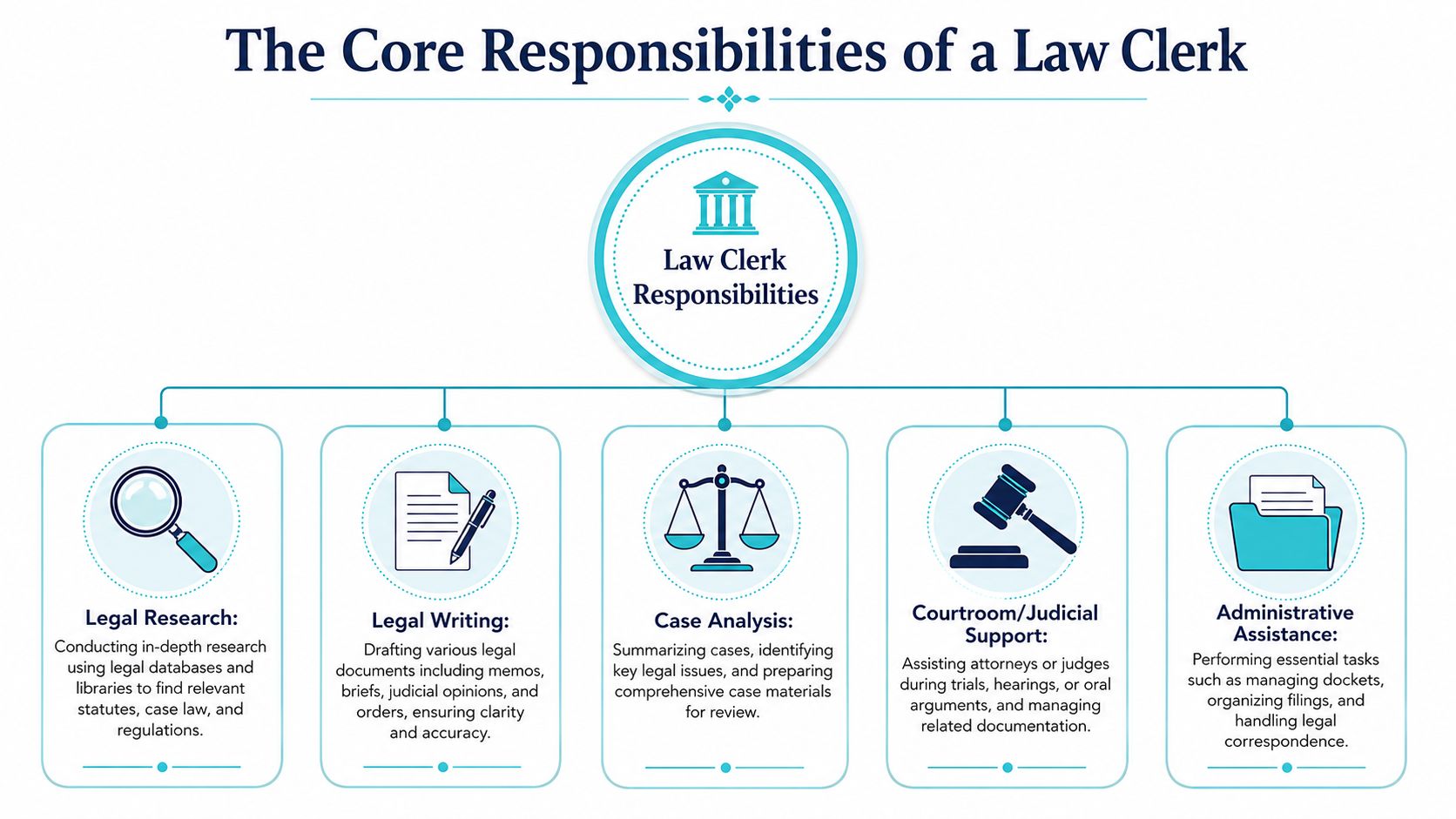
Legal research
This is the foundation. A law clerk is often the first person asked to answer, “What does the law say about this issue?”
That doesn't just mean pulling cases. Good clerks narrow the question, identify controlling authority, separate persuasive authority from noise, and flag weak spots before a lawyer relies on a bad argument.
Typical research work includes:
- Precedent review: finding statutes, regulations, and cases that control or influence the issue
- Issue framing: identifying the actual legal question, not just the question the file seems to raise at first glance
- Authority checking: confirming whether the cited law supports the position the team wants to advance
If your team wants a useful companion read on how review work fits into litigation support, Ares has a practical guide to legal document review that helps distinguish substantive legal review from lower value sorting tasks.
Legal writing
The second pillar is drafting. Research without writing usually dies in a notebook or browser tab. A clerk creates usable work product.
That work product can include memoranda, brief sections, motion drafts, summaries of witness statements, issue outlines, and citation checks. In many firms, the clerk's draft is the difference between an attorney starting from zero and an attorney revising something already coherent.
Case support
The third pillar is where many firms either gain an advantage or lose it.
Case support isn't merely clerical busywork. It's the discipline of keeping the legal file usable. That can mean organizing case materials, maintaining current file notes, supporting trial preparation, helping maintain deadlines, or preparing materials for internal meetings and hearings.
A clerk who understands docket flow is much more valuable than one who only writes memos. That's why firms should train clerks on the mechanics behind what docketing means in legal operations, even if another team member owns the master calendar.
A strong clerk doesn't just find law. They hand the lawyer a cleaner decision.
What the three pillars look like in practice
| Pillar | What the clerk produces | Why it matters |
|---|---|---|
| Research | Authorities, issue summaries, legal analysis | Reduces attorney time spent finding the basics |
| Writing | Memos, draft motions, brief sections, summaries | Speeds review and improves consistency |
| Case support | Organized files, tracked deadlines, hearing materials | Keeps matters moving without avoidable friction |
The firms that get the most from law clerk job duties don't blur these pillars together. They train for each one separately, then decide which tasks a clerk can own and which tasks require attorney review.
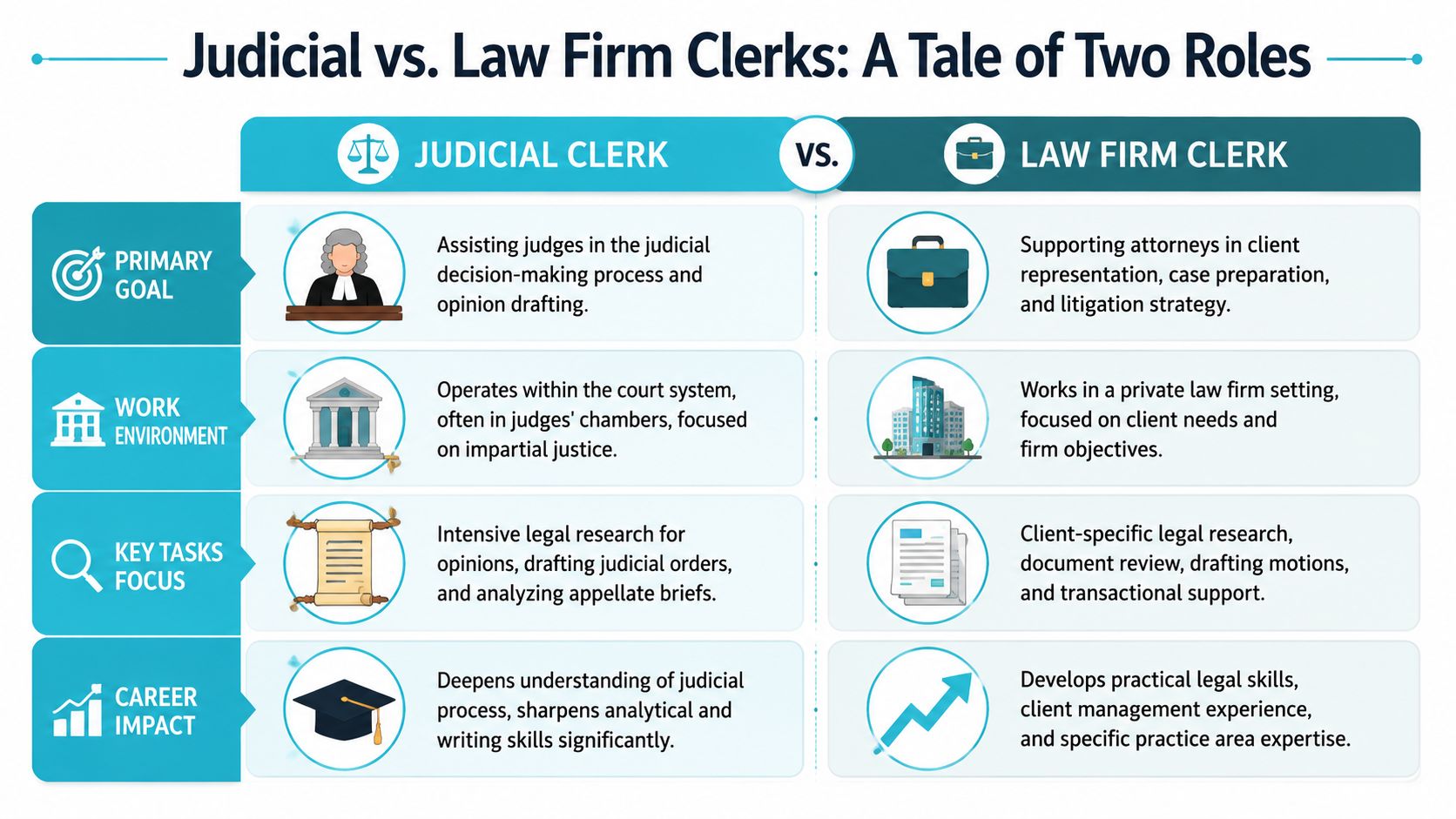
Judicial vs Law Firm Clerks A Tale of Two Roles
People often use the term law clerk as if it describes one job. It doesn't. A judicial clerk and a law firm clerk may share research and writing skills, but their work serves different masters.
A judicial clerk supports a neutral decision maker. A law firm clerk supports advocacy for a client. That difference changes everything, from what gets written to how urgency is judged.
The judicial clerk
In chambers, the clerk's job is to help the judge reach a sound legal decision. Judicial law clerks in federal chambers primarily concentrate on preparing bench memos, drafting orders and opinions, and verifying citations, with duties determined by the employing judge to maintain an extremely high level of quality and efficiency in assisting the court, as described by the federal courts' OSCAR duties page.
That setting rewards precision over persuasion. The clerk has to read what the parties filed, identify the issues, and help the judge analyze them fairly. The daily output often centers on bench memos, draft orders, opinion work, proofreading, citation verification, and support during court proceedings.
The law firm clerk
A firm clerk works in a different posture. The question isn't “What is the most neutral answer?” The question is “What is the strongest accurate position for our client, and how do we support it?”
That makes the role more tied to litigation strategy, transaction support, client file development, and practical case preparation. A firm clerk may research a point of law in the morning, draft part of a motion by lunch, and help prepare hearing materials or witness summaries that afternoon.
Side by side differences
- Primary objective: Judicial clerks support the court's decision making. Firm clerks support the attorney's case strategy.
- Primary audience: Judicial clerks write for judges and chambers. Firm clerks write for lawyers, clients, and opposing process demands.
- Tone of work: Judicial work tends to be analytical and balanced. Firm work tends to be analytical and advocacy oriented.
- Workflow pressure: Courts often revolve around motions, hearings, and opinions. Firms also carry client communications, business pressures, and file management realities.
The easiest way to mismanage a clerk is to hire for one environment and assign work from the other.
For hiring managers, this distinction matters because a candidate who thrives in chambers may need coaching on client focused urgency, while a firm trained clerk may need to adjust to the neutrality and rigor of judicial drafting. Both are strong roles. They just aren't interchangeable.
A Day in the Life Sample Law Clerk Task Lists
Abstract descriptions only go so far. The better way to understand law clerk job duties is to look at the rhythm of an actual day.
O*NET data confirms that typical law clerk duties include writing legal memoranda, drafting motions and briefs, communicating with clients and witnesses, maintaining client files, and docketing deadlines, all of which directly impact the efficiency of trial preparation, as summarized by Wizehire's law clerk job description.

A judicial clerk's day
A chambers based day usually moves in a quiet but demanding pattern. The work is less about volume for its own sake and more about depth, accuracy, and turning raw filings into something a judge can use.
Morning checklist
- Review filings: read incoming motions, briefs, or petitions and isolate the questions the court has to resolve
- Research controlling law: pull the authorities that directly govern the issue, not just the cases cited by the parties
- Draft bench materials: prepare a bench memo or issue summary that frames the dispute for the judge
Afternoon checklist
- Discuss analysis with the judge: refine the framing of the issue and test whether the legal reasoning holds up
- Revise draft orders or opinions: tighten the language, fix citations, and address gaps identified in review
- Attend proceedings when needed: observe oral arguments or hearings and note points that affect the analysis
A law firm clerk's day
A firm day is more fragmented. The clerk may touch multiple files and switch between legal and operational work quickly.
Morning checklist
- Review the active file: sort new records, pleadings, correspondence, or discovery into something attorneys can use
- Research a specific issue: answer the legal question that is blocking a motion, response, demand package, or internal decision
- Write a usable summary: give the supervising lawyer a memo, draft language, or case summary that can move directly into the next task
Afternoon checklist
- Support witness or client preparation: organize notes, summarize interviews, or pull supporting materials
- Draft and polish documents: work on motions, briefs, correspondence, or internal strategy notes
- Update file status internally: make sure the case record reflects deadlines, next actions, and what the attorney still needs
What separates a useful task list from a bad one
Bad task lists dump unrelated duties on the clerk. Good ones create a sequence.
For example, “research issue, summarize authority, draft section, verify citations” is a coherent chain. “answer phones, pull cases, draft motion, intake client, scan records” may all be necessary work in a small office, but it produces lower quality unless someone has clearly ranked priorities.
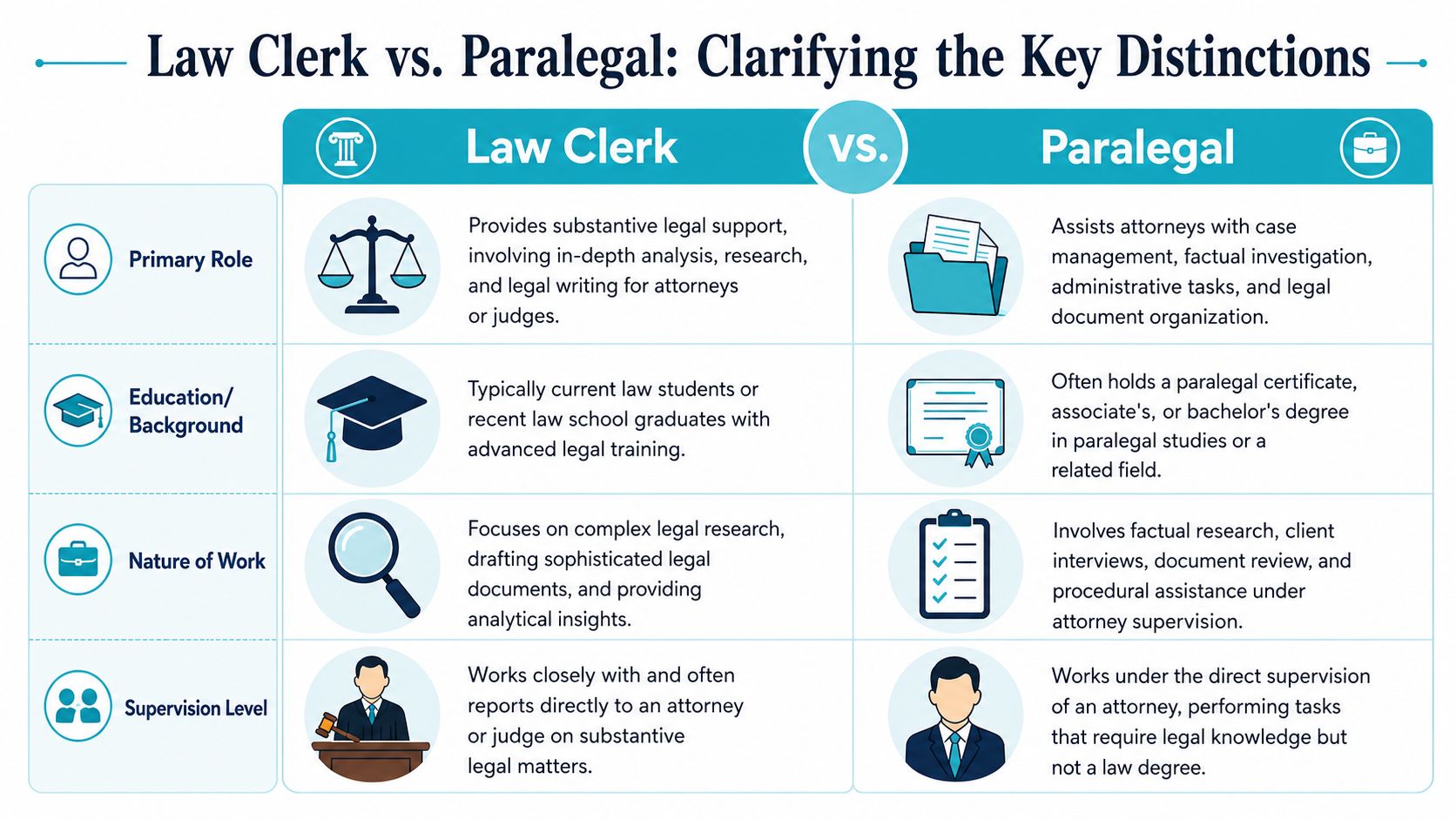
Law Clerk vs Paralegal Clarifying the Key Distinctions
Many firms say they need a law clerk, yet a paralegal is what they require. Other firms hire a paralegal and then expect law clerk level analysis. That confusion creates wasted salary, uneven supervision, and avoidable client service problems.
The biggest difference is not prestige. It's scope.
Where the work starts to split
Law clerks are usually brought in for substantive legal support. Think deeper legal research, more analytical writing, and closer work with attorneys or judges on legal reasoning. Paralegals usually carry more of the procedural, factual, and case administration load under attorney supervision.
That doesn't mean the roles never overlap. In real firms, they do. But overlap isn't the same as identity.
A practical way to separate them is this:
| Question | More often law clerk | More often paralegal |
|---|---|---|
| Who digs into unsettled legal authority? | Yes | Sometimes |
| Who prepares procedural filings and case logistics? | Sometimes | Yes |
| Who owns factual record organization and follow through? | Sometimes | Often |
| Who drafts analytical legal memoranda? | Yes | Less often |
The client communication problem
Role design often breaks down due to a key ambiguity in the legal field regarding the extent of a law clerk's client facing duties. While job descriptions mention client communication, official data from sources like O*NET omits client status reporting from a judicial clerk's tasks, creating inconsistent role scoping across firms, as discussed in Indeed's law clerk hiring guide.
That gap matters in day to day operations. Firms know clients want updates. They also know not every update should come from an attorney. So the question becomes who can safely handle what.
Boundary to keep clear: A clerk can help move information. A lawyer must own legal advice.
In practice, firms should define at least three categories:
- Administrative updates: confirming receipt of records, next scheduled event, or pending document collection
- Process updates: explaining what stage the file is in and what the team is waiting on
- Legal advice: interpreting what the development means for rights, exposure, or settlement strategy
The first two can often be systematized or delegated with supervision. The third should stay with the lawyer.
This gets especially important in practice areas with heavy client touchpoints. Teams working in plaintiff work often see the distinction more clearly after reviewing how responsibilities are divided in personal injury support roles for paralegals.
What works in a healthy staffing model
Use the law clerk for legal substance. Use the paralegal for case progression and procedural control. Let both support one another, but don't leave the boundary to chance.
If you don't define the line, staff will define it for you in the middle of a busy week. That's usually when mistakes happen.
Essential Skills and Qualifications to Become a Law Clerk
A strong law clerk usually has the same core profile no matter where they work. The person needs legal training, discipline, and judgment under supervision. If any one of those is missing, the role turns into extra review work for someone else.
According to Settlement.org's law clerk overview, the national average salary for law clerks in the U.S. is approximately $68,686 annually, which reflects the market value firms place on legal education and analytical support.
The qualifications that matter most
Formal education still matters here. Judicial roles commonly require a degree from an accredited law school, and many firm side roles also expect current law students, recent graduates, or candidates with substantial legal training.
The baseline qualifications usually include:
- Legal education: enough training to read cases accurately, spot issues, and understand procedural context
- Research ability: comfort using legal databases, court materials, and primary authority without getting lost in irrelevant sources
- Writing skill: the ability to produce concise, organized work that a lawyer can revise rather than rewrite
The skills firms should test for
The best clerks are not just smart. They're reliable in ways that protect the file.
- Attention to detail: they catch citation errors, mismatched facts, and deadline problems before they spread
- Ethics and judgment: they know what requires attorney review and what should never be communicated casually
- Communication: they can translate a messy issue into a useful internal summary
- Work management: they can handle multiple assignments without letting the urgent bury the important
A mediocre clerk produces more paper. A good clerk produces clarity.
What hiring managers should look for in interviews
Don't just ask whether the candidate is a good researcher. Ask how they narrow a broad legal question. Ask what they do when authority conflicts. Ask how they'd flag uncertainty in a draft.
Those answers tell you whether the candidate can support the actual law clerk job duties your firm needs, not just the version that looks good on a résumé.
Hiring and Managing Law Clerks for Peak Firm Performance
Most firms don't struggle because they hired a bad clerk. They struggle because they never built a usable role around the person they hired.
A good law clerk can improve workflow, but only if the firm answers three management questions early. What work belongs to the clerk, what work belongs to the attorney, and what system tells everyone where the file stands right now?
Write the role before you fill it
The job description needs to say more than “research and drafting.” It should identify the actual outputs your firm expects.
For example, a useful posting can specify that the clerk will:
- Prepare legal research memoranda: focused on issues that affect motions, hearings, or case valuation
- Draft first versions of legal materials: such as motion sections, correspondence, or case summaries for attorney review
- Support case progression: by maintaining organized file notes, compiling exhibits, and helping track internal deadlines
- Handle defined communications support: such as gathering information or relaying approved process updates, without giving legal advice
That final point matters more than many firms realize. If you don't define communication boundaries up front, the clerk either becomes underused or starts wandering into work that requires tighter supervision.
Build an assignment system, not a pile of requests
Clerks fail in firms where work arrives randomly from five different people. They succeed where one supervising attorney or operations lead controls intake, priority, and review standards.
A simple management model works best:
- One owner assigns the work
- Each task has a required output
- Each output has a review path
- The file is updated after the task is done
Without that structure, even talented clerks spend too much time figuring out who wants what.
Use the role to reduce friction for clients
Clients don't care about your org chart. They care whether the firm appears organized and responsive.
The law clerk can support that result by keeping research current, maintaining usable internal summaries, organizing hearing materials, and helping the legal team avoid last minute scrambles that slow responses. But firms should stay disciplined about the line between information flow and legal advice.
A clerk should never become the unofficial answer desk for legal judgments. The better use is to let the clerk keep the case moving so the attorney can give better answers faster.
What actually works
The firms that get real value from law clerk job duties tend to do a few things consistently:
- They assign clerks to bottlenecks, not leftovers
- They standardize research and draft expectations
- They train clerks on file hygiene and deadline awareness
- They define client facing limits clearly
- They review early, then give more ownership as trust builds
If you want peak performance, manage the role like part of your legal production system, not like an informal apprenticeship. That's when a clerk stops being “help” and starts becoming a strategic asset.
CasePulse helps law firms improve the part of the workflow that often breaks down even when legal work is strong: client communication. Through a secure CasePulse client portal that integrates with systems like Needles, Neos, LawBase, and Litify, firms can let clients check case status, message the team, share files, and complete forms without forcing staff to work in another inbox. For firms trying to define law clerk duties more clearly while reducing routine follow ups and inbound calls, that kind of structured communication layer can make the whole team more efficient.