
 CasePulse
Law firm automation software is a system built to take on the repetitive, time-consuming tasks that bog down your team. It frees them up to focus on high-value legal work. It turns chaotic, manual processes into a smooth, organized system. For firms juggling a high volume of cases, this is not just a nice to have. It's essential for staying efficient and competitive.
What Is Law Firm Automation Software, Really?
Think of a conductor leading an orchestra. Every musician knows their part and when to play it, resulting in a flawless performance. Law firm automation software is that conductor for your practice. It brings a sense of order to the daily operational grind that can easily become a mess.
This software is not here to replace legal professionals. It is here to empower them. The average lawyer only manages to log 2.9 hours of billable work a day. The rest of that time gets eaten up by administrative tasks. Automation tackles this problem head on by taking over the routine stuff.

Moving Beyond Manual Processes
So many firms are still stuck doing things the old fashioned way. We are talking about endless phone calls for case updates, disorganized files scattered across email threads, and the constant headache of chasing clients for documents. These methods are not just slow. They are magnets for human error and a source of frustration for everyone involved.
Law firm automation software brings structure to the chaos. It is built to handle tasks like:
- Client Intake: Automatically sending out new client forms and tracking their completion.
- Document Management: Requesting and organizing files without your team having to send constant reminders.
- Appointment Reminders: Firing off automated messages to slash the number of no shows.
- Case Updates: Giving clients a portal to check their case status whenever they want.
This technology creates a central command center where predictable tasks get done right, every time. This frees up your staff to concentrate on what they do best: complex legal strategy and building strong client relationships.
The core idea is simple: spend less time on tedious work and more time on the things that actually require your expertise. That is how a modern firm grows.
A Strategic Tool for Modern Firms
Getting a handle on law firm automation software starts with understanding the wider world of AI tools for law firms available today. These systems are particularly game changing for practices dealing with a massive caseload, like plaintiff personal injury firms.
In a high volume environment, communication is constant and absolutely critical. This software provides a dedicated, structured channel for that communication. It cuts through the noise and makes every interaction count. It is more than a convenience. It is a foundational piece of a modern, efficient, and client first law practice. By systemizing the mundane, you unlock your team’s true potential.
What Can Automation Software Actually Do for Your Firm?
To really get why law firm automation software is such a big deal, you have to look past the buzzwords and see what it actually does. This is not just another program to learn. It is a completely new way of running your practice, built around a few core capabilities that work together to make life easier.
Think of it as the central nervous system for your firm. It connects all the scattered tasks, client messages, and internal processes into one smooth, logical flow. This gets rid of the frustrating bottlenecks that slow your team down and leave clients feeling out of the loop. Each piece of the system is designed to solve a real, everyday problem that law firms constantly battle.
A Direct Line to Your Clients
One of the most immediate benefits comes from a secure client communication portal. This is like giving every client a private, digital key to your office that works 24/7. Through the portal, they can get what they need, when they need it. This includes case status updates, secure messages, or important documents, all without picking up the phone.
This simple feature drastically reduces the constant "just checking in" calls that interrupt your team all day. Instead of answering the same questions over and over, your paralegals can focus on high value work that actually moves cases forward. It is a win win. Clients feel informed and in control, and your staff gets their time back.
Putting Repetitive Tasks on Autopilot
Next up are automated workflows. These are essentially pre built recipes for handling all the predictable, time sucking tasks your firm has to do every single day. You set the rules once, and the software takes it from there, no manual intervention needed.
A classic example is client intake. When a new client comes on board, a workflow can kick into gear and automatically:
- Send a personalized welcome email.
- Deliver the necessary intake forms for e-signature.
- Gently nudge the client with reminders until the forms are complete.
The same logic works for chasing down medical records, scheduling depositions, or sending case milestone updates. Automation brings consistency, slashes the risk of human error, and ensures critical steps are never missed. You can learn more about how to make these processes work for you in our guide on what is workflow automation.
Playing Nicely with Your Case Management System
Here is the most important part: deep integration with the case management systems you already use every day. A great automation platform does not force you to start from scratch. It plugs right into the tools your team knows and loves, whether that is Needles, Neos, LawBase, or Litify.
This seamless connection is the secret sauce. It creates a single source of truth for every case. All client texts, emails, and documents are automatically logged and saved right inside your case management system, exactly where they should be.
This approach destroys data silos and kills the tedious task of entering the same information in multiple places. Your team keeps working in their familiar software, while the automation hums along in the background, keeping everything perfectly organized and up to date.
This move toward connected, cloud based systems is changing the game. The legal case management software market is expected to jump from $9.80 billion in 2026 to $13.4 billion by 2033. Cloud based tools are driving this growth, now holding 68.8% of the market share as firms demand more flexibility. It is individual firms and attorneys, making up 63% of the market, who are pushing this adoption forward to better manage their cases and serve their clients. You can dig into more of this data in the legal tech market report from Coherent Market Insights.
The Real-World Impact of Automating Your Firm
Let's move past the feature lists and talk about what automation actually does for a law firm. The most immediate change you will see is a massive boost in how efficiently your team operates. It fundamentally changes the rhythm of your practice. It moves everyone from a constant state of reacting to fires to proactively managing their cases.
Think about the daily grind your paralegals and case managers face. This includes the endless follow ups and the administrative busywork. By automating these routine tasks, you are not just saving them a few minutes here and there. You are giving them back significant chunks of their day to focus on the work that truly matters: the substantive, billable activities that win cases. This is not about working faster. It is about working smarter.
This shift naturally leads to a better client experience. We live in a world where people expect instant updates and easy access to information. Automation provides exactly that. When clients have self service tools to stay informed, it builds a foundation of trust and satisfaction that pays dividends.
Driving Profitability and Smart Growth
The financial argument for automation is incredibly straightforward. It directly slashes your administrative overhead by cutting down the hours your team spends on non billable work like chasing down signatures or fielding "just checking in" phone calls. This means you can handle a larger caseload and grow your revenue without having to hire more staff at the same rate.
What if you could shorten your client intake process by a full week? That is a realistic goal. Automated reminders can make sure forms are completed and returned on time, every time. With fewer delays, cases progress faster, and your firm’s capacity to take on new clients expands without adding to your payroll.
The real magic of automation is its ability to build a more profitable, scalable business model. It is about doing more with the team you already have, turning saved time directly into bottom line growth.
This is not just a niche idea. It is a massive industry shift. The global legal tech market is on a trajectory to hit $63.1 billion by 2033. And what is driving that explosion? Software. These solutions make up over 72% of the market because they offer scalable, automation powered answers to the legal world's biggest operational headaches. You can dive deeper into these insights into the legaltech market from Persistence Market Research.
To see how these principles create tangible business results, from happier clients to lower operational costs, it is worth exploring the broader world of customer services automation. The core concepts are directly applicable to law firms, where exceptional client service is non negotiable.
A Better Day-to-Day for Everyone
A happy client is a loyal client, and automation is one of the best tools for making that happen. When a client can check their case status, upload a document, or send a secure message whenever it is convenient for them, their confidence in your firm soars. That kind of transparency calms anxiety and proves you are a modern, organized, and responsive practice.
But the benefits are not just for clients. Your staff's quality of life improves dramatically, too.
- Less Burnout: Taking the tedious, repetitive follow up calls and data entry off their plate directly reduces stress and boosts job satisfaction.
- More Meaningful Work: When your team can focus on legal strategy and complex problem solving, they are more engaged, motivated, and effective.
- Fewer Mistakes: Automation brings consistency. It eliminates the risk of human error that inevitably creeps in with manual data entry or a forgotten to do list item.
Let's look at a side by side comparison to see just how stark the difference is.
Manual Processes vs Automated Workflows
This table breaks down how specific tasks are transformed when you move from a traditional, hands on approach to an automated one.
| Task | Manual Approach | Automated Approach with Software | Primary Benefit |
|---|---|---|---|
| Client Intake | Staff manually send forms, make follow-up calls, and re-enter data from paper. | Client receives a link to a digital form; automated reminders are sent until completion. | Faster intake, fewer errors, and staff time saved. |
| Document Signing | Print, mail, wait for return mail, scan, and file. | Send e-signature request via email/text; client signs on their phone in minutes. | Days or weeks cut from the process; improved security. |
| Case Status Updates | Paralegals field frequent "just checking in" calls and emails from clients. | Clients log into a secure portal for real-time status updates and case milestones. | Reduced interruptions for staff and empowered, informed clients. |
| Appointment Reminders | Staff member calls or manually emails each client before a deposition or meeting. | System automatically sends text and email reminders 24-48 hours before the event. | Drastically reduced no-shows and wasted attorney time. |
| Gathering Medical Records | Staff fax or mail requests, then make repeated follow-up calls to providers. | System sends initial request and triggers automated follow-ups at set intervals. | Consistent follow-through and a faster, more reliable record retrieval process. |
As you can see, automation does not just speed things up. It creates a fundamentally better way to work.
Ultimately, automation creates a powerful positive feedback loop. A happier, more efficient team delivers better service, which leads to more satisfied clients. Those clients leave great reviews and send referrals, fueling your firm's growth and cementing your reputation as a top tier practice. Your operations stop being a cost center and become your greatest competitive advantage.
How to Choose the Right Automation Software
Picking the right automation software for your law firm is a big deal. It is a decision that will echo through your daily operations and client relationships for years. With so many options out there, it is easy to get distracted by flashy features. The real trick is to zero in on what will actually deliver long term value.
Think of it this way: you are not just buying a tool. You are looking for a partner that fits into your firm’s unique workflow like a missing puzzle piece. The right software should solve your biggest headaches without creating new ones, like forcing your team into a clunky new system or putting sensitive client data at risk. A little homework now will save you a world of hurt later.
Prioritize Seamless Integration
Here is the absolute deal breaker: integration. Your firm already runs on a case management system. Maybe it is Needles, Neos, LawBase, or Litify. Any automation software you even consider has to connect flawlessly with that system. This is non negotiable.
Without that deep connection, you end up with data silos. Information gets stuck, forcing your team to jump between programs and manually copy paste details from one screen to another. That is not just a time waster. It is a recipe for costly mistakes. Real integration means every client text, document, and case update automatically syncs back to your case management platform, creating one reliable source of truth. If you need a refresher, check out our deep dive into the essentials of legal case management software and why it is the heart of your firm.
Insist on Top-Tier Security and Compliance
When you are handling confidential client information, "good enough" security does not cut it. The software you choose must provide robust, industry standard protection. We are talking about things like encrypted messaging, secure file sharing, and servers housed in compliant, secure data centers. Let's be blunt: using standard email or SMS to talk to clients just does not meet the legal industry's strict confidentiality requirements.
You need a vendor who gets the legal world and has built their platform with security as a cornerstone, not an afterthought. Ask them the tough questions. Dig into their data protection protocols and how they ensure compliance with legal and ethical standards. Your clients place immense trust in you, and your technology has to honor that trust, period.
Evaluate the Quality of Vendor Support
Even the most intuitive software will have its moments. You will have questions, or maybe something will not work as expected. When that happens, the quality of vendor support is everything. A slow or unhelpful support team can bring your firm’s momentum to a screeching halt.
Look for a partner that offers a dedicated, US-based support team. These are people who understand the pressures of a busy law firm.
The true test of a software partner is not just how well the platform works on a good day, but how quickly and effectively they respond when you need help. Responsive, expert support is a sign of a vendor committed to your success.
You want a team you can actually get on the phone with, someone who can troubleshoot in real time and provide hands on help when you are in a pinch. A vendor that invests in top notch support is a vendor that is truly invested in your firm’s success.
Scrutinize Scalability and Pricing
Your firm is not standing still. It is growing. The software you choose today has to be able to keep up with you tomorrow. It needs to be scalable, ready to handle more cases and more clients without slowing down. A system that is great for a 10 person firm should perform just as seamlessly for a 50 person firm.
Finally, take a hard look at the pricing model. It needs to be transparent and predictable, with no hidden fees waiting to surprise you. A month-to-month subscription is often a smart move, giving you the flexibility to adapt without being chained to a long term contract. The right partner will offer a clear, fair pricing structure that lets you scale your investment as you scale your practice.
Making the Switch to Automation: A Practical Roadmap
Let's be honest: bringing new software into a law firm can feel like a massive undertaking. But a successful rollout is not really about the tech. It is about having a smart plan. A clear roadmap turns a potentially frustrating process into a genuinely rewarding one.
The best place to start? Identify your biggest time drains.
Think about the most mind numbing, repetitive tasks your team tackles every single day. For most firms, it is the tedious back and forth of client intake or the constant barrage of phone calls from clients just wanting a quick case status update. These are your low hanging fruit. They are the perfect first targets for automation because they deliver the biggest, fastest wins.
Getting Your People on Board
Once you have zeroed in on what to automate, the real work begins: getting your team and your clients to actually use the new system. This is all about training and buy in. The single most effective way to get your staff excited is to show them exactly how this tool solves their biggest daily frustrations. Frame it as a way to make their jobs easier, not just another piece of software to learn.
After your team is up and running, it is time to roll it out to your clients. This step is crucial. A simple, friendly introduction to their new client portal can make all the difference. Position it as a major perk for them. It is a way to get instant updates and stay connected to their case, whenever they want.
A great implementation plan always puts people first. When your team and clients clearly see what is in it for them, adoption feels natural and the transition is surprisingly smooth.
This flowchart breaks down the three core pillars to consider as you choose and implement your new system.
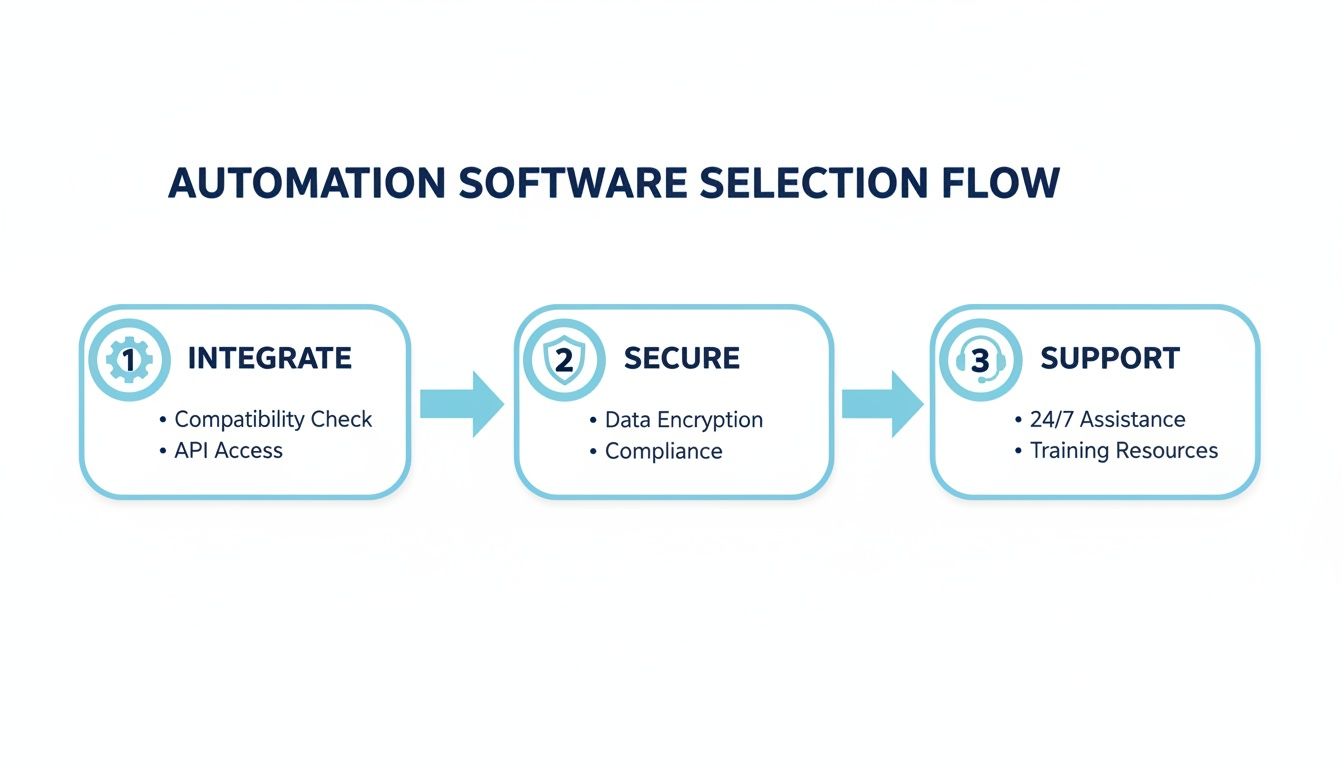
As you can see, a successful transition hinges on how well the software integrates with your existing tools, protects your data, and supports your team.
How to Know If It's Actually Working
So, you have launched the new law firm automation software. How can you tell if it is making a real difference? You need to measure what matters by tracking a few simple metrics that connect directly to your original goals. This is not about getting lost in complex analytics. It is about seeing tangible changes in your firm's day to day rhythm.
Keep an eye on these key indicators:
- A Quieter Front Desk: Is your receptionist fielding fewer "just checking in" calls? A noticeable drop in call volume is a fantastic sign the client portal is doing its job.
- Active Client Logins: Are your clients actually using the portal to send messages or upload documents? High client portal engagement proves they see the value in it.
- Freed-Up Staff Time: Just ask your team. How many hours are they getting back now that they are not manually chasing signatures or sending out routine reminders? This is your time saved on admin tasks.
With a clear plan that accounts for your processes, your people, and your progress, moving to an automated workflow becomes a straightforward and incredibly valuable upgrade. To dig deeper into boosting your firm's efficiency, check out our guide to legal operations management.
Answering Your Questions About Law Firm Automation
Making the leap to new legal tech naturally brings up a lot of questions. Firm leaders I talk to are always thinking about the practical side of things. This includes disruption, security, and whether their team will actually use the new tool. Let's tackle some of the most common concerns I hear.
One of the first questions is always about the implementation timeline. Nobody wants a months long IT headache. The good news is that modern, cloud based tools are designed to get you started fast. A system that plugs directly into your existing case management software, for instance, can often be rolled out in about a week. The goal is a smooth setup, not a massive project.
Will My Staff Have to Learn a Whole New System?
This is a big one. The last thing you want is to overwhelm your team with yet another piece of software to learn and manage. The best automation platforms do not replace your core systems. They enhance them. They are built to integrate directly into the case management software your team already lives in every day, like Needles or Litify.
This means the tool does its job quietly in the background, syncing data automatically. Your team does not have to learn a new interface or juggle a separate program. They just keep working in their familiar environment, which makes adoption incredibly easy and cuts down on resistance.
The most effective automation feels invisible. It should improve your current workflow, not force you to invent a new one. That is what makes the transition seamless for your entire team.
How Secure is This Software with Sensitive Client Data?
Security is non negotiable, and it should be a top concern. Any reputable vendor in the legal tech space makes security a core priority. They build in features like encrypted messaging and secure file sharing to safeguard confidential client information.
Think about it this way: using a purpose built client portal is worlds more secure than relying on standard email or text messages for client communication. When you are looking at different automation platforms, make sure you ask specifically about their security protocols. They need to be designed from the ground up to meet the legal industry’s demanding compliance standards.
Ready to see how a secure, integrated client portal can boost your firm’s efficiency? CasePulse provides a simple solution that works directly with your existing case management system, all backed by expert, US-based support. See how it works at https://www.casepulse.com.