
 CasePulse
 Let's be honest, most law firm marketing feels like a necessary evil. But a client newsletter? That's different. It's not about cold outreach or expensive ads. It's a smart, low effort way to generate referrals and keep your firm in the minds of people who already trust you.
This is especially true for plaintiff personal injury firms. Once a case is closed, that client relationship often just ends. A newsletter changes everything.
Why Your Firm Needs a Newsletter Now More Than Ever

With client acquisition costs always on the rise, a simple newsletter is one of the most cost effective marketing channels you have. You're not just sending another email. You're building a real connection with a warm audience that already knows your work.
Think about it. You close a case, the client is happy, and you part ways. A year later, their brother in law gets into a car accident. Who do they recommend? The firm that sent them a helpful, professional update a few months ago, or the one they haven't heard from since the settlement check cleared?
Keep Your Firm Top of Mind
Staying top of mind is the whole game when it comes to generating referrals from past clients. You want to be the first and only name they think of when someone they know needs legal help. A simple quarterly or even monthly newsletter makes that happen without you having to lift a finger each time.
The real power of a law firm newsletter is in nurturing those long term relationships. It's a quiet, consistent reminder that you're their trusted resource, ready to help whenever the need arises.
Remember, a past client is your best marketing asset. They've seen your work up close and can offer a referral that’s more powerful than any paid ad. A newsletter keeps that connection alive and makes it easy for them to advocate for you.
Complement Your Existing Technology
Many firms are already using fantastic tools like client portals for day to day case management. A portal like CasePulse, for instance, is perfect for securely sharing documents, sending case specific updates, and messaging clients one on one.
A newsletter does not replace these tools. It complements them. It serves a completely different, but equally vital, purpose.
Here’s the difference:
- Client Portals: For one to one communication on active cases.
- Newsletters: For one to many communication with your entire network of past clients, current clients, and professional contacts.
Together, they create a complete communication strategy. The portal handles the urgent, case specific details, while the newsletter builds a broader sense of community and keeps your brand visible. It’s an incredibly efficient way to provide value to your entire network. To get a feel for how this fits into the wider professional world, you can explore some general B2B and email marketing best practices.
Building Your Newsletter Content Strategy

Before a single word gets written, we need to talk strategy. A truly effective law firm newsletter isn't just a random assortment of firm updates. It's a powerful communication tool, and it needs a clear purpose to get you the results you want.
So, what's the end game? Are you trying to spark new referrals from your network of past clients? Maybe your goal is to break down complex legal issues to educate your audience. Or perhaps it's about building a tighter community around your firm. Nailing down your primary objective is the foundation for everything that follows.
Establish Your Core Content Pillars
Once you know your "why," you can start defining your content pillars. Think of these as the handful of core themes you'll return to in every issue. They provide a predictable structure that makes planning a breeze for your team and gives your readers a consistent, valuable experience.
Let's imagine you're a personal injury firm hoping to stay connected with former clients. Your pillars might look something like this:
- Case Wins & Success Stories: Showcase significant, anonymized case results. It’s a subtle but powerful way to remind people of your firm’s expertise and why they trusted you in the first place.
- Answers to Common Questions: Tackle those recurring questions about insurance claims, what to do after an accident, or statutes of limitation. This is pure value add content that positions you as the go to resource.
- Firm News & Team Spotlights: Did you hire a new paralegal or sponsor a local charity event? Share it! Putting a face to the names in your firm humanizes your brand and forges a genuine connection.
- Seasonal Safety Tips: Offer practical advice that’s relevant right now, whether it’s tips for navigating icy roads in winter or avoiding common summertime accidents.
The most successful law firm newsletters I've seen all operate on one simple principle: provide value first, promote second. When your content is so genuinely helpful that people actually look forward to it, any mention of your services feels earned, not pushy.
Decide on a Realistic Sending Schedule
When it comes to newsletters, consistency will always beat frequency. A polished, high impact quarterly newsletter is infinitely better than a frantic, thrown together monthly one that burns out your team. You have to find a rhythm that you can actually sustain.
A monthly schedule is great for keeping your firm top of mind, but only if you have a steady stream of content and the resources to execute it well.
For most firms, a quarterly schedule is the sweet spot. It gives your team plenty of breathing room to source compelling stories, write thoughtful pieces, and give every issue a final polish. This pace is perfect for showcasing major firm announcements or detailing significant case victories without feeling rushed.
Newsletters are having a major comeback for a reason. In a market with nearly 418,181 personal injury law firms across the U.S., you need a way to stand out. While 40% of firms use some form of email marketing, a well crafted newsletter is a masterclass in client retention.
Think about it: content like partner profiles (96% interest rate) and insightful articles (54%) are perfect for a quarterly send off. And when you integrate your newsletter workflow with your other systems, you can see tangible results, like a 20% boost in revenue and a 12% lift in conversions. You can find more data like this in our complete guide to content marketing for law firms.
How to Write and Design Newsletters People Actually Read
Okay, so you have your content plan locked in. Now comes the part that really matters: crafting the email your clients will actually see and open. Even the most brilliant legal insight won't connect if your writing is stiff and your design is a cluttered mess.
Let’s get practical about creating law firm newsletters that look professional, feel human, and get results. Remember, when someone opens your email, they're giving you a sliver of their precious time. Your job is to make it worth their while.
Write Like a Human, Not a Lawyer
This is the single biggest mistake I see firms make. They write newsletters that sound like they were pulled from a legal brief. Your clients aren't lawyers. Ditch the jargon and legalese.
Forget "heretofore" and "whereas." Think more along the lines of, "Here's what you need to know." A simple test is to read your copy out loud. Does it sound like something you'd actually say to a person? If it sounds stilted or robotic, it's time for a rewrite.
You're not just broadcasting information. You're building a relationship. An authentic, human tone builds trust and shows clients you're on their side, which is what keeps them coming back.
When you can explain a complex topic in simple terms, you're not dumbing it down. You're showing you understand it so well that you can make it accessible to anyone. That’s a powerful signal.
Craft Subject Lines That Demand to Be Opened
Your subject line is the gatekeeper. If it fails, your entire newsletter goes unread. The average open rate for legal emails hovers around 22%, so you're fighting for attention in a crowded inbox. Those first few words have to do some heavy lifting.
Keep it short and sweet. Under 60 characters is a good target to avoid getting cut off on phones. And always, always front load the most compelling part.
Here are a few formulas that work well:
- Ask a direct question: "What Should You Do After a Minor Car Accident?"
- Promise a clear benefit: "3 Tips to Protect Your Rights This Winter"
- Create a little intrigue: "Our Latest Case Result Might Surprise You"
The key is to be educational, not salesy. Words like “free” or “act now” are red flags for spam filters and can kill your delivery before your email even has a chance.
Design for the Way People Actually Read
Let's be honest: people don't read emails. They scan them. Your design needs to embrace this reality, making it effortless for readers to spot what’s relevant to them.
First off, a professional, mobile friendly template is not optional. More people read email on their phones than on desktops, so if it looks bad on a small screen, you've already lost.
Here’s how to build a newsletter that’s easy to scan:
- Stick to a single column layout. It’s the simplest way to ensure your email looks great everywhere.
- Use clear H3 subheadings (like the ones in this post) to break up your content into logical chunks.
- Write extremely short paragraphs. One to three sentences, max.
- Lean on bullet points and numbered lists to make key information pop.
Want to see how this fits into a bigger picture? Our comprehensive guide on email marketing for lawyers gives you the full rundown, from list building to long term strategy.
Putting Your Newsletter on Autopilot
Let’s be honest: a consistent, high value newsletter is a fantastic way to stay connected with clients, but it can also feel like a massive time suck. If you're not careful, it quickly becomes another administrative chore that gets pushed to the back burner. This is where automation comes in. The goal isn't to just "set it and forget it," but to build a smart, scalable system that works for your firm, not the other way around.
For firms already running on case management systems like Needles, Neos, LawBase, or Litify, you have a huge head start. The real power comes from connecting your newsletter process directly to the tools you already use every day. This isn't about adding more software to your plate. It's about making your existing technology work together to cut down on manual data entry and create a single, unified workflow.
Let Your Case Management System Do the Heavy Lifting
A client portal like CasePulse is the perfect go between. Since it's already plugged into your case management software, it can act as a simple but powerful bridge to your email marketing efforts. This integration makes life easier for your team and your clients.
One of the simplest, most effective things you can do is add a newsletter sign up link right inside the CasePulse portal. Clients are already logging in to check case updates or send a message. Letting them opt in with a single click is a no brainer. You'll organically build a list of your most engaged contacts, people who already know and trust your firm.
The best automation isn’t just about saving your staff a few hours. It’s about creating a better client experience. When you make it effortless for clients to get more value from you through a portal they already use, you’re removing friction and strengthening the relationship.
This simple tactic is a perfect example of effective workflow automation in action. If you want to dive deeper into how these principles can make your whole firm more efficient, you can learn more from our guide on what is workflow automation.
At its core, producing the newsletter itself boils down to a few key stages.
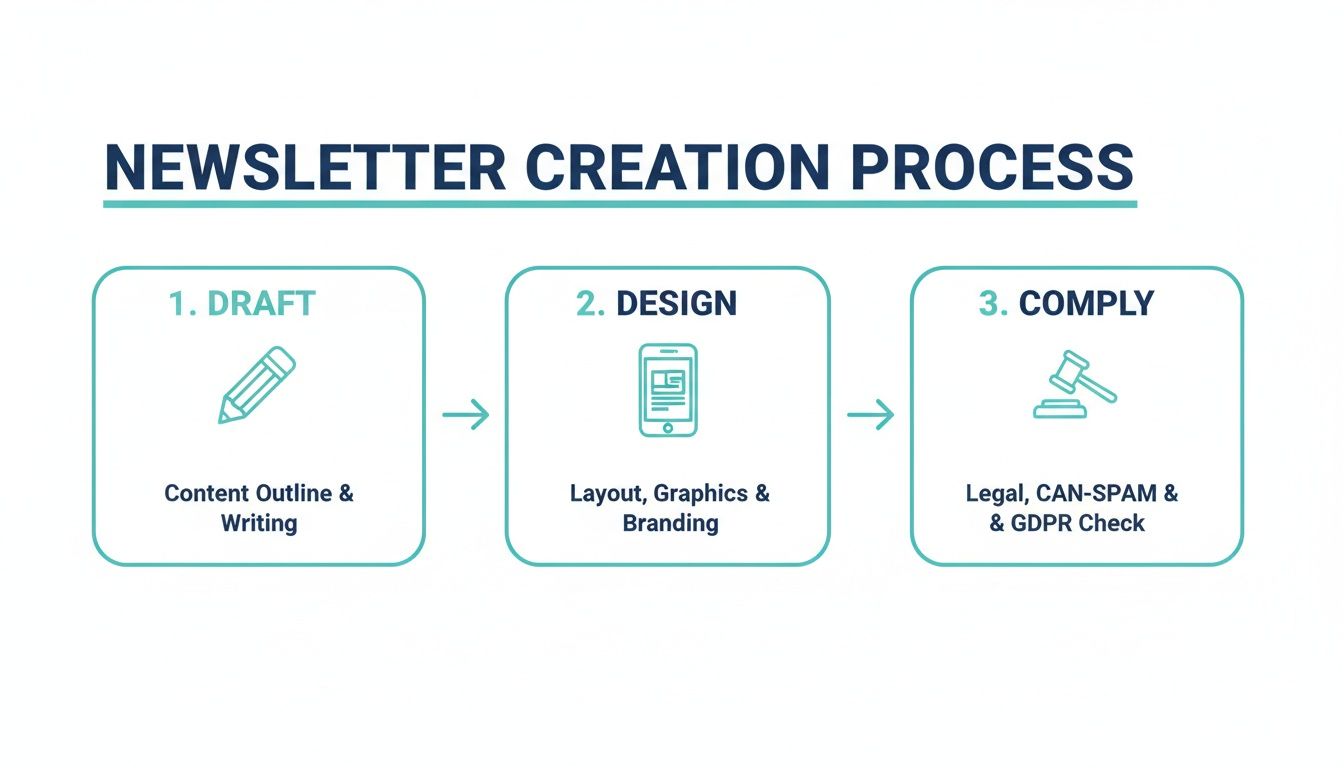
This process keeps you focused on what matters: creating great content, making it easy to read, and staying on the right side of ethics rules.
Scheduling and Scaling Your Communications
Building your list is just the first step. Automation really shines when it comes to managing the entire distribution calendar. Using a Mailchimp integration with your existing systems allows you to schedule your emails weeks or even months ahead of time.
Newsletters have long been a cornerstone for generating referrals, especially in practice areas like personal injury where your network is your lifeblood. For firms using platforms like LawBase or Neos, automated newsletters fit perfectly into a client centric workflow, keeping your firm top of mind without disrupting your team's focus on active cases.
The impact is real. In 2023, we saw some firms using intake technology capture 58,395 leads, converting 17.6% of them into new clients. A well run newsletter warms up your audience, helping you blow past the 7% national average conversion rate.
Measuring Success and Improving Your Strategy
Sending out a well crafted law firm newsletter is a great first step, but it’s just that, a first step. The real work begins after you hit "send." If you want your newsletter to be more than just another email in a crowded inbox, you have to understand what’s actually working.
This isn't about chasing vanity metrics. It's about making smart, data driven decisions that strengthen client relationships and, ultimately, bring in more business. You need to dig into the numbers to see the story they're telling. Are people opening your emails? More importantly, are they clicking on your links and taking action?
Key Performance Indicators to Watch
Diving into your email analytics doesn't have to be overwhelming. You really only need to keep an eye on a few key metrics to get a solid read on your newsletter's performance. These are the numbers that will guide your strategy.
-
Open Rate: This is the percentage of people who opened your email. It's a decent starting point, but with recent privacy changes from Apple and others, this metric is less reliable than it used to be. Think of it as a general signal for how compelling your subject line was, but don't obsess over it.
-
Click Through Rate (CTR): Now this is where the action is. Your CTR is arguably the most critical metric, showing the percentage of recipients who clicked on at least one link. A healthy CTR is proof that your content was genuinely interesting and valuable enough to make someone stop what they were doing and engage.
-
Conversion Rate: This metric ties your newsletter directly to your firm's bottom line. It tracks how many readers completed a specific goal after clicking a link, like filling out your "Contact Us" form, registering for a webinar, or downloading a guide. This is how you measure real ROI.
Don't get bogged down if your click through rate is low on your first few newsletters. Treat it as valuable feedback. A low CTR is a clear sign that you need to experiment with different content or a more persuasive call to action.
Interpreting the Data to Refine Your Approach
Data is only valuable if you act on it. For instance, let's say you see a high open rate but a disappointingly low CTR. That’s a classic sign of a great subject line but lackluster content. The headline got them in the door, but nothing inside convinced them to stay.
This is the perfect opportunity to run a simple A/B test. All this means is sending two slightly different versions of your newsletter to small, separate segments of your list to see which one performs better.
You could easily test things like:
- Different subject lines to see what grabs more attention.
- Varied calls to action to learn what language inspires clicks.
- Alternative content formats, like a quick Q&A section versus a detailed case study.
In the competitive legal space, email newsletters remain a true workhorse. While only 28% of firms are using video marketing, email provides a direct, measurable path to growth. Consider this: firms that respond to newsletter driven leads within five minutes see a 400% higher conversion rate.
And when you integrate your marketing with your practice management, the benefits multiply. Adding a simple newsletter sign up link to a client portal like CasePulse can cut down on routine client calls by as much as 20%, a huge win for firm efficiency. To see how these choices stack up, check out these insightful law firm marketing statistics.
Answering Your Law Firm Newsletter Questions
Once you start mapping out your firm's newsletter strategy, a few practical questions almost always come up. We've seen firms grapple with these same issues time and again. Let's get you some clear, straightforward answers based on what actually works.
How Often Should Our Law Firm Send a Newsletter?
For most law firms, the sweet spot is either monthly or quarterly. There's rarely a good reason to send one more often than that.
A monthly newsletter is a great rhythm if you're already producing regular content like blog posts, firm announcements, or community updates. It keeps you top of mind without flooding anyone's inbox.
On the other hand, a quarterly send is a perfectly respectable and far more manageable goal for most practices. This gives you plenty of breathing room to gather genuinely interesting stories and insights instead of scrambling for content every few weeks.
The real secret isn't about frequency. It's about consistency. A fantastic quarterly newsletter that always shows up on time is infinitely more valuable than a slapdash monthly one that you send sporadically. Pick a schedule you know you can keep.
What Is the Most Important Metric to Track for Success?
Forget the open rate. The only metric you should really care about is your click through rate (CTR).
Open rates have become a vanity metric. With recent email privacy changes, especially on Apple devices, many "opens" are just bots and not actual people reading your email. It's an unreliable number.
Your CTR, however, is pure gold. It tells you that someone not only opened your email but found the content so compelling they took action and clicked a link. That’s a real, tangible sign of engagement. The ultimate goal, of course, is to tie those clicks back to business. Tracking how many newsletter readers go on to fill out your website's contact form is how you measure real ROI.
Can We Just Use Our Paralegal's Email to Send the Newsletter?
Please don't do this. Sending a mass email from a standard Outlook or Gmail account is a common mistake, but it can cause major headaches for your firm.
Here’s exactly why it's such a bad idea:
- You'll Get Flagged as Spam: Bulk sending from a personal address is a massive red flag for spam filters. It’s the fastest way to get your entire firm's domain blacklisted, which can cripple your ability to email anyone, including clients and opposing counsel.
- You Get Zero Analytics: You're flying blind. You won’t have any idea who opened it, what they clicked on, or how many emails even made it past the spam filters.
- You Risk Compliance Problems: Professional email platforms automatically handle compliance with laws like the CAN SPAM Act by including mandatory unsubscribe links. Sending from a personal account puts that burden entirely on you.
You absolutely need to use a dedicated email marketing service. Tools like Mailchimp or Constant Contact are built specifically for this and give you the protection and analytics you need.
How Can We Get Clients to Sign Up for Our Newsletter?
First, make it incredibly simple. Your website should have a clear, easy to find signup form on high traffic pages like your homepage, blog, and contact page.
Second, integrate the ask into your existing processes. During client intake, make it a standard question. Frame it as a benefit to them: "Would you like to receive our quarterly updates with helpful legal insights and firm news?"
If you use a client portal like CasePulse, you have a golden opportunity. You can place a permanent link inside the portal inviting active clients to subscribe. This is a powerful way to build a list of people who are already highly engaged with your firm.
At CasePulse, we help firms modernize their communication without adding to their workload. See how our secure client portal can automate updates, reduce inbound calls, and create a better client experience. Learn more at CasePulse.