
 CasePulse
A new client signs at 4:45 p.m. The intake notes are still being cleaned up, the police report hasn’t arrived, and the carrier has already called twice asking for a statement. That’s a normal day in a plaintiff firm. It’s also the moment when a letter of representation either gets handled with discipline or turns into one more task that sits in the queue longer than it should.
Paralegals know what happens when it slips. The client keeps fielding calls. The adjuster starts shaping the record before counsel does. Staff has to untangle who said what, when the claim was opened, and whether anyone preserved anything important. A good letter of representation fixes that early. A bad one, or a late one, creates cleanup work that never should have existed.
Why Your Letter of Representation Is a Critical First Move
The letter of representation is not clerical paperwork. It is the first operational move that changes control of the claim.

Once it goes out, the case stops being an unrepresented claim and becomes a represented one. That matters for the client, for the adjuster, and for your internal workflow. In personal injury practice, the letter invokes ethical rules that stop direct contact with the client. The Bradley Law Firm notes that rules such as Missouri Supreme Court Rule 4-4.2 prohibit insurers from contacting a represented client directly, that represented claimants often recover 3 to 4 times more than people who handle claims themselves, and that sending the letter within 48 hours of intake correlates with 25% faster case resolutions for plaintiff firms (letter of representation guidance).
That’s the legal side. The practical side is just as important. The letter tells the insurance company that your office is organized, paying attention, and ready to manage the file from day one. Adjusters notice the difference between a rushed, vague notice and a clean letter that identifies the claimant, date of loss, contacts, and preservation expectations.
What the letter actually accomplishes
A strong letter of representation does three jobs at once.
- It establishes authority. The carrier knows exactly who represents the claimant and where all future communication belongs.
- It protects the client. Recorded statement requests, pressure calls, and side conversations should stop once the insurer has notice.
- It sets the tone. If your first correspondence is precise and complete, the file starts on your terms rather than the adjuster’s.
When people outside plaintiff work talk about whether a letter is formal enough, they often miss the point. The issue isn’t whether it looks impressive. The issue is whether it creates a clear, enforceable communication boundary. If you want a plain language refresher on what makes a legally binding document, that framework is useful because it reminds firms that form and clarity matter when a document is meant to direct conduct.
Why speed matters more than polish
Perfectionism slows firms down here. A letter of representation does not need literary style. It needs to be accurate, prompt, and complete enough to remove ambiguity.
Practical rule: If intake is signed and you know the basic loss facts, the letter should be moving. Waiting for every supporting record usually hurts more than it helps.
Intake quality shows up immediately. If your intake form captures the correct names, date of incident, location, carrier details, and contact permissions, the letter goes out fast. If intake is patchy, your team starts the file by chasing missing basics. Firms that want a tighter front end usually benefit from tightening their intake process before they touch templates. A clean client intake form workflow solves more LOR problems than most offices realize.
The firms that handle this well treat the letter as the opening move in case control. The ones that treat it as a form letter usually end up reacting instead of directing.
Drafting an LOR That Commands Attention
An adjuster should be able to read your letter once and know exactly who you represent, what claim it concerns, what you expect next, and how your office wants communication handled. If the reader has to guess, the letter is too loose.
The biggest drafting mistake is assuming brevity alone makes a letter strong. Short is fine. Incomplete is not. A good letter of representation is concise, but it still covers the facts that prevent delay, confusion, and avoidable follow up.
The non negotiable components
Below is the structure most plaintiff firms should treat as standard.
| Component | Purpose and Key Details |
|---|---|
| Client identification | State the client’s full legal name and enough identifying information to avoid a mismatch with another claim file. |
| Date and location of incident | Tie the representation to a specific event so the carrier can route the letter to the right claim or open one if needed. |
| Claim number if known | Include it when available. It speeds matching and reduces back and forth with intake staff and adjusters. |
| Representation statement | Clearly state that your office represents the claimant regarding the incident and that future communications must go through counsel. |
| Insurance and party details | Name the carrier, insured, business, or third party receiving the letter so there is no dispute about intended notice. |
| Contact instructions | Give direct firm contact information for the attorney or assigned team member handling the file. |
| Evidence preservation request | Put recipients on notice to preserve relevant materials connected to the loss and claim handling. |
| Request for correspondence and disclosures | Direct where claim documents, policy information, and future notices should be sent. |
| Medical and records coordination language | Include any necessary language that helps your office begin records collection and claim administration efficiently. |
| Signature and date | Sign the letter and date it clearly so your file shows when formal notice was given. |
Why each piece earns its place
Client identification seems basic, but small errors within this process create larger delays. If intake entered a nickname, a transposed birth date, or the wrong date of loss, the adjuster may put the letter into suspense while asking for clarification. That’s wasted time in the first week of the case.
The incident details matter because they anchor the representation to a single event. On auto cases especially, carriers may be handling multiple losses involving the same insured. Vague references invite misrouting.
The best LORs leave no room for the carrier to say, “We couldn’t tell which claim this concerned.”
The representation statement should be direct and unemotional. Don’t overstate. Don’t threaten. Don’t turn the first letter into a premature demand. You’re creating notice, communication boundaries, and an administrative path forward.
Phrasing that works and phrasing that doesn’t
What works is plain professional language. What doesn’t is puffed up legalese or accusatory writing that adds heat without adding clarity.
Good phrasing usually sounds like this:
- Clear notice: “Please be advised that this office represents [Client Name] for injuries arising from the incident of [date] at [location].”
- Communication protocol: “Please direct all communications, requests, and correspondence regarding this matter to our office.”
- Preservation notice: “Please preserve all evidence and materials relevant to the incident and claim.”
What tends to backfire:
- Hostile openings: Starting with accusations before the file is even identified.
- Vague preservation demands: Asking to preserve “everything” without tying it to the event or claim.
- Overloaded paragraphs: Burying key instructions inside dense blocks of text.
Draft for the person who has to process it
Most letters are not first read by trial counsel. They are read by a claims professional, assistant, or intake processor trying to classify and route the file. Drafting with that reality in mind makes the letter more effective.
Use a clean subject line. Put identifying facts near the top. Break out contact information so it can be copied quickly. If there is a records request, lien issue, or specific benefit inquiry, separate it from the general notice so it doesn’t get missed.
A strong LOR doesn’t try to impress. It tries to eliminate friction. That’s what gets it acknowledged, logged correctly, and acted on.
Letter of Representation Templates for Plaintiff Firms
Templates save time, but only when the underlying intake is clean and the user knows what to customize. A template is not a substitute for judgment. It is a starting point.
That distinction matters because plaintiff firms often swing between two bad habits. One is drafting every LOR from scratch and wasting staff time on repetitive work. The other is reusing the same generic language for every matter and missing facts that actually drive the claim. The sweet spot is a base template with disciplined edits for case type, recipient, and objective.

The efficiency case for templates is strong when they’re used correctly. CasePeer reports that pre-loaded templates within case management software can accelerate drafting by 70%, that firms using clear professional language see 25 to 30% quicker initial responses from insurers, and that incomplete intake data causes 35% of initial LORs to be rejected or delayed (personal injury LOR drafting details).
The base template most firms need
Here is straightforward sample language for a standard personal injury matter.
Please be advised that our office represents [Client Full Name] regarding injuries arising from the incident that occurred on [Date] at [Location].
If a claim has already been opened, please associate this correspondence with claim number [Claim Number]. If no claim has yet been opened, please do so immediately and confirm the assigned claim number to our office.
Effective immediately, please direct all communications regarding this matter to our office and not to our client. Please forward all correspondence, claim related notices, and relevant policy information to the contact listed below.
Please also preserve all evidence, records, recordings, photographs, electronic data, and other materials relevant to the incident and resulting claim.
Kindly confirm receipt of this letter and identify the adjuster assigned to the matter.
That language is useful because it is clean, neutral, and hard to misread. It doesn’t promise more than you know. It doesn’t argue liability too early. It gives the carrier a clear next step.
How to adapt it by case type
A motor vehicle case usually needs claim handling precision. If there are multiple carriers, UM or UIM issues, or PIP questions, tailor the middle portion so each recipient knows what your office needs from them.
In addition to confirming the bodily injury claim, please identify any applicable medical payments, uninsured motorist, or underinsured motorist coverage and provide the appropriate claim contacts for each.
A premises case usually benefits from stronger location detail and preservation language. The recipient may be a commercial carrier, a business, a third party administrator, or all three.
The incident occurred on the premises located at [exact address or business location]. Please preserve any incident reports, photographs, maintenance records, inspection logs, surveillance footage, and communications concerning the condition of the area where the incident occurred.
A wrongful death matter usually requires careful identification of the decedent, estate, and proper representative. The template should slow down here. Accuracy matters more than speed.
Use the base form, but confirm every capacity reference before sending. If representation is through a personal representative or another authorized party, the letter should reflect that clearly.
Where firms misuse templates
The common errors are predictable.
- They skip the edit pass. A template still says “auto collision” in a fall case or leaves the wrong recipient from a prior matter.
- They trust bad intake. The merge fields populate beautifully, but with the wrong phone number, carrier, or date.
- They turn the template into a demand. That creates confusion about the purpose of the letter and can provoke unnecessary back and forth early.
If your office wants a broader starting point for drafting other claim correspondence, these personal injury demand letter templates can be helpful as a contrast. They show how much more detailed a later stage demand becomes, which in turn helps staff keep the LOR focused on notice, communication control, and preservation rather than damages advocacy.
A template library should reflect how your firm actually works
The best template libraries are organized by recipient and task, not just by case label. For example, one version may go to the liability carrier, another to a medical provider, another to an employer, and another to a third party administrator. Each should preserve the same voice while changing the requests.
If your office stores those templates in a single accessible location, staff can move faster without sacrificing consistency. A centralized legal letter template resource is useful for that reason. It reduces the scavenger hunt for old versions and lowers the odds that someone grabs a stale draft from a random matter.
Templates are powerful when they standardize what should be standardized. They fail when they flatten the case facts that actually matter.
Timing Service and Follow Up Procedures
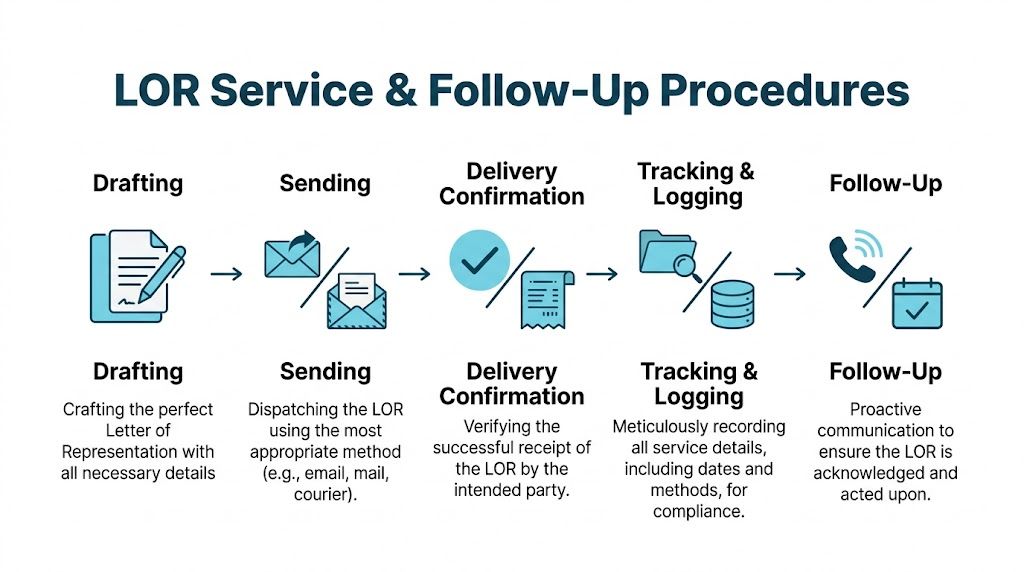
A sharp letter still fails if no one can prove when it was sent, who received it, or whether the carrier ever acknowledged it. Service and follow up are where disciplined firms separate themselves from chaotic ones.
The office reality is simple. People assume the letter was sent. Someone else assumes it was logged. The adjuster says they never got it. The client says the carrier still called. Now the team is reconstructing a basic communication event instead of advancing the case.
Choose a service method you can actually track
Certified mail still has value in some offices because it creates a familiar paper trail. The downside is speed and handling friction. Mailroom delays, scanning delays, and inconsistent logging can make a same day letter feel slower than it should.
Email is faster and easier to route internally, especially when carriers accept electronic notice. The catch is that email only helps if your team stores proof of transmission and captures any acknowledgment. An email sitting in one staff member’s inbox is not a system.
Courier or portal based delivery may make sense in some situations, especially where the recipient has clear intake channels. What matters is less about tradition and more about whether your office can verify receipt and tie that proof back to the file.
The follow up standard that prevents drift
Every LOR needs a follow up sequence. Not a vague intention. An actual sequence.
- Send the letter promptly. Once the file is ready for notice, don’t let it idle.
- Log the method of service. Record whether it went by email, certified mail, courier, or another channel.
- Save proof of transmission. Keep the sent email, mailing receipt, scan, or upload confirmation in the file.
- Set a task for acknowledgment. Someone should be responsible for checking whether the carrier confirmed receipt.
- Escalate if needed. If there’s no acknowledgment, follow up through the firm’s preferred channel and document that effort.
If your office can’t answer “when did we send it?” in under a minute, the process is too loose.
What works better than memory
A lot of missed follow ups come from informal handoffs. One person drafts, another sends, a third person expects a response, and nobody owns the checkpoint. That setup guarantees drift.
Better systems assign ownership at each stage. The drafter finalizes. The sender serves and logs. The assigned case manager confirms acknowledgment. If the carrier remains silent, the file gets a tasked follow up rather than a note buried in a chronology.
Use naming conventions that make retrieval easy. Save the final signed letter with a standard file name. Save proof of sending beside it. Add a note in the case chronology that matches the service date. Those habits sound small until the day a carrier denies notice or a client says direct contact continued after representation began.
The best service process is boring. That’s the point. It should be so consistent that no one has to improvise.
Integrating LORs into Your Digital Workflow with CasePulse
Most guidance on the letter of representation still assumes a paper first office. Draft the letter, print it, email it, scan it back, and hope everyone remembers where the latest version lives. That’s not how many plaintiff firms operate anymore, especially firms working inside Needles, Neos, LawBase, or Litify.
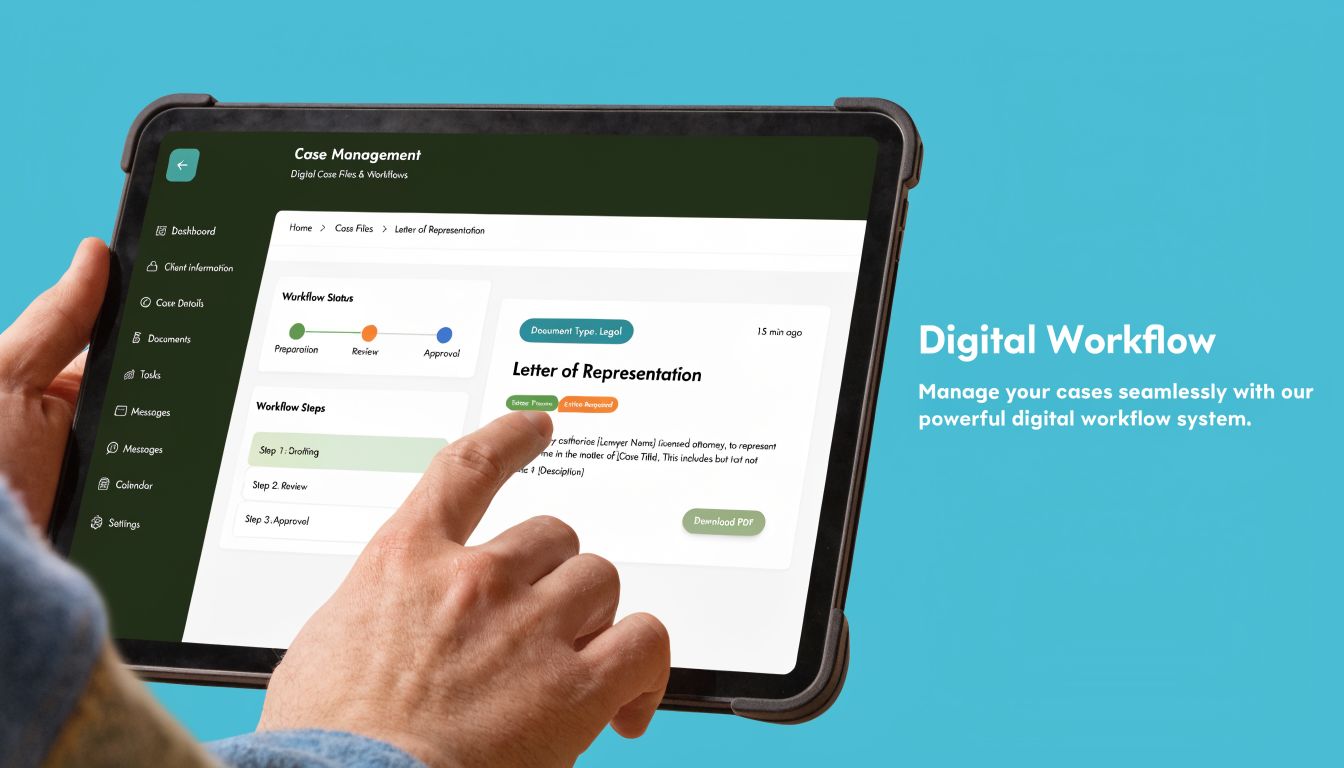
The modern workflow question isn’t just how to draft the letter. It’s how to move it from intake data to service, tracking, and client visibility without forcing staff into duplicate entry and extra inbox management. Shouse Law notes that 62% of mid-sized PI firms use client portals, yet most LOR guidance still ignores digital integration, while automation through portals can reduce related manual tasks by up to 40% and cut inbound client calls by over 30% (digital portal integration for representation letters).
Where digital workflow actually helps
The first gain is cleaner document generation. When your core case data already lives in the case management system, the letter should pull from that source rather than forcing someone to retype names, dates, and contact details into a separate document. Reentry creates preventable errors.
The second gain is centralized tracking. A digital workflow is stronger when the draft, final, proof of service, and follow up status all live where the team already works. Staff shouldn’t have to hunt through personal inboxes to answer a basic status question.
The third gain is client communication. Clients often ask the same early questions. Did the insurance company get the letter. Who is handling contact now. What happens next. If the representation letter and related updates are visible through the client communication process, staff spends less time repeating the same explanations by phone.
What a practical integrated workflow looks like
A workable setup usually looks like this:
- Intake data feeds the letter. Client name, incident date, carrier information, and assigned staff populate from the source file.
- The final letter is stored in the matter. Everyone on the team can see the version that was sent.
- Service activity is logged with the file. The office doesn’t have to reconstruct transmission history from scattered tools.
- The client has visibility where appropriate. A copy or update can be shared without staff creating one off email threads.
That’s the difference between digitizing a paper habit and improving the workflow. The first gives you PDFs. The second cuts handoffs.
Why this matters for firms on existing case systems
Most plaintiff firms are not interested in adding another disconnected platform for one task. They want the LOR process to fit the systems they already rely on. If your firm works in Needles, Neos, LawBase, or Litify, the primary value comes from reducing context switching. Staff can stay in the operational flow they already know instead of bouncing among documents, inboxes, local folders, and client update calls.
A digital workflow should remove steps, not rename them.
For firms evaluating that kind of setup, it helps to understand what the platform is supposed to solve before talking about implementation. This overview of what CasePulse is gives the basic context. The practical takeaway is not that technology magically fixes a weak process. It’s that a good process becomes much easier to execute consistently when document generation, client communication, and follow up live in one connected environment.
The firms that modernize this piece of the file usually notice the same operational shift. Staff spends less time checking whether a basic notice was sent and more time doing the work that advances value in the case.
Making the Letter of Representation a Strategic Advantage
Plaintiff firms don’t gain an advantage by doing dramatic things first. They gain an advantage by doing ordinary things faster, cleaner, and more consistently than the other side expects. The letter of representation is one of those ordinary things.
Handled well, it protects the client, establishes control, and gives the file a disciplined starting record. Handled poorly, it creates confusion that echoes through the claim. The difference usually isn’t legal theory. It’s process. Good intake. Clean drafting. Reliable service. Follow up that someone actually owns. Templates that save time without flattening the facts. A workflow that keeps the team from duplicating effort.
What firms should stop doing
A lot of plaintiff offices still lose time in familiar ways.
- Stop treating the LOR like an afterthought. If it waits behind less important admin work, the client and file both stay exposed longer than they should.
- Stop relying on one person’s memory. A process that lives in a veteran paralegal’s head is not a stable process.
- Stop using one generic template for every case. Standardization helps, but only after the facts have been checked and the recipient specific requests are right.
What consistently works
The firms that get this right tend to share a few habits.
First, they build the letter from verified intake rather than from scraps of notes. Second, they keep the language plain and direct. Third, they document service in a way the whole team can find later. Fourth, they make client communication part of the same workflow instead of treating updates as separate cleanup work.
Clean front end work lowers friction across the whole life of the case.
That’s the strategic point. A modern letter of representation process doesn’t just save staff time. It improves the client experience, reduces avoidable confusion, and makes your office look organized from the first communication. Adjusters notice that. Clients notice it even more.
A forward looking plaintiff firm doesn’t need a flashy opening move. It needs a reliable one. The letter of representation is exactly that when the process behind it is built to hold up under real caseload pressure.
CasePulse helps plaintiff firms turn early case communication into a cleaner, more trackable workflow by connecting secure client portal communication with the case systems teams already use. If your firm works in Needles, Neos, LawBase, or Litify and wants to reduce status calls, automate follow ups, and keep clients informed without leaving your existing workflow, take a look at CasePulse.