
 CasePulse
 Ever walked past a paralegal's desk and seen a stack of client letters that all look just a little bit different? That's not just a branding headache. It's a flashing sign of wasted hours and unnecessary risk. Creating a standardized legal letter template isn't just about looking good; it's a core strategy for taking back your team's time and ensuring every client gets the same, professional experience.
Why Inconsistent Legal Letters Hurt Your Firm
When your letters are not standardized, your team gets bogged down in a cycle of endless formatting fixes. This is a massive time sink, especially for a busy personal injury firm juggling a high volume of cases. Clients get confused by mismatched information, and outdated legal language can even open you up to compliance problems. The true cost of this disorganization runs much deeper than you might think.

The Hidden Costs of Inefficiency
Think about it. Every minute a paralegal spends tweaking a font, adjusting margins, or hunting for the right closing paragraph is a minute they are not spending on billable work. Across an entire team, those "quick fixes" add up to a staggering amount of lost productivity.
This problem is baked into the very tools we use every day. An incredible 82% of legal professionals see Microsoft Word as essential to their job, and half of them are already using templates to try and keep things consistent. The moment someone goes off script and starts from an old document instead of the master template, you have introduced a bottleneck that ripples through the firm.
The issue multiplies when documents are sent out. With over 75% of legal documents being shared with clients and opposing counsel, each inconsistent letter chips away at your firm's professional image and credibility.
Client Confusion and Increased Risk
Inconsistent communication does not just look sloppy. It actively confuses your clients. If a status update has a completely different tone and format from a settlement offer, it creates a jarring experience. That uncertainty almost always results in more phone calls from worried clients looking for answers, pulling your staff away from their work. For a deeper dive, review these client communication best practices.
Worse still are the legal risks. An old letter might contain outdated phrasing or a forgotten disclaimer that no longer applies. Copying and pasting from that document can inadvertently create serious compliance issues. A properly vetted and standardized legal letter template is your best defense, ensuring every single communication that leaves your office is not only professional but also legally sound. It's about protecting your clients, and ultimately, protecting your firm.
Building Your Core Legal Letter Template
Let's get down to brass tacks. The first step toward truly consistent and professional firm communication is building a master legal letter template. Think of this as your single source of truth, the foundation that eliminates the guesswork and mental fatigue of starting from scratch every single time. It ensures every document, from a quick status update to a complex settlement offer, upholds your firm's standards.
This is not about creating a rigid, one size fits all document. It’s about building a reliable blueprint.

A strong master template provides the skeleton, ensuring all the essential pieces are in place from the get go. This saves your team from reinventing the wheel and, more importantly, prevents costly errors or inconsistencies.
The Anatomy of a Professional Legal Letter
Every letter leaving your office, no matter its purpose, shares a common DNA. Getting these universal elements right in your master template is a massive time saver and a mark of professionalism.
Here’s what every solid legal letter must include:
- Compliant Firm Letterhead: This is more than just a pretty logo. It’s a legal necessity. Your letterhead must clearly display your firm’s name, address, and phone number. Crucially, it must also include any advertising disclaimers or bar association information required by your state. Don’t leave this to chance.
- Clear Date and Recipient Information: Always include the full date the letter is sent. The recipient block needs the client’s full name and address, of course, but the "Re:" line is your best friend for internal tracking. A consistent format with the case name and file number helps everyone find what they need, fast.
- Standard Body and Closing: The body is where your message lives, so make it readable. Stick to a simple, professional font and give the text room to breathe. End every letter with a consistent closing like "Sincerely," followed by the attorney's typed name, title, and signature block.
If you’re looking for inspiration on layouts, browsing some general legal contract templates can show you different ways to structure these core components effectively.
Formatting for Readability and Tone
Let’s be honest, a wall of text is intimidating. For a client who is already stressed, a dense, jargon filled letter only adds to their anxiety. The visual presentation of your letter is just as critical as its content.
Remember, the person reading your letter is often going through one of the most difficult times of their life. A clear, digestible document doesn't just convey information, it builds trust and reduces their anxiety.
Break things up. Use short paragraphs. For longer, more detailed letters, use simple headings to guide the reader through the information. I always advise my team to write in plain English and cut the legalese wherever possible. Your tone should strike a balance between professional authority and human empathy, reminding the client that you are their advocate.
To help you get this right, I have put together a quick checklist of the must have elements for your master template. Use this to build a rock solid foundation for every letter your firm sends.
Essential Components for Your Master Letter Template
Use this checklist to ensure every legal letter you send is complete, professional, and client-friendly.
| Component | Purpose | Best Practice Tip |
|---|---|---|
| Firm Letterhead | Establishes your firm's identity and ensures you meet compliance standards. | Double-check your jurisdiction's rules for disclaimers and contact information. |
| Date & Recipient Block | Provides essential context and clearly identifies the recipient. | Always include a "Re:" line with the case file number for easy tracking by both your firm and the client. |
| Salutation | Sets a respectful and professional tone right from the start. | Keep it formal and consistent. "Dear Mr./Ms. [Last Name]:" is a reliable standard. |
| Body Content Area | Delivers the core message and information of the letter. | Use placeholders for frequently used information (e.g., [Client Name], [Date of Incident]) and format for readability. |
| Closing and Signature | Officially and professionally concludes the letter. | A simple "Sincerely," with a typed name and title below the signature line, is timeless and effective. |
Once you have these components locked in, you have a master template that not only looks professional but also functions as a powerful tool for efficiency and client communication.
Adapting Templates for Common Personal Injury Scenarios
A great master legal letter template is just the starting point. The real magic happens when you clone and customize that foundation for the specific letters you send day in and day out. For any personal injury firm, this means creating ready to go versions for the major milestones of a case.
Instead of reinventing the wheel every time, your team can pull up the right template and focus their energy on the details that matter. This is how you ensure every communication is consistent, professional, and effective. Let's walk through how to build out templates for four of the most frequent letters in a PI practice.
The Letter of Representation
This is often the first shot you fire. The Letter of Representation (LOR) lands on the desk of an insurance adjuster or opposing counsel, formally announcing your involvement. Its job is simple but critical. It establishes your role and demands that all future contact comes through your office. The tone here is not aggressive; it is firm, direct, and professional.
Your master template gives you the letterhead and basic structure. From there, you will build out a dedicated LOR template with these non negotiable elements:
- A Clear Statement of Representation: A direct sentence stating you now represent the client for all claims arising from the incident.
- A Cease and Desist Directive: An explicit instruction for the recipient to stop all direct communication with your client immediately.
- A Spoliation Notice: A formal request to preserve all relevant evidence. This is a crucial step that puts them on notice. Be sure to list examples like photos, incident reports, video footage, and any electronic data.
By having a specific legal letter template for this purpose, your intake team can get this notice out the door moments after a client signs on, protecting their rights from the very beginning.
The Comprehensive Demand Letter
The demand letter is arguably the single most important document you’ll draft before filing a lawsuit. It’s your opening argument, where you lay out the facts, establish the other party's fault, detail your client's damages, and make a formal settlement demand. A powerful demand letter is what sets the stage for serious negotiations.
Using your master template as the skeleton, you’ll want to build out a robust demand letter framework that includes dedicated sections for these things:
A Factual Narrative: This is not just a dry recitation of facts. It's a concise story that explains what happened and how the at fault party's negligence turned your client's life upside down.
Liability and Fault: Briefly explain the legal grounds for the claim. You don’t need a full blown legal brief, but referencing key statutes or established case law shows you’ve done your homework.
Damages Breakdown: This is the heart of the letter. Create a clean, itemized list of all damages, including medical bills (past and future), lost income, property damage, and a well reasoned valuation for pain and suffering.
The Settlement Demand: End with a clear, unambiguous monetary demand for settlement, usually giving them a firm deadline to respond.
A well-crafted demand letter does more than just ask for money. It tells a compelling story of your client's experience and presents a logical, evidence-based argument that motivates the adjuster to negotiate seriously.
Perfecting a demand letter template with these sections pre formatted saves an incredible amount of time. If you’re looking to really elevate your firm’s approach, you can learn more about writing a demand letter for personal injury in our dedicated guide.
The Client Status Update Letter
Nothing creates client anxiety faster than silence. Proactive, regular status updates are fundamental to managing expectations and maintaining trust. An update letter should be reassuring and easy to understand, completely free of confusing legal jargon.
Your template for client updates should be simple and structured around answering the questions they already have:
- What We've Done Recently: Briefly list the tasks your team has completed since the last update. For example, "We received and reviewed the medical records from St. Mary's Hospital."
- What Happens Next: Clearly explain the next one or two steps in the process and give them a rough timeline. This directly answers the client's biggest worry, "What now?"
- A Reassuring Close: Always end on a supportive note, reminding the client that you're working hard for them.
A standardized template for these updates ensures no one falls through the cracks and significantly cuts down on those "just checking in" phone calls that can disrupt your team's focus.
The Settlement Offer Letter
When an offer finally comes in, you have a duty to present it to your client clearly and objectively. This letter needs to break down the offer, explain all the terms, and give your professional recommendation, while reinforcing that the ultimate decision belongs to the client.
The key components to build into this template are:
- The Gross Offer: State the total settlement amount and any strings that might be attached.
- The Estimated Net Payout: This is the most important part for the client. Provide a clear, estimated breakdown showing how the funds will be distributed between attorney's fees, case costs, and the final estimated amount the client will receive. Transparency is everything here.
- Your Professional Recommendation: Advise the client on whether you believe the offer is fair and explain your reasoning, but always frame it as guidance, not a directive.
Having a dedicated template for this sensitive communication ensures you convey this critical information with clarity and care, helping clients make a confident, informed decision.
Keeping Your Templates Compliant and Up to Date
Let’s be honest. A template is only a great time saver until it is not. An airtight legal letter you drafted last year could easily become a liability this year. All it takes is one new statute, one appellate court ruling, or a change in local court rules.
This is where the real work of standardization comes in. You need to build a living system that ensures every letter your firm sends is not just efficient, but also bulletproof and current, especially if you’re juggling cases across multiple states.
Building a Framework for Review
Do not treat template review as an afterthought. A sloppy, outdated letter can create serious headaches, so a formal review process is your firm’s best defense against compliance nightmares.
At a bare minimum, schedule an annual review of all master templates. Put it on the calendar and assign it to a senior partner or a detail oriented paralegal who knows your practice areas inside and out.
But an annual check in is just the baseline. Your team needs to be ready to update templates the moment an external event forces a change. Keep an eye out for triggers like these:
- Changes in State or Federal Law: When new legislation impacts your practice, your templates need to reflect it immediately.
- New Court Procedures or Rules: Local courts are notorious for tweaking filing requirements or procedural rules that can render your standard correspondence obsolete.
- Significant Appellate Rulings: A single, major court decision can fundamentally alter the language you need to use in a demand letter or client notice.
Think of your review process as proactive risk management. It transforms your templates from static documents into dynamic assets that evolve right alongside the law.
Customizing for Different Jurisdictions
If your firm operates in more than one state, a one size fits all template is a recipe for disaster. You simply can't use the same document for a case in Texas and another in Florida.
Each state has its own quirks and non negotiable requirements. The specific warning about a statute of limitations, for example, can vary dramatically. The same goes for required disclaimers or notices.
Your document management system needs to account for this. The smart way to handle it is by creating jurisdiction specific versions, like a "California Demand Letter" and an "Arizona Demand Letter." Even better, if your case management software allows it, use conditional fields or placeholders that automatically pull in the correct language based on the case's jurisdiction. This is far more reliable than expecting your team to remember which version to use every single time.
As part of this, you also have to be clear on how each state handles digital documents. Take the time to understand the nuances of electronic signature legality, as enforceability can differ significantly and affect how you and your clients execute critical paperwork.
Tapping into Automation to Supercharge Your Templates
You have put in the work to create a great set of standardized legal letter templates. That's a solid foundation, but the real magic happens when you hook those templates into your firm’s technology. Moving past simple Word docs and embracing automation is how you’ll unlock serious gains in both efficiency and accuracy. It’s about making your templates do the heavy lifting for you.
The whole idea is to get rid of the soul crushing, error prone task of manually copying and pasting client data. By linking your templates directly to your case management system, you can let technology handle the tedious parts. For many forward thinking firms, this is not a "nice to have" anymore; it's a top priority.
Connecting Templates to Your Tech Stack
This is where modern client portals like CasePulse really shine. They act as the perfect go between for your case data and your client communications. By integrating with leading case management systems, think Needles, Neos, LawBase, and Litify, they allow you to instantly pull key information right into your letters.
With just a few clicks, you can generate a perfect Letter of Representation, complete with the client’s name, case number, and date of incident, without ever having to type a single field. This kind of automation does not just speed up document creation; it drastically reduces the risk of human error. No more embarrassing typos in a client's name or the wrong case file number on a crucial demand letter.
The industry is clearly moving in this direction. Document automation is now a top priority for 54% of legal professionals around the world, a figure that shot up 13% in just one year. As personal injury claims keep climbing, firms losing 10 to 15 hours per paralegal each week to manual revisions are simply getting left in the dust. You can dig into the complete findings on legal technology trends in the global legal department benchmarking survey.
The Power of Automated Client Updates
The benefits of automation go far beyond just drafting initial letters. It completely changes the dynamic of client communication. When your templates are built into a client portal, sending routine status updates can become an almost entirely hands off process.
By automating routine communications, you free up your paralegals and case managers from answering repetitive "just checking in" calls. This allows them to focus on substantive, high-value work that actually moves cases forward.
Think about it. When a case milestone is reached and updated in your case management software, a platform like CasePulse can automatically generate a pre written status update and send it directly to the client's secure portal. Your client gets the information they are looking for, 24/7, without ever needing to call your office. This kind of proactive communication is a game changer for building client trust and slashing the administrative drag on your team.
This simple process shows how to keep your automated templates compliant and effective over time.
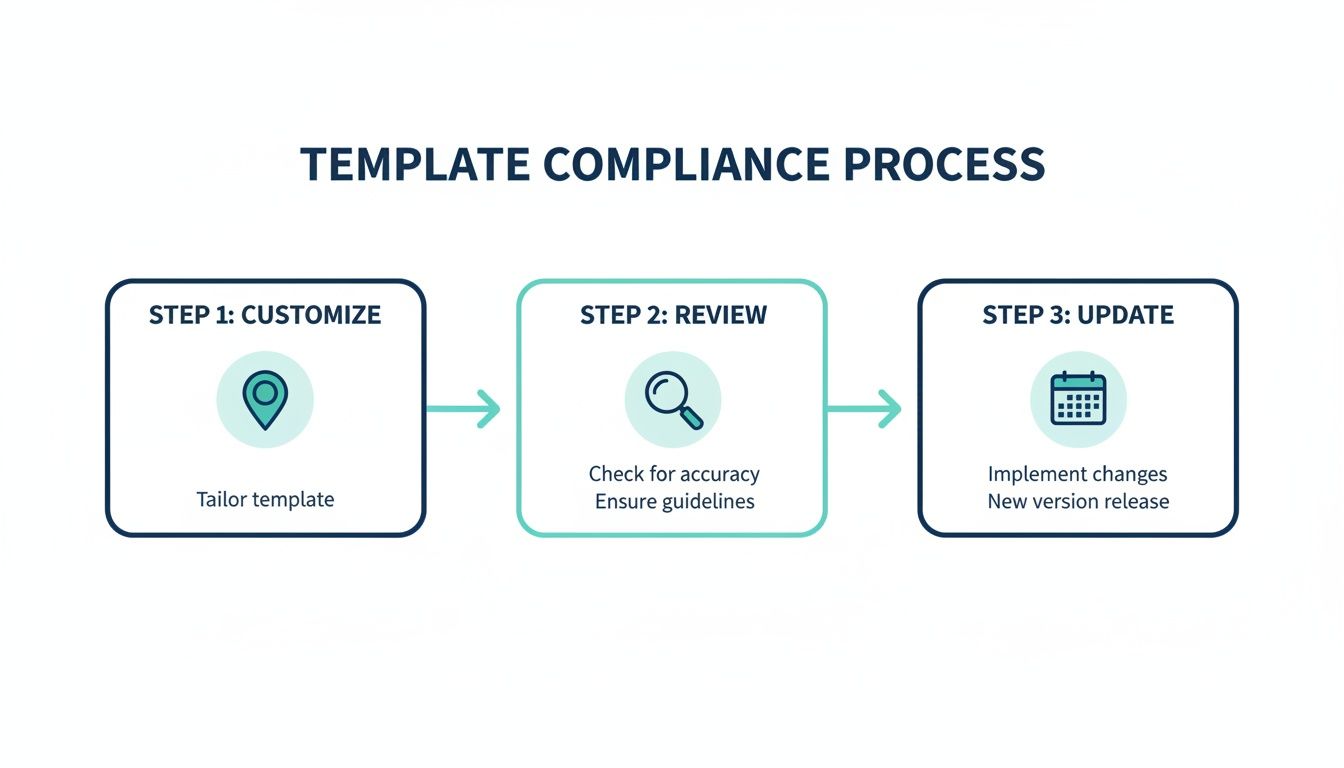
The key takeaway here is that automation is not a "set it and forget it" solution. To stay effective, it demands a continuous cycle of customization, review, and updates.
Answering Your Top Questions About Legal Letter Templates
Even the best laid plans can hit a few snags. When law firms start implementing a standardized template system, a few common questions always pop up. Getting the answers straight from the start is the key to making sure your team actually uses the new system and you see a real return on your effort.
Let's walk through some of the questions I hear most often.
How Often Should We Update Our Templates?
Think of your templates as living documents, not files you create once and forget. At an absolute minimum, you need to conduct a full review at least once a year. This annual check in is crucial for ensuring your language, disclaimers, and legal citations are all up to date with any new state or federal laws affecting your PI practice.
Of course, some events demand immediate action. You should be prepared to update templates on the fly whenever something significant happens, such as:
- Major shifts in insurance regulations.
- New state laws that change how you handle medical records or statutes of limitations.
- A landmark court ruling that establishes a new precedent.
My advice? Assign a partner to own this process and put a recurring reminder on the firm’s calendar. A little bit of proactive planning goes a long way in keeping your most critical client communications effective and compliant.
How Can We Get Our Team to Actually Use the New Templates?
Getting your team on board comes down to one simple thing, which is to make it easy. If your new templates are buried three folders deep on a shared drive nobody can find, your staff will inevitably revert to their old habits. They need to be stored in one central, easy to access spot.
The single best way to drive adoption is to bake the templates directly into your team's daily workflow. When the right template is just a click away inside your case management software, using it becomes the path of least resistance.
For instance, if your firm uses a tool like CasePulse, the templates are already integrated into the case file. It becomes the most natural and efficient option. A quick training session demonstrating just how much time this saves is usually all the convincing your team will need.
Can a Letter Template Really Cut Down on Inbound Calls?
Yes, without a doubt. A huge number of client calls are not about new developments. They are driven by simple uncertainty and anxiety. When clients get clear, consistent, and proactive communication, they feel more secure and less likely to call for reassurance.
A well crafted status update letter answers the common questions before a client even has a chance to ask them. To really see how this boosts firm wide efficiency, you have to think about the bigger picture of Business Process Automation. By automating these updates through a client portal, clients can get the information they need 24/7. They do not have to pick up the phone, and your team is not pulled away from high value work. The reduction in call volume can be significant.
Ready to modernize your client communications without adding more work for your team? CasePulse integrates directly with your existing case management system to automate client updates, document sharing, and form collection. Discover how our secure client portal can help you reduce call volume and improve client satisfaction by visiting https://www.casepulse.com.