
 CasePulse
 You're probably dealing with one of two problems right now.
Either the case is stuck in a county where everybody seems to know the facts already, and your client is convinced the jury pool is poisoned before voir dire even starts. Or you're in a civil matter where the venue is technically proper, but every practical consideration points somewhere else. Witnesses are scattered, travel is expensive, and keeping the case where it sits serves nobody except the side that filed first.
That's when a motion for change of venue stops being an academic rule and becomes a real strategic decision. The filing itself matters, but the filing is only part of the job. The harder work is deciding whether the motion is worth the fight, building a record that gives the judge something concrete to rule on, avoiding the procedural mistakes that sink otherwise decent motions, and keeping your client informed when the ruling changes the entire pace of the case.
When to Consider a Change of Venue Motion
A lot of lawyers think about venue too late. They wait until media coverage piles up, or until the client has spent months complaining that the local community is hostile, and then they draft a motion from a place of frustration instead of strategy.
That's backwards.
If you're considering a motion for change of venue because the jury pool may be tainted, you need to make that call early, while you still have time to build a record instead of just venting about unfairness. Courts don't move cases because the atmosphere feels bad. They move cases when the record shows the original venue is compromised enough to justify the disruption.

Read the room before you draft
Start with the actual conditions on the ground.
Is there pervasive local coverage that names your client, repeats inadmissible allegations, or ties the case to a broader local controversy? Is the alleged victim unusually prominent in the community? Does the opposing party have institutional influence in the county that will matter, whether anyone admits it or not? Those are the facts that should trigger a serious venue analysis.
The hard part is this. Most change of venue motions fail. Between 2000 and 2020, the overall success rate of change of venue motions in appellate court transcripts of murder trials was 23.5%, and they were denied about 76.5% of the time, according to this PubMed summary of the underlying study. That tells you two things at once. The motion matters, and the burden is steep.
Practical rule: If your best argument is that “people around here have heard about the case,” you probably don't have enough.
The same source also notes that outcomes varied across jurisdictions and that race remained predictive in venue transfer decisions in that data set. You should treat that as a reminder that venue decisions don't happen in a vacuum. They're shaped by local conditions, local judges, and local assumptions.
Weigh the upside against the collateral damage
A venue motion can help you reach a fairer forum. It can also cost time, credibility, and momentum.
Before filing, ask:
- What's the actual prejudice evidence: News stories, public statements, community saturation, or specific local ties that go beyond generalized notoriety.
- What will the client pay for this fight: More briefing, more hearing prep, and possibly delay if the court takes the motion under submission.
- What happens if you lose: You may educate the other side about your concerns without getting the transfer.
- Will voir dire solve enough of the problem: Sometimes the answer is yes, and sometimes that's wishful thinking.
A junior lawyer's mistake is treating fairness as the only variable. Fairness is the legal theory. Strategy is the primary calculation. If the chance of getting a neutral jury pool is meaningful, the motion can be worth the battle. If the evidence is thin and the court is likely to see the motion as performative, you may be better served preserving the issue, preparing for aggressive voir dire, and spending your capital elsewhere.
A simple decision frame
Use a three-part test before you file:
| Question | What you need to know |
|---|---|
| Is the problem provable | Can you document prejudice or practical burden with evidence, not impressions |
| Is the remedy meaningful | Will the new venue materially improve jury neutrality, logistics, or both |
| Is the timing right | Can you file under the applicable rule without looking late, reactive, or tactical |
If you can't answer all three cleanly, slow down. A weak motion for change of venue doesn't just fail. It can make the judge think your stronger arguments are overstated too.
Grounds for the Motion Prejudice vs Convenience
The first thing to sort out is which lane you're in. Lawyers often blur prejudice and convenience into one broad fairness argument. Courts usually don't.
In criminal matters, the classic argument is prejudice. You're saying the local atmosphere is so contaminated that your client can't get a fair trial there. In civil matters, especially federal civil cases, the argument is often more practical. The venue may be proper, but another forum makes more sense.

Prejudice asks whether the forum is tainted
A prejudice-based motion says the problem isn't inconvenience. The problem is impartiality.
That usually means pretrial publicity, an entrenched local narrative, or local relationships that distort the jury pool before a panel is even summoned. In some criminal jurisdictions, the standard is explicit. For example, in North Carolina criminal cases under G.S. 15A-957, a defendant must allege great prejudice and file within the rule's timing window, as described in the North Carolina Defender Manual discussion of change of venue.
Colorado practice gives you a good feel for what courts expect when prejudice is the theory. The motion must be in writing and supported by affidavits, and successful motions require specific documentation of prejudicial media exposure, including items like news copies and broadcast listings, as outlined in this Colorado venue motion overview.
Convenience asks whether another forum better serves the case
Federal civil practice is different. If you're moving under 28 U.S.C. § 1404(a), you aren't necessarily saying the current court is biased. You're arguing that transfer better serves the case.
In the federal system, a district court may transfer a civil action for the “convenience of parties and witnesses” and “in the interest of justice” under 28 U.S. Code § 1404.
That's an entirely different pitch from a criminal prejudice motion. You're talking about witness location, access to proof, travel burdens, and judicial efficiency. The original venue can be proper and still be the wrong place to litigate.
Put the right theory in the right box
Here's the distinction that helps in practice:
| Ground | Core question | Typical proof |
|---|---|---|
| Prejudice | Can the party receive a fair trial here | Media record, affidavits, local ties, juror exposure evidence |
| Convenience | Is another proper forum more sensible | Witness burden, travel issues, event location, efficiency factors |
The mistake is mixing them carelessly. If you say the community is irredeemably biased but your proof is really just that most witnesses live elsewhere, the motion loses force. If you dress up a logistics problem as a constitutional crisis, judges notice.
Indiana's rule is a useful state-law example of how sharply the grounds can be stated. In Indiana civil actions, a verified motion may be based on local prejudice or on the county itself being a party, and the court must grant the motion if those grounds are established under Indiana Trial Rule 76.
For immigration proceedings, there's yet another standard. The rule is good cause under 8 C.F.R. § 1003.20, and notice to the opposing party matters. Different forum, different vocabulary, same lesson. Always build the motion around the standard that governs.
If you can't state your venue theory in one sentence, you probably haven't chosen the right one yet.
Drafting a Compelling Motion and Gathering Evidence
A motion for change of venue lives or dies on proof. The brief can be polished, the case law can be clean, and the tone can be measured, but if the facts are soft, the judge has no reason to move the case.
Junior lawyers usually underbuild the evidentiary record. They file the motion once they have enough to say something. That's not the standard. You need enough to let the judge make findings.
Build the record in layers
Start with the obvious material, then go deeper.
Affidavits first
Get declarations from the client, investigator, or other relevant witnesses that establish concrete facts. Keep them factual. Dates, publications, locations, statements made in the community, witness travel burdens. Leave outrage out of it.Collect media and public discussion
If prejudice is the theory, archive every article, segment, and official public statement that matters. Preserve screenshots carefully. Courts want specifics, not summaries.Map witness inconvenience
If convenience is the theory, identify who the witnesses are, why they matter, where they are, and what burden the current forum creates. Don't say “multiple witnesses are out of county.” Name roles and locations where the rules permit that level of detail.Use investigators where they add value
In cases involving local influence, witness location issues, or factual disputes about public exposure, outside investigative work can strengthen the motion. A practical roundup of best private investigator tools is useful if you're evaluating ways to verify addresses, relationships, or background facts before you file.
Draft the motion like a hearing outline
Don't write the brief as a law school memo. Write it so you can argue from it.
A clean venue motion usually works best in this order:
- State the standard early: Put the governing rule or statute near the front.
- Tell the court exactly what relief you want: Name the proposed transferee venue if the rule requires or favors that.
- Tie each factual point to the legal standard: Don't make the judge do the matching.
- End with operational reality: Explain why staying put is unfair, impractical, or both.
Here are phrases that work because they are concrete:
- “The present venue cannot provide a reliable jury selection process because the record shows repeated local exposure to inadmissible allegations.”
- “Transfer serves witness convenience and the interest of justice because the core nonparty witnesses and material events are centered in the proposed district.”
- “The prejudice here is not speculative. It is documented in the attached publications, broadcast records, and sworn statements.”
Good venue motions don't accuse. They demonstrate.
Make your exhibits usable
Judges and clerks aren't going to reconstruct your theory from a pile of PDFs. Label exhibits so the court can move through them quickly. Put a short parenthetical description in the exhibit list. If there's a news item, identify what it shows. If there's an affidavit, identify why it matters.
For younger lawyers, it helps to review strong motion structure before drafting from scratch. A bank of sample court motions can save time on organization, even though the venue argument itself must be customized to the governing standard and your facts.
What usually doesn't work
A few habits sink these motions fast:
| Weak approach | Why it fails |
|---|---|
| General claims of local hostility | Too abstract for the court to evaluate |
| Media exhibits with no explanation | The judge won't infer your argument for you |
| Witness inconvenience with no affidavit support | Sounds like lawyer argument, not evidence |
| Overheated rhetoric | Makes the motion look tactical instead of necessary |
If you're tempted to say the venue is “hopelessly biased,” stop and ask whether your exhibits prove that. If they don't, rewrite the sentence or keep gathering.
Filing Mechanics and Anticipating Defenses
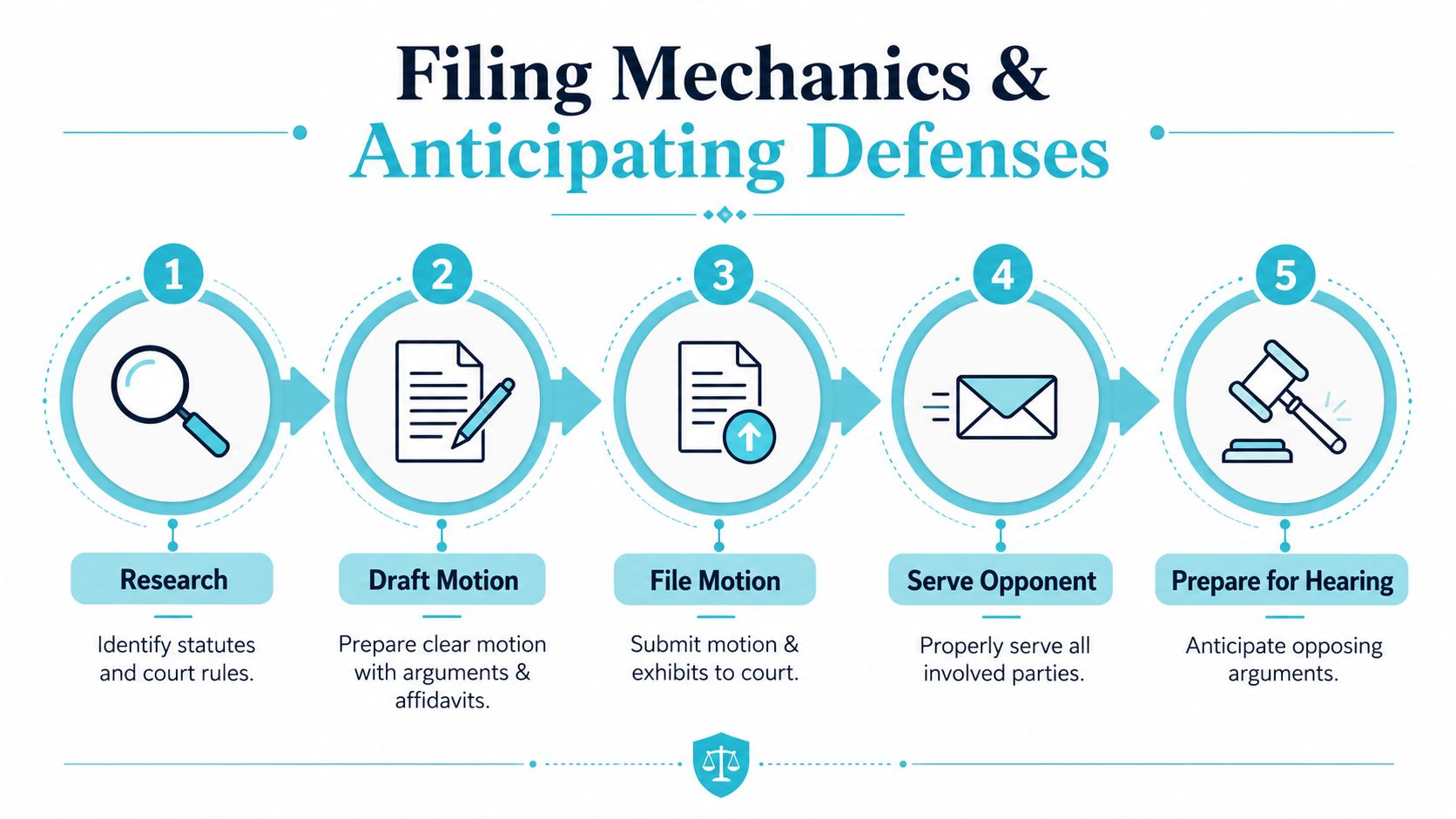
A strong brief won't rescue a bad filing. Courts deny venue motions for avoidable procedural reasons all the time, and opposing counsel will exploit every opening you leave.
That's why I tell younger lawyers to treat the mechanics as part of the merits. If you blow service, miss the local timing rule, or submit before the record is procedurally ripe, the judge may never reach your best argument.
Procedure defeats people who think writing is enough
One recurring problem is sloppy service. Incorrect notice to the opposing party creates defects that are entirely avoidable and can lead to immediate denial. Some courts also impose waiting periods that lawyers miss. In Utah practice, for example, the Request to Submit for Decision cannot be filed until 14 days after service of the initial motion, as discussed in this venue transfer practice article.
That sounds basic, but it's exactly the kind of mistake that happens when a team focuses on the brief and assumes filing is administrative.
Use a pre-filing checklist
Before the motion goes out, confirm these points:
- Rule and timing: Pull the controlling statute, rule, and local practice notes. Then calendar backward.
- Service method: Verify who must be served, how they must be served, and who on your team is responsible.
- Supporting papers: Affidavits, exhibits, proposed order, notice of hearing, and any required certification.
- Submission timing: Check whether the court requires a waiting period, separate request for hearing, or later filing to submit for decision.
If your firm handles e-filing across jurisdictions, keeping filing procedures centralized helps. A practical reference on electronic filing systems is useful for training staff on where technical filing issues usually arise.
A venue motion can be substantively right and still die in the clerk's office.
Expect the other side's stock arguments
Opposing counsel usually won't meet your motion with anything creative. They'll go to the same defenses over and over.
| Defense | What it sounds like | Best response |
|---|---|---|
| Voir dire is enough | “Any prejudice can be cured during jury selection” | Show why exposure is too broad or too specific to be screened out cleanly |
| Burden outweighs benefit | “Transfer would inconvenience our side more” | Compare witness importance, not just witness counts |
| This is tactical delay | “The movant wants a new forum, not a fair one” | Anchor the motion to documented facts and timely filing |
| Venue is already proper | “There's no defect in the original forum” | In convenience cases, explain that propriety doesn't end the analysis |
In personal injury practice, it helps to think about venue opposition the same way you think about substantive defenses. If you want a useful refresher on how defense positions are framed in that broader context, this guide to affirmative defenses in Pennsylvania personal injury is a good example of how predictable defense themes can be.
Prepare for the hearing, not just the filing
At hearing, judges want short answers to practical questions.
Why this venue. Why now. Why can't voir dire fix it. Why isn't this just inconvenience dressed up as prejudice. Why is your proposed forum better.
If you can answer those questions without reading from your papers, you're ready. If you need to rediscover your theory at the podium, you filed too early.
Beyond the Basics Advanced Venue Strategies
Single-forum venue fights are the easy version. The harder cases involve multiple defendants, overlapping forums, and parties making tactical filing decisions before the court ever reaches the merits.
That's where venue strategy stops being a filing issue and becomes case architecture.
Venue stacking is real, and it changes the opening moves
In multi-defendant civil litigation, some plaintiffs don't just choose one favorable forum. They file in more than one place and force the defense to react. The aim is obvious. Preserve options, pressure defendants, and exploit local procedural advantages while everyone fights over where the dispute should live.
Analysis of 2024 to 2025 federal civil filings found that 38% of multi-defendant personal injury cases involved initial filings in at least two different venues, and only 12% of those led to a successful consolidated transfer motion, according to this Clio discussion of venue practice. That's the tactical reality many standard venue guides miss.
What this means for plaintiff firms
If you represent plaintiffs, don't treat venue as a one-time intake field. Treat it as an evolving strategy question.
At intake, ask where defendants are located, where the events occurred, where nonparty witnesses sit, and whether parallel or competing filings are possible. If more than one forum is in play, your venue position affects early client expectations, staffing, and status reporting from the start.
The venue fight may begin before the other side appears, but the client will feel its effects the whole way through the case.
How to respond when the case fragments
When venue stacking appears, your choices narrow quickly. A few practical rules help:
- Move fast on coordination: Delay helps the side that benefits from fragmentation.
- Choose your strongest forum theory: Don't argue every possible venue at once.
- Unify the factual story: Judges deciding transfer issues need to see one coherent map of parties, witnesses, and claims.
- Keep the client updated on why the case feels slower than it looks: Parallel filings create administrative drag even before anyone wins a motion.
This is where experience matters. Lawyers who only know the textbook version of a motion for change of venue tend to focus on one docket and one judge. Real litigation often requires thinking across dockets at the same time. The forum question is no longer just “Is this venue fair?” It becomes “Which court is most likely to control this dispute, and how do we position the case before that answer hardens?”
That's a strategic gamble. Sometimes you push for consolidation. Sometimes you oppose it. The key is recognizing the game early enough to make a deliberate choice instead of inheriting one.
Communicating Venue Changes to Your Clients
Clients don't experience venue motions as legal doctrine. They experience them as uncertainty.
They want to know whether the case is moving, whether the judge believed the argument, whether trial just got pushed back, whether they still need to appear where they expected, and why a ruling that sounds procedural suddenly changes everything else. If you don't answer those questions early, your staff will answer them all day by phone.

A denied motion still changes the case
A lot of public guidance stops at “granted” or “denied.” That's not enough for actual practice.
A 2025 study of California state court outcomes found that 29% of denied venue motions led to a 4 to 6 month delay in trial scheduling, according to the California courts branch facts page on change of venue. That kind of delay affects witness scheduling, discovery calendars, and client expectations even when the motion loses.
Your client needs to hear that in plain English. Not legalese. Not a defensive explanation. A direct one.
What to tell the client right away
When the ruling comes down, your communication should cover four points:
What the court decided
“The judge granted the transfer” or “the judge denied the transfer.”What changes immediately
Venue, hearing location, scheduling process, or nothing yet.What likely happens next
New court assignment, revised scheduling, or delay while calendars are adjusted.What the client should expect from your office
When you'll update them again and what documents or appearances may follow.
Clients usually tolerate delay better than silence.
Build a repeatable communication workflow
Here, firms either create trust or create call volume.
If the motion is granted, clients often assume the transfer means the merits are going better than they are. If the motion is denied, they often hear “we lost something important” even when the ruling means the case stays put. Your communication has to frame the result accurately and quickly.
A simple workflow helps:
- Same-day notice: Send a short case update as soon as the order is entered.
- Follow-up explanation: Provide a plain-language summary of what the ruling means operationally.
- Status checkpoint: Calendar the next update so the client isn't left guessing during the lull that often follows.
- Team consistency: Make sure attorneys, paralegals, and intake staff are using the same explanation.
If you're refining that process, these client communication best practices are a useful reference point for standardizing updates and reducing avoidable back-and-forth.
Don't treat communication as a side task
A venue ruling changes more than geography. It changes how the client reads the whole case.
That's why proactive communication isn't optional. It protects trust, reduces confusion, and keeps your staff from spending the next two weeks answering the same question ten different ways. The lawyers who handle venue motions best are usually not the ones who write the longest briefs. They're the ones who manage the legal move and the client reaction at the same time.
If your firm wants a better way to handle the status updates, routine follow-ups, messages, files, and forms that pile up around motions like these, CasePulse is built for that job. It gives law firms a secure client portal that works with systems like Needles, Neos, LawBase, and Litify, so clients can check status, message the team, share files, and complete forms without pulling staff into another inbox or forcing everyone out of the workflow they already use.