
 CasePulse
 A sample demand letter for personal injury is not just a template you fill out. It is the official kickoff to settlement talks with the insurance company and your first, best chance to show them you mean business.
This letter is where you lay out the facts, detail your client's injuries, and state exactly what it will take to resolve the claim.
The Role of Your Personal Injury Demand Letter
Think of your demand letter as the opening argument in a case you intend to win long before you ever see a courtroom. It is much more than a simple request for money; it is arguably the single most important document you will draft during negotiations. It frames the entire narrative for the insurance adjuster and sets the tone for every conversation that follows.
A powerful, well crafted letter can stop lowball offers in their tracks and push the adjuster toward a fair settlement. A weak one? It gets tossed to the bottom of a very tall pile. I have seen it happen time and time again. A compelling letter commands respect and gets the ball rolling toward a swift, favorable resolution.
Why It's Your Most Important Tool
The demand letter is where you connect all the dots for the insurance company. You are translating sterile police reports, dense medical records, and your client's raw, personal suffering into a clear and persuasive story. It immediately tells the adjuster you are organized, professional, and serious about getting what your client deserves.
More specifically, this is what the letter needs to accomplish:
- Pinpoint Liability: State clearly and confidently why their insured is at fault.
- Detail the Harm: Document the full extent of your client's physical and emotional injuries.
- Calculate the Damages: Provide a meticulous breakdown of every economic and non economic loss.
- Anchor the Negotiation: Formally present your settlement demand, which serves as the starting point for all talks.
The reality is that very few of these cases ever go to trial. Statistics consistently show that around 95 to 96% of personal injury claims are settled out of court. That number alone highlights just how critical this letter is. It is the primary tool you will use to secure a win for your client.
Your demand letter is your opportunity to tell your client's story in a way an adjuster can understand, justify to their supervisor, and ultimately use to cut a check. It is the foundation of a successful settlement.
Setting the Stage for Settlement
Since most personal injury claims are won or lost at the negotiation table, mastering the art of the demand letter is crucial. A strong demand forces the adjuster to take the claim seriously from day one, which helps cut down on the frustrating back and forth that only delays your client's compensation.
By presenting a rock solid case from the outset, you position your client for a much better outcome, often without the expense and stress of litigation. For a deeper dive into this process, you can check out our comprehensive guide on the personal injury settlement process.
The Core Anatomy of a Winning Demand Letter
An effective demand letter is not just a jumble of facts and figures thrown onto a page. It is a carefully constructed argument that guides an insurance adjuster from the moment of the accident right to your final settlement number. Think of it this way: your goal is to make their job as easy as possible.
When you present a clear, logical, and well supported claim, you give the adjuster everything they need to justify the payment you are asking for. This simple flow shows how a strong letter kicks off the entire settlement process.
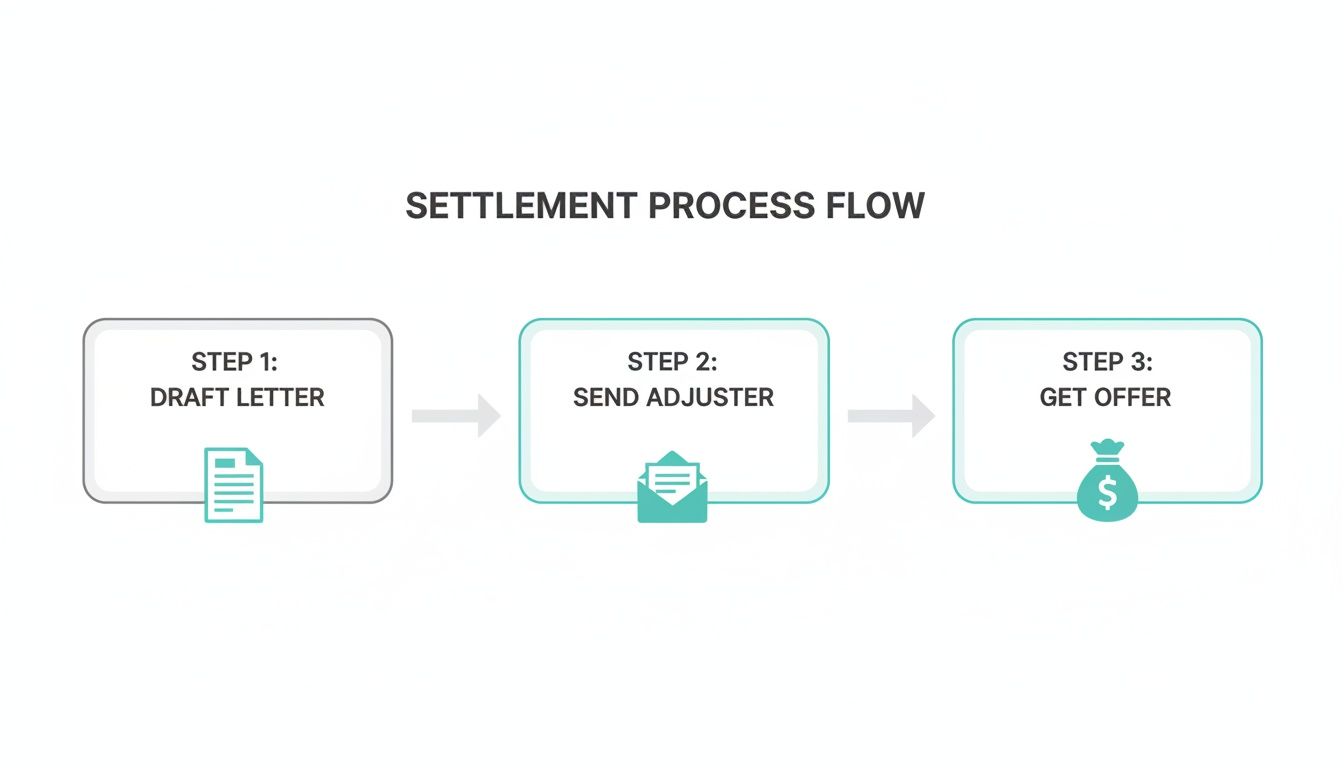
As you can see, that first step of drafting a compelling letter is what sets the stage for a successful negotiation. A messy, confusing letter gets put at the bottom of the pile; a great one gets things moving.
The Non-Negotiable Sections
Over the years, I have seen that the best demand letters all share the same fundamental structure. Each part serves a specific purpose, and if you leave one out, you risk weakening your entire case. Insurance adjusters are trained to spot disorganized or incomplete claims, which they often see as an invitation to make a lowball offer.
Here is a breakdown of the non negotiable sections every effective demand letter needs. Think of these as the building blocks of your argument.
Core Components of Your Personal Injury Demand Letter
A look at the non negotiable sections every effective demand letter needs to ensure clarity, completeness, and professionalism.
| Section Component | Purpose and Key Details |
|---|---|
| Introduction | Get straight to the point. State your name, the date of the incident, the person you are representing, and make it clear this is a formal demand for settlement under a specific claim number. |
| Statement of Facts | This is your narrative. Lay out a simple, chronological account of what happened. Focus on establishing the other party’s fault using objective facts. |
| Injuries & Medical Treatment | Detail every injury, no matter how minor it seems. Describe the full journey of medical care, from the initial emergency room visit to ongoing physical therapy or specialist appointments. |
| Damages Calculation | This is where you translate the injuries and suffering into a dollar amount. Create an itemized list of all economic damages (medical bills, lost wages) and non economic damages (pain and suffering). |
| The Settlement Demand | End with a clear, firm number. This is the total amount you are demanding to fully and finally settle the claim. Do not be vague. |
Bring the Story to Life
The Statement of Facts is your opportunity to do more than just list what happened. You need to tell a story that paints a vivid picture of the other party's negligence. Do not just rely on the police report's dry language.
For instance, instead of saying, "The other driver ran the red light," try something more impactful:
"As my client proceeded lawfully through the intersection on a green signal, your insured recklessly ignored their own solid red light, causing a violent T bone collision."
This kind of assertive and specific language removes any doubt about liability. It is not just about stating a fact; it is about framing it in a way that establishes clear responsibility.
A strong demand letter does more than list facts; it constructs an argument. It shows the adjuster not just what happened, but why their insured is legally and financially responsible for the consequences.
Knowing these core components is the first step. The next is to learn how to write a powerful insurance demand letter that weaves these elements together into a persuasive narrative. Your ultimate goal is to hand the adjuster a complete package that makes approving a fair settlement the easiest decision they will make all day.
How to Accurately Calculate Damages for a Claim

Figuring out what a claim is worth is where your strategy gets real. An insurance adjuster is not going to accept a number just because you say so; they need to see the math. Your final demand amount has to be supported by a logical, clear breakdown of every dollar you are asking for.
This all comes down to two kinds of damages: economic and non economic. Let's break down how to calculate both.
Tallying the Economic Damages
Economic damages are the easy part. These are the concrete, out of pocket losses that come with a receipt. Your job is to build an ironclad case with a paper trail for every single cost, leaving no room for the adjuster to question them. Think of it as creating an itemized invoice for the accident.
Start by gathering every single document related to your client's financial losses. Precision is everything.
You will need to account for:
- Medical Expenses: This is more than just the big hospital bill. Include the ambulance ride, ER visit, follow up appointments, prescriptions, and any ongoing physical therapy.
- Lost Wages: If the injury kept your client from working, you will need to document that lost income precisely. A letter from their employer confirming their pay rate and the exact dates they missed is crucial.
- Future Lost Income: For serious injuries that affect long term earning ability, you cannot just guess. This often requires an opinion from a vocational or economic expert to project the loss over your client's work life.
- Out of Pocket Costs: Do not forget the smaller expenses. They add up. This includes things like paying for rides to doctor’s appointments, buying crutches or a brace, or even hiring help for household chores they can no longer do.
Understanding the typical costs for treating common injuries from motor vehicle accidents can really strengthen your claim, as these expenses are a core component of economic damages.
Valuing Pain and Suffering
This is where the art of negotiation comes in. You cannot put a price tag on pain, emotional distress, or the way an injury has completely upended someone's life. But in a demand letter, you have to. This is where you calculate the non economic damages.
The most common approach is the multiplier method. It is a straightforward formula: you take the total medical expenses and multiply them by a number between 1.5 and 5. The more severe, painful, and permanent the injury, the higher your multiplier.
A minor whiplash injury that clears up in a few weeks might justify a 1.5x multiplier. In contrast, a life altering injury that requires multiple surgeries and leaves someone with a permanent disability could easily command a 5x multiplier, or even more in catastrophic cases.
For instance, let's say your client has $20,000 in medical bills from a serious but fully recoverable injury. Using a 3x multiplier seems reasonable. That would put your demand for pain and suffering at $60,000, which you would then add to their economic losses.
Since data shows that a staggering 52% of personal injury cases come from vehicle collisions, mastering this calculation is essential. A well supported demand is not just a request; it is your most powerful negotiating tool.
For more guidance on putting it all together, check out our complete guide on writing a demand letter for personal injury.
Gathering Evidence to Support Your Demand

Let's be blunt: your demand letter is just words on a page without rock solid proof to back it up. The evidence you assemble is what gives your claim teeth and forces the insurance adjuster to sit up and take notice.
Think of it from their perspective. A sloppy, incomplete set of documents suggests you are not serious or, worse, not prepared for a fight. But a professionally organized evidence package? That makes their job easier, and it sends a clear signal that you know what you are doing. That is always a good thing.
The Non-Negotiable Documents
Before you even think about drafting the letter, your first job is to play detective and gather every piece of paper related to the case. A complete file closes loopholes and prevents the adjuster from kicking the claim back with requests for more information.
Make sure your evidence package contains these absolute must haves:
- The Official Police Report: This is your starting point. It is the official narrative of the accident and often includes the investigating officer's initial determination of fault.
- All Medical Records and Bills: You need a complete, chronological set of records from every single provider. That means the initial emergency room visit, any specialist appointments, physical therapy notes, and every corresponding bill.
- Proof of Lost Income: This is not optional. Get a formal letter from your client's employer on company letterhead that confirms their job title, rate of pay, and the specific dates they were unable to work.
Every year, an estimated 39.5 million Americans need medical attention for preventable injuries, creating a tidal wave of claims for adjusters to process. This statistic, highlighted in Clio's 2024 Legal Trends Report, shows just how much competition your demand has. A strong evidence package makes it stand out.
Telling the Full Story with Supplemental Evidence
The core documents establish the facts, but extra evidence is what truly brings your client's story to life. These additional items help the adjuster see the person behind the claim number, making your arguments far more compelling.
The first 24 hours after an incident are often a goldmine for this kind of proof. For a deeper dive, check out our guide on what clients should know in the first 24 hours of their personal injury case.
A powerful demand package anticipates the adjuster's questions and answers them with undeniable proof. Your goal is to leave them with no choice but to agree with your assessment of the claim's value.
To really drive your point home, consider including these items:
- Photographs and Videos: Do not just tell the adjuster about the mangled car or the severe bruising. Show them. Photos of the accident scene, property damage, and visible injuries provide a visceral impact that words simply cannot match.
- Witness Statements: A signed statement from an independent third party who saw what happened can be invaluable. It corroborates your client's story and shuts down any attempt to dispute the facts.
- Expert Reports: For more complex cases with serious, life altering injuries, you may need to bring in the heavy hitters. Reports from medical experts, accident reconstructionists, or vocational specialists can provide an authoritative opinion that an adjuster cannot easily dismiss.
Actionable Personal Injury Demand Letter Templates
Theory is great, but nothing makes the concepts stick like seeing them on paper. To help you bridge that gap, I have put together a couple of distinct templates you can work from. A good sample demand letter for personal injury is not just a fill in the blank document; it is a framework for building your client's story into a compelling argument.
These examples pull together all the strategies we have covered. They are built to be clear, persuasive, and, most importantly, easy for a busy insurance adjuster to process. Think of them as a solid foundation you can build on, ensuring every letter that leaves your office is of the highest quality.
Sample Template for a Car Accident Claim
Car accidents are the bread and butter of most personal injury practices, so you absolutely need a go to template for these claims. This example is all about establishing the other driver’s fault in no uncertain terms and then laying out the resulting damages methodically.
Your letter should flow through these key sections:
The Opener: Get straight to the point. A sentence like, "This letter is a formal demand for settlement for the injuries my client, [Client Name], sustained due to the negligence of your insured, [At Fault Driver’s Name], on [Date of Accident]," sets a professional tone and immediately identifies the key players and the legal basis for your claim of negligence.
The Factual Story: Tell a concise, fact based story of what happened. For example: "My client was proceeding lawfully through the intersection at [Street Names] on a green light when your insured ran the red light, causing a violent T bone collision." Immediately bolster this by referencing your strongest evidence: "The attached police report (Exhibit A) confirms your insured was cited for this violation." This shows the adjuster you are already prepared to prove your case.
Injuries and Medical Treatment: Connect the crash directly to the harm it caused. "As a direct result of the impact, my client suffered a concussion and three herniated discs in their cervical spine, confirmed by the MRI report from [Medical Facility] (Exhibit B)." Then, summarize the care they have received: "Treatment has included emergency care, multiple specialist consultations, and an ongoing course of physical therapy." This demonstrates a consistent pattern of necessary medical intervention.
The Demand: State your number clearly and justify it. "We demand the total sum of [Total Demand Amount] to resolve this claim." Break it down to show your math is sound: "This figure is based on $XX,XXX in economic damages (see itemized list in Exhibit C) and $XX,XXX for pain and suffering." Separating the hard costs from the non economic damages shows your demand is not arbitrary.
Sample Template for a Slip and Fall Claim
Premises liability cases, like a slip and fall, pivot on a different element. Here, your primary job is to prove the property owner knew, or should have known, about a dangerous condition and did nothing about it.
A successful slip and fall demand letter must paint a clear picture of a hazardous environment that the property owner neglected. The core of your argument is foreseeability and the failure to provide a safe premise.
Here is how you can structure that argument:
First, you need to establish the property owner's duty of care. Start by explaining that your client was a lawful guest (an "invitee") on the property, which legally obligated the owner to maintain a reasonably safe environment for them.
Next, describe the specific hazard in detail. "A wet floor" is weak. "A significant puddle of clear liquid in the main aisle, unmarked by any warning cones or 'wet floor' signs," is much stronger. If you have photographs, this is the perfect place to reference them as an exhibit.
The crucial part is proving the owner had notice. This is where many slip and fall cases are won or lost. You have to argue why the owner knew or should have known about the danger. For instance: "Given the location of the spill in a high traffic area and the dirty footprints tracked through it, it was clearly present long enough that a reasonably attentive employee would have discovered and addressed it."
Finally, connect the hazard to the injury. Just as in a car accident letter, draw a direct line from the fall to your client's injuries, detail their medical treatment, and then present your itemized damages and a firm final demand amount.
Common Questions About Demand Letters
Even the most well crafted demand letter can leave you with a few lingering questions. It is a tricky balancing act, managing your client’s expectations while dealing with a skeptical insurance adjuster. Let's walk through some of the most common questions that come up in the trenches.
How Long Should We Wait to Send the Demand?
This is probably the most critical timing question you will face, and getting it wrong can be catastrophic for your client's case. The answer is straightforward: you should only send the demand letter after your client has completed all medical treatment or officially reached Maximum Medical Improvement (MMI).
MMI is that crucial point when a doctor confirms the client’s condition is not likely to get any better. Sending a demand before you have this confirmation is a massive gamble. If you settle the claim and your client suddenly needs an unexpected surgery or another round of physical therapy, you cannot go back to the insurance company for more money. Once that release is signed, the case is over for good. Patience is everything here.
What if the Insurance Company Rejects Our Demand?
It is easy to get discouraged when a flat out rejection lands on your desk, but this is rarely the end of the story. If the insurer denies the claim, your first move is to dig into their reasoning. Are they disputing liability? Claiming the injuries are from a pre existing condition? The denial letter itself is your road map.
More often than not, an outright rejection is just an aggressive negotiation tactic. The adjuster is testing you to see if you are serious. This is precisely the point where filing a lawsuit often becomes the most powerful next step. It is amazing how quickly filing a complaint can bring an adjuster back to the table with a far more reasonable outlook.
A flat out rejection or an insultingly low offer does not mean your case is weak. It often means the insurance company is testing your resolve. Responding with confidence and a clear next step, like filing suit, is a powerful move.
How Long Does an Adjuster Have to Respond?
While most jurisdictions do not have a strict legal clock for an adjuster's response to a demand, it is standard practice to give them 30 days. This sets a professional tone, establishes a clear expectation for a timely review, and keeps the case from gathering dust on their desk.
If that 30 day window closes with no word, do not just sit back and wait. A polite but firm follow up call or email is your next step. Consistent, professional follow up sends a clear signal to the adjuster that you are organized, on top of your files, and serious about getting a fair resolution for your client. It shows them this case is not going to just fall through the cracks.
At CasePulse, we know that managing client communication is just as important as drafting the perfect demand letter. Our secure client portal integrates directly with your case management system, letting clients check case status 24/7, reducing inbound calls and allowing your team to focus on high value work like negotiating settlements. See how you can modernize your firm's communication.