
 CasePulse
 When potential clients need a personal injury lawyer, the first place they turn is not the yellow pages anymore. It is Google. Optimizing your firm's website to show up for those searches is not just a marketing task; it is a fundamental business strategy that separates the firms that are thriving from those that are just surviving.
Getting this right means a consistent flow of high value cases, with returns that build on themselves over time.
Why SEO Is a Non Negotiable for Modern PI Firms
It is time to stop seeing SEO as an expense and start treating it as the primary engine for sustainable growth. The old model of relying solely on paid ads is becoming a financial black hole for many personal injury firms. We have seen pay per click (PPC) costs for competitive legal keywords soar past $300 per click. At that price, paid ads are simply not a viable long term plan.
This is where a smart, dedicated SEO strategy becomes your most powerful asset. Unlike paid ads, which vanish the second you turn off the spending, the value you build with organic SEO is yours to keep.
A single page ranking at the top for a high intent search term can generate enough quality leads to fund your entire marketing operation for a year. It turns your website from a static digital brochure into a powerful, 24/7 client generation machine.

Escaping the Paid Ad Trap
Too many firms get stuck on the paid search treadmill. It can bring in cases quickly, sure, but the costs are staggering and you are not building any lasting equity. The moment the budget dries up, the leads stop cold. This creates a stressful, unpredictable feast or famine cycle for your intake team.
In contrast, a well executed organic SEO plan builds a durable asset for your firm. The authority and rankings you establish this year will continue generating cases next year and the year after, delivering a far superior return on investment. This steady stream of organic leads is the only real way to break free from the pressure of ever increasing ad costs.
The Real World Impact of Visibility
Think about it this way. Imagine two PI firms in the same city.
Firm A invests in a real SEO strategy. They create helpful content that directly answers the urgent questions their potential clients are asking Google, like "what to do after a truck accident" or "slip and fall statute of limitations." As a result, they are all over the first page of search results, and their phones ring consistently with calls from motivated, qualified clients.
Firm B has great lawyers but has neglected its online presence. They are basically invisible to the 95% of people who use search engines to find an attorney. This firm is left fighting for scraps, struggling with inconsistent case volume, and often forced to rely on expensive and low quality referral services.
That is the reality in today's legal market. To get ahead and stay ahead, you have to master your firm's online footprint. For a forward looking approach, it is worth digging into a detailed Personal Injury Law Firm SEO Strategy 2026.
Connecting SEO to the Client Experience
Great SEO does not just end with a form submission or a phone call. A truly modern strategy considers the entire client journey.
For instance, you can turn your firm's commitment to communication into a competitive advantage. Mentioning a secure client portal like CasePulse where clients can log in for case updates anytime on your website builds immediate trust and can significantly boost conversion rates. This focus on a better client experience often leads to glowing reviews and more referrals, which in turn creates a positive feedback loop that strengthens your SEO.
You can dive deeper into these foundational concepts in our complete guide to SEO for law firms.
Mastering Keyword Research for High Value Cases
The foundation of any SEO campaign that actually moves the needle for a personal injury firm is not about getting more traffic. It is about getting the right traffic. It all starts with digging into the exact phrases people use when they are in crisis and urgently need an attorney.
Think about the difference in mindset. Someone searching for "personal injury information" is just dipping their toes in the water. But a person typing "commercial truck accident lawyer Houston" or "spinal cord injury attorney Chicago" has a serious, specific problem. They are not just browsing; they are actively looking to hire someone.
Those are the searches that lead to six and seven figure cases. Everything you do in SEO, your content, your technical optimizations, your link building, is built on this keyword foundation. If you get this part wrong, you are building your house on sand.
Thinking Beyond Broad Search Terms
So many firms get stuck fighting over the big, obvious keywords. In a legal market where personal injury in the U.S. is a $50 billion industry, it is no wonder the competition is brutal.
Sure, a term like 'car accident lawyer' gets a massive 82,000 searches a month, and 'personal injury lawyer' is not far behind at 79,000. But chasing these terms is often a frustrating and expensive battle. Instead, the real gold is in the details. We have consistently seen that geo specific phrases like 'Los Angeles car accident lawyer' or 'spinal cord injury attorney in Chicago' convert clients at a much higher clip, often leading directly to cases valued at $100,000 or more. You can dive deeper into keyword statistics and their strategic impact on legal marketing to see the data for yourself.
This is where you need to get smart and focus on long tail keywords. These are longer, more specific search phrases that signal a user is much further along in their journey and ready to make a decision.
- Forget "car accident lawyer." Think "head on collision lawyer for TBI case."
- Instead of "slip and fall attorney," target "grocery store slip and fall settlement amount."
- Move past "workers comp lawyer" and go after "denied workers compensation claim for construction injury."
Someone using these phrases has already done the initial research. They know what kind of case they have, and they are looking for a specialist, not a generalist.
Aligning Keywords with Client Intent
A truly effective keyword strategy maps directly to the client's journey. You need to understand their state of mind at every step and create content that speaks to them right where they are.
The best keyword maps do not just list phrases; they tell the story of a potential client's journey. When you understand their mindset, you can build a path of content that earns their trust and leads them straight to your intake team.
Let's break down how to organize your keywords based on what a potential client is trying to accomplish.
Targeting Informational Keywords
These are top of funnel searches from people who are just starting to figure things out. They are looking for answers and information, not necessarily an attorney… yet.
- What they search for: "what to do after a car accident," "symptoms of a concussion," or "how long do I have to file a claim."
- Your move: Be the helpful, authoritative resource they need. Create blog posts and guides that answer their questions clearly and establish your firm as a credible expert right from the start.
Capturing Navigational Intent
At this stage, they are getting more specific. They are starting to evaluate their legal options and might be looking into case values or the legal process itself.
- What they search for: "average settlement for a back injury," "motorcycle accident laws in Florida," or "filing a wrongful death lawsuit."
- Your move: This is your chance to showcase your expertise. Build detailed practice area pages and case studies that prove you have deep experience handling cases just like theirs.
Winning Transactional Searches
These are the money keywords. The searcher's intent is clear: they are ready to hire someone. These searches should be your absolute highest priority.
- What they search for: "best personal injury lawyer near me," "top rated truck accident attorney in Dallas," or "free consultation for medical malpractice case."
- Your move: Make it incredibly easy for them to contact you. These pages need prominent contact forms, click to call phone numbers, and powerful social proof like testimonials and case results to close the deal.
Building Your Local SEO and Google Maps Fortress
For any personal injury firm, the real fight for new clients happens right in your own backyard. When someone gets hurt in a car wreck or a slip and fall, their first instinct is to pull out their phone and search for a lawyer nearby. This is why local SEO, especially dominating the Google Maps "Local Pack," is not just a piece of your marketing. It is the whole game.
Get this right, and your firm becomes the go to choice in your community. A powerful local presence creates a kind of digital barrier around your service area, making it much harder for competitors to get a look in. Here is how we build that fortress, one piece at a time.
Optimizing Your Google Business Profile
Think of your Google Business Profile (GBP) as your firm’s digital front door. It is what shows up in Google Maps and that all important Local Pack when a potential client searches for "car accident lawyer near me." A half finished profile is the equivalent of a "closed" sign, while a fully built out one welcomes new clients.
You have to go beyond just listing your name and address. Every single section needs to be filled out with care.
- Select the Right Categories: Your primary category must be "Personal Injury Attorney." But do not stop there. Add secondary categories for every single practice area you cover, whether it is "Workers Compensation Attorney" or "Medical Malpractice Attorney." This is how you tell Google the full range of cases you handle.
- Write a Compelling Description: You get 750 characters here. Use them all. This is your chance to talk about what makes your firm different, highlight your main practice areas, and list the specific cities you serve. It is the perfect place to naturally work in the keywords potential clients are actually typing into Google.
- Utilize All Features: Get in the habit of using GBP Posts to share case results, firm news, or helpful blog articles. Take a look at the Q&A feature and proactively answer the common questions you get from new clients. This consistent activity signals to Google that your firm is active, engaged, and relevant.
An incomplete GBP is a huge missed opportunity. It is often the very first impression someone has of your firm, so it needs to be treated as a top priority.
For personal injury law firms, local SEO is a high stakes game. Practices that secure a spot in Google's local map pack can see 113% more clicks, which translates directly into a spike in qualified inquiries from potential clients who are ready to take action.
In such a competitive field, a complete and active profile is non negotiable for landing high value cases.
Creating Consistent Citations Across the Web
Next up is your firm’s Name, Address, and Phone Number (NAP). These three pieces of information must be identical everywhere they show up online. Google cross references hundreds of online directories from legal specific sites like Avvo and Justia to general business listings like Yelp to verify that you are who and where you say you are.
Even tiny inconsistencies can hurt your rankings. Using "St." on one site and "Street" on another, or having an old phone number lingering on a forgotten directory, creates confusion for search engines. The goal is to build a perfectly consistent digital footprint that gives Google absolute confidence in your firm's legitimacy and location.
Generating and Managing Client Reviews
Positive reviews are pure rocket fuel for your local rankings. They act as a powerful trust signal for both potential clients and Google’s algorithm. A steady stream of 5 star reviews provides the social proof a hesitant person needs to finally pick up the phone.
You need a system for actively asking satisfied clients for reviews; it should be a standard step in your case closing workflow. It is just as important to respond to every single review, good or bad. Thanking clients for their kind words and professionally addressing concerns in negative reviews shows you are engaged and genuinely care about client outcomes. If you are looking for a better system, check out our guide on maximizing Google reviews for your firm.
Building Geo Targeted Landing Pages
Finally, to truly own a specific city or suburb, you need to create dedicated landing pages for each one. A generic page about "car accidents" will never rank in a neighboring town as effectively as a page specifically titled "Springfield Car Accident Lawyer."
These geo targeted pages are how you prove to Google that you are the leading authority in that market. Each page has to be unique, with content that is actually relevant to that location. Mention local landmarks, discuss specific state or local laws, and most importantly, feature testimonials from clients who live in that area. This targeted approach is infinitely more effective than a one size fits all strategy.
This level of detail is a financial necessity. Personal injury is the most expensive legal SEO niche, with some keyword clicks costing over $300. As you can see in this analysis of the competitive personal injury SEO market on 12amagency.com, you can't afford not to invest in organic visibility.
Building Content That Answers Questions and Signs Clients
If keyword research is the blueprint, then content is the foundation and framework of your entire SEO strategy. For personal injury firms, this is not about churning out generic blog posts. It is about creating a powerful library of information that directly addresses a potential client's fears and questions, establishing your firm as the go to authority before they even pick up the phone.
The most effective way I have seen this done is by moving away from scattered, one off articles. Instead, you need to structure your content around a hub and spoke model. This approach is a game changer for demonstrating expertise to both Google and the people searching for your help.
Designing Your Content Hubs
Think of your core practice areas, car accidents, medical malpractice, slip and falls, as the center of your content universe. For each one, you will build a central "hub" page. This is not just a service page; it is a comprehensive, pillar piece of content that covers the topic from A to Z and links out to more specific, detailed articles (the "spokes").
This is not just about looking organized. Structuring your site this way builds massive topical authority. You are sending a powerful signal to Google that your firm has a deep, nuanced understanding of a specific legal field, which is a huge factor in ranking for competitive terms.
So, your "Car Accidents" hub page would be a master guide. It would then link out to individual "spoke" articles that dive deep into specific questions your clients have. This creates a powerful, interconnected web of content that keeps people on your site and proves you know your stuff.
Creating Spoke Content That Connects and Converts
Your spoke articles are where the real magic happens. This is your chance to answer every niche question someone might type into Google when they are stressed, injured, and looking for real answers. You want to cover topics that demonstrate you understand their exact situation, right down to their local community.
Here are a few examples of spoke articles that work incredibly well:
- State Specific Process Guides: Walk someone through the entire personal injury claims process in your state. What are the statutes of limitation? What evidence is needed? Break it down step by step.
- Hyper Local Data Posts: Publish an article on the "Top 10 Most Dangerous Intersections in Houston," complete with local crash data. This immediately proves you are a local expert, not a national content farm.
- Specific "What If" Scenarios: Create content that targets very precise, long tail queries. Think "What to Do After a Hit and Run in Dallas" or "Can I Sue for a Slip and Fall on an Icy Public Sidewalk?"
To truly attract clients on the verge of making a decision, you need to map your content to their journey. Someone just starting their research needs different information than someone ready to hire an attorney.
Here is a breakdown of how to think about this:
High Intent Content Ideas for Personal Injury Firms
| Client Journey Stage | Content Type | Example Topic |
|---|---|---|
| Awareness (Just Injured) | Educational Guides | "First 5 Things to Do After a Car Accident" |
| Consideration (Researching Options) | Comparison & "Best Of" | "How to Choose the Best PI Lawyer in [Your City]" |
| Decision (Ready to Hire) | Case Studies & Results | "How We Secured a $1.2M Settlement for a T-Bone Accident" |
| Local Search (Needs Help Now) | Geo Targeted Landing Pages | "[Your City] Truck Accident Lawyer" |
This table shows how you can strategically create content for every stage, ensuring you capture leads no matter where they are in their decision making process.
This content strategy is the core of your SEO, but it works hand in hand with your local signals.
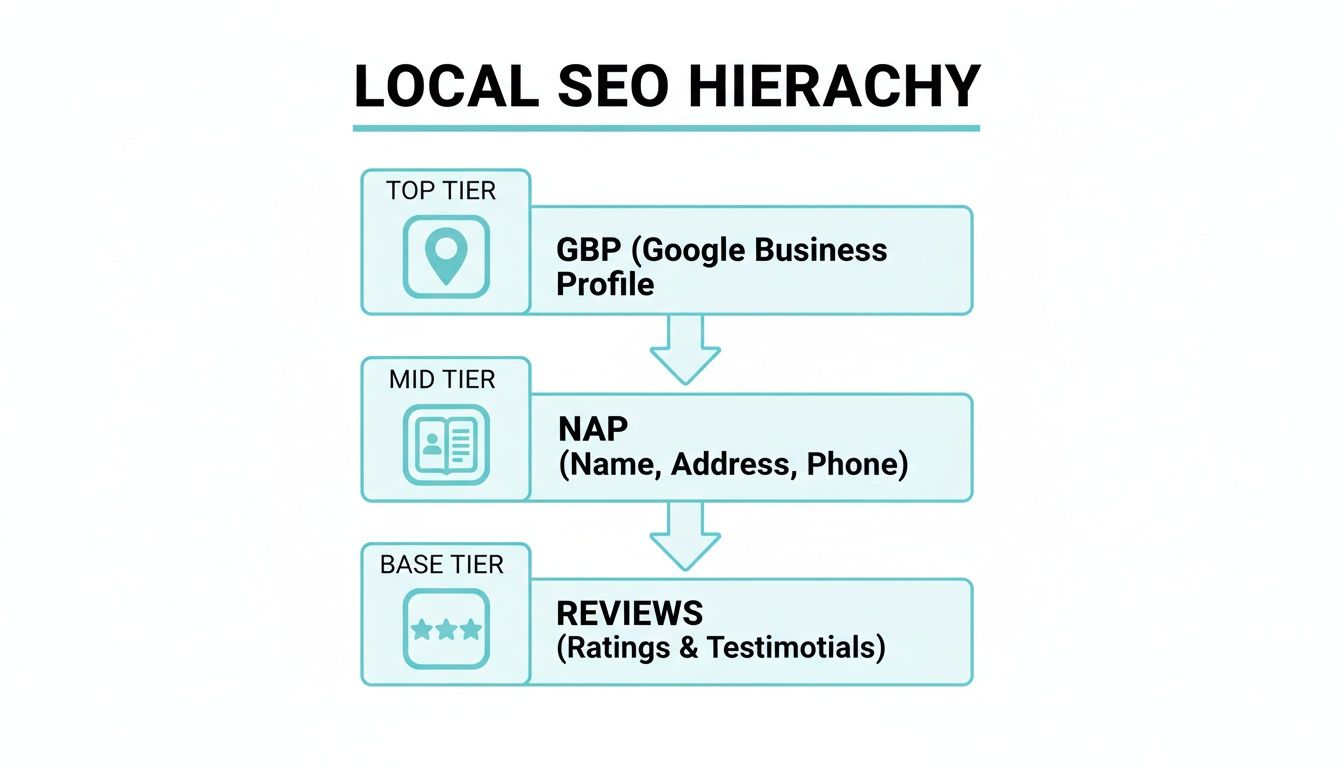
This hierarchy is a great reminder that great content needs the support of a solid local foundation, especially a well managed Google Business Profile and consistent citations. For a deeper look into this, check out our complete guide on content marketing for law firms.
Use Schema Markup to Claim More Real Estate
Great content deserves to be seen. You can give it a serious boost in the search results by using schema markup. Think of it as a secret language you speak to Google, giving search engines more context about what is on your page. The reward? You can earn "rich snippets" that make your listing bigger and more eye catching.
For a PI firm, there are two types of schema you absolutely should be using:
- FAQ Schema: When you have a page with a list of frequently asked questions, marking them up with FAQ schema can make those Q&As appear directly in the search results. This immediately answers a searcher's question and positions you as the expert.
- Attorney Schema: This markup gives Google structured data about the lawyers at your firm, their name, bar admissions, practice areas, and even educational background. It is a powerful way to build E-E-A-T (Experience, Expertise, Authoritativeness, and Trustworthiness) signals at the individual level.
By marrying a smart hub and spoke content model with technical SEO like schema, you are not just playing the SEO game. You are building a client attraction machine that establishes authority and drives qualified leads to your door.
Turning Website Visitors into Signed Cases
You have done the hard work. Your firm is finally showing up on the first page of Google. But getting someone to click on your site is just the first step. If your website does not immediately convince that injured, stressed person to pick up the phone, all your SEO efforts are for nothing.
This is where you shift your focus from getting traffic to converting it. We are talking about turning those hard won website visitors into actual, signed cases for your firm.

Put yourself in their shoes for a moment. They are likely in pain, worried about paying their bills, and desperately searching for an expert they can trust. They do not have time to decipher a confusing website or hunt for a contact form. Your site has mere seconds to prove they have come to the right place.
Designing Landing Pages That Build Instant Trust
When a potential client searches for "motorcycle accident attorney" and lands on your site, that page needs to immediately inspire confidence. A generic homepage just will not cut it. Each practice area page must be a conversion machine.
So, how do you do that? By building in trust signals that are impossible to miss.
- Make Contact Effortless: Your phone number needs to be everywhere, header, footer, and clickable in the body of the text. Keep your contact forms short, simple, and above the fold.
- Use Strong Calls to Action (CTAs): Do not be vague. Use compelling, action focused buttons like "Get a Free Case Review" or "Speak With an Attorney Now." Tell them exactly what you want them to do next.
- Show, Don't Just Tell: Nothing builds confidence like results. Prominently feature client testimonials, recent case results, and major settlement amounts. This is the proof they are looking for.
And remember, people hire people. Detailed attorney bios with professional photos help humanize your firm and build a personal connection. Incorporating these elements is a core part of a wider set of law firm lead generation strategies that drive real growth.
A potential client is making a decision based on trust. Every single element on your landing page should work together to answer one question in their mind: "Is this the right firm to handle my case?"
Use Modern Tech as Your Secret Weapon
Your website is not just a digital brochure; it is the first glimpse a potential client gets into what it is like to work with you. This is a massive opportunity to set your firm apart.
Mentioning that you use a modern client portal like CasePulse, for example, is not just a feature. It is a statement. You are telling potential clients that you value transparency and clear communication.
Highlighting that your clients get 24/7 access to their case status, secure messaging, and important documents speaks directly to a huge fear: hiring an unresponsive lawyer. This alone can be the detail that makes someone choose you over a competitor. It proves you are organized, client focused, and modern before they have even signed a retainer.
For firms using CasePulse, SEO driven leads flow directly into a secure portal for immediate updates and communication, which dramatically cuts down on inbound "just checking in" phone calls. With high intent keywords like 'motorcycle accident lawyer' getting over 40,000 searches a month, demonstrating this modern approach can position your firm as the obvious choice. You can learn more about how technology is shaping legal marketing at anytimedigitalmarketing.com.
How Conversions Fuel Your SEO Success
Here is the best part: turning more visitors into clients does more than just fill your case pipeline. It creates a powerful feedback loop that boosts your long term SEO.
A great user experience and transparent communication lead to happier clients. And what do happy clients do? They leave glowing reviews on Google, Avvo, and other key sites.
Those positive reviews are a massive ranking signal for local SEO, which in turn helps you attract even more visitors. This creates a self sustaining cycle of growth, building a dominant online presence that consistently brings high value cases through your door.
Let's cut through the noise. When I talk to personal injury attorneys about SEO, the same few questions always come up. This is a tough, competitive space, so it is smart to get some straight answers before you commit your firm's resources.
Here is what you need to know, based on years of working in the trenches of legal SEO.
How Long Until I See Real Results From SEO?
This is always the first question I get asked, and I will give you the honest truth: SEO is a long game. It is about building a powerful asset for your firm, not just flipping a switch for overnight leads.
For a completely new website in a competitive city, you should realistically expect it to take 6 to 12 months before you see a meaningful and consistent flow of organic traffic and, more importantly, qualified leads. If you are in a smaller, less saturated market, you might start seeing that traction closer to the 4 to 6 month mark.
Of course, that timeline is not set in stone. It really hinges on a few things:
- Your starting point: Are you working with a brand new domain, or does your site already have some history and authority with Google?
- Your competition: Trying to rank for "car accident lawyer" in Los Angeles is a completely different ballgame than in a smaller suburb.
- Your investment: How aggressively are you funding your strategy? The resources you put into creating expert content, fixing technical issues, and earning high quality links will directly speed up your results.
Unlike paid ads, which vanish the second you stop paying the bill, the results from SEO compound over time. The authority and content you build this year will keep generating leads for your practice for years to come. It is hands down the most cost effective client acquisition channel in the long run.
That is the real power of SEO for a personal injury lawyer. You are not just renting attention; you are building a durable asset that grows in value.
Can I Just Do This Myself, or Do I Really Need to Hire an Agency?
While the DIY spirit is admirable, the personal injury field is one of the most cutthroat arenas in online marketing. A DIY approach, while tempting to save a few bucks, often gets steamrolled by established firms who have dedicated marketing teams or expert agency partners.
Sure, you or your paralegal can probably handle some foundational tasks. Things like keeping your Google Business Profile updated with new photos and reviews or jotting down blog ideas based on common client questions are great in house activities.
But the heavy lifting? The technical site audits, the strategic link building campaigns, the deep keyword research, and the content planning required to outrank your competitors for high value terms, that all requires specialized expertise. Most successful PI firms discover that bringing on an agency that lives and breathes legal SEO is the most direct path to a positive ROI. It frees you up to do what you do best: practice law and take care of your clients.
Just be sure you partner with a transparent agency that provides clear, understandable reports on the metrics that actually grow your firm, like qualified leads and new, signed cases.
Should My Focus Be on Local SEO or General SEO?
This is not an "either/or" situation. For a personal injury firm, they are two sides of the same coin, and you absolutely need both working together.
Think of Local SEO as your ground game. It is non negotiable. Your clients are almost always located in your city or the immediate surrounding area. You have to dominate the Google Map Pack for those critical, high intent searches like "car accident lawyer near me." This is where you find the people who are injured, looking for help, and ready to make a call right now.
At the same time, general SEO is what builds your website's overall authority and proves your expertise to Google. When you publish in depth, expert content on complex legal topics or specific injury types, Google starts to see your entire website as a credible source. This boost in broad authority then directly feeds back into your local rankings, helping you push higher in the coveted Map Pack.
A winning strategy integrates both seamlessly. You use fantastic, authoritative content to power your local visibility and capture those valuable local clients.
How Much Does My Website's User Experience Really Matter for SEO?
Your website's user experience (UX) has a massive and direct impact on your search rankings. Google's number one job is to give its users the best, most helpful result for their search. That experience does not stop at the search results page; it extends to the website Google chooses to recommend.
If your site is slow to load, a nightmare to navigate on a phone, or makes it hard to find your contact information, visitors will hit the "back" button almost immediately. That quick exit, known as a "bounce," sends a powerful negative signal to Google. It basically tells the algorithm, "This page was not a good answer to the user's question."
Over time, a high bounce rate will tank your rankings.
But even beyond the algorithm, a poor user experience is a conversion killer. Imagine a potential client, in pain and under stress, trying to use your site. They will not waste time fumbling with a confusing contact form or hunting for a phone number. Investing in a fast, clean, mobile first design with a crystal clear path to contact you is not just a design choice. It is a critical piece of modern SEO for a personal injury lawyer.
Ready to transform your client communication and improve satisfaction? CasePulse provides a secure, branded client portal that integrates with your existing case management system, allowing clients to see case status 24/7 and reducing your team's administrative burden. Discover how it works at https://www.casepulse.com.