
 CasePulse
 For a law firm, time is not just a resource; it is the actual product you sell. That is why specialized time tracking software for law firms is not a luxury, it is a necessity. It is built from the ground up to capture every single billable moment, preventing lost revenue and guaranteeing billing accuracy in a way generic tools simply cannot.
Why Generic Time Tracking Fails in a Law Firm Setting
Think of your firm's revenue as a large bucket of water. Now, imagine it has dozens of tiny, almost invisible holes. Every quick client email, each five minute phone call, and all those brief research tasks that go unrecorded are small drips leaking from that bucket. On their own, they seem like nothing. But over a year, those drips add up to a massive, costly puddle of lost income.
This is the hard reality for firms still relying on manual spreadsheets or generic project management tools. Most law firms operate on the billable hour. Every minute an attorney or paralegal spends on a client matter is revenue waiting to be captured. When the system for logging that time is clunky, inefficient, or just not built for legal work, money inevitably slips through the cracks.

The High Cost of Small Omissions
The financial hit from these small leaks is often much bigger than partners realize. It is easy to wave off a two minute email or a quick follow up call, but that is real work done for a client. The problem gets worse when attorneys try to reconstruct their timesheets days or even weeks later, a practice that is at the mercy of a faulty memory.
Recreating time entries after the fact is a recipe for underbilling. The human brain simply is not wired to recall every minor task with perfect accuracy, leading to conservative estimates that shortchange the firm.
This constant underestimation quietly eats away at your profitability. We have seen firms relying on manual tracking lose a staggering 20 to 30 percent of their billable hours to these forgotten tasks. For a mid sized firm, that can easily translate to over a million dollars in lost revenue every single year.
Where Generic Tools Fall Short
Standard time tracking apps are not built for the unique pressures and workflows of a legal practice. They are missing the core architecture needed to manage legal work, and that gap creates several critical problems. Staying on top of the importance of staying up to date with technology in law firms is key to avoiding these pitfalls.
- Lack of Matter Based Tracking: Generic software tracks time by project, not by legal matter. This makes it impossible to link billable hours directly to a specific case, client, or legal issue. This is non negotiable for accurate invoicing and profitability analysis.
- Inadequate Compliance Features: These tools do not support trust accounting rules or produce the detailed, auditable billing records required by bar associations. This leaves the firm exposed to compliance risks and opens the door to client disputes.
- No Integration with Legal Systems: They cannot connect with your case management software, creating data silos and forcing your team into double data entry. This wastes valuable time and is a breeding ground for errors.
Trying to use a generic solution is like trying to turn a screw with a hammer. You might make some progress, but it is clumsy, damaging, and ultimately the wrong tool for the job. Specialized time tracking software for law firms is designed to plug every single one of those leaks, ensuring every drop of effort is captured, billed, and counted.
What to Look For: The Must Have Features in Legal Time Tracking Software
Not all time trackers are built the same, and that is especially true when you are talking about the unique pressures of a law firm. Picking the right tool goes way beyond a simple start and stop button. The best time tracking software for law firms comes loaded with a very specific set of features. These features are designed to fit legal workflows, keep you ethically sound, and directly boost your firm's profitability.
Think of it this way: a handyman might get by with a generic toolbox, but a surgeon needs a tray of highly specialized instruments for precision and safety. Your firm is no different. You need tools built for the legal world, where every single minute is tied to a specific case, a specific client, and a specific ethical duty.
Matter Based Tracking is Non Negotiable
If you take away only one thing, let it be this: you must be able to track time by matter, not just by client or project. In a law firm, the entire universe revolves around individual cases. Any generic software that only lets you log hours against a client’s name is fundamentally broken for legal billing.
Proper matter based tracking ensures every time entry is directly tied to the correct case file. This could be 30 minutes of research, a six minute client call, or two hours of drafting a motion. This is the bedrock of accurate invoicing and client trust. More importantly, it is the only way to figure out which cases are actually making you money and which ones are secretly draining your firm’s resources.
Seamless Billing and Invoice Integration
Manually copying time entries from a spreadsheet into your billing system is a disaster waiting to happen. It is tedious, inefficient, and practically guarantees errors. Top tier legal time tracking software completely eliminates this risky step by plugging directly into your billing and invoicing platform.
This creates a clean, automated path where approved time entries flow straight onto client invoices. The benefits hit you almost immediately.
- Drastically Reduced Errors: It kills the risk of manual data entry mistakes that lead to awkward conversations about underbilling or overbilling.
- Faster Invoicing Cycles: With time data instantly available, your team can generate and send invoices in a fraction of the time, which does wonders for your cash flow.
- Increased Transparency: Invoices can be populated with detailed line items pulled directly from the time entries, giving clients the clarity they deserve and cutting down on billing disputes.
To see how these tools work together in a real world setting, you can explore the various features that empower modern law firms to work smarter.
To help you visualize what is truly essential, we have broken down the key features and their direct impact on your firm's success.
Essential Features of Law Firm Time Tracking Software
| Feature | Why It's Essential for Law Firms | Impact on Profitability |
|---|---|---|
| Matter Based Tracking | Links every billable minute to a specific case, which is fundamental to legal practice management. | Enables precise profitability analysis per case and prevents revenue leakage from unassigned time. |
| Billing/Invoice Integration | Automates the transfer of time entries to invoices, eliminating manual work and potential for errors. | Speeds up the billing cycle, improves cash flow, and increases collection rates by providing clear, detailed invoices. |
| Automatic Timers | Captures activity as it happens, reducing reliance on memory and manual entry. | Maximizes billable hours by catching small tasks and "in between" moments that are often forgotten. |
| Mobile & Desktop Capture | Allows attorneys to log time from anywhere, in court, during a commute, or at a client meeting. | Prevents lost billable time by enabling immediate capture, leading to a significant increase in captured revenue. |
| Trust Accounting | Manages client funds in compliance with strict ethical rules, ensuring proper separation and tracking. | Avoids costly ethical violations and sanctions while building client trust through transparent fund management. |
| Reporting & Analytics | Provides insights into attorney productivity, case profitability, and overall firm financial health. | Informs strategic decisions on staffing, pricing, and practice area focus, directly driving firm growth. |
| Detailed Audit Logs | Creates an unchangeable record of all time entries and system changes for compliance and disputes. | Provides a bulletproof defense during billing disputes or audits and ensures accountability across the firm. |
These features are not just nice to have; they are the core components that distinguish a purpose built legal tool from a generic business app.
Automatic Timers and Mobile Capture
Attorneys are rarely glued to their desks. Work happens in the courtroom, at a client’s office, or even during the commute home. Trying to reconstruct those billable moments from memory hours or days later is a surefire way to leave money on the table.
This is exactly why automatic timers and mobile access are so crucial. Many modern systems can run quietly in the background, capturing your activity in different programs and suggesting time entries for you. A solid mobile app is just as important, letting you start a timer or log an entry on your phone the second a task is done, locking in that time with perfect accuracy.
Capturing time as it happens, rather than days or weeks later, is the single most effective way to prevent revenue leakage. Mobile and automatic capture tools make this a seamless part of the daily workflow.
Trust Accounting and Robust Reporting
Handling client funds is not just a matter of good bookkeeping; it is an ethical mandate. Your time tracking software absolutely must support this. A key feature here is the ability to manage trust accounting, making sure retainers and client funds are handled correctly and are always kept separate from your firm's operating accounts. The system must also provide a crystal clear audit trail for every transaction.
Finally, the software should not just be a data collection bucket. It should help you make sense of that data. Powerful reporting is vital for making smart business decisions. Look for a solution that can instantly generate reports on key metrics like:
- Attorney productivity and utilization rates.
- Realization rates, or what you bill versus what you actually collect.
- Profitability by client, matter, or even practice area.
This kind of insight turns your time tracking software from a simple utility into a genuine business intelligence tool, giving you the data you need to guide strategic decisions that fuel your firm's growth.
Integrating Time Tracking into Your Firm's Workflow
Let’s be honest, introducing any new software can feel like a major headache. Your team has its rhythm, its routines, and the last thing anyone wants is a tool that creates more work than it saves. It is the number one fear with any tech adoption. The best time tracking software for law firms is built to feel like a natural part of your day, not just another program to learn and manage.
Think of your firm's technology as an ecosystem. Your case management system is the heart of it all, and every other tool needs to work with it, not against it. If your time tracker does not talk to your primary system, you get friction, slowdowns, and frustration. When they connect perfectly, the whole operation just runs better.
This is where great software shows its value. It should not pull your staff out of the platforms they live in every day, whether that’s Needles, Neos, LawBase, or Litify. Instead, it should blend right in.
A well integrated system simplifies the entire process, connecting the dots between tracking time, creating bills, and generating reports.
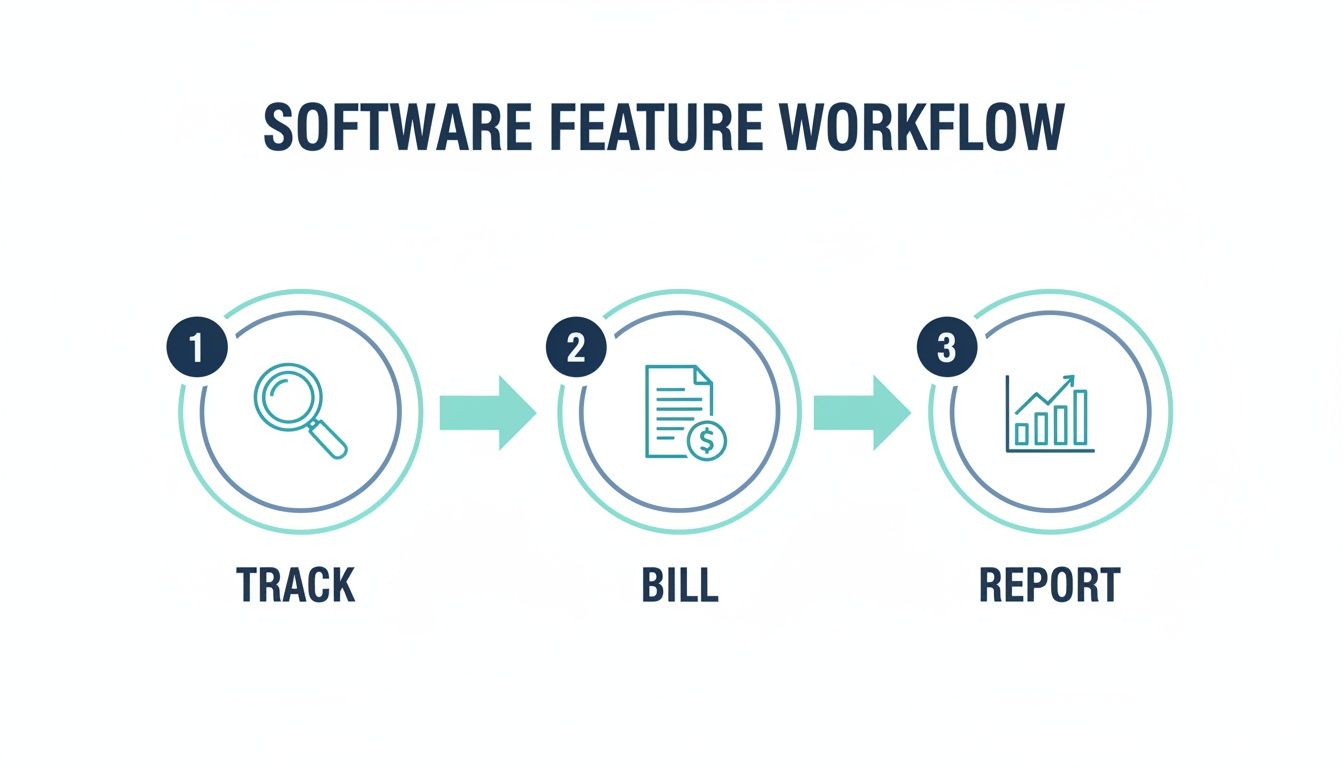
By linking these steps, the software removes the clumsy manual handoffs and ensures data moves seamlessly from one stage to the next.
Putting an End to Double Data Entry
If there is one soul crushing, time wasting task in any firm, it is double data entry. Having to manually copy time logs from a spreadsheet or a separate app into your case files is not just inefficient; it is practically an invitation for mistakes. One typo can snowball into an incorrect invoice, a difficult client conversation, and ultimately, lost revenue.
True integration solves this problem for good. When your time tracker syncs directly with your case management platform, every entry is automatically logged against the right matter. An attorney can capture a 15 minute phone call on their mobile app, and that entry instantly populates the correct case file, ready for billing. No re typing, no errors.
A genuinely integrated system creates a single source of truth for all case information. Time and expenses stop being isolated data points and become part of the client matter's permanent record, available to anyone who needs it.
This unified approach builds an accurate, trustworthy record for the entire team. To dig deeper into how these processes fit together, it is worth understanding the fundamentals of effective legal operations management.
Automating the Information Pipeline
Good integration goes beyond just preventing duplicate work. It is about building an automated pipeline that connects billable work directly to your firm’s finances. Once time is logged and approved, it should flow straight into your billing system without anyone having to manually push it along.
For a busy law practice, this kind of automation delivers some serious wins:
- Faster Billing Cycles: You can generate invoices much more quickly because all the billable data is already organized and waiting.
- Fewer Errors: Taking people out of the data transfer process eliminates the risk of human error, meaning invoices are a precise reflection of the work done.
- Better Oversight: Partners can get an immediate, real time snapshot of work in progress on any matter without having to hunt down information from multiple sources.
When you choose time tracking software for law firms that was designed for deep integration, you are not just buying another tool. You’re fundamentally upgrading your firm's operational engine to be more efficient, accurate, and profitable. It is about making the technology serve your existing workflows, not the other way around.
Your Ethical Compass: Compliance and Billing Obligations
In the legal world, an invoice is not just a request for payment. It is a statement of your firm's integrity. Clients hand you their trust, and that extends to every single line item you bill them for. This is why following the billing guidelines from bodies like the American Bar Association (ABA) is not just a box to tick. It is a fundamental professional responsibility.
Get it wrong, and you are not just looking at a client dispute. You could be facing an ethics complaint, a state bar investigation, and a reputation that is hard to repair. The stakes are sky high, which makes bulletproof timekeeping one of the smartest risk management moves a firm can make.
Your Best Defense Against Billing Disputes
The absolute best way to shut down a billing dispute is with an impeccable, detailed record of your work. Let's be honest, vague entries like "legal research" or "client call" are just asking for trouble. Clients, and auditors, want to know exactly what they are paying for. What specific legal issue was researched? Who was on that call, and what was the outcome? How did that specific task advance the client's cause?
This is where time tracking software built for law firms really shines. It is designed to prompt lawyers for this exact level of detail right from the start. You are encouraged to write clear, descriptive narratives for every entry and tie it directly to the right client matter. This creates a real time, contemporaneous record that holds up far better than a timesheet cobbled together from memory two weeks after the fact.
Think of it this way: a detailed time entry, recorded the moment the work is done, is your most powerful evidence. It tells a clear, defensible story of the value you provided, stopping most billing challenges in their tracks.
This is not just about protecting your revenue; it is about protecting your professional standing.
Preventing a Slip Up: Overbilling and Errors
Ethical billing is not just about catching deliberate wrongdoing. It is about building a system that prevents accidental mistakes. We have all been there. Manual timesheets are magnets for human error. A simple typo, a forgotten entry, or accidentally rounding up time can lead to a client being overcharged. These small errors add up, creating invoices that are unintentionally inaccurate.
Automated tools like timers and activity capture are your safety net.
- Pinpoint Accuracy: Automatic timers clock your work as it happens, down to the second. No more guesstimating.
- A Digital Memory: Many tools log your computer activity like documents, emails, and websites. This helps you accurately piece together your day and assign time to the correct client files.
- The Unchanging Record: A good system creates a clear audit trail. Every time entry, every edit, and every deletion is logged. This gives you complete transparency and accountability, showing exactly how an invoice came to be.
These features give you confidence that clients are only billed for the work you actually did, reinforcing your firm’s commitment to fair and honest practice.
Safeguarding Client Trust Accounts
Managing client funds is one of the heaviest responsibilities a lawyer carries. The rules from state bars on trust accounts and IOLTA are notoriously unforgiving. Mixing client funds with your firm's operating capital, even by accident, is a cardinal sin that can lead to severe consequences, including disbarment.
Legal specific time and billing software is built with these rules in mind. It ensures client retainers are drawn down properly, linking every withdrawal to a specific, approved time entry or expense. The system generates the clean, segregated reports you need to fly through an audit, proving your compliance. It turns trust accounting from a high wire manual act into a secure, auditable, and safe process, protecting both your client’s money and your license to practice law.
The True ROI of Automated Time Tracking
When you are looking at new technology for your firm, it all boils down to one simple question: what is the actual return on investment? Sure, the features of specialized time tracking software for law firms sound great, but their real worth is measured in the cold, hard cash and operational gains they bring to the table. This is where the initial cost of the software gets left in the dust by its power to generate revenue, smooth out operations, and reveal crucial business insights.
The most direct return comes from plugging the tiny revenue leaks that bleed profits every single day. Every forgotten email, every quick client call, or that brief research session adds up to lost income. Think of automated time tracking as a safety net, catching all these billable moments and turning them into real entries. It is about getting paid for all the work you are already doing.

From Lost Hours to Increased Profits
The financial impact of capturing previously lost time is immediate and often staggering. For a mid sized firm, clawing back even a small fraction of unrecorded billable hours can easily add up to hundreds of thousands of dollars in new revenue each year. This is not about working more; it is about accurately billing for the hours you are already putting in.
Modern software, especially tools with AI suggested entries, can recapture up to 30 percent of previously lost time. This is not just a nice to have anymore. The legal industry is facing a strange revenue dilemma where AI is making lawyers more efficient, but the dominant hourly billing model means that efficiency can actually reduce revenue. The Thomson Reuters 2026 report digs into this, projecting a potential $27,000 annual revenue dip per lawyer due to this automation paradox. Without precise time tracking, firms are left with tough choices: raise rates or watch growth flatline.
The return on investment for legal time tracking software is not just theoretical. It is a direct and measurable increase in top line revenue, often paying for the software itself many times over within the first year.
This direct revenue recovery makes the strongest business case possible, turning the software from a line item expense into a powerful profit center for your firm.
Boosting Productivity and Operational Efficiency
Beyond the immediate cash injection, automated time tracking delivers a host of indirect benefits that make the entire firm run better. When you free your attorneys and paralegals from the soul crushing task of manually reconstructing their timesheets at the end of the month, you give them back their most valuable asset: time.
This recovered time gets reinvested where it matters most.
- More Focus on Client Work: Less time fiddling with spreadsheets means more time dedicated to legal strategy, case preparation, and actually talking to clients.
- Improved Employee Morale: Let's be honest, nobody likes doing timesheets. Eliminating this universally disliked chore reduces burnout and boosts job satisfaction, which is a huge win for talent retention.
- Faster Billing Cycles: With accurate time data ready to go, invoices can be generated and sent out in a fraction of the time. This dramatically improves cash flow and shrinks your collection window.
Of course, to meet ethical billing obligations, it is critical to calculate billable hours accurately, and automated systems make this process far simpler and more defensible.
Making Smarter Decisions with Data
Finally, a powerful, and often overlooked, piece of the ROI puzzle is the business intelligence your firm gains. Good reporting features turn your time tracking data from a simple billing record into a strategic asset. You can finally get clear, data backed answers to critical questions about your firm's financial health.
For instance, you can analyze profitability not just by client, but by specific matter or even case type. This kind of data allows managing partners to make truly informed decisions about where to focus the firm's resources. You might discover that a certain practice area is far more profitable than you thought, which can guide everything from marketing spend to future hiring. This ability to make data driven decisions is essential for sustainable growth, providing a long term return that goes far beyond the initial investment.
Choosing and Implementing Your New Software
Picking the right time tracking software for your law firm is a huge decision, but how you bring it into the fold is just as critical. A thoughtful rollout can be the difference between a smooth transition that immediately boosts your bottom line and a frustrating mess that nobody wants to use.
The goal here is not just to buy a product; it is to find a true partner. And that process starts by asking the right questions. Think of it as conducting a little discovery on your potential software vendors before you sign on the dotted line.
Your Evaluation Checklist
When you are comparing your options, you need to dig deeper than just a list of features. Your evaluation checklist or RFP should get into the nuts and bolts of what it will actually be like to work with this company long term.
- Security Protocols: How are you protecting my firm's data? And my clients'? Get specific. Ask about their data encryption standards, both for data that is stored ("at rest") and data that is being sent ("in transit").
- Onboarding and Support: What does the setup actually look like? Who is helping me? Is there a dedicated support team I can call, and where are they located? You will want to know their average response and resolution times before you have a real problem.
- Pricing Transparency: Let's talk about the real cost. Are there hidden fees for setup, migrating my data, or getting premium support? Look for simple, straightforward pricing without being locked into a long term contract. You need flexibility.
- Integration Capabilities: How well does this tool play with the software I already use every day? It is essential to consider how your time tracker will connect with other core systems, like the best legal case management software, to create a single, seamless workflow.
Best Practices for a Smooth Rollout
Once you have made your choice, your success completely depends on getting your team to actually use the thing. Just dropping a new tool on everyone and expecting them to love it is a surefire way to fail. A strategic, phased approach is the only way to go.
A successful software implementation is not a single event. It is a process. It takes clear communication, good training, and the patience to start small and prove the concept before going firm wide.
Your first move? Create a pilot group. Pick a small team of tech savvy attorneys and paralegals to be your guinea pigs. Let them use the software first to work out any kinks and get comfortable with it. They will quickly become your internal champions, and their success stories will be the best marketing you can do to get the rest of the firm on board.
Consistent communication is just as important. From the very beginning, explain why this change is happening. Frame it around the benefits to them personally, such as less administrative headache, more accurate billing, and ultimately, less time wasted. Offer plenty of training and make sure support resources are easy to find. When you show your team you are invested in their success, you can turn that initial friction into genuine enthusiasm.
Your Questions About Time Tracking Software, Answered
Jumping into the world of legal tech can feel like opening a can of worms. When you are thinking about a tool as fundamental as time tracking software for your law firm, it is only natural to have questions about the cost, the security, and the biggest hurdle of all: getting your team to actually use it. Let's tackle some of the most common questions we hear from firms weighing this decision.
How Much Billable Time Can We Realistically Recover?
This is the big one, isn't it? The answer is usually more than you think. Study after study has shown that firms still relying on manual timesheets are leaving a shocking amount of money on the table. This is often between 20 to 30 percent of their billable hours. These are not hours that were not worked; they are hours that simply got lost in the shuffle of a busy day.
Modern software with automatic timers and AI powered entry suggestions can help you claw back up to 30 percent of that lost time. For a mid sized firm, that can easily translate into hundreds of thousands of dollars in found revenue each year. Suddenly, the software is not an expense; it is a powerful profit center.
Is Our Firm's Data Secure in the Cloud?
Client confidentiality is the bedrock of your practice, making data security completely non negotiable. Any reputable legal software provider worth their salt understands this and invests heavily in protecting your information. As you evaluate different platforms, you need to dig into the specifics of their security measures.
Do not be shy about asking direct questions. You should be looking for:
- Data Encryption: Is your data encrypted both when it is sitting on their servers (at rest) and while it is moving across the internet (in transit)? The answer has to be yes.
- Compliance Standards: How do they handle industry regulations and protocols for safeguarding sensitive client information?
- Access Controls: Can you granularly control who sees what? The system must allow you to set permissions so that only authorized people can view or change time entries and client files.
Frankly, top tier providers offer enterprise grade security that often surpasses what an individual firm could realistically implement on its own.
Will Our Attorneys and Staff Actually Use the New Software?
Adoption is where the rubber meets the road. You can buy the most powerful software in the world, but it is worthless if your team finds it clunky and ignores it. The secret to getting buy in is choosing a system that was clearly designed for a lawyer's real world workflow.
The best systems do not feel like an extra chore; they feel like a natural part of the workday. They reduce friction by fitting into existing habits rather than forcing new ones.
Software that offers an intuitive mobile app, fires up timers automatically, and plugs directly into your case management platform makes tracking time almost an afterthought. When an attorney can log a five minute call from their phone in just a few taps, they are infinitely more likely to do it. Pair those user friendly features with a smart, phased rollout and solid training, and you have got a recipe for success.
Ready to modernize your firm's operations and capture every billable minute? CasePulse provides a secure, integrated client portal that streamlines communication and reduces administrative burdens, allowing your team to focus on what matters most. Discover how our solution fits seamlessly into your existing workflow by visiting https://www.casepulse.com.