
 CasePulse
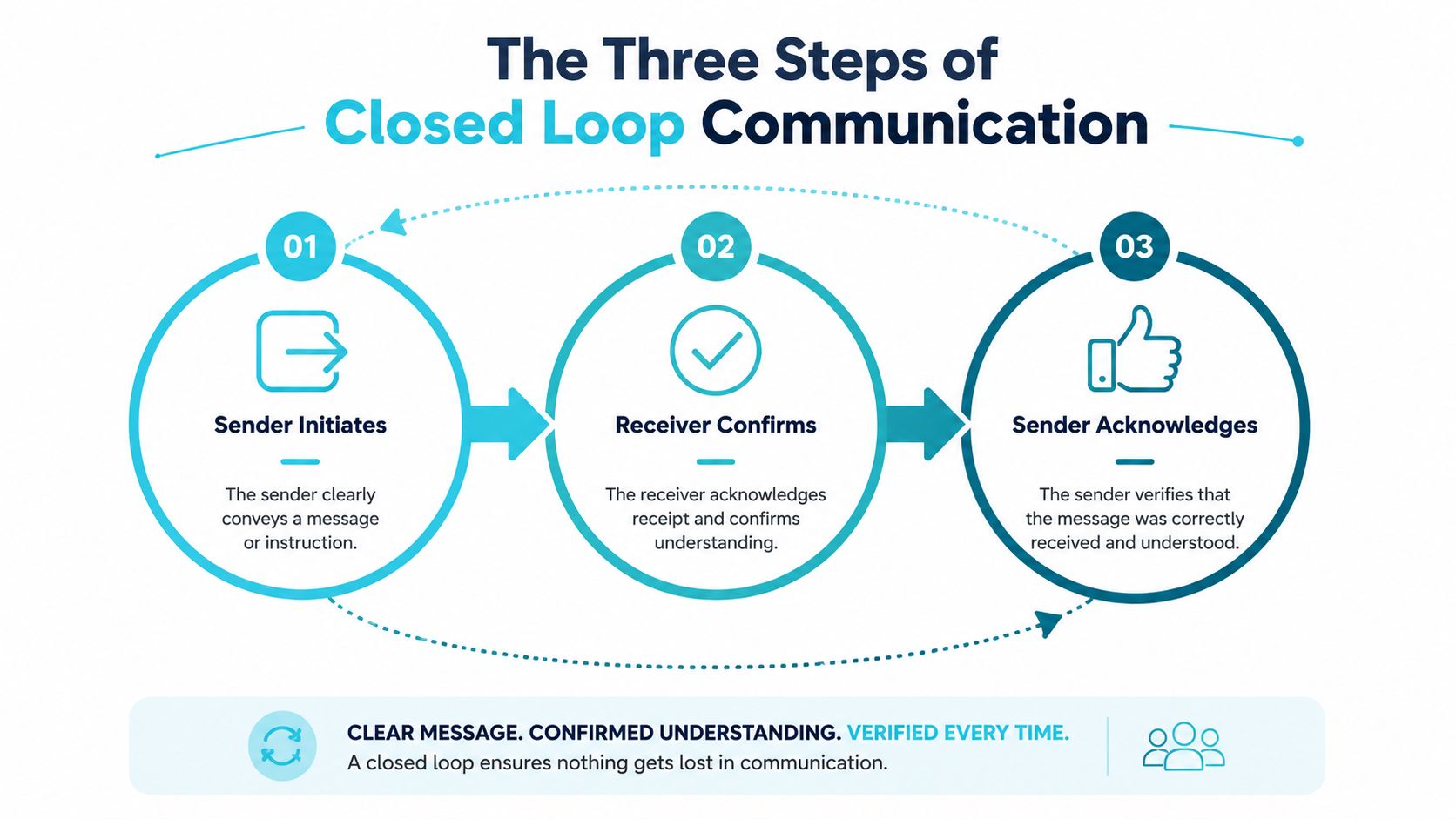
Closed-loop communication is a three-step process. The sender gives a message, the receiver repeats it back, and the sender confirms it was heard correctly, which is designed to prevent misunderstandings and improve accuracy.
If you manage a law firm, you already know how quickly a small misread can turn into a longer day. A client hears one thing, your team hears another, and suddenly someone is calling back, checking dates, or trying to repair avoidable confusion.
The High Cost of a Simple Misunderstanding
A client says they understand the next hearing date, then calls the office two days later asking whether the date changed. A paralegal thought the message was clear, the attorney assumed the client had the right note, and staff end up doing extra follow-up that never should've been needed.
That kind of friction feels minor in the moment, but it adds up. It also creates the kind of uncertainty that clients notice, because people rarely judge a firm only by legal skill, they judge it by how confidently the team communicates under pressure.
Closed-loop communication gives firms a practical way to cut that confusion. It is a formal feedback method where the receiver repeats the message and the sender verifies understanding. The same pattern shows up in high-stakes settings because it reduces the chance that a critical instruction gets lost between speaker and listener. For law firms, that matters in client service, malpractice risk, and the daily flow of work that keeps matters moving.
Why law firms should care
Aviation and medicine rely on clear acknowledgement for a reason. If a pilot hears a heading, or a nurse hears a medication order, the instruction is repeated back before anyone acts. Legal work deserves the same discipline, because a missed instruction can mean a wrong file sent, a missed follow-up, or a client who feels left in the dark.
In a firm, the cost is not just inconvenience. One unclear handoff can trigger more calls, more corrections, and more time spent repairing a problem that should have been prevented at the start. That is why closed-loop communication belongs in a law firm manager's playbook, not only in hospital training materials.
Practical rule: if the next step matters, close the loop before anyone acts.
The same habit also helps firms protect against email-driven mistakes. A useful adjacent read is the AITS expert guide to BEC prevention, because both topics focus on stopping costly misunderstandings before they spread.
The Three Steps of Closed Loop Communication
Closed-loop communication is simple on purpose. The sender speaks clearly, the receiver repeats the message, and the sender verifies that the repetition is correct. That three-step cycle is the core of the method, and it's specifically meant to avoid misunderstandings and improve accuracy (closed-loop communication definition).
Call out, read back, confirm
In healthcare settings, the workflow is often described as call out, read back, confirm. The sender directs the message to a specific person, the receiver repeats it, and the sender corrects or confirms it before action is taken (closed-loop workflow description).
That model is easy to translate into legal operations. An attorney says, “Please email the signed settlement packet to the client today.” The paralegal says, “Email the signed settlement packet to the client today.” The attorney replies, “Correct.”
Aviation and military radio practices shaped this idea, and that history matters because those fields depend on explicit acknowledgement when stakes are high (NCBI overview). The point isn't extra ceremony. It's making sure the message survived the trip.
A strong repeat-back doesn't need fancy wording. It needs the right task, the right person, and the right confirmation.
Here's a simple way to remember it in a law firm context:
- Sender initiates: Give the instruction clearly and name the person responsible.
- Receiver repeats: Restate the instruction in your own words or nearly verbatim.
- Sender verifies: Confirm the repeat-back is correct before work starts.
That's the whole loop. Once the team gets used to hearing their own instruction repeated back, ambiguity drops fast.
Why This Method Is Critical for Modern Law Firms
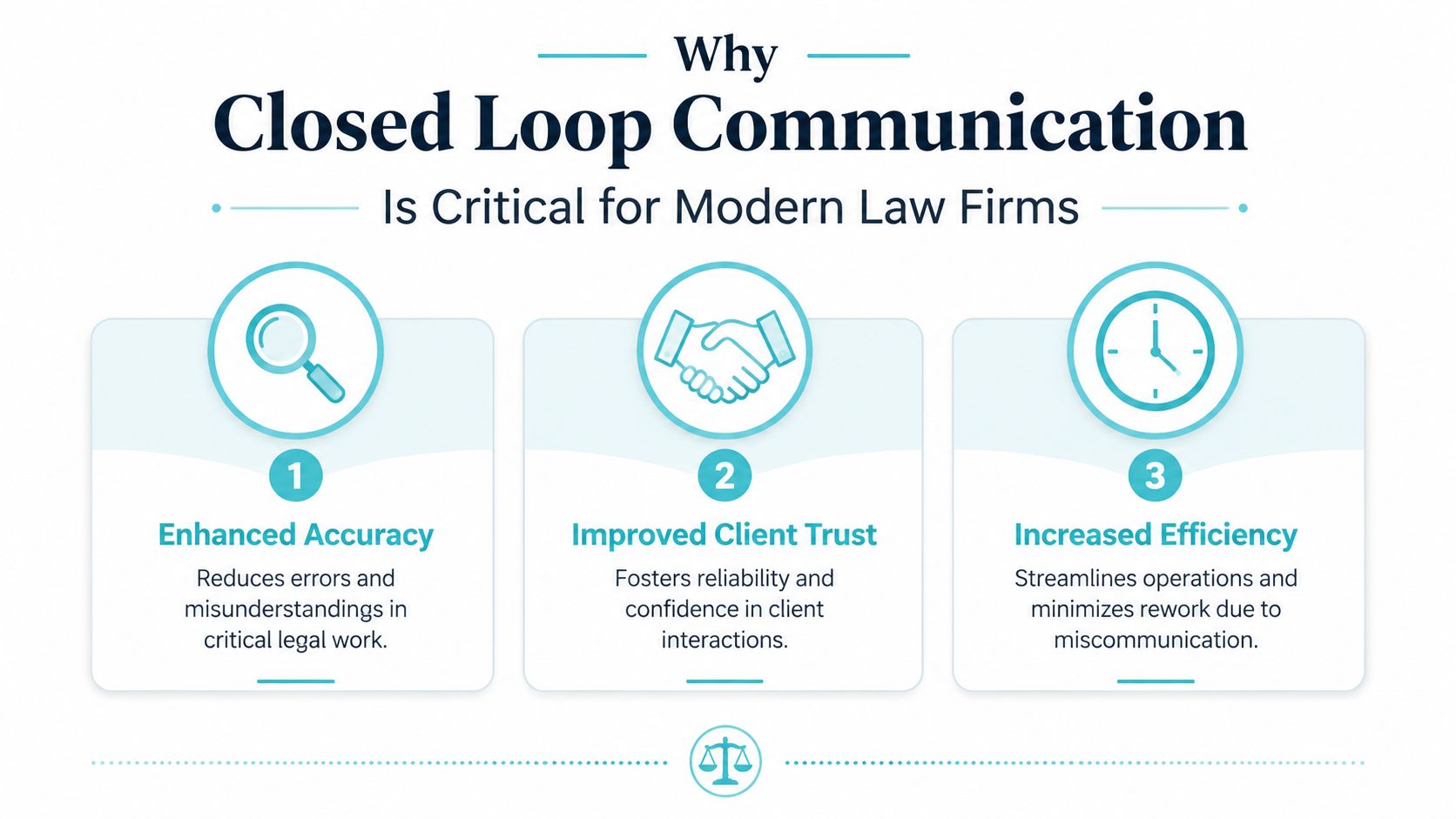
Law firms run on precision, but much of that precision depends on people sharing the same understanding of the next move. Closed-loop communication helps with accuracy, client trust, and efficiency, which is why it belongs in every client-facing workflow.
The AHA TeamSTEPPS toolkit says closed-loop communication does not require more time and is likely to save time, while also helping protect patients from communication errors that can lead to serious consequences (AHA TeamSTEPPS toolkit). That principle translates cleanly into law firm operations, because most “quick follow-ups” are really correction work.
The business case in plain English
When a client hears a step once and confirms it back, the firm gets fewer surprises. That can reduce the risk of misunderstood advice, cut down on repetitive clarification calls, and make the client feel like someone is listening.
This matters even more when a matter involves deadlines, signatures, or a sequence of tasks. A silent assumption can create stress for staff and confusion for the client, while a repeat-back turns the next action into a shared commitment.
What clients experience
Clients don't usually describe this as a protocol. They describe it as feeling informed, taken seriously, and confident that the office knows what it's doing. That's why the method isn't just about internal control, it's part of the client experience.
A useful mental model is this. If the firm wants fewer avoidable corrections later, it should spend a few seconds confirming now.
Short version: closed-loop communication turns vague handoffs into verified instructions.
For a law firm manager, that's not a soft benefit. It's a practical operating habit that protects reputation, reduces churn in the inbox, and supports a calmer front desk.
Closed Loop Communication in Action with Clients
A client doesn't need to know the term to feel the difference. They just need to hear their instruction repeated back clearly enough to know the firm got it right.

What it sounds like on the phone
An intake specialist might say, “I've got your new mailing address as 1428 Park Street and your preferred contact email as the one ending in .com. Is that correct?” The client replies, “Yes, that's right.” The specialist then confirms, “Perfect, I'll update the file now.”
That exchange sounds ordinary, but it prevents a lot of downstream cleanup. It also gives the client a chance to fix a mistake before it touches the file.
A paralegal confirming deposition logistics can sound like this. “You're scheduled for Tuesday at 10 a.m., and we're meeting at the downtown office, correct?” If the client says no, the correction happens before anyone is standing in the wrong lobby.
Where open loop creates problems
Open-loop communication skips the repeat-back. Someone says, “I'll send the document this afternoon,” and the listener assumes the message was understood without checking the details. Later, the firm learns that the client thought the document was coming to a different email address, or that the deadline was not the one they remembered.
The difference shows up in task completion too. In a simulated operating-theatre study, action completion reached 100% when closed-loop and directed communication were both used, versus 81% when neither was used. Closed-loop use alone was associated with 97% completion versus 80% without it (simulation study data).
A simple script for lawyers
- Attorney: “Please review and sign the settlement authority by 3 p.m. today.”
- Client: “You want me to review and sign the settlement authority by 3 p.m. today.”
- Attorney: “Correct.”
That's concise, respectful, and hard to misread.
For a broader communication lens, the firm can also review two-way communication principles, since the same back-and-forth discipline supports cleaner client interactions.
Implementing This System in Your Legal Practice
A law firm can explain closed-loop communication perfectly and still miss the mark if the habit is inconsistent. Emergency teams show the same pattern. In one observation of call-outs, it appeared in only 45% of 1,626 observed call-outs. That gap is a reminder that high-stakes groups do not rely on good intentions alone, they build the repeat-back into the work itself (AHRQ observation data).
Train the team on the same language
Start with shared language that everyone in the firm can use. Intake staff, paralegals, and attorneys should recognize what a clear repeat-back sounds like, what needs confirmation, and when a correction has to happen before anyone acts.
A firm does not need a script for every conversation. It does need agreement on the moments that carry risk, such as deadlines, client directions, signature requests, file status changes, and anything that could affect a case.
Use systems that preserve the confirmation
Technology can support the loop when it keeps the message, the reply, and the status change together. A client portal that includes clear client communication practices can help a firm organize two-way messaging, 24/7 case status updates, file sharing, and form completion from any device, so the confirmation does not disappear into separate inboxes and notes.
That matters because confirmation does not always happen in real time. A client may review a status update later, send a question through the portal, and confirm the next step without waiting for office hours.
Operational insight: if the confirmation lives only in someone's memory, the loop is weaker than it needs to be.
A practical rollout often starts with the interactions that create the most friction, then expands from there. The goal is to make confirmed understanding part of normal work, the same way an aviation crew confirms a clearance before takeoff or a clinical team repeats a medication order before giving it.
Building a Firm Wide Culture of Clarity
Closed-loop communication works best when it becomes part of the firm's culture, not just a script for difficult calls. A team that repeats back important instructions is a team that leaves less room for guesswork, less room for rework, and less room for client doubt.
The bigger shift is psychological. When people know their message will be repeated back, they tend to speak more clearly, listen more carefully, and correct mistakes earlier.
That's the foundation of a client-centric practice. It doesn't promise perfect communication, but it does make clarity a shared standard.
One useful way to keep the habit visible is to measure whether the firm's communication feels clearer after a change in process. If you're building that discipline, this approach to measuring communication effectiveness can help leaders think about what to observe and what to improve.
Clear communication is a competitive advantage because it reduces preventable confusion before it becomes client frustration.
For law firms, that means fewer missed details, smoother handoffs, and a more reliable client experience. It also means the team spends more time practicing law and less time repairing avoidable misunderstandings.
If you're ready to build a firmer communication habit across your intake, case updates, and client follow-ups, visit CasePulse and see how a secure client portal can support two-way confirmation, status updates, and routine follow-through for your team. It's a practical way to bring closed-loop communication into everyday legal operations without adding another inbox for staff to manage.