
 CasePulse
 Somewhere between another late night redline and another client email marked urgent, a lot of lawyers have the same thought: I worked too hard to feel this stuck.
That thought usually comes with guilt. You invested years in law school, bar prep, training, and building a reputation. Walking away from the standard path can feel reckless, or worse, like admitting something failed. In practice, that framing is wrong. What many lawyers call an exit is often a repositioning.
Alternative legal careers are not fringe roles for people who couldn't make it in practice. They are part of a broad legal labor market that has matured for years. An Indiana University law research bibliography compiled materials covering 87 different legal and legal related careers, which tells you how wide this field has become beyond the usual firm path, and it also notes that women and minority lawyers are more likely to pursue roles in public sector and other nontraditional settings than private firm jobs, according to Indiana University's alternative career paths research bibliography.
If you're burnt out, bored, boxed in, or curious, the right question isn't “what else can I do?” The better question is “where does my legal training create value without recreating the same problems I want to leave?”
Beyond the Billable Hour An Introduction
A lawyer usually doesn't wake up one morning and decide, out of nowhere, to abandon the profession. The shift is slower than that. It starts when the work you once tolerated begins to cost too much. Maybe it's the billing pressure. Maybe it's the feeling that every day is reactive. Maybe it's the realization that you're good at law firm work, but no longer interested in building your whole life around it.
That's where a lot of smart transitions begin.
Why this isn't a fallback
The phrase alternative legal careers can make these paths sound secondary. They aren't. They include durable roles across government, compliance, policy, legal research, operations, and in house legal teams. What changes is not the value of the JD. What changes is the setting where you use it.
One of the biggest mindset shifts I try to give lawyers is this: stop evaluating every option by whether it resembles firm practice. Start evaluating it by whether it rewards the skills you want to keep using.
Practical rule: Don't choose your next role by prestige alone. Choose it by the daily problems you want to solve.
A lawyer who likes structuring messy information may thrive in legal operations. A lawyer who likes interpreting rules and anticipating exposure may fit compliance or risk. A lawyer who likes writing and persuasion but not client firefighting may fit policy, legal publishing, or strategic advisory work.
What burnout often gets wrong
Burnout can push people into random job searching. That's understandable, but it usually backfires. If you search by vague categories like “non practicing lawyer jobs,” you'll get a pile of unrelated titles that tell you very little about transition difficulty, credential requirements, or day to day work.
A better approach is to treat this as a strategy problem. Your legal background already gives you assets:
- Analysis under pressure: You can sort complex facts fast.
- Client communication: You can explain risk to nonexperts.
- Issue spotting: You know how to find problems before they grow.
- Process discipline: You can work inside deadlines, rules, and competing priorities.
Those assets transfer. The actual work is matching them to a role that doesn't recreate the exact conditions that made you want out.
Mapping the Landscape of Alternative Legal Jobs
The field gets easier to understand once you stop thinking in job titles and start thinking in function. Most alternative legal careers fall into a handful of operating lanes.

Roles that improve how legal work gets done
Legal operations exists to make legal service delivery more organized, measurable, and scalable. People in these roles focus on workflows, vendor management, budgeting, reporting, and how work moves through a legal department or firm. If you've ever thought, “why are we still handling this by email and spreadsheet,” you're already thinking like a legal ops professional. For a practical view of that function inside law firms, see this overview of legal operations management.
Legal technology sits next to legal ops but is more tool and systems focused. These professionals help evaluate software, implement it, govern usage, and connect legal requirements to actual workflows. The reason these roles matter now is straightforward. A key trend in the market is the shift from purely advisory work to operational and legal tech roles that improve internal workflows, manage technology, and create accountability, making legal service delivery more scalable in overhead conscious environments, as described in Momentum Search's analysis of alternative careers for lawyers.
Roles that manage rules, exposure, and oversight
Compliance and risk are natural homes for lawyers who like structure. The mission is not just reading regulations. It is building programs, policies, training, review processes, and escalation paths that keep an organization inside the lines. This works well for lawyers who are detail oriented, comfortable with ambiguity, and strong at translating formal rules into practical guidance.
Contract management is another strong fit, especially for lawyers who enjoy the business side of legal work more than the adversarial side. These roles often involve contract intake, review coordination, playbooks, approvals, and lifecycle management. In many organizations, contract managers become the connective tissue between legal, procurement, sales, and operations.
Roles built around influence and subject matter judgment
Policy and advocacy suits lawyers who care about how rules get shaped, not just enforced. The work may include legislative analysis, research, stakeholder engagement, public comments, and issue briefs. If your favorite part of legal work was always the larger context, this lane can feel far more meaningful than standard firm practice.
Consulting and advisory roles are broader. Some are legal consulting, some are legal tech consulting, some are business facing roles that value legal training because you can assess process, risk, and communication better than someone without that background. These roles reward clarity, executive presence, and the ability to turn complex requirements into decisions.
Roles where the legal background is valuable but not central
A few categories are worth separating because they attract lawyers for different reasons:
- Legal recruiting: Strong fit for lawyers who understand talent, culture, practice groups, and candidate assessment.
- Legal education and training: Good for lawyers who enjoy mentoring, instructional design, or internal training.
- Alternative dispute resolution: Strong for people who want to stay close to disputes without staying inside litigation practice.
- Legal marketing and business development: Useful for lawyers who understand client needs and can shape messaging, relationships, and growth efforts.
The biggest mistake is treating all of these as equally accessible. They aren't. Some leverage your existing background almost immediately. Others require fresh credentials, industry experience, or both.
Comparing Top Alternative Career Paths
Once you understand the broad picture, the next question gets more practical. Which path gives you a realistic shot at transition without years of rebuilding?
Compensation varies widely. Recent career guides list 60 plus nontraditional jobs for law graduates and cite examples such as a $165,893 national average salary for general counsel and $100,237 for real estate agent, which shows how broad the pay range can be across JD advantaged work, according to Indeed's roundup of alternative jobs with a law degree.
That range matters, but salary alone won't tell you whether a path is practical. Transition cost matters just as much.
Alternative Legal Career Path Comparison
| Career Path | Typical Salary Range | Key Transferable Skills | Common Upskilling Needed |
|---|---|---|---|
| Legal Operations | Varies by employer and scope | Process design, stakeholder management, matter tracking, vendor coordination, budgeting discipline | Project management methods, reporting tools, legal department metrics, change management |
| Legal Technology | Varies by product and technical depth | Requirements gathering, issue spotting, user training, translating legal needs into workflows | Software implementation, automation logic, product fluency, systems thinking |
| Compliance and Risk | Varies by industry and regulation level | Regulatory interpretation, policy drafting, internal investigation, documentation | Industry specific knowledge, governance frameworks, sometimes certifications |
| Contract Management | Varies by company size and contract volume | Drafting, negotiation, clause analysis, playbook creation, process consistency | Contract lifecycle systems, workflow tools, operational reporting |
| Policy and Advocacy | Varies by sector and employer | Research, writing, persuasion, synthesis, stakeholder communication | Subject matter depth, legislative process knowledge, public affairs exposure |
| Legal Recruiting | Varies by compensation model | Candidate assessment, relationship building, market knowledge, communication | Recruiting tools, business development, placement economics |
| Consulting and Advisory | Varies by niche and client base | Problem solving, executive communication, judgment, client management | Industry specialization, product or platform expertise, commercial positioning |
| In house counsel | Broad range, including roles like general counsel at $165,893 on average in Indeed's cited example | Practical advice, risk balancing, cross functional communication, business judgment | Industry knowledge, internal stakeholder management, commercial fluency |
How to read the table
The easiest mistake is to focus on the far right column and get discouraged. Not all upskilling is equal.
Learning a contract lifecycle platform or getting comfortable with implementation meetings is very different from pursuing an academic route or a regulated role that may require formal credentials. In real transitions, I see lawyers do best when they choose a path where at least most of the core skill set is already in hand.
Best fits for different lawyer profiles
If you want a faster pivot, these profiles tend to align well:
- The organized operator: legal operations, contract management
- The systems thinker: legal tech, implementation, document automation
- The rules interpreter: compliance, risk, regulatory affairs
- The communicator: recruiting, training, policy, advisory work
- The business minded lawyer: in house, legal consulting, commercial roles
If a role sounds exciting but requires you to become a different person, it usually isn't the right first move. Good transitions build on identity. They don't erase it.
What doesn't work is chasing a title because it sounds modern. “Legal tech” attracts many lawyers, but some of those jobs are client facing implementation roles, some are internal operations roles, and some are quite technical. The title can be the same while the work is completely different. Read postings like a lawyer. Look for what the employer needs the person to do every week.
A Deeper Dive into Legal Tech and Operations
Legal tech and legal operations deserve special attention because they solve problems that lawyers feel every day. Delays caused by fragmented communication. Repetitive manual review. Intake bottlenecks. Reporting that lives in disconnected spreadsheets. Software that nobody owns. These are not abstract frustrations. They drain attorney time and create avoidable friction.

What the work actually looks like
Legal tech careers are no longer limited to generic business side roles. They now include specialized positions such as legal business analyst, legal engineer, and document automation specialist. These professionals translate legal requirements into technical specifications, and when they automate repeatable tasks they reduce manual review and accelerate turnaround in high volume legal work, as explained in this discussion of specialized legal tech roles.
That work can mean very different things depending on the employer:
- At a law firm: evaluating intake tools, workflow systems, document automation, client communication platforms, or reporting structures
- At a legal software company: gathering requirements from lawyers, training users, supporting implementation, refining product workflows
- Inside an in house legal department: improving matter intake, outside counsel processes, contract review flow, and reporting consistency
For lawyers exploring this direction, it helps to study how firms are reworking process and systems in practice. This overview of law firms and technology is useful because it shows where operational pain points tend to surface.
Why lawyers often fit these roles better than pure technologists
A strong legal technologist isn't just software literate. They understand why a legal workflow exists, where judgment is required, and what can be standardized without creating risk. That's where former practicing lawyers often stand out. They can map requirements in plain English and anticipate where implementation will fail if the system ignores real legal work.
If you want to move into legal ops or legal tech, project discipline matters. A practical starting point is reviewing a solid Guide to Project Management Professional certification, not because every role requires that credential, but because the framework helps you think in scope, stakeholders, process ownership, and delivery risk.
Strong legal ops people don't just buy software. They define ownership, build process around it, and make sure the tool supports the work instead of interrupting it.
This is also where some lawyers go wrong. They assume enthusiasm for AI or automation is enough. It isn't. Employers need people who can make tools usable, govern them, and tie them to actual outcomes like consistency, turnaround, and fewer manual handoffs.
How to Build Your Transition Strategy
Most lawyers don't need a dramatic reinvention. They need a disciplined transition plan. The shortest path is usually the one that respects what you've already built and closes only the gaps that matter.

Current guidance on legal career pivots points to the lowest friction moves as roles like legal recruiting, legal operations, contract management, and legal tech consulting, because they rely heavily on transferable skills. Other routes, such as licensed mediation or academia, often require additional credentials, which makes transition cost a central decision factor, as noted in Axiom's guide to alternative legal careers.
Start with a skill audit, not job boards
Open a blank document and separate your experience into four buckets:
What you know thoroughly
Practice area knowledge, industry exposure, regulatory familiarity, negotiation patterns, litigation workflowsWhat you do repeatedly
Managing deadlines, drafting, reviewing, coordinating people, presenting advice, organizing documents, handling intakeWhat you do better than peers
Client communication, triage, policy writing, process design, training, issue spottingWhat you never want to do again
This matters. It keeps you from making an expensive lateral move into the same kind of misery
If you need help translating legal tasks into broader career language, this resource on key skills for career change is a useful prompt.
Target one lane and build proof
Lawyers lose momentum when they pursue six directions at once. Pick one lane first. Not forever. Just first.
Then build lightweight evidence that you belong there:
- For legal ops: document a workflow you improved, even informally
- For legal tech: learn a platform category and explain how you'd map legal requirements into system logic
- For compliance: write about a regulatory issue in practical business terms
- For recruiting or advisory roles: sharpen your positioning around market knowledge and communication
A hiring manager doesn't need your whole life story. They need a credible reason to believe you can solve their kind of problem.
Rewrite your materials for the new audience
A resume for a law firm partner and a resume for a legal operations director should not read the same way.
Shift from tasks to outcomes and from legal jargon to business language. “Managed discovery” may matter less than “coordinated a multistakeholder review workflow under tight deadlines.” “Advised clients on risk” may be stronger as “translated complex regulatory issues into practical decision guidance.”
Your LinkedIn profile needs the same treatment. The headline should point toward the role you want, not just the role you had.
Use conversations strategically
Informational interviews work when they're focused. Don't ask strangers to map your life. Ask for pattern recognition.
Useful questions include:
- What backgrounds tend to transition well into your team?
- What skills are hard to teach once someone is hired?
- What do applicants misunderstand about this role?
- If you were making this move from law today, what would you do first?
That approach gives you better data than another hour of doom scrolling job listings.
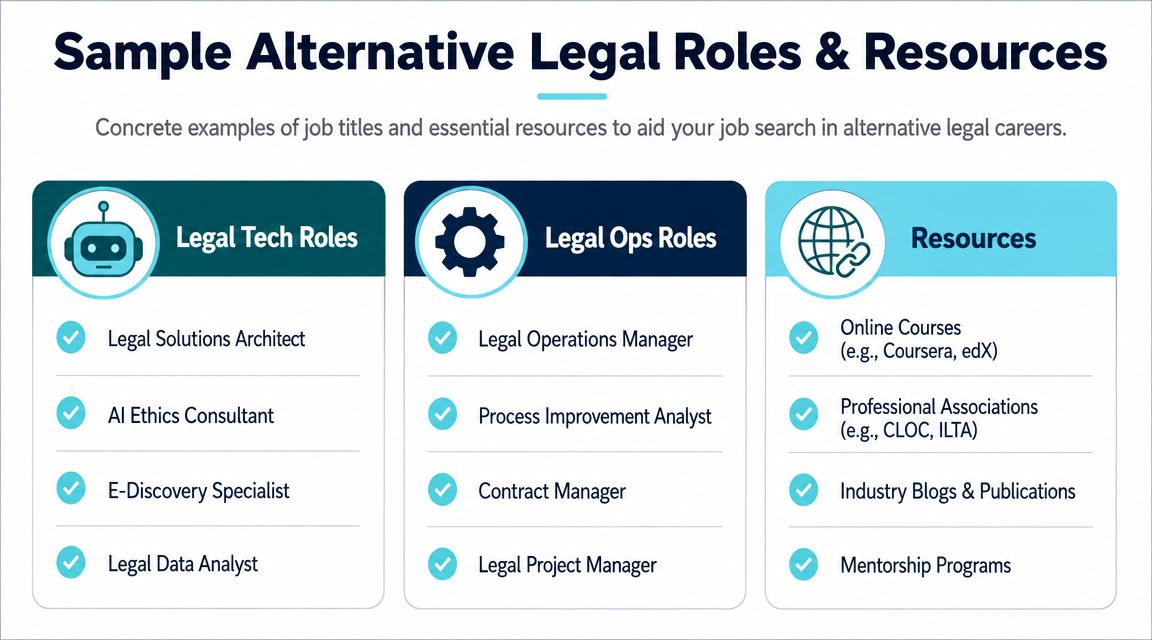
Finding Your First Role Sample Job Titles and Resources
At some point, reflection has to turn into search terms. Most lawyers stay too abstract for too long. They search “alternative legal careers” when they should be searching actual titles.
Searchable job titles worth using
Try these titles as direct searches on LinkedIn, niche boards, and company career pages.
Legal operations and process roles
- Legal Operations Manager
- Legal Project Manager
- Process Improvement Analyst
- Contract Manager
- Matter Management Analyst
Legal tech and implementation roles
- Legal Business Analyst
- Legal Engineer
- Document Automation Specialist
- Legal Technologist
- E Discovery Specialist
- Solutions Consultant at a legal software company
Compliance, policy, and advisory roles
- Regulatory Affairs Specialist
- Compliance Manager
- Risk Manager
- Policy Analyst
- Government Relations Manager
- Ethics Director
People and communication adjacent roles
- Legal Recruiter
- Professional Development Manager
- Legal Trainer
- Knowledge Management Attorney
- Legal Content Writer
If you're open to distributed work, add remote filters and search specialized listings. A practical place to start is this board to find remote jobs, then narrow by legal, operations, compliance, or project management keywords.
Resources that are actually useful
You don't need fifty websites. You need a small set of channels you can return to consistently.
- Professional associations: CLOC for legal operations, ILTA for legal technology, and relevant compliance associations in your industry of interest
- Company pages: legal software vendors, alternative legal service providers, and regulated companies with larger in house teams
- Targeted content: newsletters, webinars, and product blogs tied to the kind of work you want to enter
- Adjacent role research: if you're interested in front end law firm workflow, reading about roles like an intake specialist helps you understand how operations, client experience, and process design intersect
A simple way to keep momentum
Create a spreadsheet with five columns: title, company, why it fits, missing skill, next action.
Then force specificity. “Interesting” is not a reason. “Uses my drafting and process skills with less adversarial work” is a reason. “Need familiarity with workflow software” is a useful gap. “Watch product demo and book one informational chat” is a real next action.
Search behavior reveals commitment. Once you stop browsing categories and start tracking real titles, the transition becomes concrete.
Redefining Success in Your Legal Career
A legal career does not have to be narrow to be serious. It does not have to look conventional to be successful. And it does not have to stay on the original track just because you invested heavily in getting started.
Your legal training still matters. The discipline, analysis, judgment, writing, and communication skills are portable. What changes is where you apply them and what kind of life they support. For some lawyers, success still means partnership or general counsel. For others, it means legal operations, compliance, policy, consulting, or a role that gives them room to think clearly again.
The point isn't to reject the profession. It's to stop assuming there is only one respectable way to use what you know.
If you're considering alternative legal careers, don't wait for perfect certainty. You probably won't get it. Get clearer instead. Choose a lane. Test it. Build evidence. Talk to people already doing the work. Then make the move that fits the person you are now, not the version of you who started law school.
If your firm is already thinking more seriously about legal operations, client communication, and reducing manual admin load, CasePulse is worth a look. It gives law firms a secure client portal that works with systems like Needles, Neos, LawBase, and Litify, so clients can check status, message the team, share files, and complete forms without staff leaving their existing workflow. For firms trying to modernize service without adding another disconnected inbox, that's a practical operational upgrade.