
 CasePulse
 Most advice on an attorney marketing plan starts too late.
It starts with channels, ad platforms, keyword lists, and content calendars. That is backwards for a plaintiff PI firm. If the plan does not begin with budget discipline, intake clarity, client expectations, and a view of how your staff handles communication after a lead comes in, the rest becomes expensive activity.
A managing partner does not need more marketing noise. You need a system that brings in the right cases, helps your team respond well, and creates an experience clients will talk about after intake. That last part matters more than most firms admit. Good marketing can win the click. Client experience decides whether that click becomes a signed case, a good review, or a referral six months later.
A strong attorney marketing plan should do three things at the same time. It should create visibility, produce measurable case intake, and reduce friction for clients and staff. If your plan only handles the first one, it is incomplete.
Laying the Foundation for a Winning Attorney Marketing Plan
Too many firms build their plan around internal frustrations.
They say they need more cases, fewer bad leads, better follow up, or stronger partner participation. Those are real issues, but they are not a strategy. They are symptoms. A useful attorney marketing plan starts with market position and client behavior, not with your internal wish list.
That distinction matters because law firm plans often fail for predictable reasons. One of the biggest is choosing an efficiency mindset over an effectiveness mindset, and another is focusing on internal problems instead of external market opportunities. The same analysis notes that 54% of U.S. law firms lack an annual marketing budget entirely, and only 63% of medium sized firms report dedicated budgets according to Legal Evolution’s analysis of common strategic planning failures.

A PI firm cannot afford that kind of drift. The market is too competitive, and delay costs too much.
Start with effectiveness, not busyness
An effective plan answers a few hard questions first.
Which cases do you want more of
Not “personal injury” in general. Be specific. Motor vehicle collisions, premises liability, trucking, wrongful death, or another segment.Which geography matters most
If your intake team serves three counties well and struggles outside them, your plan should reflect that.What makes your firm easier to trust
Faster response, better communication, stronger courtroom reputation, bilingual intake, better case updates, or easier document handling.Where does the current process break
Leads sitting too long, unclear handoff from marketing to intake, weak follow up, poor expectations after sign up.
A lot of firms skip this work because it feels slower than launching campaigns. It is slower. It also generates the return.
A plan is not serious until a managing partner can say what case types deserve more budget, what case types do not, and what client experience the firm wants to be known for.
Set goals that can survive partner scrutiny
Vague goals create vague spending.
“Grow the firm” is not a usable target. “Improve visibility” is not much better. Your goals need a number, a time frame, an owner, and a source of truth inside your intake or case management process.
For a PI firm, that usually means goals built around signed cases, qualified consultations, response times, review generation, and channel specific conversion quality.
A practical way to frame goals:
Revenue aligned goal
Increase signed matters in the case types you want.Pipeline goal
Improve the volume and quality of consultations from qualified channels.Operations goal
Reduce avoidable client check in calls and intake bottlenecks.Experience goal
Increase the consistency of client communication after sign up.
These goals shape every later decision, including brand language, SEO priorities, PPC spend, intake workflow, and technology choices.
Build client personas that reflect PI reality
Most law firm personas are too shallow to help.
Age range, income band, and city are not enough. A PI client often arrives stressed, hurt, confused about the process, and suspicious of vague promises. They are not comparing firms the way a business buyer compares software vendors. They want signs of competence, clarity, and responsiveness.
Your persona should answer questions like these:
- What happened right before they searched for counsel
- What questions do they ask in the first hour, not just the first week
- What makes them hesitate before calling
- What language sounds reassuring versus evasive
- What do they need after intake to feel informed
Positioning begins there.
If your ideal client wants constant reassurance, your marketing should not promise “aggressive representation” and then hand them a silent process once they sign. If your firm is strongest with serious injury cases that require patience and documentation, your messaging and intake should prepare clients for that reality.
Your brand is not your logo
Branding in a PI practice is the gap between what you say and what clients experience.
That includes your website, intake scripts, consultation follow up, forms, review requests, and the way updates are delivered after engagement. If you want a useful refresher on positioning and execution, these proven law firm marketing strategies are worth reviewing alongside your internal planning work.
Firms that want tighter alignment between brand and client experience should also think beyond surface design and look at how communication reinforces trust at every step. In these situations, resources on law firm branding become more practical than another mood board exercise.
Choosing Your Digital Battlegrounds for Client Acquisition
A PI firm does not need to be everywhere.
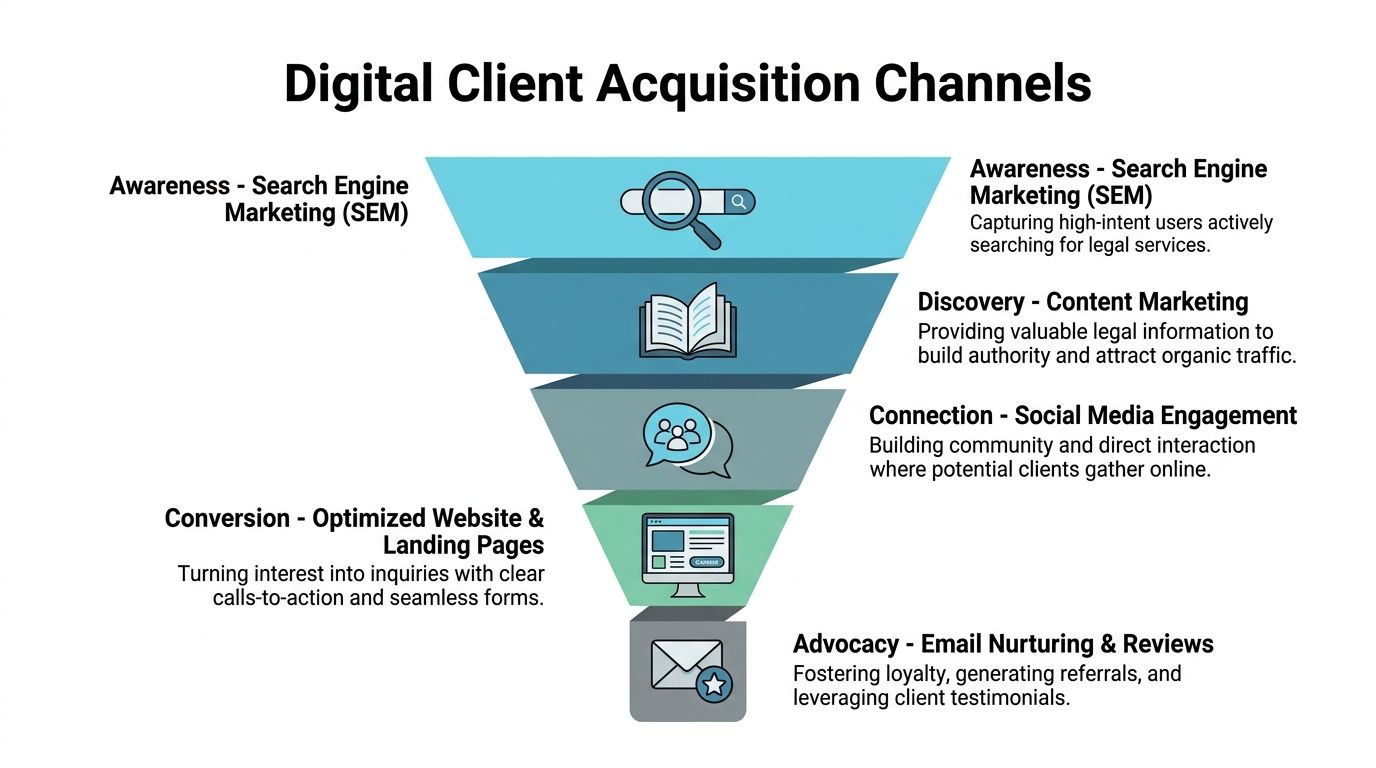
It needs to win in the places where injured people look for help, compare options, and decide whether to reach out. That usually means search first, then content that supports search, then conversion assets that turn urgency into contact.
The data on search behavior is clear. In 2025, 96% of potential clients seeking legal services begin their search with a search engine, organic search drives 52.6% of website traffic in competitive areas like personal injury, and high growth firms reaching 41.7% revenue growth rely heavily on SEO according to attorney marketing statistics compiled here.
That does not mean every dollar should go to SEO. It means search visibility is the base layer. Everything else works better when that foundation is in place.
SEO is the durable asset
For PI firms, SEO does two jobs.
First, it captures active demand from people already looking for legal help. Second, it compounds. A strong practice area page, local page, FAQ, or intake focused article can keep producing consultations long after it is published, assuming the page is technically sound and helpful.
What works:
Focused practice area pages
One page per meaningful case type, written for actual client questions.Local relevance
City and regional intent matter. A page should reflect where you serve clients and what local searchers need to know.Strong intake paths
Every SEO page should make next steps obvious. Phone, form, and consultation request should be easy to find.Useful supporting content
Content should answer pre hire questions and reduce uncertainty, not just repeat slogans.
What does not work:
- Thin city pages copied across markets
- Generic blog posts with no intake purpose
- A beautiful site that buries contact options
- Publishing without tracking signed case quality
If your PI firm relies on search, local visibility matters. That is one reason many firms invest in a more specialized approach to SEO for personal injury lawyer campaigns rather than generic legal SEO packages.
PPC buys speed, but mistakes get expensive fast
Paid search can fill the pipeline quickly. It can also burn budget quickly.
Legal services carry the highest paid search costs in 2025, with an average CPC of $8.58 and average CPL of $131.63 in the U.S. Personal injury also shows an average CTR of 4.56% and conversion rate of 5.45% in the benchmark data summarized by this 2025 legal advertising report.
Those numbers should shape expectations. PPC is not a set it and forget it channel.
Here is the trade off in plain terms:
| Channel choice | Strength | Risk | Best use |
|---|---|---|---|
| SEO | Builds long term visibility | Slower ramp | Durable case intake |
| PPC | Immediate traffic | High cost and waste if unmanaged | Fast testing and urgent lead flow |
| Content | Supports trust and rankings | Weak if disconnected from search intent | Education and conversion support |
A lot of PI firms lose money in paid search for simple reasons. They send all traffic to the homepage. They target broad terms. They do not screen leads well. Or they judge the campaign only by call volume instead of signed case quality.
If PPC is generating consultations but intake is rejecting most of them, the ad campaign may not be the only problem. The keyword set, landing page promise, and intake script may all be out of alignment.
Content is not filler. It is pre intake trust
Many firms treat content like a publishing chore.
That is a mistake. In a PI practice, content should answer the exact questions that stop a person from calling. What happens if the insurance company already called me? Do I need a lawyer after a rear end collision? How long will this take? What should I bring to the first conversation?
Good content does not just attract traffic. It pre qualifies and calms.
Use content in three layers:
Decision content
Practice area pages, service pages, local pages, consultation pages.Trust content
Attorney bios, process explanations, FAQs, case handling philosophy, review pages.Support content
Articles or videos that answer practical questions tied to intake friction.
A related point that often gets missed is form design. If a page finally persuades someone to act, the form should not create a new obstacle. Firms reviewing intake UX can borrow ideas from these high-converting lead capture forms, especially around simplicity, field count, and call to action clarity.
What to prioritize first
If your budget is limited, do not split it across every platform because it feels modern.
A better sequence looks like this:
- Fix the website path to contact
- Build or repair local and practice area SEO
- Launch paid search only where intake can support it
- Publish content that supports both search and consultation conversion
- Use social selectively, mainly to support credibility and visibility
That order is less exciting than chasing every channel. It is also how firms avoid spending money on activity that never turns into signed cases.
Structuring Your Marketing Budget and Timeline
A budget reveals whether your attorney marketing plan is real.
If there is no committed spend, no owner, and no timeline, partners will treat marketing as optional right up until they want more cases. That cycle creates stop start execution, which is one of the main reasons firms never build momentum.
The first rule is simple. Budget by objective, not by vendor.
Do not begin with “how much should we spend on SEO” or “what does a PPC agency charge.” Start with the outcomes you need, the workload required to support those outcomes, and the operational readiness of intake and case handling. A PI firm that cannot respond well should not scale ad spend just because lead volume sounds attractive.
Build the budget in phases
Most firms do better with a phased plan than with a flat annual spend.
In the first phase, invest in the assets that improve every later channel. That usually means website improvements, intake flow cleanup, analytics setup, core practice area pages, local search work, and a modest content schedule. Paid campaigns come after those basics are strong enough to convert.
In the second phase, you can add or expand paid search, increase content production, strengthen review generation, and refine landing pages. The timing depends on staffing, intake consistency, and whether your case mix supports more demand.
The best marketing budget is not the one that looks aggressive in a partner meeting. It is the one your team can execute without dropping leads or frustrating new clients.
Sample 12-Month PI Firm Marketing Budget Allocation ($250,000 Annual)
| Category | Q1-Q2 (Months 1-6) | Q3-Q4 (Months 7-12) | Notes |
|---|---|---|---|
| Website and conversion improvements | Higher initial allocation | Lower maintenance allocation | Early investment improves all channels |
| SEO and local search | Strong ongoing allocation | Strong ongoing allocation | Core long term visibility work |
| Content production | Moderate allocation | Increased allocation | Expand once core pages are live |
| PPC and landing pages | Controlled test budget | Scaled budget if lead quality holds | Do not scale before intake validates quality |
| Analytics and intake tracking | Front loaded setup | Ongoing reporting and refinement | Needed for ROI decisions |
| Reviews and client communication support | Moderate allocation | Moderate allocation | Protects reputation and referral flow |
| Contingency and testing | Reserved budget | Reserved budget | Keeps room for adaptation |
That structure matters more than a rigid formula. A mature PI firm with strong intake may shift more into paid search. A firm with weak local presence may keep more in SEO and website work longer. A firm rolling out new client communication systems may need extra time before adding aggressive acquisition spend.
Put the timeline on the calendar, not in a slide deck
A real marketing timeline should show who is responsible each month.
That includes not just agencies or vendors, but managing partners, intake leads, paralegals, and whoever owns reporting. If nobody owns the handoffs, your timeline is decorative.
A practical annual rhythm often looks like this:
Months 1 through 3
Audit current performance, fix website friction, define goals, confirm intake scripts, clean tracking, refresh local visibility.Months 4 through 6
Publish core pages, improve consultation paths, launch or tighten paid campaigns, review lead quality by source.Months 7 through 9
Scale what is producing qualified consultations, cut what is not, improve review requests and follow up communication.Months 10 through 12
Reallocate budget based on signed case data, not vanity metrics. Set next year’s budget before momentum drops.
Keep some budget flexible
Every PI market changes.
Competitors increase spend. Intake staffing changes. One campaign underperforms while another effectively brings in better cases. A rigid budget prevents adaptation. A flexible budget lets you move funds toward proven opportunities and away from channels that are just generating noise.
That is how managing partners should read a marketing plan. Not as a promise that every tactic will work, but as a disciplined framework for testing, measuring, and reallocating.
Measuring Performance with the Right KPIs
Most firms track too much of the wrong stuff.
Traffic goes up. Clicks go up. Calls go up. None of that matters if signed cases do not improve, or if the firm keeps attracting leads that intake rejects. A strong attorney marketing plan needs KPIs that connect activity to revenue and to client experience.
The basic rule is straightforward. Track each channel separately, but judge them by business outcomes.
According to LegalSoft’s guidance on KPI tracking for law firm marketing, law firm marketing works best when firms use SMART goals, track channels separately, and rely on client intake software to identify referral sources and lead origins. That same source notes that digital marketing channels deliver an average ROI of 122%, but only when proper tracking infrastructure exists.
Start with business KPIs, then work backward
A managing partner should see performance in a short list first.
That list usually includes:
- Qualified consultations
- Signed cases
- Cost per signed case
- Lead to consultation rate
- Consultation to signed case rate
- Time to first response
- Client source by case value or case type
Those are decision metrics. They tell you where to spend more, where to cut, and where operations are blocking growth.
Then you add channel KPIs underneath them.
For SEO, that may include rankings for important practice terms, organic conversions, local visibility, and page level form submissions.
For PPC, look at click through rate, cost per lead, landing page conversion, and whether the leads survive intake screening.
For content, track whether specific pages generate consultation requests, assist conversions, or help intake staff answer recurring questions.
Use intake software as your source of truth
Many firms break the chain at this point.
Marketing reports live in one system. Intake notes live somewhere else. Signed case data lives in Needles, Litify, Neos, or another case management system. Nobody reconciles them. Then partners debate performance based on anecdotes.
That is avoidable.
Your intake and case systems should capture, at minimum:
| KPI area | What to record | Why it matters |
|---|---|---|
| Lead source | Search, paid ad, referral, review site, direct | Shows where inquiries begin |
| Campaign detail | Page, keyword theme, ad group, form path | Helps identify specific winners and losers |
| Intake result | Qualified, unqualified, pending, conflict, no show | Stops false optimism from raw lead counts |
| Matter outcome | Signed or not signed | Ties marketing to actual results |
| Client communication issues | Delays, repeated status requests, missing documents | Reveals operational friction affecting reviews and referrals |
If your firm uses Needles or Litify but the marketing team still relies on spreadsheets and disconnected call logs, fix that before expanding spend. The reporting problem will only get worse at scale.
A KPI dashboard should let a partner answer one question in under five minutes. Which channels produced signed cases we want, and what did those cases cost to acquire?
Watch for vanity metric traps
Some numbers look good in meetings and still lead nowhere.
Examples include:
- Traffic growth without consultation growth
- Cheap leads with low qualification
- High call volume driven by poor messaging
- Social engagement that never reaches intake
- Ranking wins for keywords that do not convert
That does not mean those signals are useless. It means they are secondary.
A practical review rhythm helps. Weekly checks for intake responsiveness and campaign anomalies. Monthly reviews for channel performance. Quarterly reviews for budget reallocation based on signed cases and case quality.
When firms do this well, the conversations change. Instead of asking whether marketing “feels busy,” partners start asking whether one channel is outperforming another for the exact case types the firm wants.
Turning Client Service into a Marketing Engine with a Portal
The piece most attorney marketing plans ignore.
They stop at lead generation. They treat the signed client as the end of marketing and the start of operations. In a PI firm, that split causes problems. The client does not experience your firm in separate departments. They experience one relationship. If communication is poor after intake, it hurts reviews, referrals, staff workload, and the credibility of every promise you made before sign up.
That is why client service belongs inside the attorney marketing plan.
The gap is well documented. Existing attorney marketing content focuses heavily on acquisition while neglecting retention and engagement. Clio data cited in this industry analysis reports that 68% of PI firms lose potential revenue from poor follow up, and firms using integrated client portals see 25% higher retention and 40% referral boosts, yet less than 15% of mid sized firms include this technology in their plans according to this discussion of legal marketing plan gaps.

Marketing Value of a Client Portal
A secure portal is often discussed like a back office convenience.
For PI firms, it is much more than that. If it integrates with systems such as Needles, Neos, LawBase, or Litify, it can improve how clients experience the firm from intake forward. That matters because clients judge your reliability by how easy it is to get updates, send documents, complete forms, and feel informed.
The marketing benefits are practical, not theoretical.
Clients get 24/7 access to status information
That reduces uncertainty and cuts down on routine calls asking what is happening.Secure messaging creates a cleaner communication path
Clients know where to ask questions, and staff avoid juggling scattered follow ups.Document sharing and fillable forms reduce friction
The easier it is for clients to send what you need, the smoother intake and case progression become.Branded communication reinforces trust
Every interaction supports the firm’s identity instead of pushing clients into disconnected tools.
The key point is that better communication changes outcomes that marketing teams care about. Happier clients leave stronger reviews. Informed clients are more likely to refer friends and family. Staff spend less time answering repetitive status questions and more time moving cases forward.
Where firms get this wrong
A lot of firms buy technology and never make it part of the client journey.
They mention it once in onboarding, bury access instructions in an email, and then keep handling updates the old way. That turns a useful system into shelfware.
A portal only becomes a marketing asset when the firm builds it into the process.
How to make the portal part of the plan
Tie it to intake from day one
Introduce the portal as part of how your firm works, not as an optional extra.
During intake, explain that clients can check updates, message the team, share files, and complete forms via the portal. That sets expectations early. It also signals organization, which matters in PI where clients often feel they have lost control of everything else.
Use it to reduce avoidable communication failure
The worst communication problems are predictable.
Clients wonder whether the case is moving. They are unsure whether documents were received. They do not know who to contact. Those problems are often what drive negative reviews, repeated calls, and frustration that spreads through the case team.
A good portal workflow addresses those moments directly. Not by making communication robotic, but by making routine communication dependable.
When a client can see progress, send a message securely, and complete forms from one place, your team stops spending the day repeating the same update twenty times.
Build review requests around milestones
Many firms ask for reviews at random.
A better approach is to ask when the client has recently felt informed, supported, or relieved. That might be after a key update, successful intake completion, or another positive milestone. A client who just had a smooth experience is far more likely to describe that experience publicly.
Such communication systems support reputation management. Review generation should not feel detached from service. It should be a natural extension of a process that already feels organized.
Support referrals without sounding transactional
Referrals come from confidence.
If clients feel ignored, they will not recommend you, even if the result is good. If they feel guided and informed, they are much more likely to tell others about the firm. That is why portal driven communication belongs inside the growth plan. It turns service quality into a repeatable source of word of mouth.
Give staff a cleaner workflow
Managing partners sometimes view client communication tools as a client facing issue only. They are also an internal efficiency issue.
When staff can work within existing systems and avoid managing another inbox, response quality tends to improve because the workflow is simpler. That matters in firms using Needles or Litify where the cost of fragmented communication shows up in delays, duplicated work, and dropped follow ups.
The attorney marketing plan most firms still do not have
A mature PI plan should include acquisition, conversion, and post intake experience.
That means your annual planning should ask questions like these:
| Plan area | Standard approach | Better approach |
|---|---|---|
| Lead generation | Focus on SEO, PPC, and content | Keep those, but connect them to intake quality |
| Conversion | Measure forms and calls | Also track signed cases and client fit |
| Client experience | Treated as operations | Treated as a driver of reviews and referrals |
| Communication | Manual and scattered | Structured through secure, branded workflows |
| Retention and advocacy | Passive | Intentionally supported throughout the case |
Many PI firms can separate themselves here without chasing every new marketing trend. A cleaner client experience is harder for competitors to copy than an ad campaign, and it compounds through reviews, referrals, and staff efficiency.
If your firm is evaluating how portals fit into that process, it helps to review what modern client portals for law firms are expected to support inside a legal workflow, especially for practices managing high communication volume.
The strongest attorney marketing plan does not end at the signed retainer. It keeps working throughout the case, because that is where trust is either reinforced or lost.
CasePulse helps plaintiff firms turn client communication into a measurable advantage. Its secure client portal integrates with systems like Needles, Neos, LawBase, and Litify so clients can check case status, send messages, share files, and complete forms without pulling staff into another inbox. If you want a cleaner way to reduce routine calls, improve client satisfaction, and support a stronger referral and review engine, see CasePulse.