
 CasePulse
 Your phone rings. A spouse wants to hire you for someone who was arrested overnight. An anxious parent sends a voicemail with half the story. A potential client emails a PDF with missing pages, no court date, and a long narrative that probably shouldn't have been written down in the first place.
That's a normal morning in criminal defense.
A criminal law client intake form sits right in the middle of that chaos. If it's poorly designed, your staff chases basic facts, attorneys review messy and risky submissions, and urgent cases wait too long for attention. If it's designed well, the form becomes a controlled first step. It captures usable information, reduces avoidable risk, and gives your team a cleaner path to screen, prioritize, and respond.
Why Your Intake Form Is More Than Just Paperwork
Most firms start with intake as an administrative task. Name, phone number, charges, maybe a box for “tell us what happened.” That approach breaks down fast in criminal matters because timing, accuracy, and discretion matter from the first contact.
A better view is simple. Intake is your first operational filter.

Intake captures business value
Firms sometimes treat forms like a replacement for a receptionist's notepad. That understates what a digital process can do. MyCase reported that its customers captured 58,395 leads from customized lead intake forms embedded in their workflows in its 2024 Legal Industry Report, which is a useful reminder that intake can function as a measurable lead channel, not just a contact sheet.
That matters in criminal defense because many inquiries arrive after hours, during weekends, or in moments of panic. If your intake path only works when a staff member answers the phone live, you're relying on luck.
Intake also protects the firm
The business side is only half the story. Criminal intake has always been tied to early fact gathering. Public criminal questionnaires commonly ask for charges, court information, prior history, and related personal details because firms need enough context to decide whether the matter fits, whether it's urgent, and what immediate issues might affect representation.
Practical rule: A good intake form doesn't collect the most information. It collects the minimum information needed to decide the next safe step.
That's the shift many firms need to make. Stop treating the form as a document to “complete.” Start treating it as a controlled entry point into your screening process.
What works and what fails
What works is a form built around decisions your team needs to make in the first few minutes or hours:
- Can we reach the person quickly
- Is someone in custody
- Is there an upcoming hearing or arraignment
- Does the matter fit our practice and geography
- Do we need an immediate conflict check
- Should a lawyer, not intake staff, handle the next conversation
What fails is the opposite:
- Narrative overload: Long free text responses create review burden and risk.
- No urgency cues: If custody status and next court event are buried, staff can miss priority matters.
- One-size-fits-all forms: DUI, domestic violence, and felony matters don't always need the same first questions.
- Paper-first habits: Email attachments, scans, and handwritten PDFs produce delays and incomplete records.
A criminal law client intake form should make your front office calmer, not busier. Done right, it becomes a risk tool, a screening tool, and a workflow tool at the same time.
Designing Your Core Intake Questions
The fastest way to ruin intake is to ask everything at once. The second fastest is to ask so little that your team still has to start from scratch on the phone.
The right approach is to group questions by decision value. Every field should earn its place.
Start with identity and contact basics
These fields seem obvious, but firms still lose time because they collect them inconsistently. In criminal matters, “client” may mean the accused person, a parent, a spouse, or another family member trying to help. Your form should make that distinction clear.
Ask for:
| Category | Field Name | Purpose & Notes |
|---|---|---|
| Contact | Full legal name | Needed for identification, records review, and later conflict screening |
| Contact | Best phone number | Critical for urgent follow-up, especially after hours |
| Contact | Email address | Useful for written confirmation and form completion |
| Contact | Preferred contact method | Helps staff respond in the way the person is most likely to answer |
| Contact | Are you the accused person | Separates direct client contact from third-party inquiry |
| Contact | Name of person completing form | Important when a family member or friend submits intake |
Those fields reduce confusion before legal analysis even begins.
Capture the case facts that drive triage
Your intake form should next gather a narrow set of case facts that determine urgency and fit. Public criminal intake materials reflect this broad screening role. The State Bar of Michigan's criminal questionnaire asks for detailed data points including charges filed, court information, citizenship status, and prior convictions, which shows how intake has become a practical tool for assessing both case merit and collateral risks.
You do not need to copy a long questionnaire to use the same logic.
Core case questions usually include:
- Charges or alleged offense: Use a short field or selectable list where possible.
- Court and county: This tells you whether the matter falls within your geographic footprint.
- Next court date or appointment date: This helps staff spot matters that can't wait.
- Custody or bail status: A person in jail needs a different response path than someone seeking advice before arraignment.
- Date and location of arrest or incident: Enough context for internal routing and preparation.
- Law enforcement agency involved: Often useful for early orientation.
For many firms, that's enough for stage one.
The form should answer, “What is this matter, where is it, and how quickly do we need to act?”
Ask screening questions that actually change decisions
Some fields are not about the immediate charge. They're about what else could affect representation. That's where intake becomes a genuine screening instrument.
Consider questions like these:
- Prior convictions or pending matters: Useful for issue spotting and case fit.
- Citizenship or immigration status: Important because criminal charges can carry collateral consequences.
- Existing lawyer or prior consultation with another lawyer on the same matter: Helps identify practical and ethical issues.
- Known witnesses or co-defendants: Potentially relevant for screening and later conflict review.
- How did you hear about the firm: Operationally useful, though not legally essential.
Keep narrative fields on a short leash
The common mistake is a giant text box labeled “Explain everything that happened.” That invites speculation, emotional venting, and admissions that your team may not need at intake.
A better design is structured prompts with limits:
- Brief description of the matter
- What happened next
- What is your most urgent question
That gives enough context without turning intake into a written statement.
Build for use, not appearance
The strongest criminal law client intake form is not the prettiest PDF. It's the one your staff can review quickly, your attorneys can trust, and your prospective clients can finish under stress. If a field doesn't support triage, conflict review, or the next conversation, it probably doesn't belong in stage one.
Crafting Critical Consent and Confidentiality Language
Criminal intake is where firms often create risk by trying to be thorough. A public form asks about prior record, mental health history, or “what happened,” and the person fills it in because they assume more detail will help. Sometimes it does. Sometimes it creates a record you would rather not have collected that early.
That's why your consent and confidentiality language matters as much as your questions.
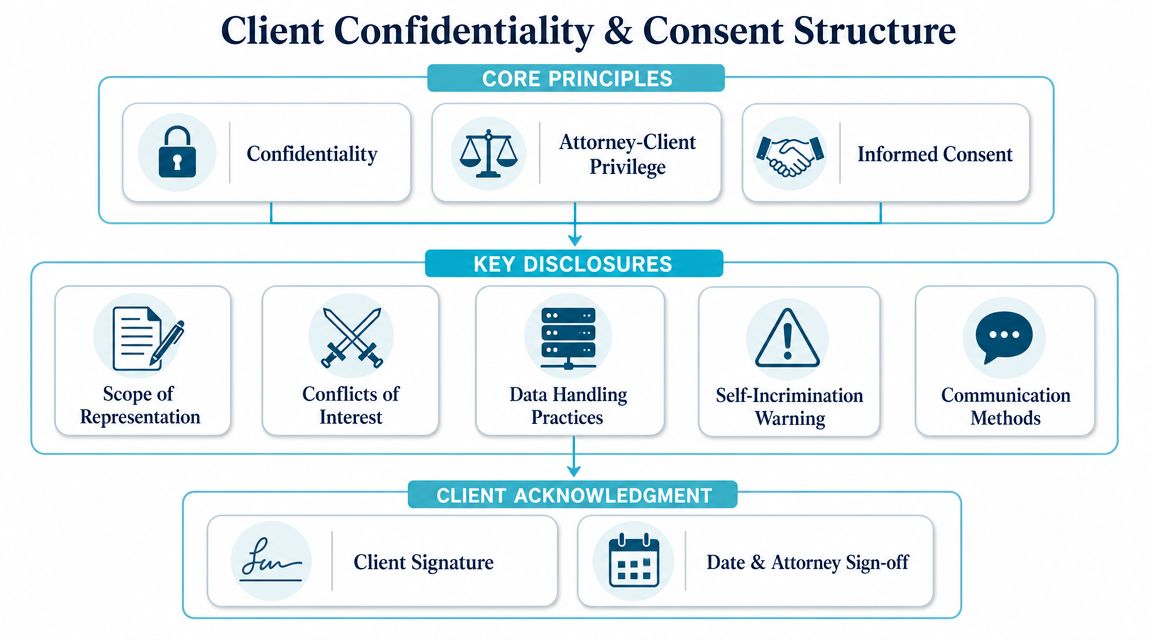
Say what the form is and what it isn't
Too many forms are silent on status. The user assumes they already “have a lawyer” because they submitted information. The firm assumes no engagement exists yet. That gap creates avoidable confusion.
Your intake language should clearly address a few basics in plain English:
- Submitting the form doesn't by itself create an attorney-client relationship
- The firm must complete its review before agreeing to representation
- The person shouldn't send unnecessary sensitive facts through the initial form
- Urgent deadlines or custody issues should be flagged immediately through the firm's stated contact method
This language doesn't need to sound defensive. It needs to be understandable.
Warn against over-disclosure
One of the biggest blind spots in criminal intake design is the risk of unnecessary self-incrimination. Public criminal intake samples often ask for highly sensitive details but rarely explain how to minimize unnecessary disclosure or warn clients that responses may become discoverable in some contexts. That's a design problem, not just a legal one.
A safer form usually does three things.
First, it separates administrative intake from substantive legal discussion.
Second, it narrows open text fields so the person gives a short summary rather than a full confession or chronology.
Third, it tells the user what not to include at the first stage.
Don't invite a witness statement when what you need is a callback number, custody status, and court information.
Use staged collection
The best criminal intake processes are usually staged.
Stage one gathers contact details, basic case information, urgency flags, and enough information for internal screening.
Stage two happens after the firm decides to proceed to consultation or representation. That's where more sensitive facts can be discussed in a controlled setting, ideally with attorney review and a clearer privilege framework.
This approach solves two common problems at once. It lowers the amount of sensitive data sitting in an intake queue, and it improves completion because people are more likely to finish a shorter form.
Include data handling language people can understand
If your form collects personal information, your notice should explain the practical points users care about:
- Who reviews submissions
- How the firm uses the information
- Whether the information is stored in firm systems
- How the firm will contact the person afterward
Keep the wording direct. Avoid burying the meaningful warning inside dense legal boilerplate.
A criminal law client intake form should not pressure a stressed person into giving the firm their entire life story before a lawyer has even reviewed the matter. Good consent language slows that down in the right way.
Implementing Risk Triage and Screening Logic
A form by itself doesn't fix intake. Its true value appears when responses trigger action. Criminal matters arrive with uneven urgency, uneven fit, and uneven risk. Your team needs a triage model that turns raw submissions into clear next steps.
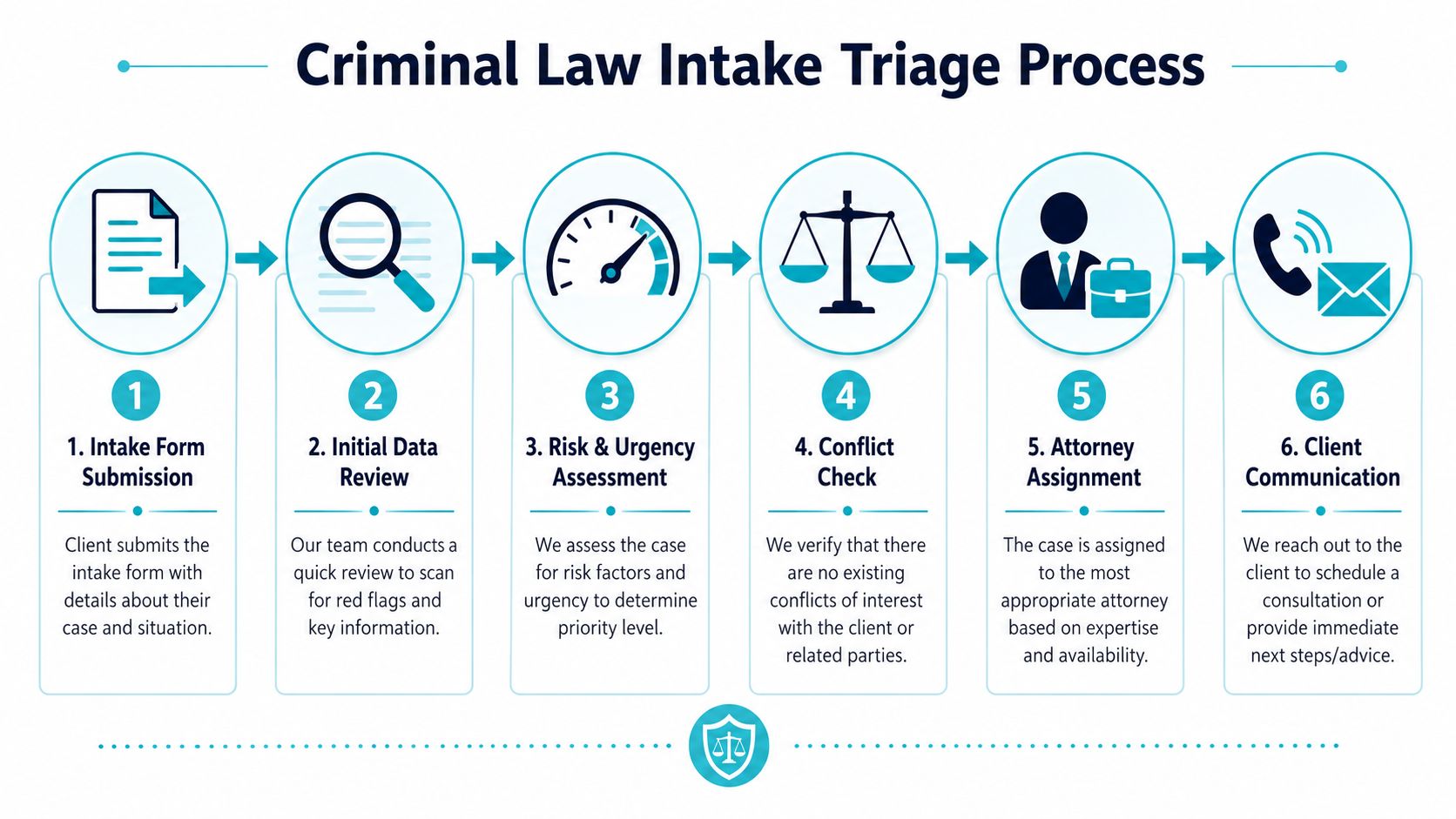
Sort for urgency first
The first pass should answer one question. Does a human need to look at this immediately?
Good urgency triggers often include:
In custody status
If the person is jailed, the submission should move ahead of routine consultations.Imminent court event
Arraignments, first appearances, and deadlines should not sit in a general inbox.Active warrant or recent arrest
These matters often need fast lawyer review, even if full facts are still missing.Protective order or no-contact issue
These can affect communication, strategy, and immediate advice.
Not every practice uses software rules the same way, but every practice needs an explicit urgency list.
Run fit and conflict checks early
Once urgency is sorted, look at fit. County, charge type, and representation scope should all be screened before scheduling a consultation that the firm may decline later. This is also where conflict review has to happen quickly and consistently. A useful reference on setting up that process is this guide to conflict checks for law firms.
If your staff has to “remember” how to triage, you don't have a system. You have a habit.
Use routing rules your staff can follow
The firms that handle intake well usually keep routing simple enough that non-lawyer staff can apply it without guessing.
A practical model looks like this:
| Intake Signal | Immediate Action |
|---|---|
| Person is in custody | Escalate to attorney or designated urgent review queue |
| Court date is approaching | Prioritize same-day review |
| Matter is outside practice area or geography | Decline or refer using a standard response |
| Potential conflict appears | Pause scheduling until conflict review is complete |
| Information is incomplete but matter appears viable | Request missing items through a controlled follow-up |
Avoid over-engineering
Triage should be disciplined, not elaborate. If you build too many categories, your staff will ignore them. If you build none, everything feels urgent and nothing gets handled well.
A criminal law client intake form works best when it feeds a small number of reliable decisions: urgent now, review soon, conflict hold, out of scope, or ready to schedule.
Building a Secure and Accessible Digital Intake Process
A lot of criminal intake still relies on habits that don't match how people generally seek help. Download a PDF. Print it. Fill it out. Scan it. Fax it or email it back. That process may feel familiar to a law office, but it often feels impossible to a person dealing with an arrest, a court notice, or a family emergency.
Accessibility is not a side issue here. It directly affects whether the form gets completed at all.
Where traditional intake breaks down
Public examples still often assume English-only forms and manual fax or email return. That approach can exclude people who lack printing access or struggle to work through long legal questions under stress. In criminal defense, that's a serious operational weakness because urgency and stress are part of the intake environment.
The common failure points are easy to spot:
- Device friction: A form that works poorly on a phone is a barrier.
- Language friction: If the user can't comfortably read the form, completion quality drops.
- Submission friction: Faxing and email attachments add steps and create avoidable abandonment.
- Security friction: Standard email workflows can scatter sensitive information across inboxes and downloads.
Why portal-based intake is different
A portal-based approach addresses several problems at once. It gives the firm a controlled submission path, reduces dependence on attachments, and lets clients complete forms from whatever device they already have in hand.
That doesn't mean every portal is equal. The practical questions are narrower:
- Can the form be completed on mobile without pinching and zooming
- Can the firm present shorter staged forms instead of one long questionnaire
- Can staff send reminders without manually chasing every lead
- Can the firm limit unnecessary exposure of sensitive intake data
Those are workflow questions as much as technology questions.
Accessibility starts before the form opens
Many firms focus on the form builder and ignore the intake path leading to it. If the website confuses people, the form never gets opened. For firms evaluating intake experience more broadly, examples from legal web design can be useful. This overview of Charlotte law firm website design is worth reviewing for how firms present contact paths, mobile layouts, and conversion points without overwhelming visitors.
Security has to be designed in
Criminal intake involves names, allegations, court information, and often other sensitive personal details. That means the submission method matters. So does storage, internal access, and follow-up communication. Firms that still pass intake through shared inboxes and downloaded attachments should review their broader approach to cybersecurity for law firms.
A secure and accessible process is usually shorter, cleaner, and more disciplined than the older PDF model. That's the point. Clients under stress don't need more steps. Your team doesn't need more loose files. A modern criminal law client intake form should reduce friction for both sides.
Integrating Your Form with Client Portals and Case Systems
The strongest intake process doesn't end when the person clicks submit. That's where the real workflow begins.
When intake data sits in email, staff retype it into a case management system, attorneys ask for the same facts again, and clients repeat themselves. Every handoff adds delay and creates room for error. An integrated setup cuts out much of that duplication by moving the form directly into the systems the firm already uses.
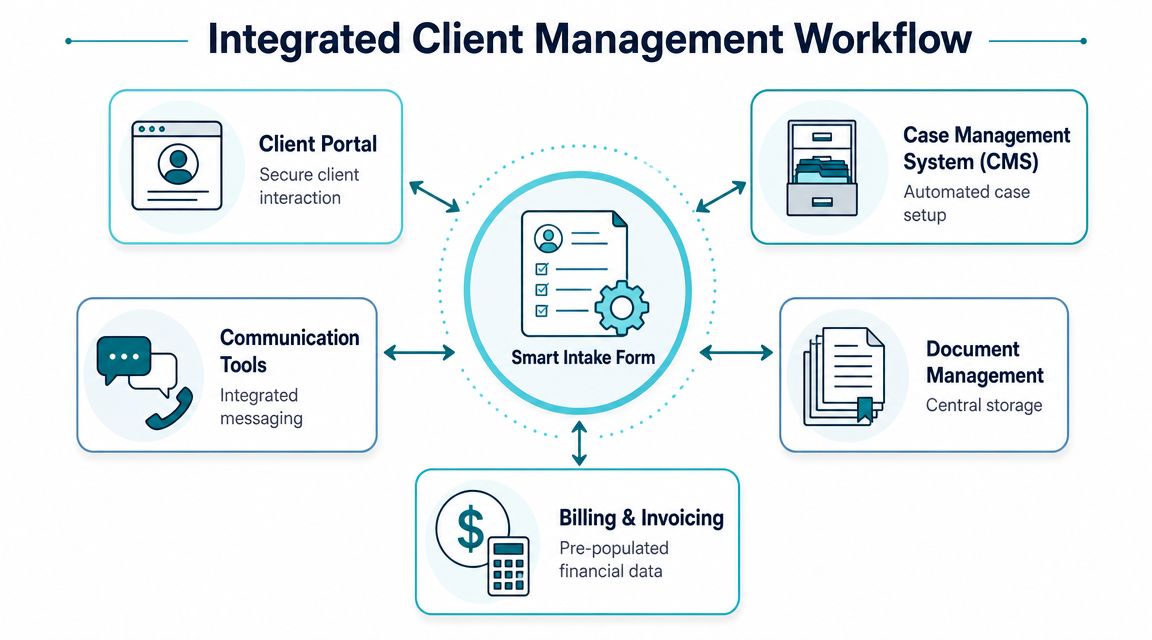
What integration changes in practice
A portal-hosted intake flow can feed structured information into the firm's broader case workflow. That may include case management, document collection, status communication, and routine follow-up. For firms that want a central place for forms, messages, and client-facing updates, client portals for law firms are one way to organize that process.
CasePulse is one example of this kind of portal approach. It lets firms offer fillable forms, messaging, file sharing, and case-status access while staff continue working inside existing case systems such as Needles, Neos, LawBase, and Litify. For intake, that means the form can become the first structured record in a broader client workflow rather than a standalone document someone has to chase down later.
Keep legacy channels as a backup, not the default
Some criminal defense clients will still need alternative submission methods. Courts, jails, and third parties don't all operate on the same timeline. If your firm still accepts faxed materials in limited situations, use a controlled process rather than an office machine free-for-all. A practical reference is SendItFax for secure online faxes, especially for firms trying to move old fax habits into a more manageable digital workflow.
The intake form shouldn't be an isolated admin task. It should be the first clean data point in the life of the case.
When firms get this right, the benefits are straightforward. Staff spend less time re-entering information. Clients get a more consistent handoff. Attorneys review cleaner records. Follow-ups become easier to automate and easier to track. That's not flashy. It's just competent legal operations, which is exactly what high-stakes criminal work demands.
If your firm is still juggling emailed PDFs, missed calls, and manual follow-ups, CasePulse is worth a look. It provides a secure client portal for law firms with fillable forms, messaging, file sharing, automated reminders, and integrations with systems such as Needles, Neos, LawBase, and Litify, so intake can move into the same workflow your staff already uses.