
 CasePulse
 Absolutely. Electronic signatures are not just a convenient modern tool. They are legally binding and carry the same weight as a traditional "wet ink" signature. This validity is firmly rooted in both federal and state law, creating a reliable framework that law firms can trust for everything from retainer agreements to settlement documents.
The Legal Bedrock: ESIGN and UETA
So, what makes a client tapping "I Agree" on their phone a legally enforceable action? It's not just the technology. It's a solid legal structure that gives that digital action its power. This framework ensures that a digital agreement is every bit as valid as a paper contract signed in your office conference room.

This confidence comes from two landmark laws that work in tandem. The Electronic Signatures in Global and National Commerce Act, better known as the ESIGN Act, was signed into law on June 30, 2000. It provides federal level validation for e signatures across the entire country.
Working alongside it is the Uniform Electronic Transactions Act (UETA). UETA is a model law that provides a consistent set of rules for states to adopt, ensuring electronic records and signatures are just as enforceable as their paper counterparts.
How ESIGN and UETA Work Together
Think of ESIGN as the national standard and UETA as the state level implementation. While ESIGN sets the federal baseline, UETA allows states to enact their own specific laws, so long as they don't undermine the core principles of ESIGN. This dual layer system has created a predictable legal environment for digital transactions in 49 states, Washington D.C., Puerto Rico, and the U.S. Virgin Islands (New York is the only state that hasn't adopted UETA but has its own similar statute).
To make this clearer, let's break down the key details of each act.
ESIGN and UETA At a Glance
The table below offers a quick comparison of the two primary laws governing electronic signature legality, highlighting their scope and core principles for law firms.
| Legal Act | Scope | Core Principle | Adoption |
|---|---|---|---|
| ESIGN Act | Federal – Applies to all interstate and foreign commerce. | A contract or signature cannot be denied legal effect solely because it is in electronic form. | Nationwide since 2000. |
| UETA | State – A model law adopted by individual states. | Provides uniform rules for electronic records and signatures at the state level, mirroring ESIGN's principles. | Adopted by 49 states, plus D.C. and several U.S. territories. |
These laws create a foundation of trust, but they come with a few core requirements that any law firm's e signature process must meet.
The Core Principles of a Valid E-Signature
Both ESIGN and UETA are built on a few simple but powerful ideas:
- Non-Discrimination: This is the big one. A signature or contract can't be tossed out in court just because it's electronic. The format doesn't invalidate the agreement.
- Intent and Consent: For an electronic signature to be valid, the signer must have clearly intended to sign the document. They also must have consented to conducting business electronically. This is often handled with a clear disclosure statement before the signing process begins.
- Record Integrity: The system you use must create an accurate and unalterable record of the signing process. This includes what was signed, who signed it, when, and how. This audit trail is your proof.
The bottom line is this: a properly executed electronic signature isn't a "lesser" signature. It is a fully recognized legal method for demonstrating agreement, backed by robust federal and state regulations built for the modern world.
This legal foundation is precisely what allows your firm to adopt more efficient digital workflows, from client intake to final case filings. By using systems that adhere to these rules like those for secure file sharing with clients you can modernize your practice without sacrificing legal integrity. Every digital agreement you execute will be built on solid ground.
Meeting ESIGN and UETA Compliance Requirements
Knowing electronic signatures are legally binding is one thing. Actually making them compliant is another challenge entirely. The ESIGN Act and UETA didn't just legalize e signatures. They laid out a specific roadmap for turning a simple click into a rock solid, binding agreement. For any law firm, following that map isn't just a good idea. It's absolutely critical for the enforceability of every single document your clients sign.
Think of these requirements as the foundation of a house. Without them, an e signature is just a picture on a screen. With them, it becomes a powerful, legally defensible action. There are three essential elements your firm has to get right every time.
The Three Pillars of a Compliant E-Signature
For an electronic signature to stand up in court, it has to satisfy three core requirements that both ESIGN and UETA demand. These aren’t complex technical hurdles. They're common sense principles that prove a genuine meeting of the minds occurred.
Intent to Sign: The signer has to know what they’re doing. The process must make it crystal clear that their electronic action be it a click, a typed name, or a scribble on a screen is the legal equivalent of putting a pen to paper. There can be zero ambiguity.
Consent to Do Business Electronically: You can't just assume everyone is on board with digital paperwork. All parties must explicitly agree to use electronic records and signatures for the transaction. This consent has to come before they sign, ensuring no one is railroaded into a digital process they’re not comfortable with.
Record Keeping and Association: You need a paper trail, even if it's a digital one. A durable record of the entire signing process, often called an audit trail, must be created, maintained, and permanently linked to the signed document. This log proves how the signature was created and, just as importantly, that the document hasn't been touched since.
Putting Compliance into Practice
These pillars might sound a bit theoretical, but they have very direct applications in your firm's day to day work. Let’s walk through a real world example. Imagine a personal injury firm sending a retainer agreement to a new client through a secure client portal.
When the client logs in, the first thing they see is a clear statement explaining that they are about to sign a legally binding document electronically. Before they can even see the agreement, a pop up or checkbox appears: "I agree to conduct business and sign documents electronically." Checking that box provides their explicit consent, satisfying pillar number two.
Next, the client reads through the retainer. At the end, there's a signature block with a big, obvious button that says, "Click to Sign and Agree." When the client types their name and clicks, their action shows a clear intent to sign, fulfilling the first pillar.
Crucially, the system must create a comprehensive audit trail. This isn't just a copy of the signature; it's a detailed log that includes the client's IP address, a timestamp of when they viewed and signed the document, and a record of their consent. This secure, unchangeable record satisfies the third pillar of record keeping.
The combination of clear consent, demonstrated intent, and a verifiable audit trail creates a powerful piece of evidence that a valid agreement was made.
Ensuring you're always on the right side of these rules often means having regular internal discussions. Keeping detailed records of these meetings, perhaps using a compliance meeting transcription service, can add another layer of proof to your firm's diligence. This is how you turn legal theory into a reliable, everyday operational reality.
What Makes an E-Signature Defensible in Court
It's one thing to know that electronic signatures are legal. It's another thing entirely when one of those signatures is challenged in court. The conversation shifts instantly from general legality to the nitty gritty of proof. What, exactly, turns a simple click into a legally binding action that can hold up under judicial scrutiny?
The answer is building a fortress of evidence around the signing event, making its validity virtually undeniable. This goes way beyond just having a digital copy of someone’s name. You need a comprehensive, verifiable record of the entire signing process from start to finish.
Think of a proper e signature platform as a digital notary, meticulously recording every detail to create an ironclad trail of evidence. This digital trail is your ultimate defense, proving not just that a document was signed, but who signed it, when they signed, and how you verified their identity.
The Power of a Complete Audit Trail
At the core of any defensible e signature is the audit trail. This isn’t just a simple log. It's a detailed, timestamped certificate that documents every single action taken, from the moment the document is sent to the final signature.
A robust audit trail is the cornerstone of proving a signature’s integrity in any legal dispute. To be truly effective in court, it must capture several key pieces of data:
- Signer Identity: It needs to record identifying information like the signer’s name, email address, and the IP address they used to access the document.
- Event Timestamps: Every action like opening the document, scrolling through pages, applying the signature must be time and date stamped in a consistent, verifiable format.
- Document History: The trail should paint a full picture of the document's lifecycle, showing when it was sent, viewed, and completed by each party.
- Consent Record: Critically, it must show proof that the signer affirmatively consented to doing business electronically before they were allowed to sign.
This complete record acts as an independent, third party verification of the signing event. It lays out a clear, sequential story of the transaction that becomes incredibly difficult for someone to dispute later on.
Proving Signer Identity and Intent
A common attack on an e signature is the simple claim: "That wasn't me." This is where authenticating the signer’s identity becomes absolutely crucial. While an email link provides a basic level of authentication, you can build a much stronger case with more advanced methods.
The goal is to tie a specific, unique individual to a specific electronic action. The more layers of authentication you have, the stronger your argument becomes that the person who signed is exactly who you say they are.
For instance, many secure client portals require a user to log in with a unique username and password before they can even see, let alone sign, a document. This two step process creates a much stronger chain of evidence than a simple link sent to an email inbox that could potentially be accessed by others.
This is a key area where firms can shore up their processes. If you want to centralize client documents and communications securely, check out our guide on the best document management software for law firms.
Ensuring Document Integrity
The final pillar of a defensible e signature is proving the document itself hasn't been touched since it was signed. What good is a signature if one party can secretly alter the terms afterward? This is where tamper sealing technology is non negotiable.
Modern e signature platforms use cryptographic tools, like hashing algorithms, to create a unique digital "fingerprint" of the document at the exact moment of signing. If even a single comma is changed after the fact, that fingerprint breaks, giving you instant, provable evidence of tampering.
To preserve the integrity of these signed documents for the long haul, it’s also wise to implement robust data preservation strategies like immutable backup solutions. When you combine a detailed audit trail, strong signer authentication, and verifiable document integrity, you create a powerful defense that ensures your firm's electronic agreements hold up where it matters most: in court.
Navigating Common Exceptions in E-Signature Law
Think of the ESIGN Act and UETA as the legal superhighway for electronic signatures, paving the way for most commercial transactions to move at digital speed. But just like any highway, there are specific off ramps for certain types of documents. These are the high stakes or deeply personal legal matters that still require the formality of a traditional "wet ink" signature.
Knowing where these off ramps are is a critical piece of risk management for any law firm. If you use an e signature on an excluded document, a court could deem it invalid, creating a real mess for your client. This isn’t about a flaw in the technology itself. It's a legal safeguard, a recognition that some life events demand an older, more deliberate process to prevent fraud or confusion.
The federal ESIGN Act largely punts to state laws on these exceptions, so you absolutely have to know your local rules.
Key Documents Often Excluded from E-Signature Laws
While the exact list can differ slightly between states, both UETA and ESIGN carve out a few consistent categories where electronic signatures are generally a no go. You should treat these as wet ink only until you’ve confirmed the specific rules in your jurisdiction.
Here are the common exceptions your firm needs to have on its radar:
Wills and Testamentary Trusts: These documents are the final word on a person’s legacy and are held to an incredibly high standard. To guarantee authenticity and prevent things like undue influence, almost every state mandates a physical signature, often with witnesses present in the room.
Family Law Documents: Because of their profound personal impact, many family law records are also excluded. This typically covers adoption papers and divorce decrees, which are often tied to in person court proceedings.
Official Court Orders and Notices: Any document coming directly from a court like official orders, notices of default, or foreclosure notices operates under its own set of rules. These require court approved methods for signing and delivery, falling outside the scope of general e signature laws.
The rule of thumb for law firms is simple: when in doubt, use a pen. If a document alters fundamental family relationships, transfers property after death, or involves a direct court mandate, the default should always be the traditional paper and ink method.
The Importance of State-Specific Variations
It's easy to forget that UETA is a uniform act, not a federal one. That means states can adopt it as is or tweak it. For example, a state might have specific, stricter rules for real estate transactions, demanding wet signatures on deeds even when other business contracts are handled electronically.
This variability is why local knowledge is king. An e signature that's perfectly valid for a client agreement in one state might be completely invalid for a power of attorney next door. You're also starting to see some states pass specific laws allowing for remote notarization or electronic wills, but these are new, highly specific exceptions with their own strict procedural hoops to jump through.
At the end of the day, the legality of an e signature isn't a blanket "yes." While it's the go to for the vast majority of business agreements, knowing the specific carve outs is a non negotiable part of practicing law today. It’s how you operate efficiently without compromising on compliance or the validity of your clients' most important documents.
Implementing a Compliant E-Signature Workflow
Knowing the law is one thing; putting it into practice is another. Shifting your firm to a compliant e signature workflow isn't just a matter of picking some software off the shelf. It’s about building a repeatable, defensible system that protects your firm, simplifies your operations, and gives clients a secure, easy to use experience. A well thought out process ensures every signature you collect stands up to legal scrutiny.
The idea is to make compliance the default setting, not an extra step someone has to remember. By establishing clear, firm wide procedures, you transform a complex legal requirement into a simple, efficient part of your daily routine. This structured approach doesn't just save time. It significantly strengthens your firm's legal footing.
Choosing the Right E-Signature Platform
The technology you choose is the bedrock of your entire workflow. The right platform does more than just capture a signature. It creates an ironclad record of the entire signing event. This is absolutely non negotiable for proving the electronic signature legality of your documents down the road.
When you're vetting potential solutions, you need to zero in on a few key features:
- A Detailed Audit Trail: The system must generate a comprehensive, tamper proof log for every document. This digital paper trail should capture everything: IP addresses, precise timestamps for every action (like when the document was viewed and signed), and proof of the signer's consent.
- Strong Authentication: Don't settle for a simple email link. Look for tools that add a stronger layer of identity verification. For example, secure client portals like CasePulse require a unique login, making it much harder for a signer to later claim they weren't the one who signed.
- Integration Capabilities: Your e signature tool should play nicely with your existing case management system. This integration prevents data from getting siloed and allows your team to manage signature requests without juggling multiple programs. You can learn more about this core principle in our guide to workflow automation for law firms.
This process flow shows how to think through whether an e signature is appropriate or if you need to hit pause and consult counsel.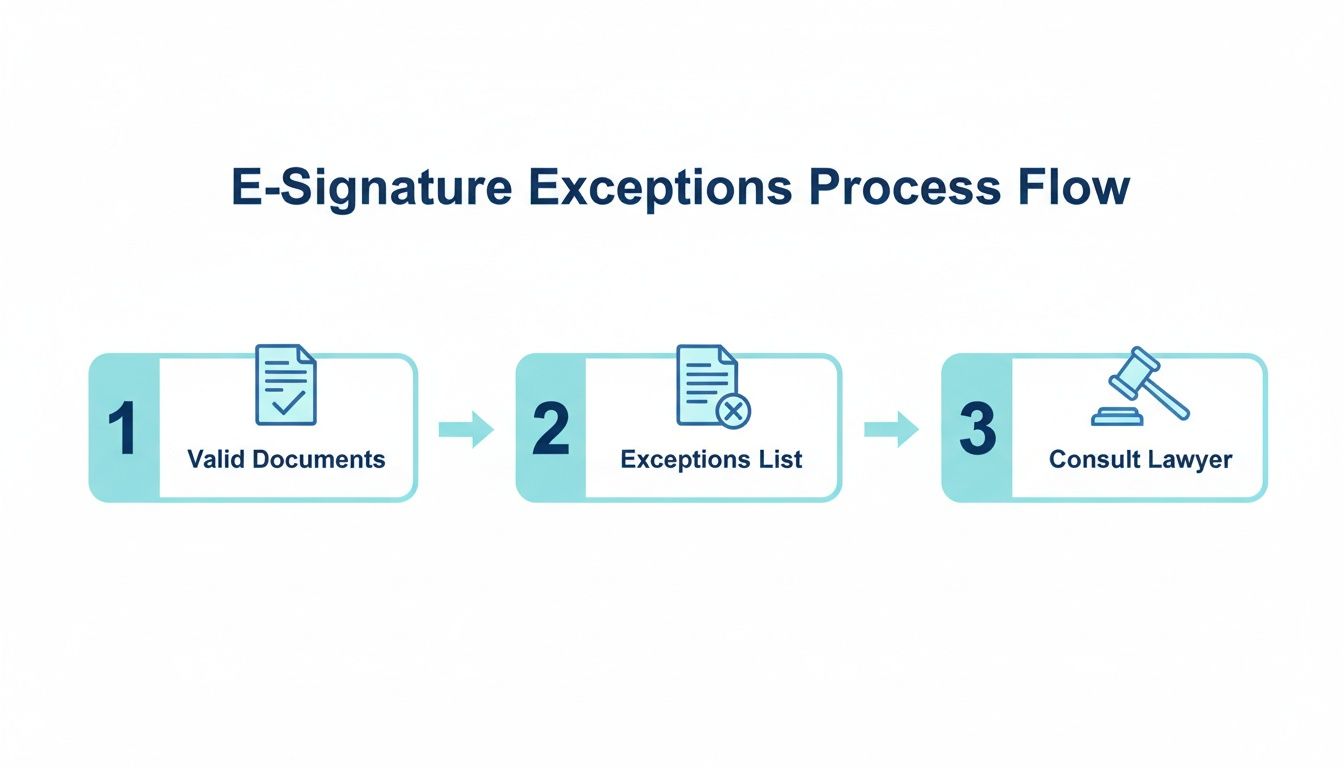
The visual makes it clear: while most documents are fair game for e signing, checking the exceptions list and getting a legal opinion in gray areas is a critical part of staying compliant.
Developing Internal Policies and Training Staff
Once you have the right tool, you need clear rules of the road for using it. Your firm should create a written internal policy that spells out the proper procedure for every step of the e signature process. Think of this document as your firm’s official playbook for compliance.
Your policy needs to cover a few key areas:
- Obtaining Client Consent: Standardize how your firm gets explicit consent from clients to conduct business electronically before you send the first document to sign.
- Document Handling: Specify which types of documents are approved for e signature and, just as importantly, which ones still require a traditional wet ink signature (referencing the exceptions we've discussed).
- Record Retention: Define exactly how long e signature audit trails and the signed documents themselves will be stored, making sure it aligns with your firm's broader document retention policies.
A policy is only as good as the people who follow it, which is why training is so critical. Every attorney, paralegal, and staff member who deals with clients needs to understand these procedures inside and out. Regular training sessions ensure everyone uses the system correctly and can confidently answer basic client questions, creating a consistent and professional front.
Crafting Standard Language and Educating Clients
The final piece of the puzzle is making the process feel transparent and simple for your clients. This starts with creating standard language to include with every e signature request. This text should briefly explain that they are signing a legally binding document and confirm their consent to do so electronically.
A simple, clear statement can make all the difference. For example: "By clicking 'Sign and Agree,' you are applying your legally binding electronic signature to this document and confirming that you consent to conduct this transaction electronically."
For U.S. firms that work on international cases, platform choice becomes even more crucial. Europe's eIDAS Regulation, which has been in effect since July 1, 2016, is widely seen as a global benchmark. If your firm handles cross border matters with parties in the EU, using a portal with eIDAS compatibility ensures you can seamlessly and compliantly execute things like global NDAs or expert consents.
By taking these steps, you're building more than just a workflow. You're creating a reliable, efficient, and legally sound system that boosts your firm's productivity and your clients' confidence.
Common Questions About E-Signature Law
When law firms start using electronic signatures, a few key questions always pop up. Let's walk through the most common ones to clear up any confusion and help you move forward confidently.
What's the Real Difference Between an Electronic and a Digital Signature?
This is a classic question, and the distinction is important. Think of an electronic signature as a broad umbrella term. The ESIGN Act defines it as any "electronic sound, symbol, or process" attached to a contract or record, made with the intent to sign. It can be as simple as typing your name into a PDF or clicking an “I Agree” button.
A digital signature, on the other hand, is a specific type of electronic signature. It’s the high security version, using sophisticated encryption (public key infrastructure) to create a unique, tamper evident "fingerprint."
Here's the takeaway: All digital signatures are electronic signatures, but not all electronic signatures are digital. For the vast majority of legal agreements in the U.S., a standard electronic signature is perfectly sufficient and legally binding, as long as it has a solid audit trail backing it up.
Can a Client Just Say No to E-Signatures?
Yes, they absolutely can. Consent is the cornerstone of e signature law. Both the ESIGN Act and UETA are built on the principle that people must voluntarily agree to do business electronically. You can't force a client to sign a document online.
If a client is more comfortable with a pen and a piece of paper, you have to provide that option. That’s why client portals are designed to be a convenient choice for those who opt in, not a rigid mandate. It’s all about meeting your client where they are.
How Long Do We Need to Keep E-Signature Records?
The rule of thumb is simple: keep your electronic signature records and their associated audit trails for at least as long as you're required to keep the equivalent paper documents. Your retention duties are dictated by things like statutes of limitation, bar association rules, and other specific regulations.
As a best practice, your electronic record retention policy should mirror your firm's overall document retention schedule. Don't create two different systems because it's an unnecessary headache.
Using a secure client portal is a great way to centralize these records, making them easy to find, manage, and eventually purge according to your firm's policy.
Are Signatures from a Phone or Tablet Legally Sound?
Absolutely. An electronic signature is legally valid whether it’s done on a 27 inch monitor or a 6 inch smartphone screen. The device doesn't matter.
What matters is that the process meets all the requirements of the ESIGN Act and UETA. That means you have to clearly demonstrate the signer’s intent, get their consent to sign electronically, and keep a reliable audit trail of the entire transaction. Good client portals are built to be mobile responsive for exactly this reason. It gives clients the flexibility to sign documents securely from anywhere, which is a huge win for client experience.
Ready to modernize your client communication and document workflows with a secure, compliant platform? CasePulse integrates directly with your existing case management system, allowing you to manage e-signatures, share files, and communicate with clients without ever leaving your primary software. See how you can improve efficiency and client satisfaction by visiting the CasePulse website.