
 CasePulse
Most personal injury claims resolve in about 11.4 months, but that average hides the actual split your firm lives every day: pre suit cases can wrap up far sooner, while cases that require filing often take 1 to 3 years or more. That gap is why “how long does a personal injury lawsuit take” is never just a client question. For a plaintiff firm, it’s a staffing, communication, and workflow question.
If you run a PI practice, you already know the scene. A paralegal is trying to move records requests, answer adjuster emails, and prep a demand package while the phone keeps lighting up with the same update request from worried clients. The legal work may be on track. The client experience still feels slow.
That’s the operational problem behind the timeline question. The issue usually isn’t that your team lacks urgency. It’s that the personal injury process has long stretches where real progress is happening, but little looks visible to the client. Medical treatment continues. Records are still coming in. Discovery stalls. The insurer sits on a response. The court sets a hearing date months out.
Firms that handle this well don’t promise speed they can’t control. They explain the process clearly, define what each phase requires, and build a reliable way to keep clients informed during the quiet periods. That’s what protects staff time and client trust.
The Question Every Personal Injury Client Asks
Monday morning. A case manager opens the queue to three portal messages, two voicemails, and an email from the same client asking the same thing in different words: how long is this going to take?
That question shows up at every point in the file. It comes in after the first orthopedic visit, after records requests go out, after the demand is sent, after suit is filed, after mediation, and again after the release is signed. The client is not really asking for a lesson on procedure. They are asking whether the case is still moving and whether your firm still has control of it.
For a plaintiff firm, that makes the timeline question an operations problem as much as a legal one. The answer has to be honest about uncertainty without sounding evasive. A short answer buys you five minutes. A structured answer protects the relationship for months.
I advise firms to stop treating this as a one-time explanation and start treating it as a repeatable communication workflow. Your staff should be able to tell the client four things clearly: where the case sits today, what work is happening now, what has to happen before the file can advance, and what delays are outside the firm's control. Firms that build that discipline into their personal injury case communication workflow spend less staff time repeating status updates and less partner time calming avoidable frustration.
One practical rule holds up across firms. Clients can live with a long case more easily than a silent one.
That is why the key question is not just how long a personal injury lawsuit takes. It is how your firm explains a long, uneven timeline in a way that preserves trust, reduces inbound status traffic, and keeps the legal team focused on work that moves the file.
The Four Stages of a Personal Injury Case Journey
A client calls two weeks after signing, then again after the first records request, then again when the carrier goes quiet. The legal work may be progressing on schedule, but if your firm does not frame the case in stages, the client experiences the timeline as drift.

A plaintiff case usually moves through four operational stages. Labels differ by firm, but the sequence is consistent. The management value is simple. Each stage has different legal tasks, different risks, and different client communication needs.
Investigation and preparation
This stage decides how much friction the file will carry later. The team gathers reports, scene photos, witness information, policy details, billing, records, and employer or wage documents where needed. At the same time, someone has to shape a working theory of liability, causation, and damages. If that theory is thin, the file stalls later in negotiation or discovery.
Clients rarely see that work clearly. They see no hearing date, no offer, no dramatic event. They assume waiting.
That is why firms benefit from a defined personal injury case communication workflow at intake and during records collection. Staff should know what updates go out when records are requested, when treatment is still developing, and when the file is being held for a stronger damages picture. Without that structure, every quiet week turns into another status call.
Pre litigation negotiation
Once treatment and documentation are far enough along to value the claim responsibly, the case moves into demand and negotiation. Some files resolve here. Many should. A premature demand can leave money on the table, while a delayed demand can make the client think the firm is sitting on the case.
This stage tests discipline. The adjuster may respond quickly, slowly, or not at all for stretches. Meanwhile, your team is weighing whether to press, supplement, wait for additional treatment, or recommend filing suit. Clients do not need a lecture on claim strategy, but they do need a clear explanation of what has been sent, what response is due, and what decision point comes next.
Litigation and discovery
Filing suit changes the timeline and the communication burden. Now the pace depends not only on your team and the carrier, but also on court calendars, defense counsel, scheduling orders, discovery disputes, deposition availability, motion practice, and mediation settings.
Expectation problems often originate at this stage. Clients hear that suit has been filed and assume the end is close. In practice, filing often begins the most procedural stretch of the case. Good firms prepare clients for that before the complaint goes out, not after weeks of silence.
A simple stage map helps:
| Stage | What your team is doing | What clients often think |
|---|---|---|
| Investigation | Building liability and damages proof | Waiting to “start” |
| Negotiation | Sending demand and working offers | Settlement should happen quickly |
| Litigation | Exchanging information and meeting court deadlines | Filing means trial is close |
| Resolution | Finalizing settlement or preparing verdict collection steps | Money should arrive immediately |
Resolution
Cases end by settlement or by court decision, but the client’s sense of closure usually arrives later than the legal result. Releases need review. Liens need to be confirmed and negotiated. Checks need to clear. Disbursement statements need to be approved. One missing signature can add another week and trigger another round of anxious calls.
A case can be legally near the finish line while still feeling unfinished to the client for weeks or months.
For firm leaders, that final stage deserves the same process discipline as intake and litigation. If the team treats resolution as administrative cleanup instead of a managed phase, the file may be won on paper and still feel mishandled to the client.
Key Factors That Slow Down or Speed Up a Lawsuit
“It depends” is technically true, but it’s not useful unless your team can explain what the dependency is. The primary drivers fall into two buckets: what’s inside the case itself, and what’s outside the file but still affects movement.

Case specific drivers
Injury severity changes everything. According to updated personal injury timeline data summarized here, claims involving severe back and spinal cord issues average 27 to 36 months, and traumatic brain injuries can take 33 to 48 months or more. By contrast, minor injuries such as cuts or burns often settle within 10 to 13.5 months.
That difference isn’t arbitrary. Severe injury files usually involve longer treatment arcs, more uncertainty about future care, higher damages scrutiny, and harder causation fights. If a client is still treating, the firm may be protecting value by waiting, not delaying for the sake of delay.
Liability clarity matters too. A rear end case with clean documentation moves differently from a multi vehicle crash with conflicting accounts. So does party count. Add a commercial defendant, multiple carriers, or a disputed policy issue and the file usually becomes slower and more document heavy.
A managing partner should train staff to translate complexity into plain language:
- Ongoing treatment: The case may not be ready for serious valuation until the medical picture is clearer.
- Disputed fault: The defense won’t pay fairly until liability proof tightens.
- Multiple parties: Every additional defendant adds another review cycle, another insurer, and another potential delay.
- Thin documentation: Missing records or inconsistent treatment history almost always slows negotiations.
External drag on the file
Not every delay comes from the merits. Some come from the system around the case.
Insurance carriers can slow responses. Defense counsel can ask for extensions. Courts can push hearings out. Experts may not be available when you need them. None of that is unusual, but clients often read these delays as neglect unless someone explains them promptly.
When clients don’t understand the source of delay, they often assume the firm has gone quiet.
That’s why status communication should identify not just what happened, but what the case is waiting on. “We’re waiting on defense responses due next month” is far better than “no update yet.” One tells the client there is a process. The other sounds like drift.
What actually speeds things up
Fast files usually share a few traits. Liability is clear. Treatment is relatively straightforward. Records arrive on time. The insurer is responsive. There are no major lien or coverage complications.
What doesn’t speed things up is chasing settlement before the file is ready. Firms sometimes create more delay by forcing early negotiations, then having to reopen valuation after treatment changes or new records arrive. That rarely helps the client relationship. It usually creates confusion and rework.
Comparing Settlement and Trial Timelines
The biggest fork in the road is whether the case resolves by agreement or requires a verdict. In this scenario, strategy and timeline directly collide.
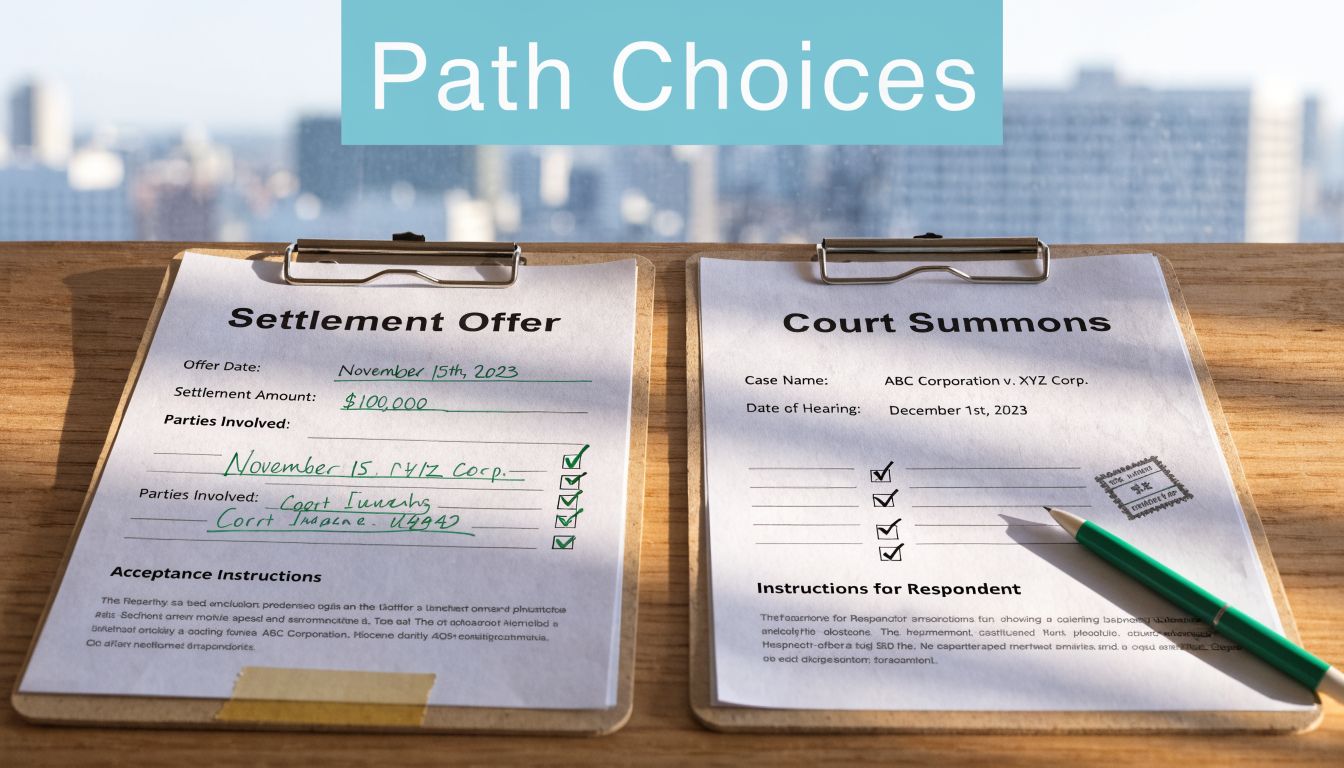
Most firms already know the broad answer. Settlement is usually faster. Trial is slower, costlier, and less predictable. But that doesn’t mean trial is the wrong call. It means the client needs to understand the trade off before the case reaches that point.
The settlement path
Settlement works best when the defense sees credible risk and both sides have enough information to price the claim. Many firms use early valuation tools to frame that conversation internally. If you want a simple client friendly way to determine your injury claim value, a structured calculator can help clients understand the moving parts before they fixate on a single number.
For firms standardizing this process, a dedicated personal injury settlement communication workflow helps keep negotiations and client updates aligned. The legal judgment still belongs to the lawyer. The workflow just prevents routine status questions from eating the team alive.
The trial path
Trial becomes necessary when the offer doesn’t reflect the case, liability remains contested, or damages are too disputed to resolve informally. In such situations, some firms hurt themselves by speaking only in terms of principle. Clients also need a sober explanation of timing, burden, and emotional cost.
A useful way to frame it is side by side:
| Path | Upside | Cost of the choice |
|---|---|---|
| Settlement | Faster resolution, lower litigation burden, more certainty | May require compromise on value |
| Trial | Full presentation of disputed liability or damages | Longer timeline, more preparation, more uncertainty |
A fast answer and a fair answer aren’t always the same answer.
That sentence tends to land with clients. It’s direct, and it respects the reality they’re facing. If your attorneys and case managers use a line like that consistently, clients are less likely to treat every rejected offer as unnecessary delay.
The Hidden Timeline Killer After a Case Settles
Many firms lose control of expectations at the worst possible moment: after everyone says the case has settled.
Clients hear “settled” and assume the check is basically in the mail. Operationally, you know better. Releases must be signed. Trust accounting steps must be coordinated. Liens have to be confirmed and resolved. Carriers still have their own processing timelines.
Why the final phase triggers so many calls
According to post settlement timing data summarized here, settlement checks are often expected in 4 to 6 weeks, but unresolved liens such as Medicaid or Medicare claims, or insurer processing backlogs, frequently extend payout to 2 to 3 months. That same source notes this expectation gap can increase inbound client calls by up to 40%.
This is a classic law firm communications trap. The legal dispute feels over to the client, so any delay after that point feels irrational. To the firm, it’s just the last administrative mile. To the client, it feels like the finish line keeps moving.
What firms should explain earlier
The best time to talk about post settlement delay is before the agreement is signed. Not after the first “where’s my check” call.
A short explanation should cover:
- Signed releases: Funds usually don’t move until required paperwork is complete.
- Lien resolution: Government or medical claims may need to be confirmed before disbursement.
- Carrier processing: The insurer still has internal issuance steps even after agreement.
- Trust account handling: The firm has to receive, process, and properly disburse funds.
If your firm already gives clients visibility into trust account and disbursement communication, use it to make the last phase visible instead of mysterious. That alone can prevent a lot of frustration.
Managing Expectations and Firm Efficiency During the Wait
The hard truth is that your firm can’t force a court to move faster, make an adjuster more responsive, or compress a client’s medical recovery. What you can control is how clearly and consistently the client hears from you while all of that unfolds.

Discovery is where communication systems break
Discovery is often where even organized firms start to feel pressure. According to litigation timing data summarized here, the discovery phase lasts 6 to 18 months and is often the longest stage of litigation. That same source notes court backlogs were up 22% as of 2025, and firms can lose 15 to 20 hours per week per case to manual status updates.
That’s not just an inconvenience. It’s expensive distraction. Your best staff end up spending prime hours re answering questions that should have a standard, visible, secure answer.
What works and what doesn’t
Some firms try to solve this with more human effort alone. They schedule extra call blocks, tell staff to “be more proactive,” or ask paralegals to send manual check in emails every week. That can help for a short period. It rarely scales.
What tends to work better is a communication model built around consistency:
- Stage based updates: Clients should know what stage the case is in and what happens next.
- Routine reminders: Forms, signatures, and document requests need structured follow up.
- Secure messaging: Clients need one reliable channel instead of scattered calls, texts, and emails.
- Self service visibility: If a client can check status without calling, many of them will.
The operational standard firms should aim for
For firms using Needles, Neos, LawBase, or Litify, the practical goal isn’t more software for staff to babysit. It’s less duplicate work. Clients should be able to check status, send messages, share files, and complete fillable forms without forcing your team to manage another disconnected process.
The right communication system doesn’t replace legal judgment. It removes the repetitive status work wrapped around it.
That distinction matters when managing partners evaluate technology. If the tool requires staff to leave their workflow constantly, adoption slips. If it supports custom branding, 24/7 status checks, routine follow ups, secure file sharing, and forms from any device while staff stay inside existing case management habits, the firm is much more likely to use it consistently.
A simple policy shift that pays off
Even before a platform rollout, firms can improve quickly by setting a basic communication policy around long timeline matters:
- Define the next milestone in every client update.
- Name the current blocker if the case is waiting on a third party.
- Set the next touchpoint so silence never feels indefinite.
- Centralize messages and files instead of scattering them across email and phone notes.
Those habits reduce friction. Technology makes them repeatable.
Turning Case Timelines into a Competitive Advantage
Long timelines are part of PI practice. They aren’t going away. What separates firms isn’t whether a case takes months or years. It’s whether the client feels informed during that wait.
A firm that handles communication well can make a slow process feel orderly. A firm that handles communication poorly can make a well worked case feel neglected. That’s why managing expectations is not soft work. It’s operational discipline.
The strongest plaintiff firms treat timeline management as a service line of its own. They explain the difference between negotiation and litigation. They prepare clients for the slow middle. They warn them that settlement isn’t always the end of the waiting. And they build systems that keep staff from repeating the same updates all day.
If you’re asking how long does a personal injury lawsuit take, the legal answer is still case specific. The management answer is clearer. Assume the process will be longer and less linear than the client expects, then build your communication model around that reality.
That’s how a frustrating fact of practice becomes an advantage. Clients remember whether your firm kept them informed when the case moved slowly. They talk about that experience long after the file closes.
If your firm wants a better way to keep clients informed without adding more manual follow up, CasePulse gives plaintiff firms a secure client portal that works with systems like Needles, Neos, LawBase, and Litify. Clients can check status, message the team, share files, and complete forms from any device, while staff stay in their existing workflow. It’s a practical way to cut routine status calls, reduce manual tasks, and deliver a more consistent client experience during long personal injury cases.