
 CasePulse
You're probably somewhere between interest and commitment right now. Maybe you're finishing junior year, looking at your transcript, wondering whether a major in political science, psychology, or English will help. Maybe you already know you want courtroom work, client contact, and the kind of cases where the facts matter, the state has the burden, and the defense lawyer has to be ready every single day.
That's a good place to start, because becoming a criminal defense attorney rewards clarity early. People often treat it like a vague ambition. They say they want to “go to law school” and assume the path will sort itself out. It won't. This career has a fixed sequence, a demanding licensing process, and some real trade-offs that generic career guides tend to soften.
The core path is straightforward on paper and demanding in practice. You earn a bachelor's degree, take the LSAT, complete law school, pass the ethics and bar requirements, and start building actual trial judgment. The foundational timeline is a minimum of seven years of full-time education, made up of a four-year bachelor's degree and a three-year J.D., plus additional time for bar prep and licensing, according to Best Accredited Colleges on criminal defense lawyer requirements.
What matters is not just finishing those steps. It's doing them in the right order, at the right pace, and with the right expectations. A student who plans clinics too late, treats the LSAT casually, or assumes specialization happens in law school usually loses time they can't easily get back.
Introduction
A lot of future defense lawyers start with the same mix of motives. They care about fairness. They like argument. They're drawn to criminal law because it feels urgent and human, not abstract. Then they hit the practical questions. Which major makes sense. When should they take the LSAT. Does law school let them specialize right away. What happens after graduation if they want actual courtroom time instead of a desk-heavy role.
Those questions matter because this is one of the more structured legal career paths. There's no shortcut around the degree sequence, the admissions process, or licensure. If you want to learn how to become a criminal defense attorney, you need a plan that starts before law school and keeps going past bar admission.
Practical rule: The students who do best in criminal defense usually don't chase prestige first. They build judgment, writing skill, and courtroom exposure first.
The roadmap also needs to reflect real life. Criminal defense is meaningful work, but it can be financially uneven early on. Public defender offices often offer the fastest path to experience, while private firms may offer a different mix of training and client development. The right move depends on how you weigh skill growth, debt pressure, and the kind of lawyer you want to become.
A strong plan answers both the formal questions and the overlooked ones. It tells you what to study, when to take the LSAT, how to use law school well, what the bar process demands, and when specialization starts. It also forces you to think about cost, workload, and where early training is strongest.
Setting Foundations With Prelaw Planning
A student finishes junior year with a decent GPA, no real legal experience, and an LSAT date booked out of panic. That is a common way to make this path harder than it needs to be. Strong prelaw planning is less about looking impressive and more about sequencing your choices so your grades, test timing, and early exposure to criminal practice support each other.
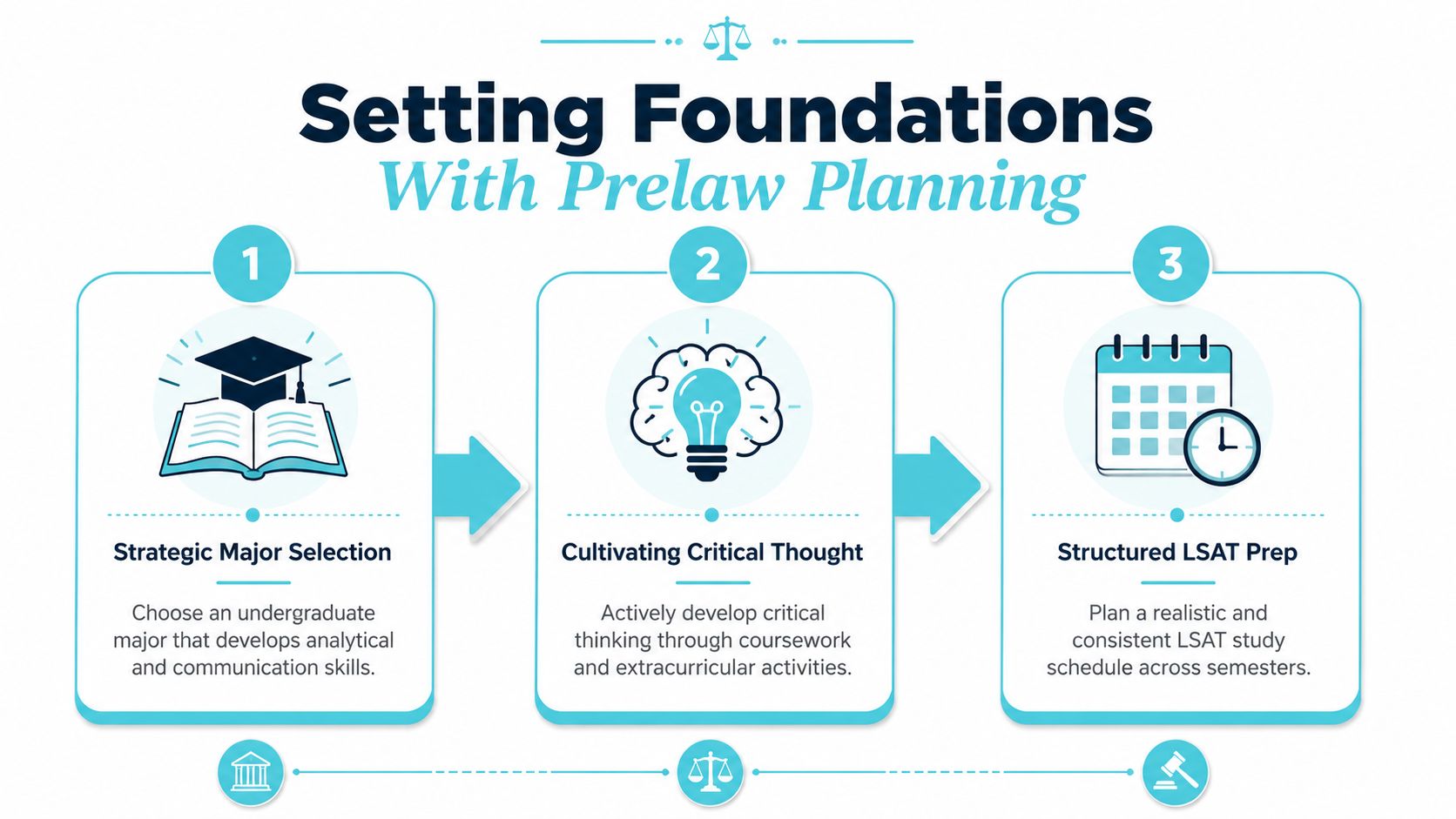
Choose a major for skill transfer
You need a bachelor's degree before law school, and there is no required major. Many future defense lawyers study criminal justice or political science for background, according to Criminal Justice Programs on defense attorney education.
Background helps, but skill transfer matters more.
Criminal defense work depends on reading closely, writing clearly, spotting weak facts, and making arguments under pressure. A major in political science, psychology, English, history, or philosophy can all serve you well if the course load pushes you to write, research, and defend a position. The weaker choice is the major that feels law-adjacent but lets you avoid difficult reading and revision.
Build your schedule around work that carries forward:
- Writing-heavy classes: Prioritize courses that require drafts, feedback, and revision.
- Research seminars: Learn how to find authority, test source quality, and support a claim.
- Behavior-focused coursework: Psychology helps with witness credibility, client communication, memory, and decision-making.
- Speaking opportunities: Mock trial, debate, student government, and oral presentation courses build comfort under scrutiny.
Build a record that looks intentional
Admissions committees and future employers are trying to read your pattern of choices. A scattered résumé suggests curiosity. A focused one suggests judgment.
Use college to test the work, not just to collect credentials. Time in a courthouse, legal aid office, public defender clinic, or community advocacy group shows you what criminal practice feels like at ground level. Even support roles can be useful. Reviewing law clerk job duties in a legal office gives you a realistic picture of the research, drafting, file organization, and case support tasks that often sit behind courtroom appearances.
A simple way to structure your undergraduate years is to stack experience in a sequence that makes sense:
| Stage | Useful focus | Why it helps |
|---|---|---|
| Early college | Writing and logic courses | Builds the base for LSAT performance and legal analysis |
| Middle semesters | Debate, mock trial, student publications | Develops argument, public speaking, and fast thinking |
| Summers | Legal aid, courthouse, or public service internships | Tests your interest in client-facing and system-facing work |
| Final undergraduate year | Faculty relationships and polished applications | Improves recommendation letters and application quality |
One practical warning matters here. Criminal defense attracts students who are passionate about justice, but that motivation can lead them to overcommit. If your GPA is slipping because you packed in too many activities, scale back. Law school admissions will forgive fewer internships faster than they will forgive weaker academic performance.
Treat LSAT prep like a scheduling problem, not a side task
The education path is long, and the timing is fixed. According to Best Accredited Colleges' overview of defense attorney education requirements, the process includes a four-year bachelor's degree, a three-year J.D., and several additional months for bar preparation afterward. The same overview notes that competitive schools tend to expect stronger LSAT scores. That combination is why rushed prep creates problems that can follow you for years, especially if scholarship options matter to your budget.
This is also where timing and finances meet. A stronger LSAT score can improve your school options and your scholarship chances. For many future defense attorneys, that matters as much as admissions itself because early criminal defense jobs do not always align with high debt loads. If you already know you may start in a public defender office or another lower-paid training-heavy role, minimizing debt should be part of the plan now, not an afterthought in law school.
Use a semester-based approach:
- Sophomore year: Learn the test format and identify your weak section.
- Junior fall: Start consistent prep with timed practice.
- Junior spring or summer: Take the exam once your practice scores are stable.
- Retake window: Leave room in your application cycle for a second attempt if needed.
For application strategy, essential tips for pre-law students offers a solid outside checklist.
One more point gets overlooked. You do not need to specialize in criminal defense before law school. You do need to know whether the work itself fits you. The right prelaw foundation gives you both. Better admissions odds and an early answer to whether you can handle the pace, conflict, and client pressure that come with defense practice.
Excelling in Law School and Practical Training
A lot of applicants focus so heavily on getting into law school that they don't think carefully enough about what they need once they arrive. That's a mistake. Criminal defense is one of those practice areas where grades matter, but practical training matters almost as much, and eventually more.
Apply with timing in mind
Many students take the LSAT during their junior year so they have time for a retake if needed, and the exam tests reading comprehension, analytical reasoning, and logical reasoning, according to CareerExplorer on defense attorney education and LSAT timing. That timing works because it protects your application cycle from a rushed score.
A strong application package usually has three things working together:
- A transcript with rigor: Not perfect, but serious.
- A personal statement with judgment: Explain why criminal defense interests you without turning it into a movie script.
- Letters from faculty who know your work: Specificity beats prestige every time.
If you want a clean outside resource on applications, LSAT Lab has essential tips for pre-law students that line up well with what admissions committees tend to notice.
Pick schools for fit, not just name
Some students choose a law school based only on ranking. That can work, but not always. If you know you want criminal defense, look at clinics, externships, trial advocacy offerings, and the local criminal court ecosystem around the school. A school with active indigent defense clinics and strong courtroom training can serve you better than a school that looks stronger on paper but offers little practical access.
Use this checklist when comparing programs:
- Clinical access: Can students get into criminal defense clinics early enough to matter?
- Externships: Are there placements with judges, defender offices, or trial-level agencies?
- Trial advocacy culture: Moot court is useful, but actual defense-oriented practice settings matter more.
- Regional placement: If you want to practice in a certain state, local ties help.
A lot of future attorneys also underestimate the value of support roles. Reviewing the day-to-day work described in these law clerk job duties gives a realistic sense of how legal research, drafting, and case support develop before full attorney responsibility kicks in.
Use law school to get close to real cases
Law school is academic by design, but you still have choices. The students who graduate ready for defense work usually prioritize criminal procedure, evidence, trial advocacy, and clinics that put them in contact with clients and files. They also learn how to write motions that solve a problem, not just impress a professor.
Don't confuse law school activity with legal training. Journal work can be valuable. Moot court can be valuable. But if you want to defend criminal cases, at some point you need exposure to clients, facts, and pressure.
Many people get the sequence wrong. They think they need to “specialize” in law school in a rigid way. They don't. What they need is to make smarter elective and clinic choices that support a later move into criminal defense practice.
Navigating Bar Exam and Licensing Requirements
A lot of graduates hit the same wall in late spring. They have the J.D., a job lead, and a rough idea of where they want to practice, but no real margin for bar prep costs, licensing delays, or a weak first exam attempt. In criminal defense, that timing matters because your first year can change fast if admission gets pushed back.
Licensure is not a formality. It is the last gate between law school and standing next to a client in court.
Understand the gatekeepers
Passing the state bar examination is the core requirement, and difficulty varies by jurisdiction. Georgia's first-time pass rate is around 70%, while some states report rates as low as 50 to 55%, according to English Law Firm's overview of becoming a criminal lawyer. The same source notes that the Multistate Professional Responsibility Examination is required for admission in 44 of the 50 U.S. states, and that bar prep can add 3 to 6 months to the overall timeline, with 2 to 4 months of intensive study for the exam itself.
That range should affect your planning well before graduation. If you want to start in criminal defense right away, choose your target state early, confirm its testing and admission rules, and budget for a post-grad period where studying limits your ability to earn much income. Students who wait too long to make those decisions often create their own delay.
There is also a specialization trade-off here that aspiring defense lawyers miss. You do not need to over-specialize in law school, but by 3L year you do need clarity about where you want to get licensed. Criminal defense hiring is still local in many markets. Sitting for one state while hoping to work in another can slow hiring, complicate networking, and force a second licensing decision sooner than expected.
Handle character and fitness like a case file
Character and fitness problems are often self-inflicted. Applicants leave out an old address, report one employment date on a résumé and another on the bar application, or give a half-answer about academic discipline because they assume the issue was minor.
According to WikiHow's criminal defense lawyer pathway summary, failure to complete character and fitness evaluations, including criminal background checks, results in about 8% of applicants being delayed or denied licensure annually. The practical lesson is simple. Inconsistency creates scrutiny.
Treat the application the way a defense lawyer treats a file that may be challenged later. Build one master record and cross-check every entry against your school records, job history, and résumé. If you need help tightening up the résumé side before your applications go out, this guide for first-time resume writers is a useful place to clean up dates and role descriptions.
A working licensing file should include:
- Residential history: Full addresses and dates, not rough guesses
- Employment records: Start and end dates, supervisor names, and job titles that match prior applications
- Academic incidents: Clear disclosures with the same facts every time
- Financial issues: Complete explanations if your jurisdiction asks about debt, collections, or related problems
Small omissions hurt more than old mistakes that are fully disclosed.
Plan for the money and timing after graduation
The post-graduation stretch is where planning becomes real. Bar prep courses, exam fees, background checks, travel, and living expenses can stack up at the same time your student loan grace period is getting closer to ending. If you are counting on immediate full-time income, build a backup plan now, not in July.
I tell aspiring defense lawyers to plan this period like a short, expensive clerkship with no paycheck. Set a fixed study schedule. Protect sleep. Practice essays and multiple-choice questions under time pressure. Keep your paperwork moving while you study, because licensing delays rarely come from one big problem. They come from several small ones left too late.
It also helps to stay connected to practical defense work while you prepare. Reviewing a criminal law client intake form used in early case screening keeps your mind on how real clients describe facts, risks, and urgency, which is a better frame than treating bar study as pure memorization.
After you pass, you still need formal admission and swearing-in before you can appear for clients as a licensed attorney. That last step sounds ceremonial. In practice, it determines when you can start doing the work you trained for.
Launching Your Defense Career and Early Skills Building
The first year after licensure often looks like this. You have a calendar full of arraignments or status dates, a client calling twice before noon, and a supervising attorney who wants a clean answer on whether a motion is worth filing. Early criminal defense work teaches fast, but the wrong job can also slow down skill growth if you are stuck doing only research with little client contact or only appearances with no feedback.
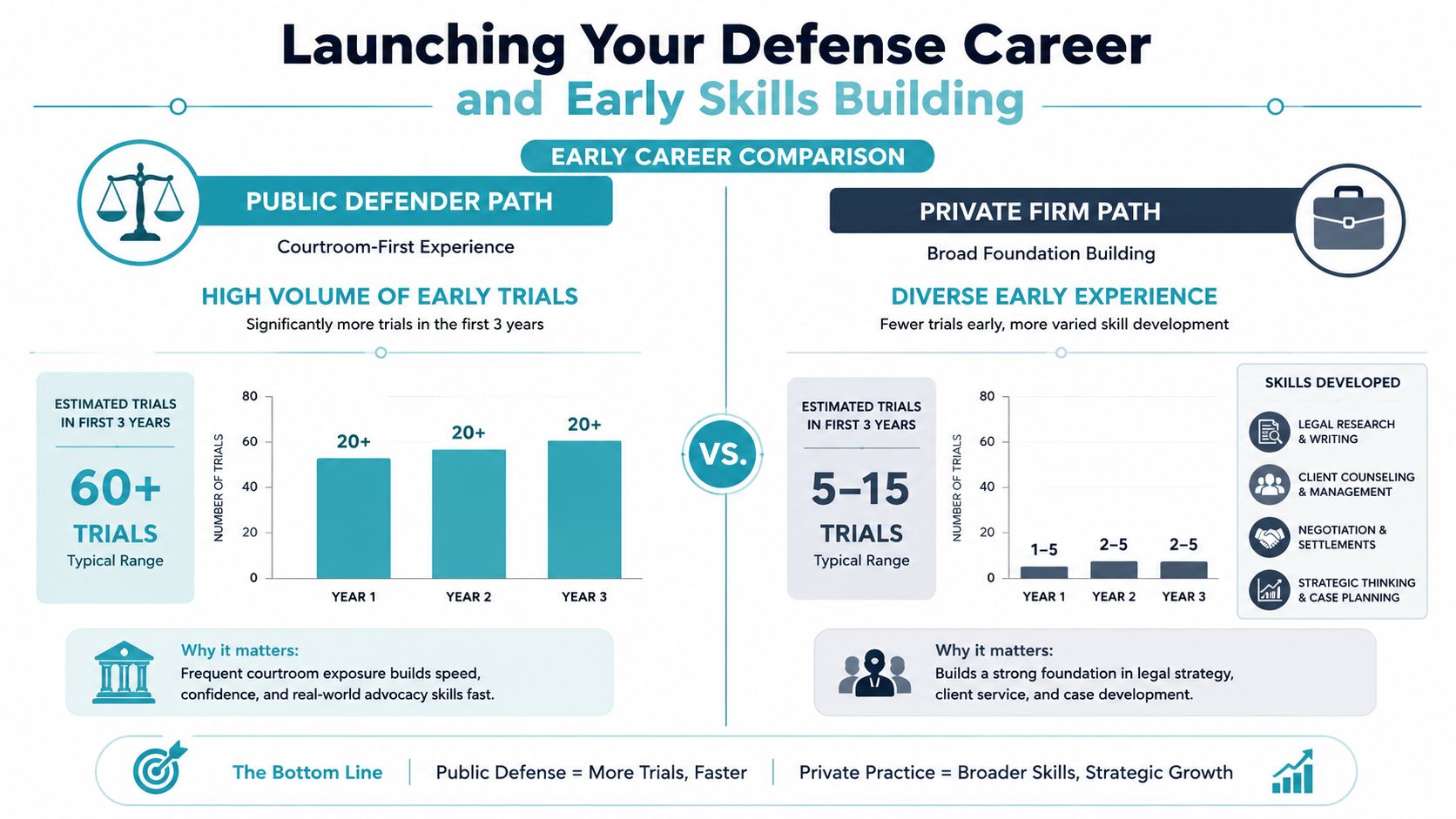
Public defender office versus private firm
The first real career decision is less about prestige and more about training structure. Public defender offices tend to give younger lawyers faster courtroom repetition, heavier client volume, and earlier responsibility. Private firms can offer closer supervision, more time on research and drafting, and exposure to how paying clients evaluate responsiveness and strategy.
Neither path is universally better. The better path is the one that develops the skills you still lack.
| Path | Early advantage | Common trade-off |
|---|---|---|
| Public defender | Frequent hearings and faster stand-up experience | Heavy caseload and less control over pace |
| Private firm | More direct mentorship in some offices | Slower courtroom exposure in many roles |
A defender office can be the stronger choice if you need reps. Reps matter. You learn how to speak to judges without sounding tentative, how to negotiate with prosecutors who have heard every weak argument before, and how to advise frightened clients when there is no perfect option on the table.
A private defense firm can be the stronger choice if the office trains juniors instead of treating them like overflow staff. Ask direct questions before you accept an offer: Who drafts motions? Who argues them? How soon do junior lawyers handle hearings? Who reviews your work, and how often? Those answers tell you more than the job title.
Build the skills clients notice first
New defense lawyers often focus on trial skills and forget what clients experience day to day. Clients judge your competence long before trial. They notice whether you call back, whether you explain risk in plain language, whether you remember the facts, and whether you show up prepared.
That is why intake discipline matters early. Using a structured tool such as a criminal law client intake form used to capture charges, deadlines, and custody status trains you to spot what cannot wait and what needs follow-up before the next court date.
The first few years tend to sharpen these skills fastest:
- Motion drafting: Judges and supervising attorneys respect short, fact-specific writing that asks for a precise ruling.
- Witness handling: Clean questions matter more than dramatic ones.
- Client management: Clear expectations prevent many problems that young lawyers mistake for difficult clients.
- Case triage: Good defense lawyers rank urgency well. A custody issue, a discovery problem, and a sentencing deadline do not belong in the same mental bucket.
Reliability is a legal skill, not just a personality trait.
Get hired with practical signals
Public defender offices and smaller criminal defense firms hire on evidence, not slogans. They want to see that you can write, stay organized, handle ugly facts, and keep your judgment under pressure. A polished résumé helps, especially if your legal experience is still developing. If you need help tightening the basics, this guide for first-time resume writers is useful for presenting your experience clearly.
Interviews in criminal defense also reward specifics. Strong candidates talk about hearings they observed, clinic files they managed, motions they drafted, clients they interviewed, or deadlines they handled when the facts were messy. Weak candidates speak in abstractions about justice and passion. Offices hear that every week.
Pay deserves the same level of honesty. Entry-level compensation can be modest, especially in public service, while private practice ranges widely depending on the market and the firm. Weigh salary against training, debt load, commuting costs, and how quickly the role will let you build marketable courtroom and client skills. Early specialization can wait. Financial pressure cannot.
Advancing Career With Specialization Networking and Growth
A first-year lawyer takes a misdemeanor calendar, picks up a few DUI matters, helps on a suppression motion, and then sits through a homicide hearing out of pure curiosity. Six months later, that lawyer usually has a much clearer answer about where to focus than they did in law school. That timing matters. Specialization in criminal defense makes sense after you have handled enough real files to see what work fits your judgment, stamina, and financial reality.

Specialize after the bar, with enough exposure to choose well
Students often assume they need a niche early. In practice, early overcommitment can box you into the wrong kind of work before you have enough courtroom and client experience to judge it. A better approach is to spend your first stretch of practice building broad criminal procedure skills, then narrow your focus once patterns start to repeat.
CareerVillage's discussion of criminal defense career timing points in the same direction. Law school gives you the base. Practice tells you where to concentrate.
The trade-offs are real. White collar work may offer stronger billing rates and more document-heavy strategy, but it can take longer to break into and usually demands comfort with financial records and slower-moving investigations. Juvenile defense can be personally rewarding and fast-paced, though compensation may be tighter in some markets. DUI and traffic-related defense can provide a quicker path to managing your own files and generating business, but the volume can become repetitive if you dislike procedure-heavy calendars. Violent felony work gives serious trial exposure, yet the emotional load is heavier and the margin for error is thinner.
Common directions include:
- White collar defense
- Juvenile defense
- DUI and traffic-related defense
- Violent felony defense
- Cases involving digital or forensic evidence
If you are testing interest in traffic-related defense, PDF AI's ticket analysis tool offers a useful example of how legal issue-spotting can be structured around a citation and the documents behind it.
Build a network that improves your judgment
Useful networking in criminal defense is local, specific, and ongoing. The lawyers who help your career are usually the ones who will answer a quick call about a bond condition, tell you which prosecutor will negotiate reasonably on a borderline case, or warn you that a certain judge expects a tighter evidentiary foundation than others in the same courthouse.
A working network usually has four parts:
- A senior defense lawyer who will give honest feedback on strategy and client management.
- A few peers in your class year who trade samples, referrals, and practical court intel.
- Bar and courthouse relationships that keep you visible to hiring partners, appointment committees, and referral sources.
- Investigators, mitigation specialists, and experts you can trust before a difficult case forces you to find one overnight.
For lawyers who need a clearer process, this guide to networking for lawyers lays out habits that are usable.
The strongest network also helps with money decisions. A mentor can tell you whether a boutique firm's lower starting salary is worth it because the partners hand associates suppression hearings early. A peer can tell you which office burns through young lawyers. Those conversations save years.
Keep training tied to the cases you want
Post-bar growth depends less on collecting random CLE credits and more on choosing training that matches the files on your desk and the files you want next year. A lawyer handling routine misdemeanors does not need the same investment plan as a lawyer trying to move into digital evidence litigation or serious felony trials.
Match the training to the work. If your cases involve body cam footage, learn how to review it efficiently and preserve objections. If phone extractions and social media evidence keep showing up, get comfortable with the terminology before you challenge the state's witness on the stand. If you want to build a DUI practice, spend time on breath and blood testing issues, not just general trial advocacy.
That is how specialization becomes useful. It grows out of repeated case exposure, deliberate training, and relationships with lawyers who know where your market is headed.
Conclusion
The path is long, but it isn't mysterious. You need a disciplined undergraduate plan, a serious LSAT strategy, a law school experience built around useful training, a careful approach to licensing, and an early career choice that fits your goals and finances. These steps outline how to become a criminal defense attorney.
The mistake to avoid is treating the process like one big decision. It's a series of smaller ones. Which classes build your writing. When you take the LSAT. Which clinics put you closest to real clients. How early you gather character and fitness records. Whether your first job should maximize courtroom repetitions or give you a slower ramp.
Commit to a plan you can sustain. Keep debt in view. Don't chase specialization too early. Build relationships with lawyers who do the work well. If you do that, you won't just reach bar admission. You'll arrive ready to practice.
If your firm wants a cleaner way to keep clients updated, collect forms, and reduce routine status calls without changing how staff already work, CasePulse is worth a look. It gives law firms a secure client portal that integrates with systems like Needles, Neos, LawBase, and Litify, so clients can check case status, message the team, share files, and complete forms while your staff stays inside the existing workflow.