
 CasePulse
 Monday starts with a stack of demands that have nothing to do with trying a case.
A client wants an update. A spouse wants a callback. Intake needs someone to review a form. A paralegal needs a decision on records. Accounting wants help chasing an old balance. By lunch, the managing partner in a plaintiff firm has worked hard and moved very little forward.
That is the trap. The practice may be good. The business may not be.
Plaintiff personal injury firms feel this more than most. They handle high emotion, high volume communication, and long case timelines. Clients want reassurance. Staff need process. Partners need visibility. If none of that is systemized, the firm becomes dependent on interruption.
Treating a law firm as a business does not cheapen the work. It protects it. It gives the legal team enough structure to serve clients well without burning out the people doing the serving.
The scale of the opportunity is not theoretical. The U.S. law firm industry was projected to reach $426.7 billion in revenue by 2025 according to IBISWorld's law firms industry data. Even for firms far from Big Law, that matters. In a market this large, small operational gains compound fast.
The End of the Accidental Business Owner
A lot of firm owners did not set out to build a company. They set out to become excellent lawyers.
Then the cases came in. Staff got hired. Rent went up. Software piled up. Clients expected instant updates. Somewhere along the way, the owner became responsible for payroll, hiring, process design, collections, training, and conflict resolution.
That person is not failing. That person is operating without a business model.
The firm starts to run the partner
In plaintiff PI firms, the warning signs are familiar.
- The phone controls the day: Client status calls interrupt focused work.
- Important work lives in people's heads: A senior paralegal knows the process, but the process is not documented.
- Partners become escalation points for routine issues: Staff ask for approvals because no standard exists.
- Service quality varies by employee: Good clients get good communication only when the right person remembers to send it.
None of this means the lawyers are weak. It means the operation is still informal.
A firm can survive like that for a long time. It cannot scale cleanly like that.
Business discipline is not corporate fluff
The phrase law firm as a business still makes some lawyers uncomfortable. It sounds like something imported from another industry. In practice, it is much simpler than that.
It means the owner decides that legal skill alone is not enough. The firm also needs repeatable delivery, financial discipline, role clarity, and a client communication system that does not rely on memory.
A healthy firm does not ask talented people to compensate for broken process every day.
The firms that make this shift stop treating operational pain as the price of growth. They start treating it as a solvable management problem.
That is the turning point. The owner is no longer an accidental business operator. The owner becomes a deliberate one.
Why Mindset Matters From Practice to Enterprise
The old model says a good lawyer will naturally build a good firm. Sometimes that happens. More often, the lawyer builds a busy firm and mistakes busyness for performance.
A practice mindset is case by case and reactive. A business mindset is system driven and selective. It asks different questions. Not just, "How do we win this matter?" but also, "How does this type of matter move through the firm, who owns each step, and where are we leaking time?"
What the practice mindset gets wrong
In many plaintiff firms, people protect their time by working harder instead of redesigning the work. That feels noble. It is expensive.
Partners and key staff in many mid-sized plaintiff firms spend up to 20% of their time on non-billable firm management tasks like client follow-ups according to this LHH analysis. That is not a small annoyance. It is lost capacity sitting inside the day.
When leaders keep treating follow-ups, status checks, reminders, and scheduling friction as unavoidable, the firm keeps paying for manual work with senior attention.
What changes when the firm is run like an enterprise
A business mindset changes where leadership effort goes.
Instead of praising heroics, the firm reduces the need for them. Instead of asking staff to juggle every communication manually, it builds a channel and a standard. Instead of assuming growth requires more people, it first asks whether better process can absorb more volume.
That is the core of a profitable new law business model. The economics improve when repetitive work is handled in a repeatable way and attorney attention is reserved for judgment, advocacy, negotiation, and strategy.
The trade-off most firms avoid naming
Some lawyers resist operational discipline because they think it creates rigidity. They worry templates, workflows, and communication standards will make the firm feel impersonal.
The opposite is true.
When routine work is organized, staff have more room to be thoughtful where it counts. Clients get faster responses. Lawyers are less rushed. Case managers spend less time repeating the same update and more time solving actual problems.
Consider the difference:
| Mindset | Typical result |
|---|---|
| Reactive practice | Work depends on memory, partner availability, and inbox triage |
| System driven business | Work moves through defined stages with clearer ownership and less chaos |
Better business means better client service
Clients rarely judge a PI firm on legal theory alone. They judge it on responsiveness, clarity, consistency, and confidence.
A business-first firm is more likely to deliver all four because its service model is intentional. It does not leave communication quality to chance. It does not force staff to reinvent common steps every week. It does not ask partners to act as switchboards.
That is why mindset matters. It determines whether growth creates value or just creates noise.
The Core Functions and KPIs of a Modern Law Firm
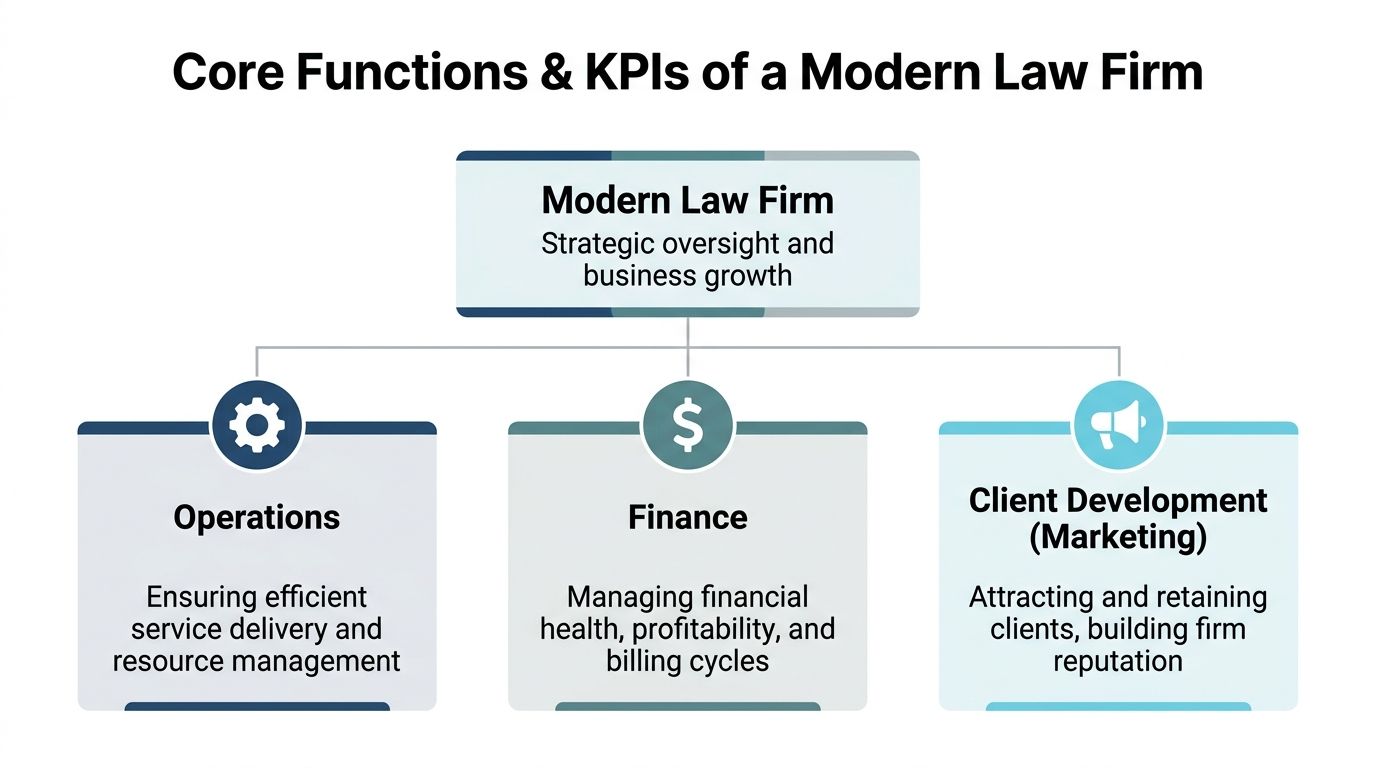
A modern plaintiff firm should be managed like three connected engines. Operations, Finance, and Client Development. If one underperforms, the others feel it.
Leaders get into trouble when they stare only at revenue. Revenue tells you the score after the play. It does not tell you why the play worked or failed.
Operations tells you whether the work can move
Operations is the delivery system. In a PI firm, that means intake handoff, records collection, treatment tracking, client updates, document collection, pre-suit workflow, litigation support, and escalation rules.
Good operations reduce waiting. Bad operations hide waiting.
The operational questions worth asking are simple:
- Where does work stall: Not in theory, but in actual day to day case progression.
- Who owns communication at each stage: If the answer is "whoever sees it first," the system is weak.
- What generates avoidable calls: Most firms know the top recurring questions without needing a survey.
A firm should track case movement and communication pressure. You do not need fancy dashboards to start. You do need discipline. If call volume around status requests is constant, if files sit untouched between milestones, or if intake quality varies by staff member, operations is where the fix starts.
For firms trying to strengthen front-end consistency, hiring support can help, but only if the role sits inside a real process. A practical example is using a dedicated intake function such as this resource on Hire intake specialist. The mistake is expecting one new person to solve a system problem without defined handoffs and scripts.
Finance shows whether effort becomes cash
Plenty of firms stay busy and still underperform financially because they measure too little.
The most useful financial metrics are not exotic. They are diagnostic.
According to Amicus Attorney's guide to law firm data insights, top-performing firms pay close attention to realization rate and utilization rate. The distinction matters.
- Utilization rate: How much of available time becomes billable work.
- Realization rate: How much of recorded billable work turns into collected revenue.
A firm can have strong utilization and weak realization. That means the lawyers are working, but discounts, write-downs, billing practices, or collections are dragging results. Leaders who miss this point often pressure lawyers to work harder when the actual issue sits in billing discipline or client payment behavior.
If utilization is healthy and realization is weak, the firm does not have a motivation problem. It has a management problem.
For a deeper look at operational reporting, this piece on https://casepulse.com/the-metrics-that-matter-why-law-firms-cant-improve-what-they-dont-measure/ is useful because it frames measurement as a decision tool, not a spreadsheet exercise.
Client development reveals whether demand is durable
Marketing in a plaintiff firm is not just advertising. It includes intake quality, response speed, referral handling, reputation, and the experience clients have once they sign.
A lot of firms pour money into lead generation and ignore the conversion path. That creates a false sense of growth. The phone rings, but the business does not improve in proportion.
The client development function should answer questions like these:
| Function | KPI focus | What it tells you |
|—|—|
| Operations | Case flow, update burden, service consistency | Whether the team can deliver without chaos |
| Finance | Realization, utilization, profit by lawyer or matter | Whether work turns into healthy revenue |
| Client Development | Intake quality, conversion discipline, retention and referral patterns | Whether demand is profitable and repeatable |
One practical rule matters here. Track handoff quality between marketing and intake. If marketing promises responsiveness but intake takes too long to respond, the firm is buying attention it cannot convert well. If intake signs clients who are a poor fit, operations and finance pay the price later.
The point of KPIs is not to impress anyone. It is to expose where the business leaks.
Leading the Change The Partner and Culture Shift
The hardest part of running a law firm as a business is not software. It is leadership behavior.
A managing partner cannot keep acting like the firm's best individual contributor while also expecting the business to mature. At some point, leadership has to move from doing everything important to building a place where important work gets done well without constant rescue.
The partner role changes first
In firms that make this transition cleanly, the lead partner starts doing less tactical triage.
That does not mean disengagement. It means a different focus:
- Set standards: Define what good intake, good updates, and good file progression look like.
- Delegate with structure: Give staff authority with clear boundaries.
- Review patterns, not just incidents: One upset client is a service event. Ten upset clients with the same complaint is an operational signal.
If partners still solve every routine bottleneck personally, staff never build confidence and systems never stabilize.
Staff need tools and trust together
Paralegals and case managers know where the friction lives. They hear the same questions all day. They know which steps get repeated, which documents go missing, and which updates clients ask for most often.
Leadership should ask them where the work gets stuck and then act on what they say.
That only works if the firm gives them two things:
- A clear process
- Enough authority to run it
Without process, staff improvise. Without authority, they escalate everything.
Culture improves when staff can answer common client needs confidently without waiting on partner approval for routine issues.
Modern culture also affects hiring and retention
The firms with the strongest long-term position feel organized from the inside. Good people notice that quickly.
By 2024, lawyers of color represented 23% of all U.S. lawyers according to Statista's legal services industry overview. Firms that build a modern culture are in a better position to attract and retain that growing talent pool.
This is not just a branding issue. It changes who wants to work there and who stays. A chaotic shop that relies on burnout, unclear expectations, and constant interruption will lose strong people. A disciplined firm with better systems and clearer roles gives talented lawyers and support staff room to do strong work.
What culture shift looks like in practice
Not slogans. Not retreats. Specific behaviors.
- Meetings use numbers and examples: Leaders discuss actual workflow issues, not just opinions.
- Process is documented: The firm writes down how work should move.
- Feedback is operational: Staff are encouraged to flag recurring friction, not hide it.
That is culture in business terms. It is what people do repeatedly when pressure rises.
A Practical Framework for Business Operations
Most firms do not need another abstract conversation about efficiency. They need a working operating model.
For plaintiff PI firms, that model should center on three flows. Intake, case progression, and client communication. If those flows are uneven, the rest of the firm spends its time compensating.
Build the firm around standard operating procedures
A standard operating procedure is not a corporate artifact. It is a way to keep the same mistake from showing up every week.
Start with the work that repeats most often.
Intake
Intake should not depend on who answered the phone. The firm needs a consistent path from first contact to signed client.
A practical intake SOP defines:
- Response ownership: Who replies first and who follows up if the prospect goes quiet
- Qualification rules: Which cases fit, which need attorney review, and which are declined
- Document collection steps: What information and forms are required before handoff
Good intake process creates cleaner files. Clean files reduce downstream confusion.
Case progression
Many plaintiff firms drift into inconsistency in case progression. One file moves aggressively because a strong case manager owns it. Another sits because no one is clearly responsible for the next action.
A useful SOP for case progression maps the matter by stage. Not every detail. Just the points where delay happens.
Examples include records requests, treatment follow-up, demand preparation, litigation handoff, and periodic status review. Each stage should have an owner, a trigger, and a next action.
Client communication
This is the bottleneck most firms underestimate.
Clients call because they do not know what is happening. Staff get buried because they answer the same questions repeatedly. Partners get dragged in because repeated silence turns normal delay into client anxiety.
That is why communication needs its own operating standard. The firm should decide:
| Communication issue | Operational rule |
|---|---|
| Routine status questions | Give clients a consistent way to check status without calling |
| Document exchange | Use a secure channel for file sharing and form completion |
| Escalations | Define when a case manager responds and when an attorney steps in |
Integration matters more than feature lists
Many law firms waste money on integration. They buy software that sounds useful but forces staff into a separate workflow.
If a plaintiff firm uses Needles, Neos, LawBase, or Litify, new tools should support the existing process rather than compete with it. If staff have to maintain another inbox or duplicate data entry, adoption drops fast.
The right legal operations setup is one where communication, documents, and reminders fit the current case management environment. The closer the technology sits to the firm's actual workflow, the more likely the team will use it consistently.
For a practical overview of how firms should think about this, https://casepulse.com/legal-operations-management/ offers a useful lens on legal operations as process design, not just software purchasing.
The best operational tool is usually the one staff can use without changing how they already manage the file.
Financial management has to connect to workflow
Bookkeeping tells you what happened. Business management asks why it happened.
For plaintiff firms, the useful move is linking financial review to operational stages. If certain matter types stall longer, if certain lawyers collect differently, or if one stage repeatedly creates write-offs or delay, leaders need to see that pattern.
You do not need a complex finance department to do this. You need regular review of where files sit, where communication breaks, and where the collection process weakens.
Brand is also an operational asset
Clients do not separate service from brand. They experience the firm through messages, forms, updates, document requests, and responsiveness.
That is why custom-branded client-facing tools matter operationally, not just cosmetically. A branded client experience signals professionalism and consistency. It reassures clients that they are dealing with an organized firm, not a loose collection of emails and callbacks.
In plaintiff work, where clients often feel uncertain and stressed, that matters more than many lawyers realize.
Implementing Change Without Disrupting Your Firm
Firms avoid operational change for one reason. They fear a messy rollout more than they dislike the current pain.
That fear is reasonable. A bad implementation can confuse staff, annoy clients, and create duplicate work. The answer is not to avoid change. The answer is to reduce the surface area of change.
Start with one friction point
Do not begin with a full firm overhaul. Begin with the issue everyone already agrees is a problem.
In plaintiff PI firms, that is often client communication. Too many updates happen by phone. Too many answers are repetitive. Too much staff time disappears into chasing, reminding, and reassuring.
A simple audit works well here. Ask:
- Which client questions repeat most often
- Where does staff spend the most avoidable communication time
- Which handoffs create the most confusion
This gives you a pilot target that matters.
Choose a pilot with visible payoff
The best pilot solves a real burden and has a short learning curve.
Client updates are a strong candidate because the pain is obvious to everyone. Clients want visibility. Staff want fewer interruptions. Leadership wants smoother case flow.
According to Elevate's discussion of law firm data strategies, firms using data-backed client portals can reduce inbound client calls by up to 40% by giving clients proactive, 24/7 access to case status, documents, and messaging. That is a meaningful implementation standard because it ties the change to a daily operational problem, not an abstract modernization goal.
Frame the rollout around staff relief
Many rollouts fail because leadership describes the change in terms that matter only to owners. Efficiency. Transformation. Optimization.
Staff care about whether the new process makes their day easier or harder.
A better rollout message sounds like this:
- Fewer repetitive status calls
- Less phone tag
- A simpler way to collect files and forms
- Fewer manual reminders
When staff can see the direct benefit, resistance softens.
People adopt new process faster when they believe it removes friction from work they already dislike.
Keep training narrow and practical
Do not train the whole vision. Train the next task.
For a communication pilot, that means showing staff how clients will receive updates, where messages are handled, how documents are shared, and when an issue still needs a live call.
Keep the rules concrete. For example:
| Implementation area | Good rollout practice |
|---|---|
| Pilot scope | Limit the first phase to one workflow, such as client communication |
| Team training | Train by role, using actual daily scenarios |
| Success review | Measure reduced call burden, faster response handling, and staff adoption |
This is also where low-friction deployment matters. If a tool can be set up quickly, supported well, and aligned to the firm's current system, the odds of a clean pilot go up. That is one reason firms often prioritize solutions with straightforward onboarding and hands-on support. A broader look at this kind of staged modernization appears in https://casepulse.com/digital-transformation-for-small-business/, which treats digital change as a sequence of operational wins rather than a single giant leap.
Measure before expanding
Do not call the pilot a success because people liked the demo. Measure what changed in the work.
Look at:
- Client status call burden
- Response backlog
- Staff time spent on repetitive follow-up
- Client adoption of the new communication path
You are building an internal business case. If the pilot reduces noise and staff can feel the difference, expansion becomes much easier.
What does not work
Some firms sabotage implementation by making three avoidable mistakes.
First, they launch too broadly. Everything changes at once, nobody knows the new rules, and staff build workarounds.
Second, they fail to assign ownership. If no one is responsible for adoption, everyone assumes someone else is handling it.
Third, they tolerate duplicate process for too long. If staff keep one foot in the old way and one foot in the new way indefinitely, the system never settles.
The best implementations are smaller, clearer, and stricter than most lawyers expect. That is why they work.
Common Questions About the Business of Law
Does treating a law firm like a business weaken professional ethics
No. It usually strengthens service. Better systems create clearer communication, cleaner handoffs, and more reliable follow-through. Clients benefit when the firm is organized.
Is this only relevant for larger firms
No. Smaller firms often need this discipline more because they have less room for waste. When a small team loses time to avoidable calls, missing process, or unclear roles, the impact is immediate.
What is the first thing to fix
Fix the client communication bottleneck first. In plaintiff PI work, that is often the highest-volume source of interruption and frustration. It affects clients, paralegals, case managers, and partners all at once.
Do I need to become a full-time CEO
No. You do need to lead like an owner instead of acting only like a technician. That means setting standards, reviewing performance, and refusing to let routine work remain chaotic.
Will staff resist more structure
Some will at first, especially if past changes created more work. Resistance drops when the new process is practical, role-based, and clearly removes friction from daily tasks.
What does success look like
Success looks quieter. Fewer avoidable calls. Less chasing. Better visibility into work. More consistent client experience. More attorney time spent on judgment instead of interruption.
If your firm is trying to reduce client update calls, automate routine follow-ups, and give clients a secure way to check status, message the team, share files, and complete forms without forcing staff out of Needles, Neos, LawBase, or Litify, CasePulse is worth a close look. It is purpose-built for law firms, supports custom branding, offers month-to-month pricing, and is designed for low-friction adoption with hands-on U.S.-based support.