
 CasePulse
 Personal injury case management software is the central command center for a modern PI law firm. Think of it as the digital brain of your practice, holding every critical piece of information for every case. Instead of juggling scattered emails, overflowing file cabinets, and clunky spreadsheets, this software organizes every detail into one secure, accessible place.
Why Your Firm Needs a Case Command Center

Personal injury litigation is a beast. It's defined by high case volumes, mountains of medical records, and unforgiving deadlines. This combination creates an environment where administrative overload is not just possible, it's practically guaranteed.
Relying on manual methods to track everything is more than just inefficient; it's a huge risk. A single missed statute of limitations or a misplaced expert report can tank a case and damage your firm's reputation for good. This is exactly the problem that purpose built software solves. It brings order to the chaos by automating the most demanding, repetitive parts of managing a case.
Moving Beyond Spreadsheets and Sticky Notes
Imagine logging in and seeing a single dashboard with the real time status of every case, every approaching deadline, and every recent client communication. That is what a dedicated platform delivers. It turns a mess of disorganized information into clear, actionable insights, letting your team focus on practicing law instead of chasing down paperwork.
But this technology isn't just a fancy digital filing cabinet. It's about building intelligent, repeatable workflows that guide each case from intake to settlement. The software takes over the heavy lifting for key administrative functions, such as:
- Centralized Document Management: Every file, from initial police reports to complex medical opinions, is stored and organized, ready to be pulled up in seconds.
- Deadline and Calendar Tracking: The system automatically monitors critical dates and statutes of limitation, sending alerts to prevent catastrophic errors.
- Structured Communication Logs: Every email, text message, and phone call note is logged directly in the case file, creating a complete, chronological record of all interactions.
Of course, case management is just one piece of the puzzle. A top performing practice uses a full suite of essential platforms for lawyers to run smoothly. But having the right case management system is foundational for any PI firm that wants to operate efficiently and scale.
The table below paints a clear picture of just how different the day to day reality is for a firm that has made the switch.
Comparing Manual vs. Software-Driven Case Management
| Task | The Traditional Manual Workflow | The Modern Automated Workflow |
|---|---|---|
| Document Retrieval | Searching through physical folders, email attachments, and various server directories. Often time consuming and unreliable. | Instant keyword search within a centralized digital case file. All documents are indexed and immediately accessible. |
| Deadline Tracking | Relies on manual calendar entries, sticky notes, and individual memory. Highly prone to human error. | Automated calendaring with rule based reminders for statutes of limitation and other key dates. Alerts are sent to the entire team. |
| Case Status Updates | Requires interrupting a colleague, searching through notes, or calling a client back after digging for information. | A real time dashboard shows the current stage, last activity, and next steps for any case, accessible to anyone on the team. |
| Generating Reports | A painful, manual process of pulling data from multiple spreadsheets and sources to build a caseload or financial report. | One click report generation for caseloads, settlement values, marketing sources, and team productivity. |
As you can see, the difference is not just about convenience. It is about fundamentally changing how your firm operates, reducing risk, and freeing up your people to do what they do best.
The real value of personal injury case management software lies in its ability to give your staff back their most valuable asset: time. By automating routine tasks, it frees up paralegals and attorneys to focus on high value work that moves cases forward.
Ultimately, making this shift allows your team to handle a larger caseload without ever sacrificing the quality of your work or your responsiveness to clients. It ensures that every single client receives the attention they deserve, which strengthens relationships and, in the end, drives better outcomes.
If you're exploring your options, our broader guide on the different types of legal case management software might be a helpful next step.
The Features Your PI Firm Absolutely Needs
When you're shopping for personal injury case management software, it's easy to get lost in a long checklist of features. But the real test is not about which platform has the most features; it's about which one solves the real world headaches your firm deals with every single day. The best systems are designed from the ground up to handle the unique, high stakes flow of a PI practice.
Getting this right is more important than ever. The market for this kind of software is exploding for a reason. Firms are finally getting serious about efficiency. The global case management software market was valued at USD 9.70 billion in 2023 and is expected to hit USD 26.82 billion by 2032. That's a huge jump, and it shows just how many of your competitors are investing in better tech. You can dig into more data on this legal tech trend to see where things are headed.
So, let's cut through the noise and talk about the core functions that will actually make a difference in your firm’s day to day operations and, ultimately, your bottom line.
Automated Statute of Limitations Tracking
For a personal injury lawyer, missing a statute of limitations is not just a mistake, it's malpractice. It's the kind of catastrophic error that keeps attorneys up at night. Trying to track these dates with manual calendar entries and sticky notes is just asking for trouble when you're juggling a heavy caseload.
This is where automated deadline tracking becomes your firm’s best line of defense. Good software calculates and monitors these critical dates automatically from the moment you open a file. As deadlines get closer, it sends out escalating alerts to the entire team, creating an unbreakable safety net that protects your clients, your reputation, and your practice.
This single feature is completely non negotiable. It turns deadline management from a constant source of anxiety into a reliable, automated process that just works, ensuring nothing ever slips through the cracks.
Centralized Document Management
Think about a single car accident case. It can easily generate thousands of pages of documents: police reports, witness statements, a mountain of medical records, expert opinions, and endless correspondence. When that information is scattered across email inboxes, local hard drives, and physical file cabinets, you're wasting time and inviting risk.
A centralized document management system fixes this by creating a single, secure digital home for every case. Every single document is organized, indexed, and instantly searchable. Imagine needing to pull up a specific MRI report from a case two years ago and having it on your screen in seconds instead of sending someone to a dusty storage unit. That is not a luxury; it's essential for building a strong case and responding confidently to opposing counsel.
Integrated Calendaring and Task Management
The calendar for a busy PI firm is a tangled web of client meetings, court dates, depositions, and internal follow ups. A great case management platform brings all of this into one master calendar that is synced and accessible to everyone on the team, wherever they are.
But it is about more than just scheduling. It is about creating accountability. You can assign tasks to specific team members, set due dates, and link those tasks directly to the case file. For instance, a paralegal can be assigned the task of "Order medical records from St. Mary's Hospital," and you can see its status until it's marked complete. This kind of transparency keeps cases moving forward and makes sure everyone knows exactly what they're responsible for.
- Integrated Time and Expense Tracking: Many platforms also let you log billable hours and track every case related cost. This is crucial for ensuring every single expense is captured for the final settlement and for keeping your firm’s financials crystal clear.
- Built in Conflict of Interest Checks: Before you even agree to represent a new client, the software can run a quick search against your entire database to flag any potential conflicts. This simple, automated step is a powerful shield against serious ethical breaches and future legal headaches.
Detailed Reporting and Analytics
At the end of the day, you can't improve what you don't measure. As a firm owner or partner, you need a clear, honest picture of your business's health, and that requires data. Good software gives you a reporting dashboard that shows you key performance indicators at a glance.
These dashboards can track where your best cases are coming from, average settlement values, individual attorney workloads, and overall firm profitability. This is not just about numbers; it is about insight. This data empowers you to make smarter business decisions, spot bottlenecks in your workflow before they become major problems, and figure out where to best invest your resources. It turns your case files into a strategic asset for growth.
How New Software Integrates with Your Current Systems
Let's be honest, one of the biggest roadblocks to adopting new tech at a law firm is the fear of total disruption. Nobody wants to hit pause on active cases just to migrate data or force the entire team through a painful retraining process. The very thought is enough to make you stick with what you know, even if it is not working perfectly.
But here is the thing: the right software does not force you to rip everything out and start over. Instead, it is designed to plug into and enhance the systems and workflows you already have in place.
Think of your core case management system, your Needles, Neos, LawBase, or Litify, as the central nervous system of your firm. It's your single source of truth for every case file, deadline, and document. The real magic happens when that system can seamlessly connect with your other essential tools. This is what we call integration.
Connecting Your Firm’s Most Important Tools
Without strong integrations, your firm’s tech stack becomes a bunch of disconnected islands. Your accounting software doesn't talk to your case files. Your email client is completely separate from your document storage. This is where mistakes happen and time gets wasted.
Good integrations build bridges between these islands, creating a unified ecosystem where information flows automatically. This eliminates the soul crushing task of manual, duplicate data entry, a major time sink and a huge source of clerical errors. For any firm already invested in an established platform, making sure new tools can "play nice" with it is non negotiable.
The goal isn't to replace what works; it's to make it work better. Smart integrations let your team keep using the tools they know, but with new capabilities layered on top that make their jobs fundamentally easier.
The infographic below shows how these core functions of a PI practice, from deadlines to documents, are all interconnected through a central system.
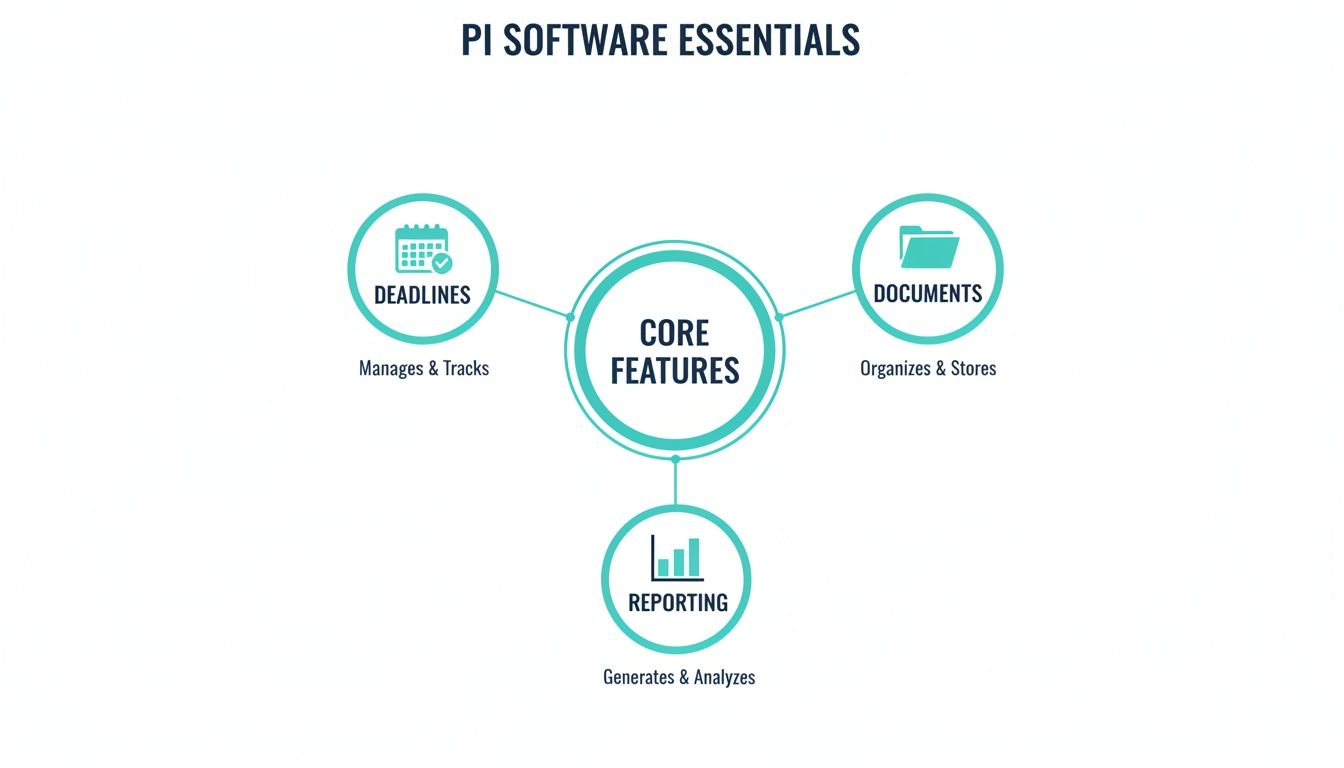
When these pillars are properly connected, your whole practice runs more smoothly. Deadlines are automatically tracked, documents are organized, and reporting becomes a simple click instead of a frantic scramble.
How a Client Portal Fits Into Your Existing Workflow
So, where does a specialized tool like a client portal fit into this picture? A common misconception is that it is just another piece of software your team has to learn, log into, and manage separately.
That couldn't be further from the truth.
A purpose built client portal like CasePulse is engineered to be an extension of what you already use. It is not a standalone system; it's a new "front door" for your clients that connects directly to the case management software your team lives in every day. It works with the most common platforms in the PI world:
- Needles and Neos: Your paralegals and attorneys continue working in Needles/Neos, and the portal automatically pulls key case updates to share with the client. No extra steps.
- LawBase: Staff can share documents and send messages to clients without ever having to leave their familiar LawBase dashboard.
- Litify: The immense power of an enterprise system like Litify is magnified when you can securely expose relevant case data directly to your clients through an integrated portal.
The integration is what makes it all work. Your team continues to manage cases, log notes, and upload documents just like they always have. The portal does the heavy lifting in the background, making that information securely available to your clients whenever they need it.
This means there's no new inbox for your team to monitor or a separate platform to keep updated. They work where they're comfortable, and the portal automatically handles the client communication piece. You give clients the modern, on demand experience they expect without adding a single second of work to your team's day. It is the definition of a win win.
When it comes to picking new case management software, one of the first and biggest decisions your firm will face is where that software will actually live. Are you going to host it yourself on your own servers, or will you access it over the internet? This choice between a "cloud based" system and a traditional "on premise" setup will ripple through everything from your budget and IT needs to your firm's security and your team's ability to work from anywhere.
Let's break down what these terms really mean for your practice.
On-Premise: The DIY Approach
An on premise solution is exactly what it sounds like. You buy the software license, you buy the physical servers, and you install it all right there in your office. Think of it like owning a house. You have total control over the property. You can paint the walls any color you want, and nobody can tell you otherwise.
But all that control comes with a whole lot of responsibility. You're the one on the hook for purchasing those expensive servers, keeping them cool and running, and handling every single software update and security patch. This almost always means you need a dedicated IT person on staff or an IT consultant on speed dial, which quickly becomes a major, ongoing expense.
The Cloud: Handing Off the Headaches
Cloud based software flips that model on its head. Instead of a massive upfront purchase, you pay a predictable subscription fee to a provider who handles all the heavy lifting behind the scenes. The software and all your data are hosted on their highly secure, remote servers, and your team just needs an internet connection to log in.
This means the provider takes care of all the security, maintenance, backups, and updates. Your firm gets all the power of a top tier system without the capital expense and constant hassle of managing the tech that runs it.
This is not some niche trend; it's the direction the entire legal tech world is heading. Cloud based tools are quickly becoming the new standard, with recent data showing that 71% of firms are now using them. It's a huge part of a market expected to balloon from USD 8.26 billion to USD 24.09 billion by 2034, all driven by the simple need for smarter, more secure ways to work. If you're interested in the numbers, you can explore the full market analysis from Precedence Research.
What Matters Most for Your PI Firm?
For a personal injury firm, this decision is about more than just convenience. There are a few critical factors that can make or break your day to day operations.
- Data Security & HIPAA Compliance: On premise gives you physical control, sure, but top cloud providers can almost always offer a level of security that a single law firm could never afford on its own. They have entire teams of cybersecurity experts and use military grade encryption to protect sensitive client information and keep you compliant with regulations like HIPAA.
- Access from Anywhere: The days of being chained to your office desk are over. Your attorneys and paralegals need to access case files securely from the courthouse, a client's living room, or their own kitchen table. Cloud software is designed for this reality, giving you safe access from any device.
- Scaling with Your Success: What happens when you land a big case and need to bring on more staff, fast? With an on premise system, you'd be scrambling to buy and install more server hardware. With a cloud solution, you just update your subscription. The software grows right alongside your practice, without missing a beat.
- The True Cost: The sticker shock of on premise servers and software licenses is real. While a cloud subscription is an ongoing operational cost, it's predictable. It eliminates the surprise expenses of IT salaries, hardware failures, and emergency repairs, often leading to a much lower total cost of ownership over time.
For most modern PI firms, the flexibility, enhanced security, and predictable costs of a cloud based system make it the clear strategic choice. It lets you focus your time and money on what you do best: practicing law, not playing IT manager.
How a Client Portal Transforms Firm Efficiency
A distinction worth keeping in mind while you evaluate: CasePulse is not a case management system and does not replace the one you choose — it is the client-facing layer on top. It connects to Neos, Needles, LawBase, and Litify and handles the portal side: automated status updates, secure messaging, smart forms and file exchange, all under your firm’s branding. If you are settled on your platform and the gap is client communication, the integrations pages cover each supported system, and a demo can run against your workflow.
Once you've tightened up your internal workflows, the next big win for efficiency is all about how you interact with your clients. This is where a dedicated client portal, one of the most powerful tools in modern personal injury software, comes into play. It’s essentially a secure, private digital hub for every client.

This single addition is a direct solution to one of the biggest time sinks in any PI firm: the constant barrage of calls and emails from clients asking, "What's happening with my case?"
Ending the Communication Bottleneck
A well designed client portal like CasePulse automates these routine check ins, giving both your clients and your staff precisely what they need. It offers a single, firm branded space where clients can get answers on their own time.
This self service model is a total game changer for productivity. Think about it: instead of a paralegal spending hours every week fielding the same basic questions, that time is freed up for high value work that actually pushes cases toward settlement.
Key functions of an integrated portal usually include:
- 24/7 Case Status Access: Clients can log in anytime, from any device, to see the current stage of their case. No more waiting for your office to open for a simple update.
- Secure Two Way Messaging: All conversations happen right inside the portal. Every message is automatically logged to the correct case file in your management system, creating a perfect, time stamped record without anyone lifting a finger.
- Easy Document and Photo Sharing: Clients can snap photos of their injuries or the accident scene on their phone and securely upload them on the spot. Your team can just as easily share documents back for their review.
The real magic is the double sided benefit. Clients feel more informed and in control, which skyrockets their satisfaction. Simultaneously, your staff reclaims hundreds of hours by cutting out the back and forth of routine communication.
A Win for Clients and Your Bottom Line
This shift in communication does more than just save time; it builds trust. And in the attorney client relationship, trust is everything. Anxious clients become confident partners when they have direct, transparent access to information. Some firms are even pairing their portals with a legal chatbot to provide instant answers to frequently asked questions, further improving the client experience.
A good portal fundamentally changes the dynamic from reactive to proactive. You're no longer just responding to client inquiries. You're giving them the tools to stay informed from the start.
Ultimately, this efficiency boost directly impacts your firm's capacity. When your team is not bogged down in administrative follow ups, they can manage their caseloads far more effectively. That's how you create the bandwidth to serve more clients without ever compromising on service quality. You can learn more about what to look for when choosing the best client portal software to get these results for your own firm.
How to Calculate the Return on Your Software Investment
When it is time to talk about new personal injury case management software, the conversation with partners almost always starts with the price tag. But the sharpest firms know that is the wrong place to begin. The real conversation is not about cost; it’s about value. Figuring out the true return on investment (ROI) means looking past the initial expense and focusing on what you gain in efficiency, caseload capacity, and client happiness.
A proper ROI calculation has two sides. First, you've got your "hard ROI," which is all the direct, measurable financial wins you can see on a spreadsheet. These are the numbers that make the investment a no brainer.
Then there is the "soft ROI." These are the benefits that are a bit harder to quantify but are absolutely vital for the long term health and growth of your firm. Think of these as the gains that build a stronger, more efficient, and more respected practice.
Measuring the Hard Financial Gains
Hard ROI is where the software clearly pays for itself. You’ll see it in the measurable improvements to your daily operations and your bottom line.
These gains usually pop up in three main areas:
- Reduced Administrative Costs: Automation takes over the tedious, non billable tasks that eat up your staff's day. Imagine the hours saved by generating documents automatically, logging every communication, and sending out deadline reminders without anyone lifting a finger.
- Increased Case Capacity: With faster, more organized workflows, your current team can handle more cases without getting buried or letting quality slip. That translates directly into more revenue without having to expand your payroll.
- Improved Time and Expense Capture: When your tracking tools are built in, every minute of work and every case related expense gets logged accurately. This stops revenue from slipping through the cracks and helps you maximize the value of your settlements.
Understanding the Equally Important Soft Returns
Soft ROI is all about the powerful, strategic advantages that don’t show up on an invoice but are the real drivers of sustainable growth. These are the benefits that strengthen your firm from the inside out.
Investing in the right technology is also an investment in your people and your brand. It reduces the daily friction that leads to staff burnout and gives clients the transparent, responsive experience that earns five star reviews.
You'll see this kind of return in a few critical ways:
- Better Client Satisfaction and More Referrals: Clients who can check their case status 24/7 and communicate easily through a secure portal feel confident and cared for. Happy clients become your best marketing tool, driving great online reviews and a steady stream of word of mouth referrals.
- Higher Staff Morale and Retention: Taking the mind numbing administrative work off your team’s plate and giving them tools that actually make their jobs easier is a massive morale booster. A happy, less stressed team is a productive team, and you’ll save a fortune on recruiting and training new people. You can read more about how the right platform acts as a powerful CRM for lawyers to improve both client and staff relationships.
- Mitigated Firm Risk: Stronger security measures and automated deadline tracking create a serious safety net. This drastically lowers the risk of data breaches, malpractice claims from missed statutes, and other expensive mistakes that can wreck your firm’s finances and reputation.
As the legal tech market continues to boom, these benefits only get bigger. Personal injury firms are operating in a market valued at USD 2.37 billion in the U.S. alone, with projections hitting USD 7.05 billion by 2034. Many are now using AI tools to instantly pull key information from medical records, which cuts down review time and helps them spot high value cases faster, a direct boost to the firm’s revenue. You can read more about these PI case management software trends and how they’re making an impact.
By looking at both the hard numbers and the soft benefits, you can build a rock solid case for an investment that will pay for itself for years to come.
Frequently Asked Questions
It's natural to have a few questions when you're thinking about new software for your firm. Let's tackle some of the most common ones we hear from personal injury attorneys who are looking to make a change.
How Long Does It Take to Implement New Software?
The honest answer? It depends. The timeline hinges on the complexity of the software and the size of your firm. The good news is that modern, cloud based tools are worlds away from the lengthy, disruptive installations of old on premise systems.
A client portal like CasePulse, for instance, can be up and running in about a week. Because it integrates directly into the case management system you're already using, there's no major transition. You can start inviting clients and reaping the benefits almost right away. The trick is to partner with a provider who offers real, hands on support to walk you through it.
Is My Firm's Data Secure in a Cloud-Based System?
This is a big one, and rightly so. The short answer is yes, absolutely. Reputable cloud software providers live and breathe security. They have to. They use advanced encryption, run constant security audits, and have automatic backups in place to guard your firm's most sensitive data.
In fact, the security measures they have in place are often far more robust than what a single law firm could manage on its own. Just make sure you're working with providers who are fully compliant with data privacy laws like HIPAA and GDPR. That's how you know both your firm and your clients are protected.
Will My Staff Need a Lot of Training?
The best software doesn't force you to change how you work. It fits right into your existing process. When a tool is designed to be intuitive and integrate seamlessly with the systems your team already knows, the learning curve is surprisingly small.
A platform like CasePulse is built so your staff never has to leave their primary case management system. This completely eliminates the need for them to learn a new piece of software. Always look for a vendor that provides excellent, US based support to ensure a smooth transition for everyone.
What if Our Firm Grows or Our Needs Change?
This is where modern cloud based platforms really shine. They're built for growth. Scalability isn't an afterthought; it's a core feature.
As your practice expands, you can add more users, handle more cases, and unlock new features without having to make another huge investment in hardware or software licenses. Look for flexible, month to month pricing plans that let you adjust your subscription as your caseload fluctuates. It’s the smart way to ensure you're only paying for what you actually use.
Ready to see how a client portal can boost your firm's efficiency and make your clients happier? With CasePulse, you can give clients the 24/7 access they crave without adding a single task to your team's plate. Find out more at https://www.casepulse.com.