
 CasePulse
 Poor communication drives a large share of malpractice exposure. Managing partners who still treat the attorney client relationship as a soft skill issue usually find the cost elsewhere, in status calls, delayed approvals, frustrated staff, fee disputes, and preventable claims.
The point is operational control. Firms with clear communication rules tend to move matters with fewer interruptions. Firms that rely on scattered inboxes, one-off phone updates, and individual memory create avoidable friction for clients and avoidable risk for the firm.
Client expectations have changed. Legal consumers now expect digital access, timely updates, and a simple way to see what is happening without calling the office. That expectation matters most in practices with long case timelines and uneven visible progress, especially plaintiff personal injury. If the firm does not make progress visible, clients often assume nothing is happening.
The practical fix is not more reminders to "communicate better." It is a workflow that makes communication routine. Client portals connected to the case management system give clients a single place to check status, review documents, send questions, and track next steps. That reduces inbound noise, shortens response loops, and creates a cleaner record if a communication dispute later turns into a risk issue. Firms that want better client satisfaction through clearer legal communication workflows usually do better when they standardize the system, not just the script.
That same system also supports growth. A client who feels informed is more likely to leave a useful review, refer work, and give the firm material for how to collect impactful social proof.
Why Client Relationships Define Your Firm
Most firms still talk about attorney client relationships as if they live in the domain of bedside manner. That misses the point. In practice, the relationship is a production system. It affects how many inbound calls your staff fields, how often clients chase updates, how fast documents come back, how many complaints get escalated, and whether small misunderstandings harden into bigger disputes.
The operational problem is inconsistency. A partner may believe the firm is responsive because substantive calls happen at key moments. The client often judges the firm by the gaps between those moments. Silence feels like neglect even when work is happening behind the scenes.
What managing partners should treat as a business issue
A strong relationship does three jobs at once:
- It protects trust: Clients are more likely to stay calm when they know what is happening and what comes next.
- It protects staff time: Fewer "just checking in" calls reach the front desk when updates are easy to access.
- It protects the firm: Clear communication habits reduce the chance that a disappointed client reframes a process failure as legal neglect.
Practical rule: If a client has to guess whether the firm is working on the case, the firm has already created unnecessary risk.
That doesn't mean every matter needs high touch hand holding. It means every matter needs a repeatable communication system. Firms that want better reviews and stronger referral momentum should also get disciplined about collecting client feedback in a structured way. A practical reference on how to collect impactful social proof is useful because it shows how to capture the client voice without relying on vague anecdotes.
Client satisfaction also improves when communication is designed, not improvised, making operational guidance on improving client satisfaction in law firms more relevant than another generic customer service checklist. The firms that perform well don't just tell lawyers to communicate more. They define when updates happen, who sends them, where they live, and how the client can respond.
Understanding How a Relationship Legally Forms
The legal relationship often starts earlier than lawyers think it does. That matters because once the relationship forms, duties attach whether the firm has finished its paperwork or not.

The standard is simple in theory and dangerous in daily practice. A person seeks advice or assistance from an attorney, and the attorney appears to give, agrees to give, or gives that advice or assistance. The key issue is the client's reasonable belief that representation exists. The Louisiana State Bar practice aid explains that this is the hinge point, and it notes that 35 to 45% of casual consultations result in unintended attorney client relationships in the materials summarized at the LSBA practice aid guide.
Where firms get into trouble
This usually doesn't happen because a lawyer signs the wrong retainer. It happens because the intake experience is blurry.
A prospective client calls after an accident. Someone at the firm asks detailed questions, comments on the likely value of the case, promises to "get started," and invites the person to send records. No engagement letter goes out that day. Internally, the team still thinks the matter is under review. Externally, the person often believes they already have a lawyer.
That gap is where trouble starts.
- Informal advice creates expectations: A quick opinion can sound like legal guidance the client should rely on.
- Warm handoffs create implied commitments: When staff members speak as if the matter is active, clients hear acceptance.
- Portal or message access changes perception: If a person can message the firm in a client-facing system, that often strengthens the belief that representation exists.
Duties begin before firms feel ready
Once that belief is reasonable, the firm can't treat communication casually. Core duties follow, including the duty to communicate under Rule 1.4. That has operational consequences for intake, non engagement letters, response protocols, and who is allowed to say what during screening.
A retainer helps document the relationship. It doesn't always control when the relationship actually began.
The firms that handle this well don't rely on disclaimers buried in email footers. They build intake steps that clearly separate consultation, review, engagement, and non engagement. Every transition should be documented. Every client-facing message should match the firm's actual status.
If your process leaves room for "I thought you were my lawyer," then your process needs work, not better excuses.
The Core Duties of Trust and Confidentiality
Once the relationship exists, trust stops being abstract. It becomes a set of duties that shape how your firm stores, sends, and separates information.
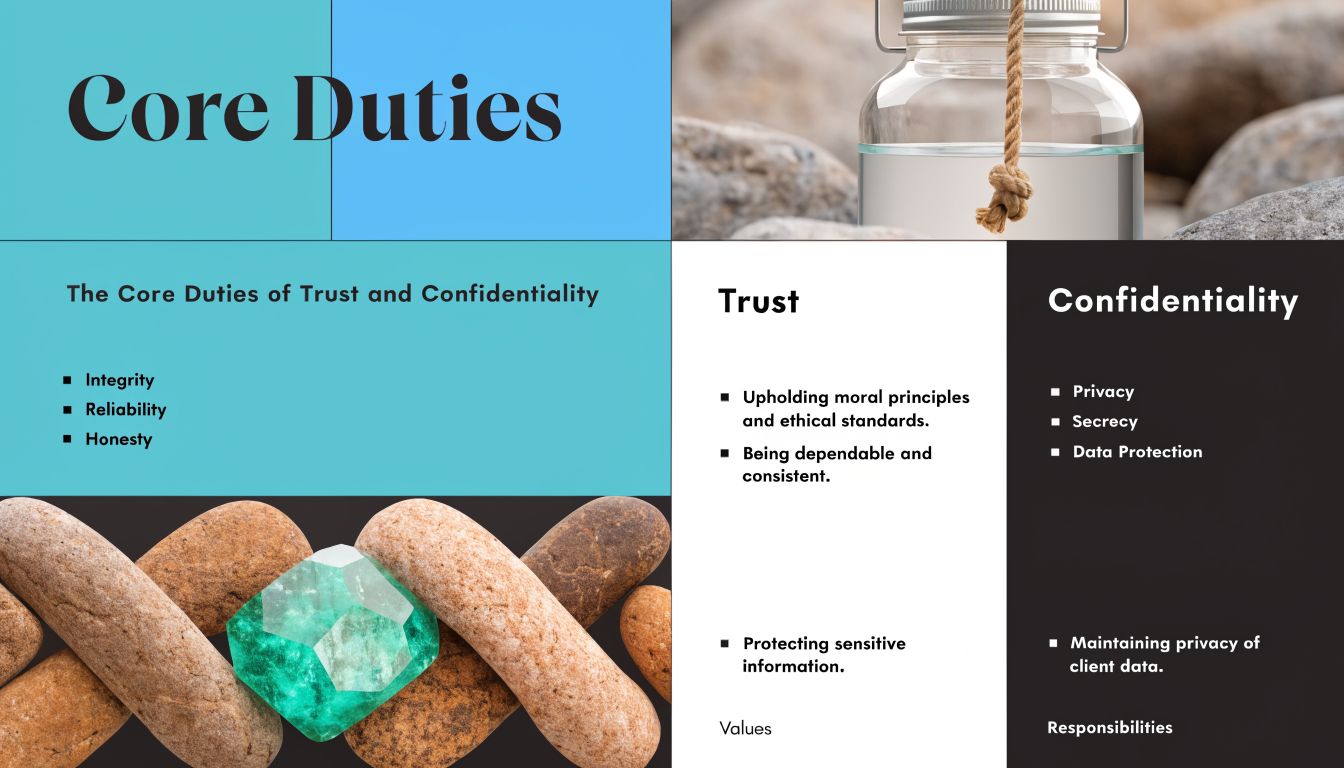
Confidentiality and privilege are related, but they aren't the same thing. Firms get into trouble when they treat all communication as a single stream. The operational reality is more nuanced. Some messages are legal advice or strategy. Others are administrative updates about appointments, records, filing dates, or forms.
The distinction matters because, as Texas Law Help's explanation of the attorney client relationship states, attorney client privilege protects confidential information and, in criminal cases, any fact the lawyer learns because of the relationship. That creates a practical requirement for communication systems. They need to architecturally segregate privileged legal advice from non privileged administrative updates to reduce the risk of waiver.
Why ordinary communication habits fall short
Email is convenient, but convenience isn't the same as control. Standard inboxes encourage forwarding, copying, mixing threads, and loose file handling. The same problem appears when firms use generic messaging habits for everything from legal analysis to appointment reminders.
That creates at least three avoidable problems:
- Mixed threads: Strategy discussions and routine logistics end up in the same chain.
- Weak boundaries: Staff may send sensitive material through channels designed for general business use.
- Poor auditability: When a dispute arises, the firm struggles to show what was sent, by whom, and in what context.
This is one reason firms should think seriously about cybersecurity planning for law firms. Security isn't only about stopping outside threats. It's also about controlling internal communication patterns that can compromise confidentiality.
Loyalty also lives in process
Trust isn't just secrecy. It's also disciplined handling of the client's matter. That includes conflict checks, role clarity, and consistent communication boundaries. A client who doesn't know whether they're talking to a lawyer, a case manager, or an intake coordinator is more likely to misunderstand what the firm has promised.
The safest communication system is the one that makes the right action the default action.
That is the operational standard firms should aim for. Don't ask busy lawyers and staff to remember distinctions in the middle of a packed day. Build channels and workflows that enforce those distinctions.
Where Attorney Client Communication Breaks Down
Clients rarely begin by criticizing legal analysis. They begin with a simpler complaint: they did not know what was happening, what the delay meant, or when they would hear from the firm again.
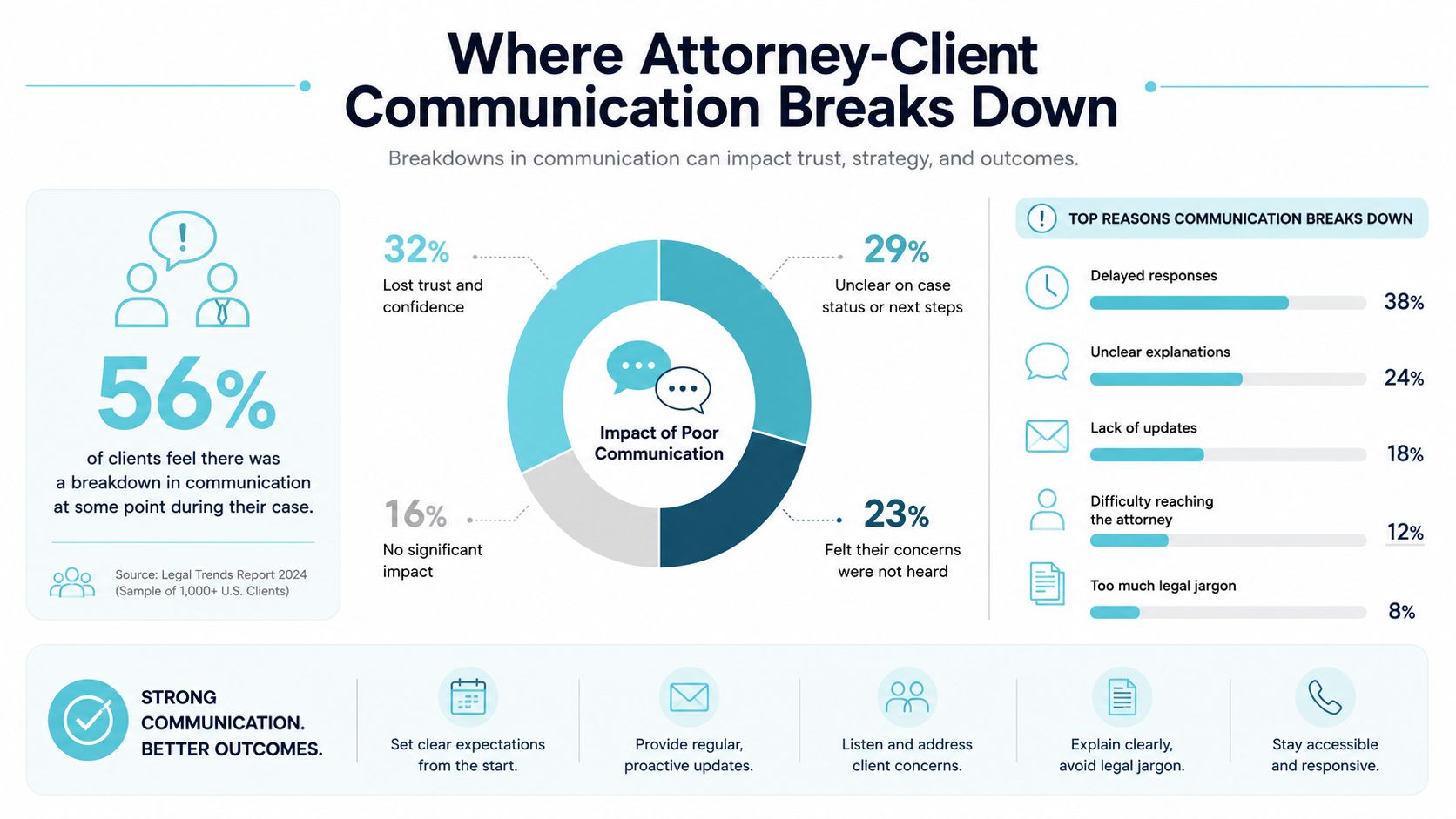
That gap usually comes from operations, not intent. Lawyers believe the matter is moving because work is happening. The client sees silence. Internal notes, draft pleadings, and hallway updates do not count as communication unless they reach the client in a form the client can understand.
The breakdown usually follows a familiar pattern. No one owns the update cadence. Status lives in the case management system, email inboxes, and staff memory instead of one client-facing workflow. Routine questions then pile up at the front desk, bounce to a paralegal, and interrupt the lawyer who should be focused on judgment work.
The result looks like a service problem, but it is also a risk problem.
Clients lose confidence when calls are not returned, timelines are not explained, or legal terms go untranslated. They get more anxious when weeks pass without a touchpoint and there is no easy way to check status on their own. By the time a client says the firm is unresponsive, the file often already contains the warning signs: repeated inbound follow-ups, inconsistent answers from different team members, and no clean record of what the client was told.
That perception gap is expensive. It drives avoidable phone traffic, duplicate explanations, and last-minute escalations. In plaintiff practices especially, one missed update can trigger three or four more contacts that consume receptionist time, case manager time, and attorney time without moving the matter forward.
It also affects growth. Firms investing in marketing and finding legal clients in the AI era lose value quickly if intake promises a responsive experience that the delivery model cannot support.
A better test is simple: can the client get the next routine answer without calling the office? If not, the firm has built a communication dependency that does not scale. Secure client portals for law firms that connect with case management systems address that dependency by giving clients one place to view updates, exchange documents, and send messages inside a controlled workflow.
That does not replace personal communication. It reserves lawyer time for advice, strategy, and difficult conversations, while the system handles status visibility, document collection, and message tracking. That is how firms reduce friction, protect margins, and lower the chance that a communication lapse turns into a grievance or malpractice claim.
Building Strong Relationships with Modern Workflows
Remote service is no longer a side channel. Clients now expect the same clarity from a law firm that they get from their bank, doctor, or insurance carrier. Firms that still rely on phone tag and scattered email create a service model that costs more to run and is harder to defend when a client says, "No one told me."
The operational question is straightforward: which communications require legal judgment, and which should run through a defined process?
That distinction matters. A strategy discussion, bad news call, settlement recommendation, or expectation-setting conversation belongs with a lawyer or trained case manager. Status visibility, document requests, reminders, intake follow-ups, and routine messaging belong in a system that records what was sent, when it was sent, and whether the client received it.
Firms that get this right reduce two problems at once. They lower avoidable service work, and they create a cleaner record if a complaint, fee dispute, or malpractice allegation later turns on communication.
What the workflow should do
A modern client communication workflow should answer routine questions before they become interruptions. It should also keep staff from re-entering the same information across inboxes, voicemail, and the case management system.
The practical shift looks like this:
| Task | Traditional Method (High Friction) | Modern Method (Low Friction) |
|---|---|---|
| Case status check | Client calls office and waits for callback | Client views status in a secure portal |
| Routine update | Staff leaves voicemail or sends scattered emails | Update appears in one client-facing location |
| Document collection | Client emails attachments or drops papers off | Client uploads files through a secure workflow |
| Form completion | Staff mails forms or repeats questions by phone | Client completes fillable forms on any device |
| Follow-up reminders | Staff manually tracks each outreach | Routine reminders are automated |
| Client messaging | Messages spread across inboxes and phones | Messages stay in a designated communication channel |
This is not about replacing personal service with software. It is about reserving personal service for the moments that require it.
The highest-value change is system integration
Many firms add a portal, then create a second administrative burden because staff have to update two systems. That usually fails. If the communication tool does not connect to the case management system your team already uses, adoption slips, records become incomplete, and lawyers go back to email and phone.
The better approach is a portal that works inside the firm's existing operating model. Client portals for law firms that integrate with case management systems let clients check status, send messages, share files, and complete forms without forcing staff into a separate communication process. For firms on Needles, Neos, LawBase, or Litify, that matters because efficiency gains only hold if updates flow through the same file the team is already managing. CasePulse is one example of that model.
Clients need one reliable place to understand the state of their matter.
Set expectations clearly at the start. Tell clients where updates will appear, what the firm will send automatically, how to ask non-urgent questions, and when they should expect a direct call from a lawyer. That simple operating discipline reduces confusion and makes response time more predictable for the team.
There is also a business development angle. Firms investing in finding legal clients in the AI era should treat post-signup communication as part of the client acquisition system, not an afterthought. Marketing creates demand, but workflow determines whether that demand turns into trust, referrals, and profitable files.
How to Measure and Manage Relationship Strength
Firms that measure relationship strength well usually have fewer service disputes, cleaner handoffs, and less time wasted answering the same question twice. That result does not come from intuition. It comes from tracking whether communication is clear, timely, documented, and tied to the file your team is already managing.
Managing partners should review relationship health the same way they review intake conversion, cycle time, or case expenses. If a client relationship weakens, the first signs usually show up in operations before they show up in a bar complaint, a write-off, or a negative review.
Operational Metrics That Matter
Start with a small set of measures your team can review every week and act on quickly:
- Status inquiry volume: Count how many inbound calls, emails, or portal messages ask for basic updates. A high volume usually means clients do not know where to find current case status.
- Response time by channel: Measure how long it takes to answer client questions in email, phone, and portal workflows. Long delays often reflect poor routing or unclear ownership.
- Document completion time: Track how long clients take to return forms, records authorizations, or requested files. Slow turnaround often points to confusing instructions or too many steps.
- Open message backlog: Review unanswered client messages by age and matter type. A growing backlog is an operations problem with risk implications, not just a staffing inconvenience.
- Non-engagement follow-through: Confirm that declined matters receive clear written non-engagement communication and that the record is stored in the correct system.
- Feedback patterns: Watch for repeated comments such as “I wasn't sure what happened next” or “I did not know you needed that from me.” Those phrases usually point to a workflow gap, not an isolated service issue.
For firms that want a simple framework for collecting and organizing client feedback, these customer experience management templates can help. The value is not the survey itself. The value is a repeatable process for spotting confusion early, before it turns into churn, write-downs, or allegations that expectations were never set.
Documentation Quality Is Part of Relationship Strength
Client satisfaction matters, but it is not enough. A strong relationship is also traceable.
That means the firm can confirm what was sent, when it was sent, who sent it, whether the client opened it, and how the matter status changed afterward. If those records sit across inboxes, voicemail, and staff memory, the firm is exposed. If they sit inside a portal tied to the case management record, supervisors can audit them, lawyers can rely on them, and staff can manage follow-up without chasing fragments.
This is the operational advantage of integrated communication. It gives the firm a way to measure whether the relationship is being maintained consistently, not just whether a client seemed happy at the last call.
A useful test is simple: when a client says, “No one told me,” can your team verify the communication history in minutes? Firms that can answer yes are in a better position operationally and defensibly.
The Future of Your Firm Is Relational
Attorney client relationships have always been central to legal practice. What's changed is the operating environment around them. Clients expect visibility, responsiveness, and digital convenience. Firms still have the same ethical duties, but they now need workflows that make those duties sustainable at scale.
The old model asked lawyers and staff to carry too much of the communication burden manually. That creates delay, inconsistency, and unnecessary risk. A modern model gives clients a dependable way to check status, exchange information, and stay connected without forcing the firm into constant reactive work.
For managing partners, this is a practical decision. Better communication lowers friction. Lower friction improves satisfaction. Better documented communication also puts the firm in a stronger position when questions arise about service, expectations, or relationship formation.
The firms that will hold up over time aren't necessarily the firms with the loudest marketing or the biggest headcount. They're the firms that make trust visible in the day to day client experience.
If your firm wants a cleaner way to manage updates, secure messaging, forms, and file sharing inside the systems you already use, CasePulse is worth evaluating. It gives plaintiff and litigation teams a secure client portal that connects with case management workflows so clients can stay informed without creating another inbox for staff to manage.