
 CasePulse
 Marketing spend is up. Your intake team says the phones are busy. Your partners still ask the same question at the end of the month: why aren't signed cases moving the way they should?
That's where a lot of firms start looking for a Law Firm SEO Expert. Sometimes that's the right move. Sometimes it's a costly misdiagnosis.
In a plaintiff firm or a larger practice, SEO isn't a side project. It sits close to revenue. But before you hire anyone, you need to know whether your bottleneck is discovery or what happens after discovery. A firm can rank well, show up in local search, and still lose work because follow up is slow, trust signals are weak, or clients get friction the moment they reach out.
Is an SEO Expert Really What Your Firm Needs Now
A managing partner usually feels the problem before they can name it. Website traffic looks respectable. Branded searches are steady. Google Business Profile gets attention. But signed cases stay flat, and the intake team blames lead quality.
That diagnosis is often too convenient.
Independent legal marketing statistics report that 96% of people seeking legal advice use a search engine and 62% of legal searches are non branded, which means many prospects are searching by problem or practice area before they know your firm's name, according to legal SEO statistics compiled by The Trust Agency. If your firm is invisible for those searches, you have a real top of funnel problem. If you're visible and prospects still don't convert, your issue may sit somewhere else.

Signs you probably need SEO help
A real SEO problem usually looks like this:
- Practice pages don't pull their weight: Your core service pages are thin, duplicated, or too broad to rank for high intent searches.
- Geographic coverage is weak: You serve several markets, but your site doesn't reflect how people search by city, county, or region.
- Your firm depends too heavily on brand demand: You get found when people already know your name, but not when they search by case type.
- Local search assets are inconsistent: Listings, attorney profiles, and page signals don't align well enough to support local visibility.
If that sounds familiar, it's worth reviewing a more tactical breakdown of SEO for law firms.
Signs SEO may not be the main problem
Some firms chase traffic when the actual problem sits in intake and client experience.
Practical rule: If prospects already find you through brand searches or local profile views, the next dollar may belong in faster follow up, cleaner handoffs, and better communication, not more traffic acquisition.
That shows up in a few predictable ways:
- Response lag: A lead comes in after hours and waits too long for meaningful contact.
- Trust erosion: The site gets the inquiry, but the next steps feel uncertain, generic, or difficult.
- Poor handoff discipline: Marketing says the lead was qualified, intake says it wasn't, and no one can trace what happened.
- Client friction: Prospects and clients call repeatedly because they can't easily check status, send information, or complete tasks.
A strong Law Firm SEO Expert should be willing to tell you when SEO is not the first fix. If they can't do that, they're probably selling a channel, not solving a business problem.
Defining the Ideal SEO Expert Profile for Your Firm
A generic digital marketer isn't enough in a competitive legal market. You need someone who understands search intent, local trust signals, technical site health, and the commercial reality of case acquisition.
The baseline is strategic discipline. A high quality law firm SEO workflow should start with intent based keyword clustering and move through four operating stages: keyword analysis and strategy, content development, authoritative link building, and reporting or consultation, as outlined in PaperStreet's law firm SEO guide. That same guide warns against a common mistake: content that is not a 1:1 match for the target query.
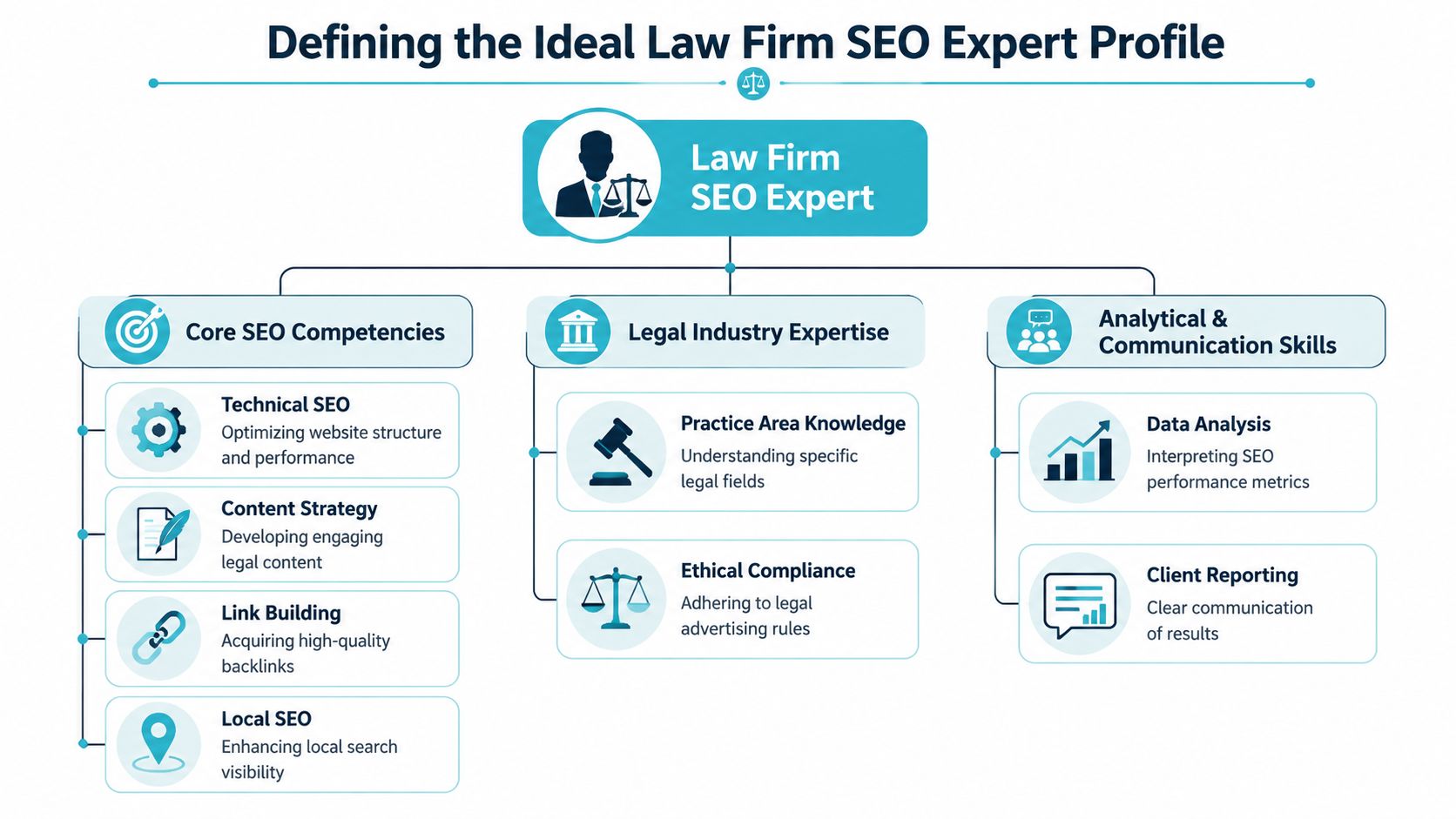
What a real expert must be able to do
An experienced legal SEO operator should be able to look at your firm and answer five hard questions quickly.
| Capability | What good looks like |
|---|---|
| Technical SEO | They can diagnose crawl issues, template problems, page speed bottlenecks, weak internal linking, and mobile friction without hiding behind jargon. |
| Practice area strategy | They know that a trucking case page, a mass tort page, and a car accident page cannot all be rewritten as the same generic “injury law” asset. |
| Local SEO | They understand how office pages, attorney profiles, and firm level trust signals work together in local discovery. |
| Content judgment | They can map a target query to the right page type, instead of forcing every term into a blog post. |
| Reporting discipline | They tie activity back to consultations, qualified leads, and what intake actually says about lead fit. |
Legal context matters more than most firms think
A candidate doesn't need to be a former lawyer. They do need to understand how law firms operate.
That includes the practical environment around the website. In larger firms, lead handling isn't abstract. It runs through case management, intake rules, call workflows, and staff capacity. Someone who understands systems such as Litify or Neos usually asks better questions about lead routing, data quality, and campaign goals because they know rankings alone won't tell you whether marketing is working.
The right hire doesn't just ask, “What do you want to rank for?” They ask, “Which matters more to the firm right now: more consultations, better case quality, or less waste in intake?”
What separates strong candidates from polished presenters
Watch for specificity. Strong candidates speak in page types, workflows, and trade offs.
They'll talk about practice area pages, attorney bios, location pages, internal links, title tags, and content gaps. Weak candidates hide behind broad language like visibility, brand elevation, and online presence.
Look for these signals during evaluation:
- They can prioritize: They know what should happen in the first quarter versus what can wait.
- They challenge bad ideas: If you ask for ten city pages with duplicate content, they should push back.
- They understand local trust: They treat reviews, attorney pages, and local business visibility as revenue assets, not side chores.
- They respect conversion reality: They know a perfect ranking means little if the intake path is confusing.
The Vetting Process How to Interview and Spot Red Flags
Most firms interview SEO candidates the wrong way. They ask about tools, dashboards, and rankings. Those questions are fine, but they don't reveal judgment.
A better interview tests whether the person can think through your actual business. For a PI firm, that means evaluating how they balance local visibility, branded trust, page level intent, and case quality. For law firms, Google Business Profile, attorney profiles, and branded name searches can be more important than broad organic rankings because that's often where prospects first judge credibility, as discussed in this legal SEO commentary on YouTube.
Questions that expose real strategic depth
Ask the candidate to work through your firm, not SEO in theory.
| Category | Question to Ask |
|---|---|
| Strategy | If you joined us this month, what would your first ninety days focus on and why? |
| Strategy | How would you decide whether our bottleneck is traffic, conversion, or intake handling? |
| Local visibility | What would you review first in our Google Business Profile and attorney profile presence? |
| Content | Show me how you would map one practice area and one city into a page plan without creating generic pages. |
| Technical | What site issues do you usually want access to before making recommendations? |
| Reporting | Show me a sample report and explain which parts matter to a managing partner versus an intake manager. |
| Business alignment | How do you separate qualified leads from low value form fills when reporting performance? |
| Risk | Tell me about a legal SEO engagement that didn't go well and what you changed afterward. |
A polished talker can answer broad questions. A serious operator can explain priorities, trade offs, and what they would stop doing.
The red flags that should end the process fast
Some warning signs are obvious. Others get missed because the candidate sounds confident.
- Guaranteed rankings: No credible operator should guarantee placement outcomes.
- Vanity metric obsession: If they spend the whole meeting on impressions, clicks, and traffic with little discussion of signed cases or intake quality, keep looking.
- No legal specificity: If their examples could apply just as easily to a med spa or roofing company, they probably don't understand legal search behavior.
- Thin reporting logic: If they can't explain how reporting should support decisions, not just prove activity, they'll create noise.
- Reluctance to discuss failure: The best consultants can name a bad fit, a wrong assumption, or a campaign they had to correct.
If a candidate never says “it depends,” they either haven't done enough of this work or they're telling you what they think you want to hear.
How to cross check their process
Before you sign anything, ask for artifacts. Not confidential client work, but representative examples.
Request:
- A sample audit: You want to see how they identify issues and how they rank priorities.
- A sample content brief: This shows whether they understand search intent or just produce word count.
- A reporting example: Good reporting should help a partner decide what to do next.
- A communication cadence: You should know who meets with whom, how often, and what gets reviewed.
If you want a broader framework for evaluating agencies, this guide on vetting marketing agencies for local businesses is a useful cross check because it highlights the difference between sales fluency and operating discipline. If you're comparing providers that specialize in legal search, it also helps to review what separates the best SEO company for lawyers from a generalist shop.
Understanding Pricing Models and Budgeting for Success
Legal SEO is expensive for a reason. The work is specialized, local competition is intense, and the financial stakes around case acquisition are high.
According to Clio's guide on hiring a law firm SEO expert, law firm SEO can range from $2,000 to $6,000 per month for a single market, $6,000 to $12,000 per month for competitive dominance in one market, and more than $12,000 per month for multi market programs. Those ranges matter because they reflect the reality that legal SEO usually includes technical audits, on page work, content, local SEO, and authority building.

How to think about pricing without getting fooled
Cheaper proposals often remove the hard parts. They may include light content production and basic reporting, but avoid technical fixes, local profile work, or serious content strategy. That can make the retainer look attractive while leaving the firm underpowered in the areas that matter most.
A better budgeting question is not “What's the lowest fee?” It's “What level of competition are we trying to beat, and what work is included?”
Here's a practical way to frame it:
- Single market, narrow scope: Works when the firm is focused on one geography and one core practice line.
- Single market, aggressive growth: Fits firms trying to own a category in a tough metro.
- Multi office or multi practice expansion: Requires a bigger operating plan because complexity rises fast.
Pricing model trade offs
Different firms prefer different deal structures, but each has strengths and weaknesses.
| Model | Best use | Main concern |
|---|---|---|
| Monthly retainer | Ongoing SEO where strategy, execution, and reporting need continuity | Firms may overpay if scope is vague |
| Project based | One time audits, migrations, or page rebuilds | Momentum often dies after delivery |
| Hourly | Advisory work for internal teams | Costs can drift if oversight is weak |
| Performance based | Firms that want direct incentive alignment | Attribution disputes can become a problem fast |
Budget for the work your market requires, not the story you wish were true. In legal SEO, underfunding usually means partial execution.
A practical planning exercise helps. Put your target geography, practice focus, current visibility, intake capacity, and timeline in one document before you review proposals. That forces vendors to respond to business conditions instead of selling a canned package. It also makes your attorney marketing plan more realistic because the spend lines up with the growth target.
Structuring the Engagement Contracts KPIs and Onboarding
A bad SEO engagement often starts with a vague contract. The firm thinks it bought growth. The provider thinks they sold activity. Six months later, everyone is frustrated.
The statement of work should remove that ambiguity. It should define what gets done, who owns what, how performance gets reviewed, and how either side can exit if the relationship isn't working.
What belongs in the contract
A serious agreement needs more than a price and a monthly call.
Include these items:
- Defined deliverables: Spell out whether the scope includes audits, content briefs, page optimization, local SEO work, link outreach, reporting, and implementation support.
- Approval workflow: Clarify who approves content, page changes, and local listing edits on the firm side.
- Access and dependencies: Note what systems, accounts, and internal contacts the expert needs to do the work.
- Meeting cadence: Monthly is common, but larger firms often need a tighter operating rhythm during onboarding.
- Termination terms: Avoid arrangements that trap the firm if execution is poor or the relationship changes.
Pick KPIs that help you run the firm
SEO reporting gets messy when firms focus on visibility without tying it back to intake and signed business. Rankings matter. So do calls, forms, and local profile actions. But none of those should sit in isolation.
For a plaintiff firm or a larger practice, the useful questions are operational:
| KPI area | What to review |
|---|---|
| Lead quality | Which practice areas and page types are generating consultations that intake considers viable |
| Conversion flow | Where prospects drop off between click, contact, follow up, and retained matter |
| Local trust | Whether local profiles, reviews, and attorney pages support first impression credibility |
| Execution pace | Whether the agreed work is actually shipping on time and at the expected quality |
If your intake team uses platforms such as LawBase or Needles, reporting should fit the way those teams already evaluate matters. The point is not to create another marketing dashboard. The point is to connect search performance to how the firm opens and advances cases.
Onboarding that gives the expert a fair shot
Firms sometimes hire a strong specialist, then starve them of access and context. That slows the work and muddies accountability.
A clean onboarding checklist should cover:
Business priorities
Name the practice areas, markets, and case types that matter most.Current marketing baseline
Share existing reporting, lead handling notes, and any known site or content issues.System access
Provide access to analytics, search tools, the CMS, Google Business Profile, and relevant intake reporting.Internal owners
Assign one decision maker from marketing and one from intake or operations.Review schedule
Put reporting dates and working sessions on the calendar at the start.
The first month should produce clarity before it produces volume. If your new expert can't establish priorities early, the engagement will drift.
Conclusion Integrating SEO for Long Term Firm Growth
Hiring a Law Firm SEO Expert is not a box to check. It's a strategic hire tied to revenue, market position, and operational discipline.
The firms that make this decision well do three things differently. First, they diagnose the bottleneck before spending money. Second, they vet candidates for judgment, not presentation skills. Third, they manage the engagement against business outcomes, not marketing theater.
That matters even more in PI and large firm environments. A ranking improvement can create opportunity. It does not guarantee retained clients. If the intake path is slow, if the local trust picture is weak, or if communication breaks down after the first contact, the value of SEO gets diluted fast.
The best long term view is simple. Search should bring the right people to your digital front door. Your systems, staff, and client experience should make it easy for those people to move forward with confidence.
That's why smart firms don't isolate SEO from the rest of the client journey. They treat it as one part of a broader acquisition and service model. Better visibility creates demand. Better communication helps convert and retain it.
If your firm is about to hire for SEO, start with the hard question: do we need more discovery, or do we need to stop wasting the discovery we already have? The answer will save you time, money, and a lot of internal frustration.
If your firm is investing in SEO but still losing momentum after the first inquiry, CasePulse is worth a close look. It gives law firms a secure client portal that works with Needles, Neos, LawBase, and Litify, so clients can check case status, message the team, share files, and complete forms without forcing staff into a separate workflow. That helps reduce routine calls, tighten follow up, and protect the value of every qualified lead your marketing creates.